Floor plan

Time and placeThe 16th century

The 16th century

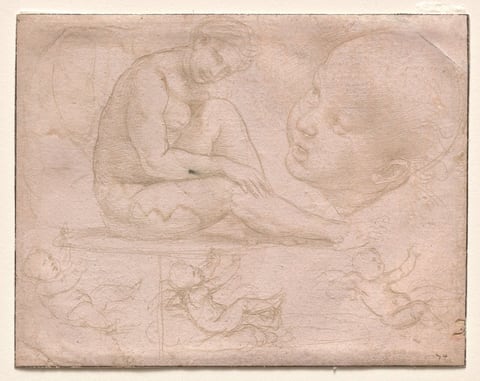
Studies of a Seated Female, Child's Head, and Three Studies of a Baby, by Raphael, c. 1507–8
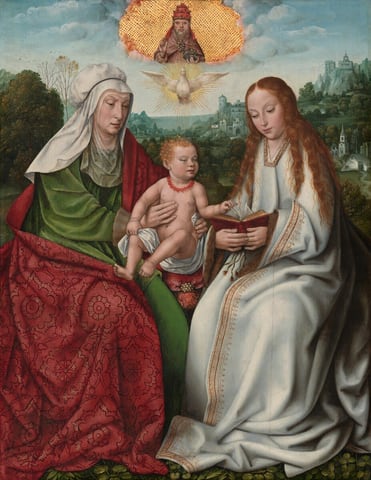
This painting depicts three people seated side-by-side outdoors. The central person is a young, nude child with curly, reddish hair and a red beaded necklace, sitting on a red cushion. Their head is turned to the right. The woman on the left wears a white head covering, a sheer veil around her neck, a green dress, and a red cloak with floral designs. She holds the torso of the child and drapes a white cloth around its legs. The woman on the right has long, flowing reddish hair and wears a white dress or robe with gold detailing down the front, on the neckline, and on the wrists. She holds an open red book, and the child is turning one of the thin pages. All three people have pale skin. Above them, in the cloudy blue sky, there is a white dove with its wings outstretched, gold lines radiating from it. Above the dove, there is an image of a crowned bearded man with pale skin, wearing red robes and holding an orb. He is against a golden background with red dots that breaks through the pale clouds. The background shows a landscape with green trees, hills, and pale blue buildings.
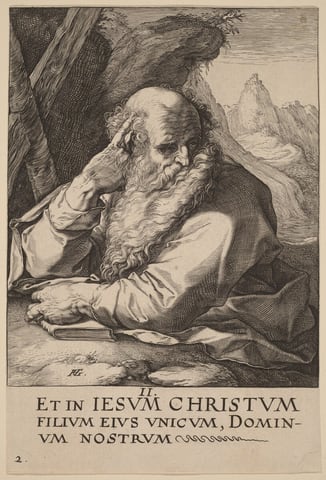
The image shows an elderly man seated from the waist up. He is angled slightly away from the viewer, resting his head on one hand and leaning on the other arm. The man has a deeply lined face, a large beard, curly hair, and appears focused on something outside the frame. He wears flowing garments and a book is under his arm. In the background, there are rugged, mountainous rock formations. Ornate text frames the image at the bottom.
A work made of oil on panel.
A work made of engraving on laid paper.
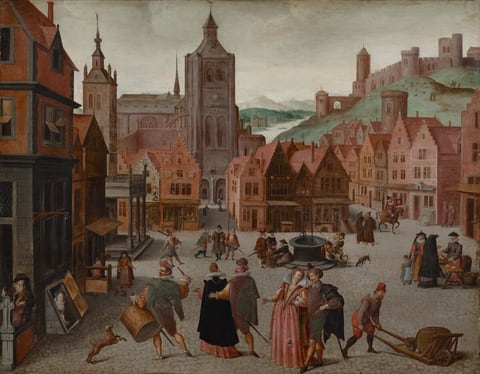
We look slightly down onto a scene with people gathering in small groups in a cobblestone town square lined with rows of brick, wood, and stone buildings, many with stepped rooflines, in this horizontal painting. Singly or in pairs or trios, men, women, and children walk across the square, move goods around, or talk to merchants. All the people have light skin. Many of the men have mustaches and wear hats, and some carry swords. In tones of black, olive green, brick red, and plum purple, they wear hip-length cloaks over jackets, with white collars or ruffs and brass buttons, and knee-length breeches over yellow or black stockings. The women all wear long dresses in salmon pink, coral red, or golden yellow, with white collars or ruffs, and many wear black, ankle-length cloaks, some with hoods. Closest to us, a sumptuously dressed man and woman walk toward us while another similarly elegant couple walks away. Also facing away from us, to our left, a man wearing a large drum strapped around his waist raises one drumstick as he looks over his left shoulder. Nearby, a woman peers up out of a cellar door that opens on an angle to the street. More couples gather around a well across the square, and two women and a child talk to a third woman selling wares at a wooden table to our right. A pair of hooded priests or monks walk near a man blowing on a trumpet on horseback. The buildings are mostly shades of brick red and brown, and most have three or four stories with steeply pitched roofs. More people walk along side streets leading off the main square. One gap in the buildings across from us leads to a nickel-gray stone church with a pointed spire and square tower. A grassy, green hill rises steeply beyond the buildings to our right, leading down to a waterway that extends up and away into the distance. A few boats float in the water, which reflects the leaden-gray sky. Beyond the town square, a brown stone structure like a fortress with turret towers and crenellated walls looms along the ridge of the hill to our right. Tiny in scale, people on horseback and tending sheep dot the hillside below. The date “1590” is painted on the front of one of the buildings across from us while another date, “1597,” is painted on the end of a short wall near the lower left corner.
A work made of oil on panel.
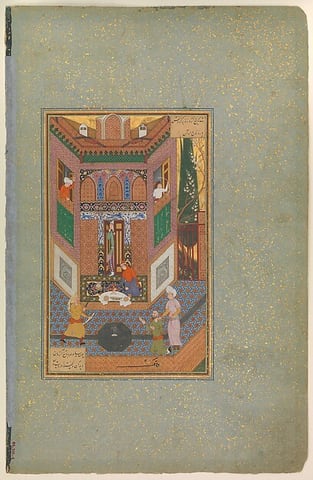
"A Ruffian Spares the Life of a Poor Man", Folio 4v from a Mantiq al-Tayr (Language of the Birds), by Farid al-Din `Attar, ca. 1600

The works in this room are listed below.

Works in this room

Works made in the 16th century, anywhere in the world.

First room, north wall

  1. Studies of a Seated Female, Child's Head, and Three Studies of a Baby, by Raphael, c. 1507–8
    Studies of a Seated Female, Child's Head, and Three Studies of a BabyRaphael, c. 1507–8Courtesy of the Cleveland Museum of Art
  2. This painting depicts three people seated side-by-side outdoors. The central person is a young, nude child with curly, reddish hair and a red beaded necklace, sitting on a red cushion. Their head is turned to the right. The woman on the left wears a white head covering, a sheer veil around her neck, a green dress, and a red cloak with floral designs. She holds the torso of the child and drapes a white cloth around its legs. The woman on the right has long, flowing reddish hair and wears a white dress or robe with gold detailing down the front, on the neckline, and on the wrists. She holds an open red book, and the child is turning one of the thin pages. All three people have pale skin. Above them, in the cloudy blue sky, there is a white dove with its wings outstretched, gold lines radiating from it. Above the dove, there is an image of a crowned bearded man with pale skin, wearing red robes and holding an orb. He is against a golden background with red dots that breaks through the pale clouds. The background shows a landscape with green trees, hills, and pale blue buildings.
    Saint Anne with the Virgin and the Christ ChildMaster of Frankfurt, c. 1511/1515Courtesy National Gallery of Art, Washington
  3. The image shows an elderly man seated from the waist up. He is angled slightly away from the viewer, resting his head on one hand and leaning on the other arm. The man has a deeply lined face, a large beard, curly hair, and appears focused on something outside the frame. He wears flowing garments and a book is under his arm. In the background, there are rugged, mountainous rock formations. Ornate text frames the image at the bottom.
    Saint AndrewHendrick Goltzius, probably 1589Courtesy National Gallery of Art, Washington
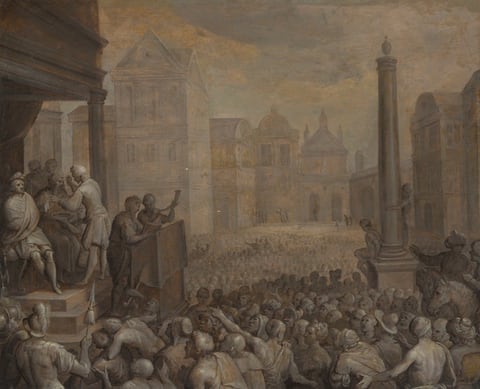
  4. A work made of oil on panel.
    The Judgement of ZaleucusOtto van Veen, c. 1605Courtesy of the Art Institute of Chicago

First room, south wall

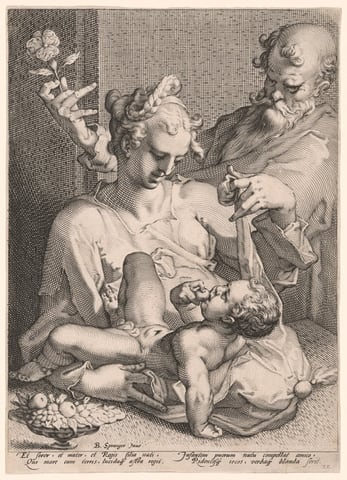
  1. A work made of engraving on laid paper.
    The Holy FamilyPieter de Jode, I, c. 1585-1595Courtesy of the Art Institute of Chicago
  2. We look slightly down onto a scene with people gathering in small groups in a cobblestone town square lined with rows of brick, wood, and stone buildings, many with stepped rooflines, in this horizontal painting. Singly or in pairs or trios, men, women, and children walk across the square, move goods around, or talk to merchants. All the people have light skin. Many of the men have mustaches and wear hats, and some carry swords. In tones of black, olive green, brick red, and plum purple, they wear hip-length cloaks over jackets, with white collars or ruffs and brass buttons, and knee-length breeches over yellow or black stockings. The women all wear long dresses in salmon pink, coral red, or golden yellow, with white collars or ruffs, and many wear black, ankle-length cloaks, some with hoods. Closest to us, a sumptuously dressed man and woman walk toward us while another similarly elegant couple walks away. Also facing away from us, to our left, a man wearing a large drum strapped around his waist raises one drumstick as he looks over his left shoulder. Nearby, a woman peers up out of a cellar door that opens on an angle to the street. More couples gather around a well across the square, and two women and a child talk to a third woman selling wares at a wooden table to our right. A pair of hooded priests or monks walk near a man blowing on a trumpet on horseback. The buildings are mostly shades of brick red and brown, and most have three or four stories with steeply pitched roofs. More people walk along side streets leading off the main square. One gap in the buildings across from us leads to a nickel-gray stone church with a pointed spire and square tower. A grassy, green hill rises steeply beyond the buildings to our right, leading down to a waterway that extends up and away into the distance. A few boats float in the water, which reflects the leaden-gray sky. Beyond the town square, a brown stone structure like a fortress with turret towers and crenellated walls looms along the ridge of the hill to our right. Tiny in scale, people on horseback and tending sheep dot the hillside below. The date “1590” is painted on the front of one of the buildings across from us while another date, “1597,” is painted on the end of a short wall near the lower left corner.
    The Marketplace in Bergen op ZoomAbel Grimmer, probably 1590 and 1597Courtesy National Gallery of Art, Washington
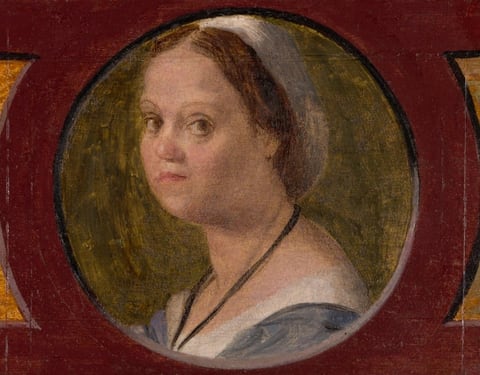
  3. A work made of oil on panel.
    Lucrezia di Lippo di Iacopo GuidiAndrea del Sarto, 1525–28Courtesy of the Art Institute of Chicago
  4. "A Ruffian Spares the Life of a Poor Man", Folio 4v from a Mantiq al-Tayr (Language of the Birds), by Farid al-Din `Attar, ca. 1600
    "A Ruffian Spares the Life of a Poor Man", Folio 4v from a Mantiq al-Tayr (Language of the Birds)Farid al-Din `Attar, ca. 1600Courtesy of The Metropolitan Museum of Art

Second room, south wall
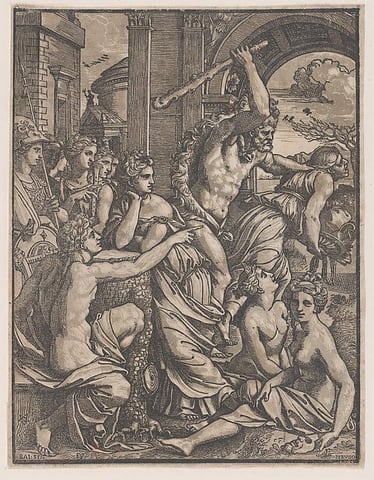
  1. Hercules chasing Avarice from the Temple of the Muses, by Ugo da Carpi, ca. 1520–27
    Hercules chasing Avarice from the Temple of the MusesUgo da Carpi, ca. 1520–27Courtesy of The Metropolitan Museum of Art
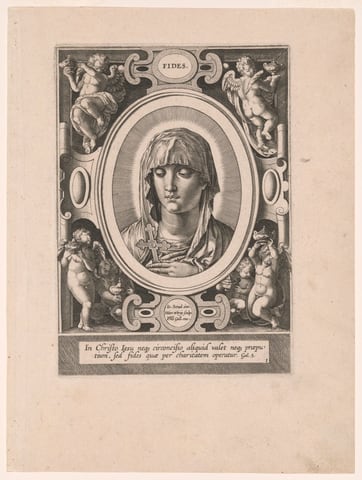
  2. A work made of engraving on ivory laid paper.
    Fides, plate 1 from The Seven VirtuesHieronymous Wierix, c. 1598Courtesy of the Art Institute of Chicago
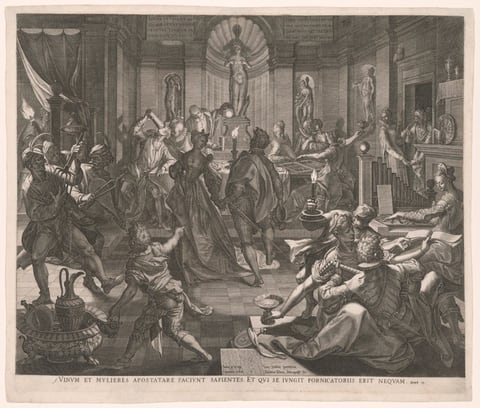
  3. A work made of engraving in black on cream laid paper.
    The Carnival (or the Prodigal Son)Jan Sadeler, I, 1588Courtesy of the Art Institute of Chicago
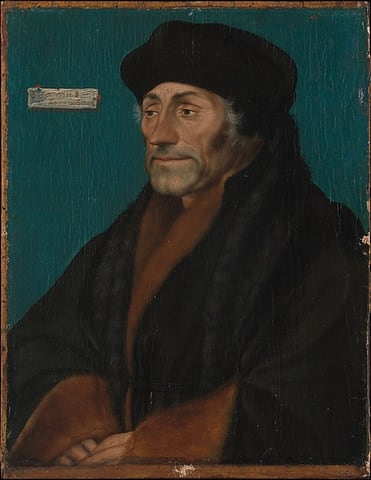
  4. Erasmus of Rotterdam, by Hans Holbein the Younger, ca. 1532
    Erasmus of RotterdamHans Holbein the Younger, ca. 1532Courtesy of The Metropolitan Museum of Art

Second room, north wall
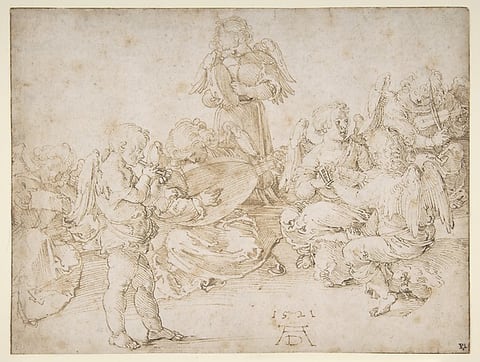
  1. Music-Making Angels, by Albrecht Dürer, 1521
    Music-Making AngelsAlbrecht Dürer, 1521Courtesy of The Metropolitan Museum of Art
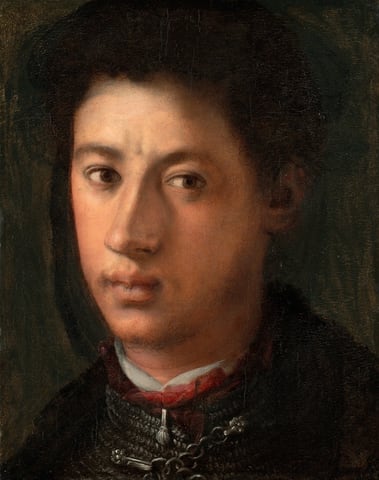
  2. A work made of oil on panel.
    Alessandro de' MediciPontormo, (Jacopo Carrucci), 1534–35Courtesy of the Art Institute of Chicago
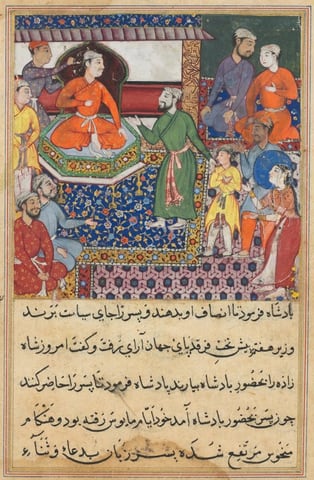
  3. The handmaiden again pleads for the death of the prince, from a Tuti-nama (Tales of a Parrot): Eighth Night, by Lalu, c. 1560
    The handmaiden again pleads for the death of the prince, from a Tuti-nama (Tales of a Parrot): Eighth NightLalu, c. 1560Courtesy of the Cleveland Museum of Art
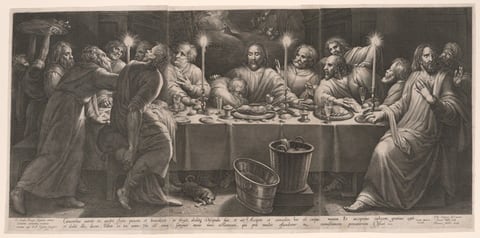
  4. A work made of engraving on three joined sheets of laid paper.
    The Last SupperJan Harmensz. Muller, 1594Courtesy of the Art Institute of Chicago