Skip to content
Ochre Editions
ArtArtistsCollectionsGalleriesDrops
SearchSign inCart (0)
The galleries · Time and place

The 17th century

Works made in the 17th century, anywhere in the world.

266 works · hang 1792 ·

Share The 17th century, in the galleries

The rooms are imagined; every work on their walls is real.

Walk this roomRehang this room

Section 1, north wall

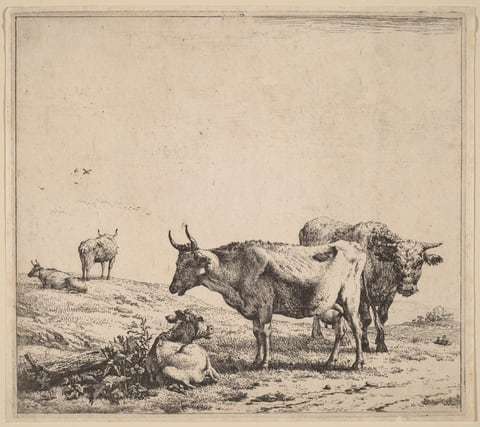
  1. Cow, Bull and Calf, by Karel Dujardin
    Cow, Bull and CalfKarel DujardinCourtesy National Gallery of Art, Washington
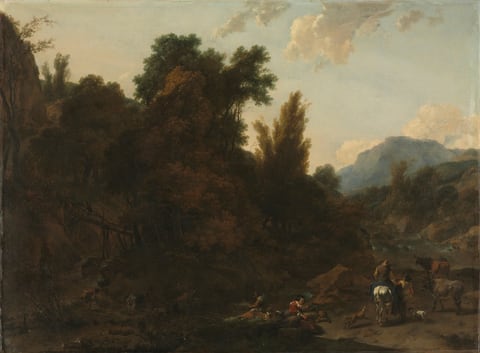
  2. Rush Gatherers, by Nicolaes Berchem, 1657
    Rush GatherersNicolaes Berchem, 1657Courtesy of the Cleveland Museum of Art
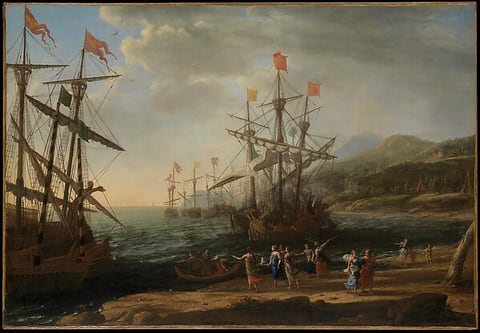
  3. The Trojan Women Setting Fire to Their Fleet, by Claude Lorrain (Claude Gellée), ca. 1643
    The Trojan Women Setting Fire to Their FleetClaude Lorrain (Claude Gellée), ca. 1643Courtesy of The Metropolitan Museum of Art

Section 1, south wall
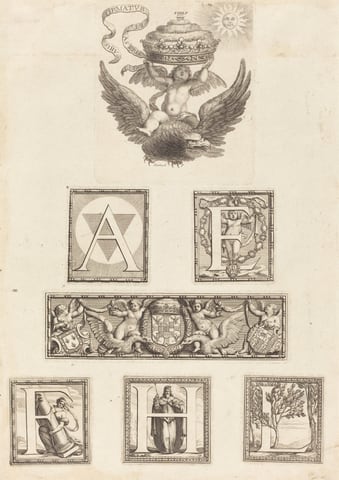
  1. This image features intricately designed ornate letters of the alphabet surrounded by elaborate illustrations. The top of the composition shows a cherub riding on an eagle, holding a crown above their head. A ribbon with inscriptions unfurls around the crown, and a sun with a human face is visible in the corner. The letters "A," "F," "D," "H," and another "H" are decorated with classical elements like putti, garlands, and mythological figures. The central panel is adorned with heraldic symbols, angelic figures, and coats of arms. The overall style of the artwork reflects baroque or renaissance decorative artistry, known for its ornamental details and classical themes.
    PendantRobert NanteuilCourtesy National Gallery of Art, Washington
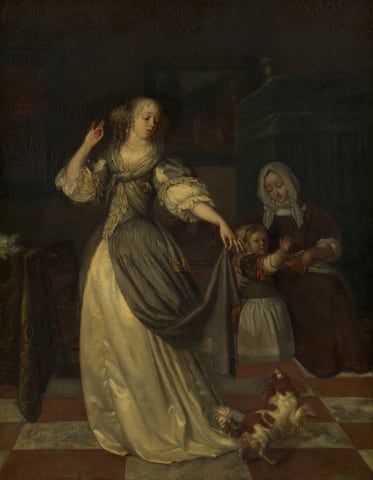
  2. A work made of oil on canvas.
    Lady Playing with a DogEglon van der Neer, c. 1670Courtesy of the Art Institute of Chicago
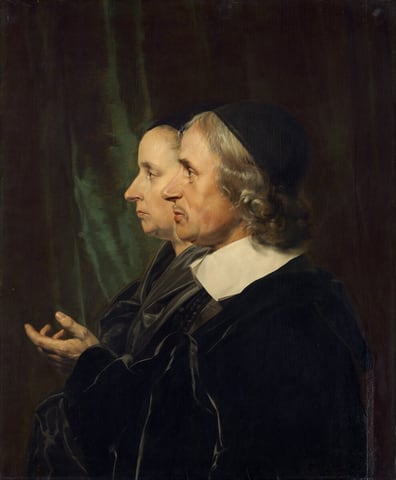
  3. Shown from the shoulders up, a man and woman face our left in profile against a shadowy, dark green curtain in this vertical portrait painting. They both look steadily to our left, they and have pale skin and wear black. The man is closer to us so he overlaps the woman, whose profile is shifted to our left. A black cap sits on the man's curly, silver, shoulder-length hair. He has a slight double chin and soft jowls. A thin mustache curves over his upper lip, and a line of hair runs down his chin as a narrow beard. A broad, flat, white collar lies across his shoulders over a velvety black coat. He lifts his left hand, closer to us, in front of his chest with the fingers curled gently inward. The woman also has a double chin and soft jowls. Her thin lips are closed and downturned. Her hair is pulled back under a black covering, and her black garment has a sheen, suggesting satin.
    Portrait of the Artist's Parents, Salomon de Bray and Anna WesterbaenJan de Bray, 1664Courtesy National Gallery of Art, Washington
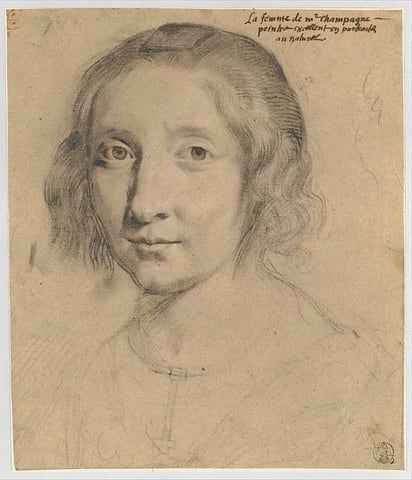
  4. Portrait of Charlotte Duchesne, by Philippe de Champaigne, ca. 1628
    Portrait of Charlotte DuchesnePhilippe de Champaigne, ca. 1628Courtesy of The Metropolitan Museum of Art

Section 2, south wall
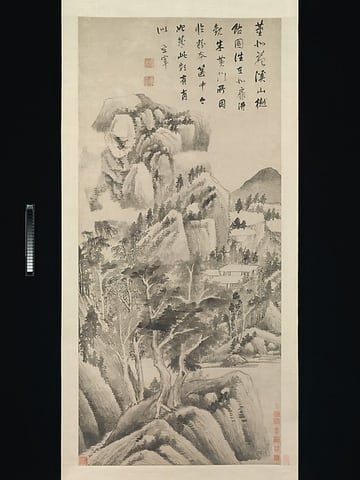
  1. Shaded Dwellings among Streams and Mountains, by Dong Qichang, ca. 1622–25
    Shaded Dwellings among Streams and MountainsDong Qichang, ca. 1622–25Courtesy of The Metropolitan Museum of Art
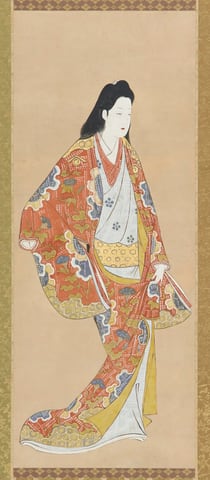
  2. Hanging scroll (mounted on panel)
    Girl in an orange vermillion dressUnrecorded Japanese maker, 1661-1673Courtesy of the National Museum of Asian Art, Smithsonian Institution
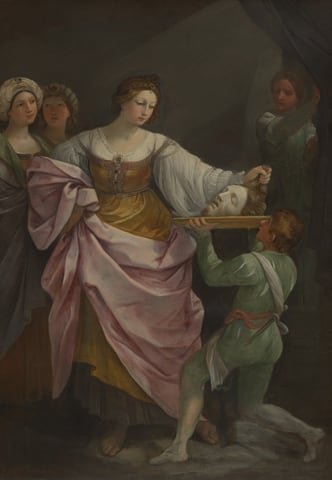
  3. Large painting of woman, in gold and pink dress, placing severed head on platter.
    Salome with the Head of Saint John the BaptistGuido Reni, c. 1639–42Courtesy of the Art Institute of Chicago

Section 2, north wall
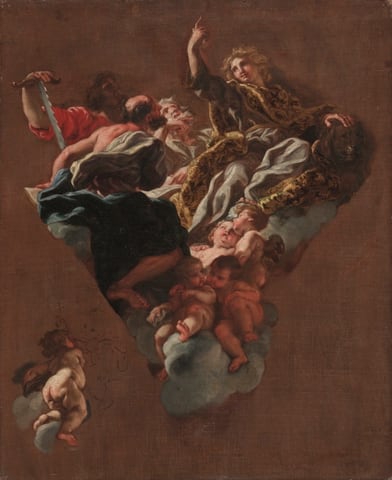
  1. Sketch for "The Four Prophets of Israel" (for Il Gesù, Rome), by Giovanni Battista Gaulli, c. 1675–1677
    Sketch for "The Four Prophets of Israel" (for Il Gesù, Rome)Giovanni Battista Gaulli, c. 1675–1677Courtesy of the Cleveland Museum of Art
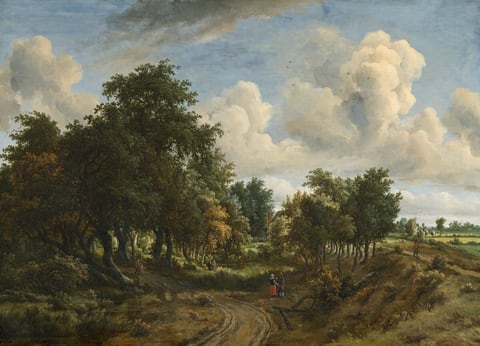
  2. A rutted, dirt road curves from the bottom center of the canvas toward and behind a grove of tall trees to our left, beneath a pale blue sky with fluffy white clouds that fills the top two-thirds of this horizontal landscape painting. The broad, green canopies of the trees to our left create deep shade over twisting trunks, shrubs, and grasses. A narrow stream meandering alongside the road to our left reflects the moss, pine, and sage greens of the leaves. The land rises in a sloping bank to our right, and leads back to open fields with hedgerows that stretch to the horizon. Shorter, more spindly trees cluster along the bank in the distance. Tiny in scale, people are sprinkled throughout the landscape, either singly or in small groups. In the shade of the grove to our left, a man with dark pantaloons, a brown hat and coat, and a walking stick strolls along the road with a woman wearing a red skirt, a dark shirt, and a white apron and cap. Just off the curve of the road to our right, another man with a walking stick, tan hat, and dark gray pantaloons talks to a woman also wearing red, black, and white. Another person, slightly smaller in stature, stands between them. At a pond farther back from this trio, a man with a broad-brimmed hat sits fishing at the edge of the water. Barely visible, a house with a pitched roof, a tall, brick-red chimney, and a white picket fence peeks out from behind the trees beyond the pond. Finally, a man wearing a rust-orange coat, gray pantaloons with white stockings, and a tall hat, carrying a pole propped on his shoulder, walks toward us on a footpath running alongside the fields. Tall, cream-white clouds dot the pale blue sky above, and tiny dots of dark paint suggest flying birds. Soft sunlight pours across the countryside. The artist signed and dated the painting in small script in the lower right corner: “meijndert Hobbema F 1663.”
    A Wooded LandscapeMeindert Hobbema, 1663Courtesy National Gallery of Art, Washington
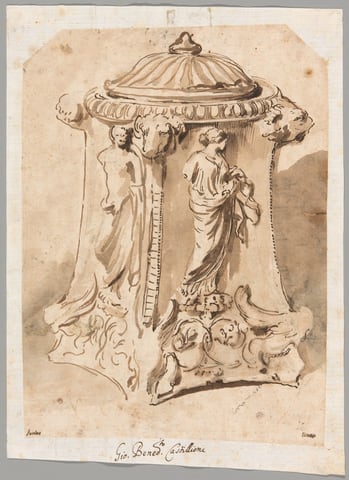
  3. A work made of pen and brown ink and brush and brown wash, over graphite, on cream laid paper laid down on off-white laid paper.
    Antique Carved Marble Candelabra BaseAndrea di Lione, 1642/44 or 1647/51Courtesy of the Art Institute of Chicago

Section 3, north wall
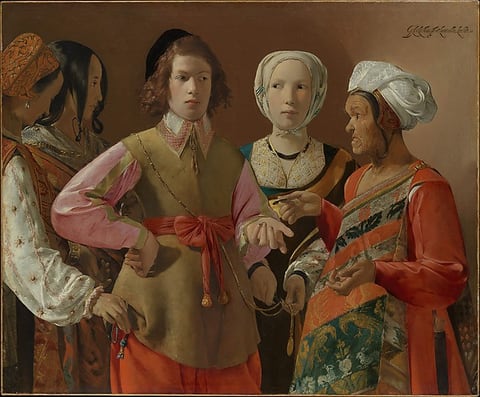
  1. The Fortune-Teller, by Georges de La Tour, probably 1630s
    The Fortune-TellerGeorges de La Tour, probably 1630sCourtesy of The Metropolitan Museum of Art
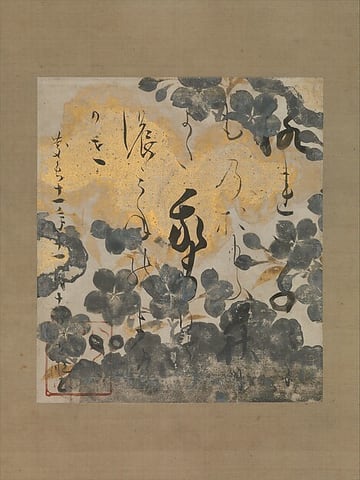
  2. Poem by Kamo no Chōmei with Underpainting of Cherry Blossoms, by Hon'ami Kōetsu, 1606
    Poem by Kamo no Chōmei with Underpainting of Cherry BlossomsHon'ami Kōetsu, 1606Courtesy of The Metropolitan Museum of Art
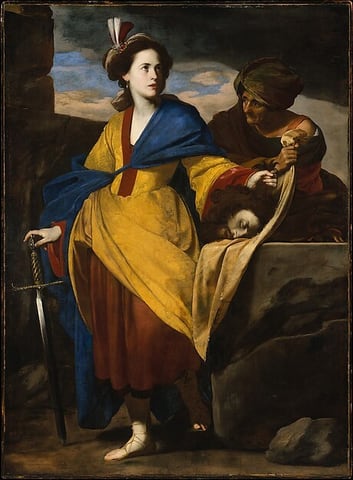
  3. Judith with the Head of Holofernes, by Massimo Stanzione, ca. 1640
    Judith with the Head of HolofernesMassimo Stanzione, ca. 1640Courtesy of The Metropolitan Museum of Art

Walk on

  • The 17th century, room 2
  • Massimo Stanzione's contemporaries 8 works
  • More Italian Baroque 13 works
Ochre Editions

The world's museums, on your wall. Every work here is a reproduction of a public-domain original, credited to the museum that holds it.

Shop

All artCollectionsLimited dropsPrints and framing

Help

Find an orderShippingReturnsVerify a certificate

About

About Ochre EditionsMuseum creditsFor agentsDevelopers

Legal

Terms of UseTerms of SaleLimited Editions and CertificatesPrivacy PolicyCookie PolicyAcceptable Use PolicyAgent & API TermsCopyright and DMCA PolicyPrinting Your Own PhotoVulnerability Disclosure PolicyAccessibility StatementOpen-Access Credits
© 2026 Ochre EditionsPrices in US dollars. Prints ship within the United States.