Floor plan

Time and placeThe 17th century

The 17th century

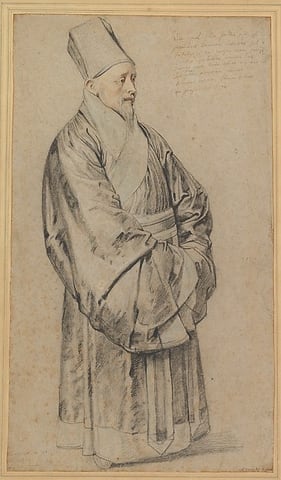
Portrait of Nicolas Trigault in Chinese Costume, by Peter Paul Rubens, 1617
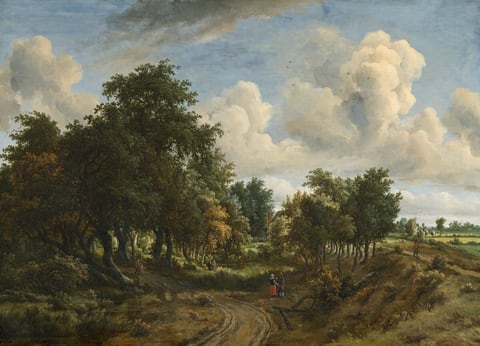
A rutted, dirt road curves from the bottom center of the canvas toward and behind a grove of tall trees to our left, beneath a pale blue sky with fluffy white clouds that fills the top two-thirds of this horizontal landscape painting. The broad, green canopies of the trees to our left create deep shade over twisting trunks, shrubs, and grasses. A narrow stream meandering alongside the road to our left reflects the moss, pine, and sage greens of the leaves. The land rises in a sloping bank to our right, and leads back to open fields with hedgerows that stretch to the horizon. Shorter, more spindly trees cluster along the bank in the distance. Tiny in scale, people are sprinkled throughout the landscape, either singly or in small groups. In the shade of the grove to our left, a man with dark pantaloons, a brown hat and coat, and a walking stick strolls along the road with a woman wearing a red skirt, a dark shirt, and a white apron and cap. Just off the curve of the road to our right, another man with a walking stick, tan hat, and dark gray pantaloons talks to a woman also wearing red, black, and white. Another person, slightly smaller in stature, stands between them. At a pond farther back from this trio, a man with a broad-brimmed hat sits fishing at the edge of the water. Barely visible, a house with a pitched roof, a tall, brick-red chimney, and a white picket fence peeks out from behind the trees beyond the pond. Finally, a man wearing a rust-orange coat, gray pantaloons with white stockings, and a tall hat, carrying a pole propped on his shoulder, walks toward us on a footpath running alongside the fields. Tall, cream-white clouds dot the pale blue sky above, and tiny dots of dark paint suggest flying birds. Soft sunlight pours across the countryside. The artist signed and dated the painting in small script in the lower right corner: “meijndert Hobbema F 1663.”
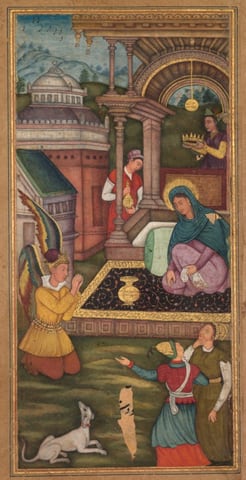
The Annunciation (folio 15 recto), from a Mirror of Holiness (Mir’at al-quds) of Father Jerome Xavier, 1602–4
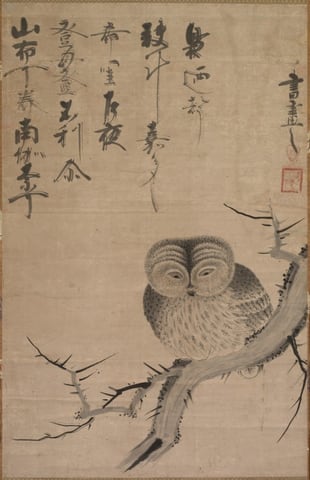
Owl, by Tsuda Bensaku, 1630s
A work made of oil on panel.
The image shows a wide aerial view of a public gathering. Buildings line the horizon overlooking the scene below. The detailed illustration features various individuals and animals in motion, including groups of people, horse riders, and carts. The monochromatic color palette contributes to a classic aesthetic.
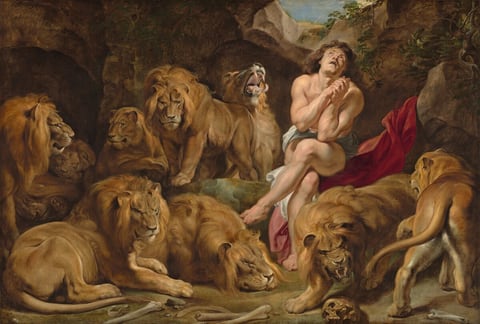
A nearly nude, muscular man with pale, peachy skin sits in an underground cave among seven male and two female lions in this horizontal painting. The man sits to our right of center with his legs crossed, elbows close to his body with hands clasped by his chest. His head tips back to look up through a small opening above. He has long, wavy, chestnut-brown hair and dark eyes. A white cloth wraps across his hips, and he sits on a scarlet-red swath of fabric draped up over a rock next to him. The nine lions stalk, sit, or lie down around the man. One male lion next to the man, to our left, opens his mouth with his head thrown back, curling tongue extended beyond long fangs. A human skull and other bones are strewn on the dirt ground close to us. The rocky cave curves up around the animals and man to a narrow, round opening showing blue sky above.

The works in this room are listed below.

Works in this room

Works made in the 17th century, anywhere in the world.

Section 1, north wall

  1. Portrait of Nicolas Trigault in Chinese Costume, by Peter Paul Rubens, 1617
    Portrait of Nicolas Trigault in Chinese CostumePeter Paul Rubens, 1617Courtesy of The Metropolitan Museum of Art
  2. A rutted, dirt road curves from the bottom center of the canvas toward and behind a grove of tall trees to our left, beneath a pale blue sky with fluffy white clouds that fills the top two-thirds of this horizontal landscape painting. The broad, green canopies of the trees to our left create deep shade over twisting trunks, shrubs, and grasses. A narrow stream meandering alongside the road to our left reflects the moss, pine, and sage greens of the leaves. The land rises in a sloping bank to our right, and leads back to open fields with hedgerows that stretch to the horizon. Shorter, more spindly trees cluster along the bank in the distance. Tiny in scale, people are sprinkled throughout the landscape, either singly or in small groups. In the shade of the grove to our left, a man with dark pantaloons, a brown hat and coat, and a walking stick strolls along the road with a woman wearing a red skirt, a dark shirt, and a white apron and cap. Just off the curve of the road to our right, another man with a walking stick, tan hat, and dark gray pantaloons talks to a woman also wearing red, black, and white. Another person, slightly smaller in stature, stands between them. At a pond farther back from this trio, a man with a broad-brimmed hat sits fishing at the edge of the water. Barely visible, a house with a pitched roof, a tall, brick-red chimney, and a white picket fence peeks out from behind the trees beyond the pond. Finally, a man wearing a rust-orange coat, gray pantaloons with white stockings, and a tall hat, carrying a pole propped on his shoulder, walks toward us on a footpath running alongside the fields. Tall, cream-white clouds dot the pale blue sky above, and tiny dots of dark paint suggest flying birds. Soft sunlight pours across the countryside. The artist signed and dated the painting in small script in the lower right corner: “meijndert Hobbema F 1663.”
    A Wooded LandscapeMeindert Hobbema, 1663Courtesy National Gallery of Art, Washington
  3. The Annunciation (folio 15 recto), from a Mirror of Holiness (Mir’at al-quds) of Father Jerome Xavier, 1602–4
    The Annunciation (folio 15 recto), from a Mirror of Holiness (Mir’at al-quds) of Father Jerome XavierUnrecorded Indian maker, 1602–4Courtesy of the Cleveland Museum of Art
  4. Owl, by Tsuda Bensaku, 1630s
    OwlTsuda Bensaku, 1630sCourtesy of the Cleveland Museum of Art

Section 1, south wall

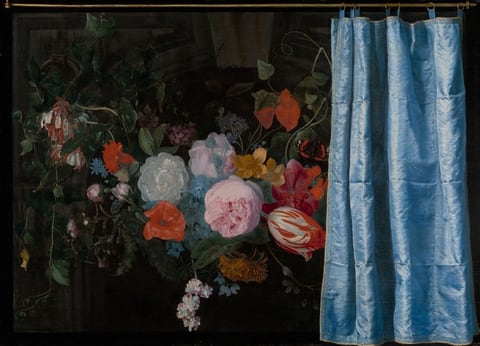
  1. A work made of oil on panel.
    Trompe-l'Oeil Still Life with a Flower Garland and a CurtainAdriaen van der Spelt, 1658Courtesy of the Art Institute of Chicago
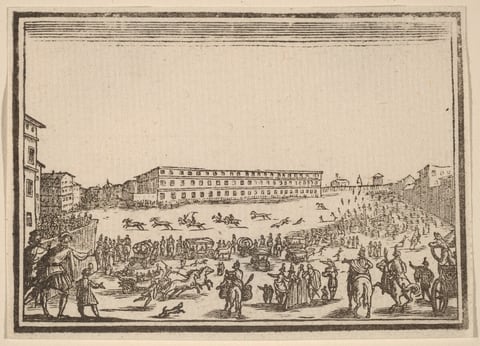
  2. The image shows a wide aerial view of a public gathering. Buildings line the horizon overlooking the scene below. The detailed illustration features various individuals and animals in motion, including groups of people, horse riders, and carts. The monochromatic color palette contributes to a classic aesthetic.
    Piazza Presso alla Porta al PratoEdouard Eckman, 1621Courtesy National Gallery of Art, Washington
  3. A nearly nude, muscular man with pale, peachy skin sits in an underground cave among seven male and two female lions in this horizontal painting. The man sits to our right of center with his legs crossed, elbows close to his body with hands clasped by his chest. His head tips back to look up through a small opening above. He has long, wavy, chestnut-brown hair and dark eyes. A white cloth wraps across his hips, and he sits on a scarlet-red swath of fabric draped up over a rock next to him. The nine lions stalk, sit, or lie down around the man. One male lion next to the man, to our left, opens his mouth with his head thrown back, curling tongue extended beyond long fangs. A human skull and other bones are strewn on the dirt ground close to us. The rocky cave curves up around the animals and man to a narrow, round opening showing blue sky above.
    Daniel in the Lions' DenPeter Paul Rubens, c. 1614/1616Courtesy National Gallery of Art, Washington

Section 2, south wall
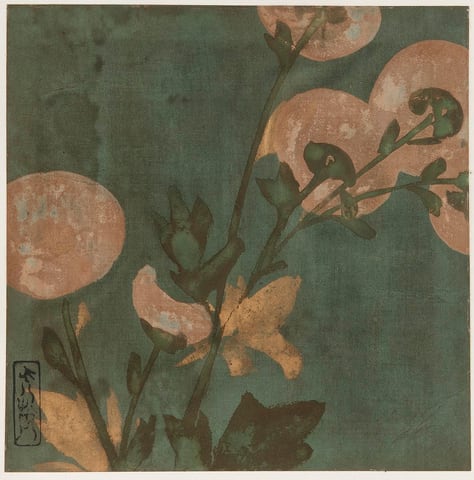
  1. Poetry sheet (shikishi)
    ChrysanthemumsHon'ami Kōetsu, 1615-1868Courtesy of the National Museum of Asian Art, Smithsonian Institution
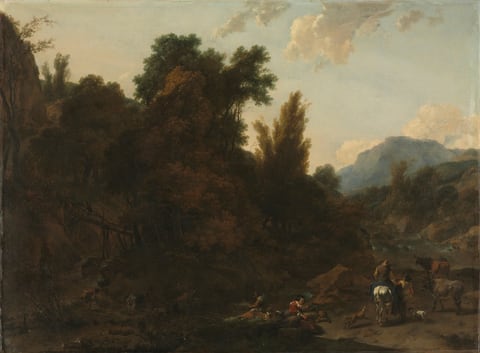
  2. Rush Gatherers, by Nicolaes Berchem, 1657
    Rush GatherersNicolaes Berchem, 1657Courtesy of the Cleveland Museum of Art
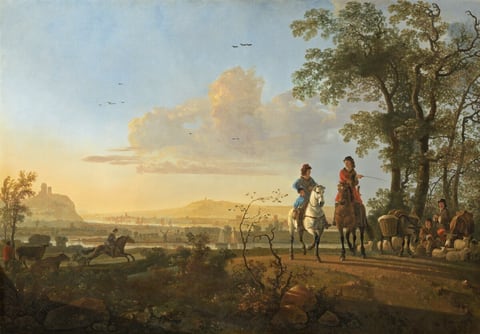
  3. Golden sunlight pours across a landscape with three people on horseback and two more people near a flock of sheep, a cow, and a mule in this horizontal painting. The people all have pale, peachy skin. The horizon is about a third of the way up the composition and is lined with towers on distant, hazy, pale yellow hills. Two of the horses are to the right of center, both facing us. The horse on the left is white, and the rider wears an azure-blue tunic and red brimless cap. The other horse is brown with a white blaze, and its rider wears a red tunic and black cap. That second rider points with a whip to the sitting and standing people near the sheep, to the right. Those two people wear brown jackets, and the standing man has a mustache. The seated person rests a long staff over one shoulder. About half of the nine sheep there lie on the ground, and the others stand. The cow dips her head down to the sheep, and the splay-footed donkey has baskets hung to each side. This grouping is in front of a copse of tall trees that nearly reach the top edge of the composition. The third rider is to our left and a short distance away. That dark brown horse gallops to our right. A short distance away, another herdsman along the left edge of the composition wears a red tunic and brown pants, and he rests a long staff on one shoulder. One cow stands and one lies down next to that herdsman. Sunlight rakes across twigs, leafy plants, scrubby growth, and rocks in the foreground, closest to us. Sailboats float on the waterways that stretch horizontally across the painting in the distance, and the land separating those bodies of water is dotted with spires, windmills, towers, and other structures. A dozen dark birds fly high in the sky, which takes up the top two-thirds of the picture. A bank of iridescent yellow and pearly white clouds trundle across the pale blue sky. The artist signed the painting in the lower right corner, “A.cuijp.”
    Horsemen and Herdsmen with CattleAelbert Cuyp, 1655/1660Courtesy National Gallery of Art, Washington

Section 2, north wall
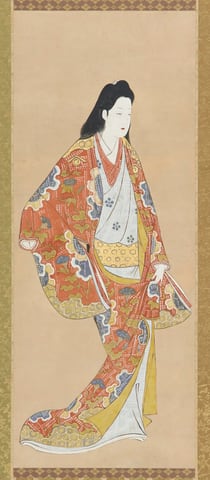
  1. Hanging scroll (mounted on panel)
    Girl in an orange vermillion dressUnrecorded Japanese maker, 1661-1673Courtesy of the National Museum of Asian Art, Smithsonian Institution
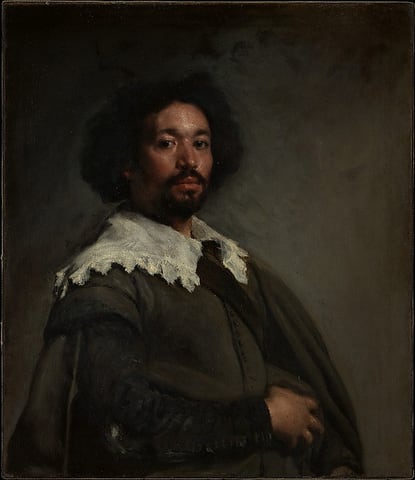
  2. Juan de Pareja (ca. 1608–1670), by Diego Velázquez, 1650
    Juan de Pareja (ca. 1608–1670)Diego Velázquez, 1650Courtesy of The Metropolitan Museum of Art
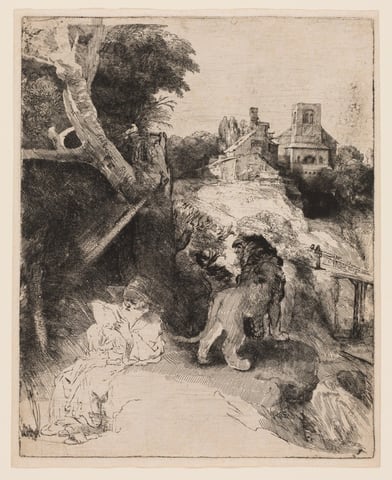
  3. A work made of etching, burin, and drypoint on ivory laid paper.
    Saint Jerome Reading in an Italian LandscapeRembrandt van Rijn, c. 1653Courtesy of the Art Institute of Chicago
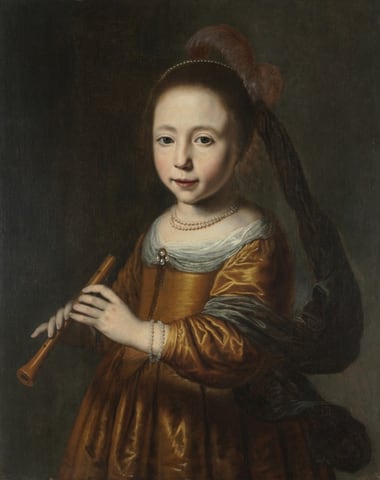
  4. Portrait of Elizabeth Spiegel, by Dirck Dircksz. Santvoort, 1639
    Portrait of Elizabeth SpiegelDirck Dircksz. Santvoort, 1639Courtesy of the Cleveland Museum of Art

Section 3, north wall
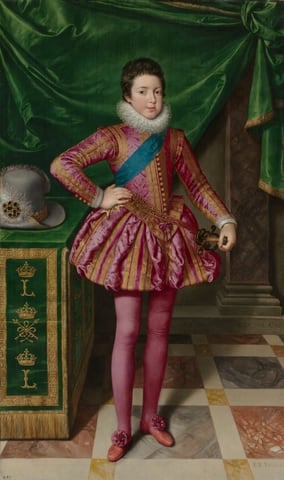
  1. Portrait of King Louis XIII of France, by Frans Pourbus, 1611
    Portrait of King Louis XIII of FranceFrans Pourbus, 1611Courtesy of the Cleveland Museum of Art
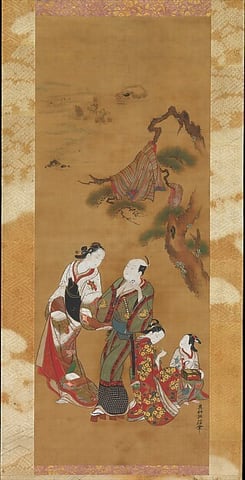
  2. Yukihira and Two Brinemaidens at Suma, by Okumura Masanobu, 18th century
    Yukihira and Two Brinemaidens at SumaOkumura Masanobu, 18th centuryCourtesy of The Metropolitan Museum of Art