Floor plan

Time and placeThe 17th century

The 17th century

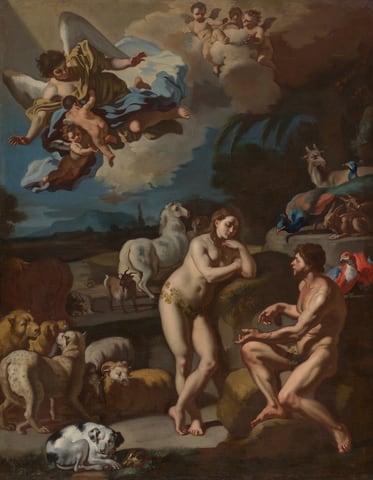
A work made of oil on canvas.
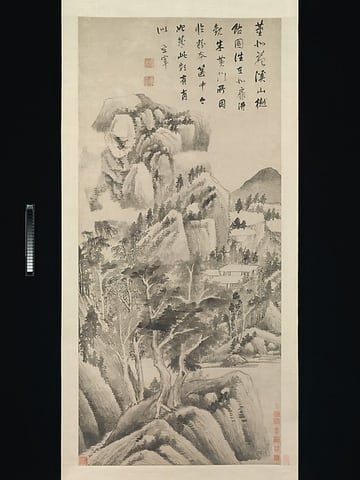
Shaded Dwellings among Streams and Mountains, by Dong Qichang, ca. 1622–25
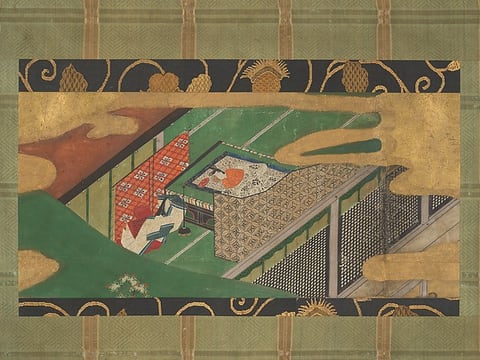
“Trees Encoiled in Vines of Ivy” (Yadorigi), by Tawaraya Sotatsu, early 17th century
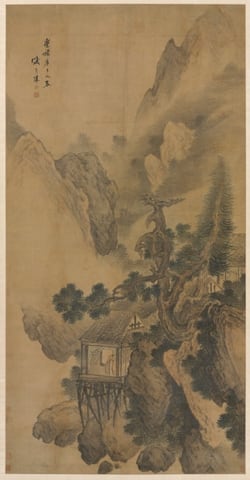
Lonely Retreat Overlooking a Misty Valley, by Sheng Maoye, 1630
A work made of ink on paper.
A work made of oil on canvas.
A work made of black chalk, with touches of white chalk, on ivory laid paper.

The works in this room are listed below.

Works in this room

Works made in the 17th century, anywhere in the world.

Section 1, north wall

  1. A work made of oil on canvas.
    Adam and Eve in ParadiseFrancesco Solimena, c. 1700Courtesy of the Art Institute of Chicago
  2. Shaded Dwellings among Streams and Mountains, by Dong Qichang, ca. 1622–25
    Shaded Dwellings among Streams and MountainsDong Qichang, ca. 1622–25Courtesy of The Metropolitan Museum of Art
  3. “Trees Encoiled in Vines of Ivy” (Yadorigi), by Tawaraya Sotatsu, early 17th century
    “Trees Encoiled in Vines of Ivy” (Yadorigi)Tawaraya Sotatsu, early 17th centuryCourtesy of The Metropolitan Museum of Art

Section 1, south wall

  1. Lonely Retreat Overlooking a Misty Valley, by Sheng Maoye, 1630
    Lonely Retreat Overlooking a Misty ValleySheng Maoye, 1630Courtesy of the Cleveland Museum of Art
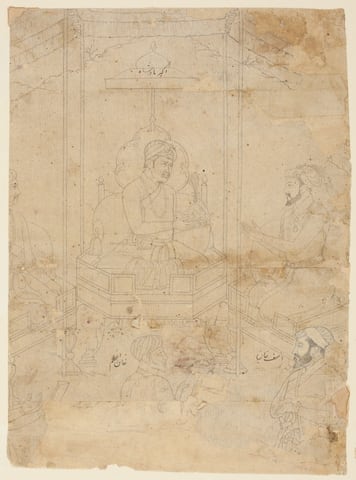
  2. A work made of ink on paper.
    Akbar Offering Timur's Crown to Shah JahanIslamic, Mughal period (1526–1857), ca. 1650–1700Courtesy of the Art Institute of Chicago
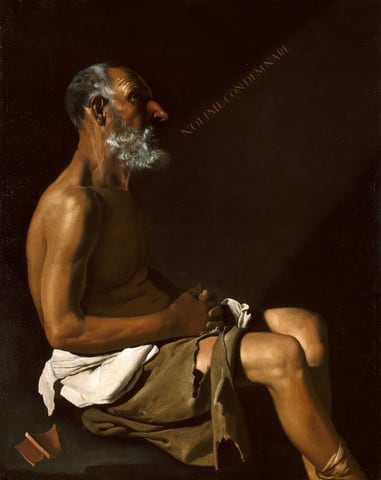
  3. A work made of oil on canvas.
    JobSpanish, c. 1618–c. 1630Courtesy of the Art Institute of Chicago
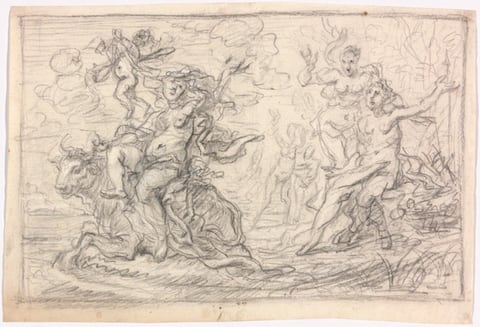
  4. A work made of black chalk, with touches of white chalk, on ivory laid paper.
    The Rape of EuropaCornelis Schut, I, 1635/40Courtesy of the Art Institute of Chicago

Section 2, south wall
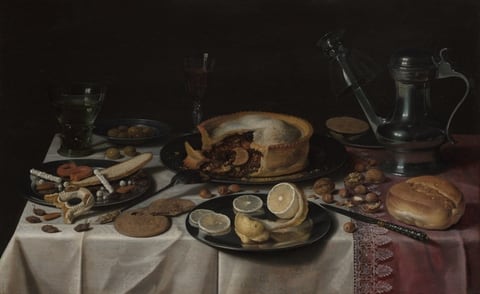
  1. A work made of oil on panel.
    Still LifePieter Claesz, c. 1625Courtesy of the Art Institute of Chicago
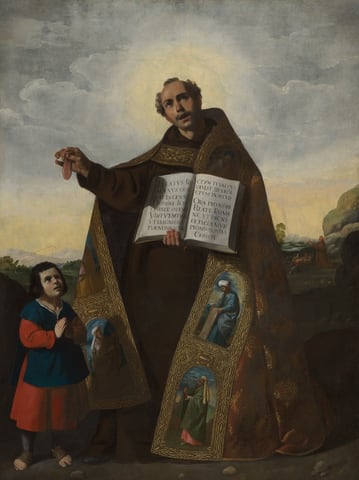
  2. A work made of oil on canvas.
    Saint Romanus of Antioch and Saint BarulasFrancisco de Zurbarán, 1638Courtesy of the Art Institute of Chicago
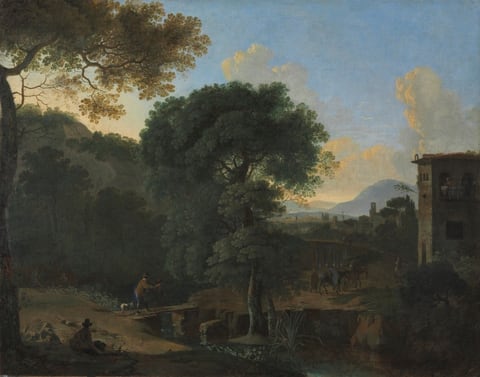
  3. Landscape with Travelers, by Herman van Swanevelt, 1630s
    Landscape with TravelersHerman van Swanevelt, 1630sCourtesy of the Cleveland Museum of Art

Section 2, north wall
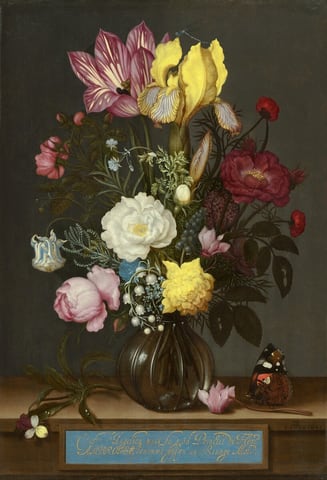
  1. Gathered in a round glass vase, a tall bouquet of flowers in shades of light and deep pink, sunshine yellow, and white with pine-green leaves nearly fills this vertical still life painting. Shown against an gray background, the vase sits on a narrow ledge, perhaps made of wood. A label with looping, cursive French text painted in gold against a baby blue background is affixed to the front of the ledge, along the bottom edge of the composition. The text reads, “C'est l'Angelicq main du grad Peinctre de Flore AMBROISE, renommé jusqu' au Rivage Moré.” A few of the flowers draw the eye, including a tulip and iris at the top of the bouquet. To our left, the tulip is mauve pink with cream-colored streaks, and one petal folds down to reveal the stamen inside. Next to it, a damselfly, an insect like a delicate dragonfly, rests on the vibrant yellow iris. The petals curling down from the iris are veined in muted burgundy red. Flowers filling in the bouquet below include a shell-pink cyclamen, a white gardenia, a closed blue and white striped columbine, a slate-blue grape hyacinth, lily of the valley, pale blue forget-me-nots, and a pink peony interspersed with leaves and greenery. The round glass vase has a narrow opening. A sprig of viola rests to our left of the vase on the ledge, and an orange, black, white, and brown butterfly perches on the stem of a pink cyclamen laying to our right of the vase. The artist signed the painting with a monogram and dated it in dark paint to our right on the face of the ledge: “AB 1621.”
    Bouquet of Flowers in a Glass VaseAmbrosius Bosschaert, 1621Courtesy National Gallery of Art, Washington
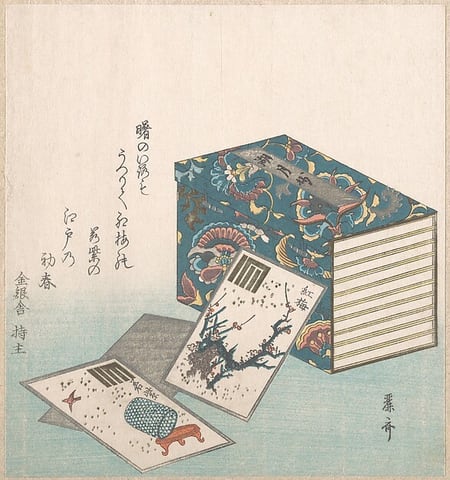
  2. Books and Cards, by Reisai, 18th–19th century
    Books and CardsReisai, 18th–19th centuryCourtesy of The Metropolitan Museum of Art
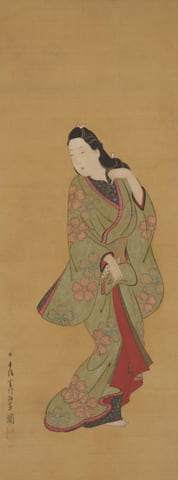
  3. A work made of hanging scroll; ink and colors on paper.
    Beauty Turning Her HeadHishikawa Moronobu, c. 1685-94Courtesy of the Art Institute of Chicago
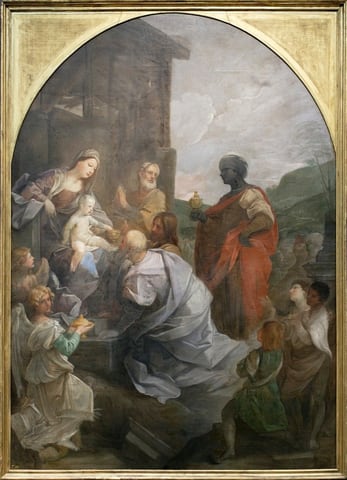
  4. Adoration of the Magi, by Guido Reni, 1642
    Adoration of the MagiGuido Reni, 1642Courtesy of the Cleveland Museum of Art

Section 3, north wall
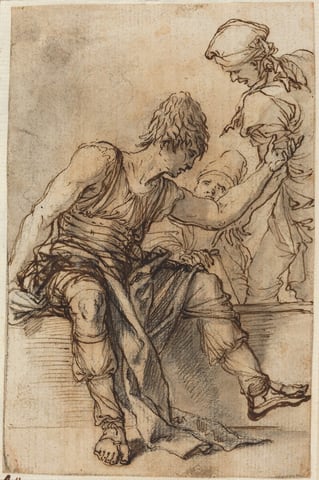
  1. The image shows a drawing of three figures. The central figure is seated, leaning slightly forward with one arm outstretched towards the standing figures. They have short, slightly messy hair, traditional clothing, and muscular limbs. The standing figures on the right are partially obscured but appear to interact with the seated figure. One of them is extending their arm towards the seated figure. The individuals wear layered clothing, with one wearing a head covering. The background is simple, emphasizing the interaction between the figures. The drawing style is classical or historical, using ink and wash for texture and depth.
    Youth Sitting on a Wall in Conversation with Two MenSalvator Rosa, c. 1656/1657Courtesy National Gallery of Art, Washington
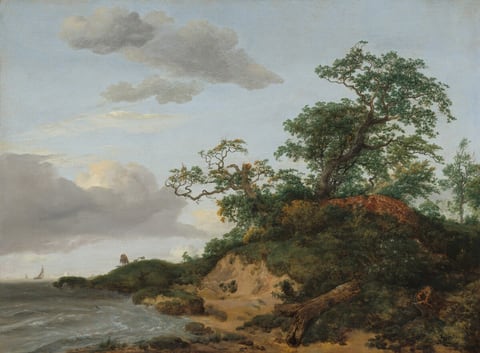
  2. Water laps at a curving shoreline in front of a steep sandy dune carpeted in grass, shrubs, and trees in this horizontal landscape painting. The dune takes up the lower right quadrant of the composition. A few broken tree trunks are overgrown with vines and plants across the top and down the sloping side of the dune facing us. A red brick wall cuts through the vegetation up the side of the dune and disappears into the shrubbery at the top. The twisting branches and canopies of three large trees reach into the upper right quadrant of the composition. The vegetation stops abruptly along the sheer edge of the dune where it faces the water. The land curves like a backward capital letter C so it almost reaches the left edge of the painting along the horizon, which comes a quarter of the way up the composition. A cow and three more animals, perhaps sheep or more cows, graze or lie on a grassy mound in the distance, and sailboats line the horizon in the deep distance. White ripples swirl in the steel-blue water. The artist signed and dated the lower center, “J Ruisdael . 1648.”
    Dunes by the SeaJacob van Ruisdael, 1648Courtesy National Gallery of Art, Washington