Floor plan

Time and placeThe 17th century

The 17th century

A work made of oil on canvas.
A sprig of flowering rosemary lying against an ivory-white background and the twelve insects that surround it fills this horizontal painting. Stretching nearly the length of the composition with the cut end to our left, the rosemary has blunted, needle-like, gently curling teal-green leaves and small periwinkle-blue flowers along the ash-brown stem. Several insects perch on the sprig while others are seen as if looking from overhead, resting on the white background. The three largest insects perch along the top of the sprig, with an ivory-white butterfly with moss-green and black markings to the left, a black and golden, fuzzy bumblebee near the center, and a lemon-yellow butterfly with red antennae to our right. A tiny red insect, perhaps a ladybug without spots, sits on a leaf between the bee and yellow butterfly, and a small wasp-like insect rests on a leaf in at the lower left. Another mosquito-like insect alights on the surface nearby, next to a beetle with a honey-orange body with black, almost tiger-like stripes. A large cockroach sitting near the lower right corner has six spindly legs, a mahogany-colored abdomen, a black thorax, and tiny, black head. Spaced somewhat evenly across the top of the panel are a brick-red, winged insect to the left, a mint-green, beetle-like bug near a moth patterned with bone white and black, and a black, fly-like insect to our right. Lit from the upper left, the rosemary and insects cast shadows on the surface. The artist signed and dated the work with gray in the lower left corner: “J v. kessel . . f. Ao 1653.”
A work made of ink on paper.
Study of a Tulip (Wit en root boode), by Pieter Holsteyn II, c. 1645
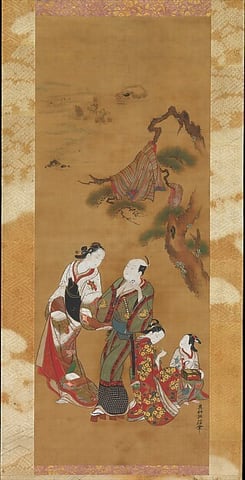
Yukihira and Two Brinemaidens at Suma, by Okumura Masanobu, 18th century
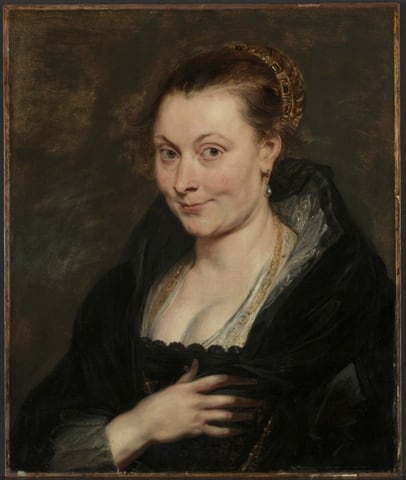
Portrait of Isabella Brant, by Peter Paul Rubens, c. 1620–25
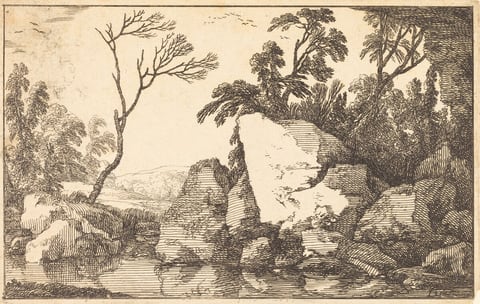
The image shows a landscape with trees, rocks, and water. The perspective is slightly elevated. Rocks are prominent in the central area, with various shapes and textures. Trees and foliage are depicted with detailed brushstrokes. The color scheme is sepia, creating a warm and vintage atmosphere. The scene includes water reflecting rocks, distant hills, and faint cloud formations.
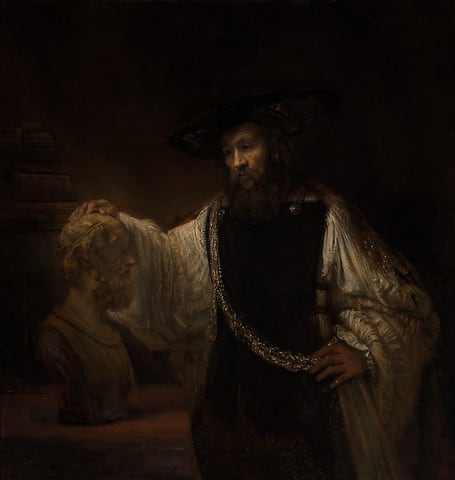
Aristotle with a Bust of Homer, by Rembrandt van Rijn, 1653

The works in this room are listed below.

Works in this room

Works made in the 17th century, anywhere in the world.

Section 1, north wall

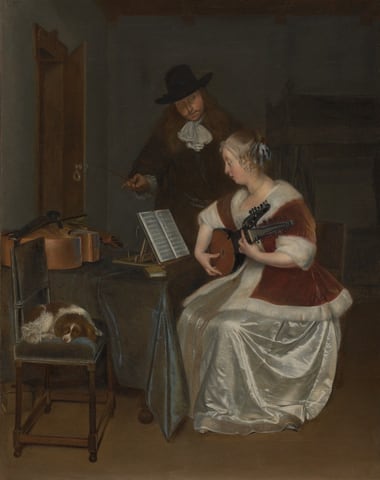
  1. A work made of oil on canvas.
    The Music LessonGerard ter Borch the Younger, c. 1670Courtesy of the Art Institute of Chicago
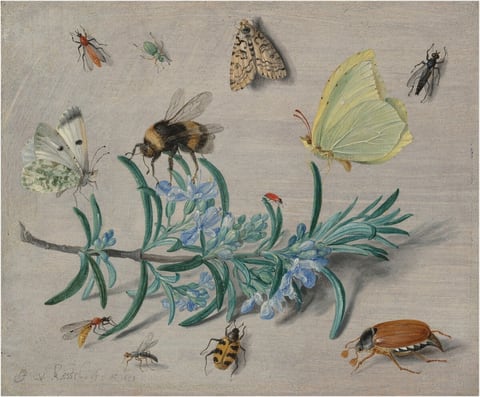
  2. A sprig of flowering rosemary lying against an ivory-white background and the twelve insects that surround it fills this horizontal painting. Stretching nearly the length of the composition with the cut end to our left, the rosemary has blunted, needle-like, gently curling teal-green leaves and small periwinkle-blue flowers along the ash-brown stem. Several insects perch on the sprig while others are seen as if looking from overhead, resting on the white background. The three largest insects perch along the top of the sprig, with an ivory-white butterfly with moss-green and black markings to the left, a black and golden, fuzzy bumblebee near the center, and a lemon-yellow butterfly with red antennae to our right. A tiny red insect, perhaps a ladybug without spots, sits on a leaf between the bee and yellow butterfly, and a small wasp-like insect rests on a leaf in at the lower left. Another mosquito-like insect alights on the surface nearby, next to a beetle with a honey-orange body with black, almost tiger-like stripes. A large cockroach sitting near the lower right corner has six spindly legs, a mahogany-colored abdomen, a black thorax, and tiny, black head. Spaced somewhat evenly across the top of the panel are a brick-red, winged insect to the left, a mint-green, beetle-like bug near a moth patterned with bone white and black, and a black, fly-like insect to our right. Lit from the upper left, the rosemary and insects cast shadows on the surface. The artist signed and dated the work with gray in the lower left corner: “J v. kessel . . f. Ao 1653.”
    Insects and a Sprig of RosemaryJan van Kessel the Elder, 1653Courtesy National Gallery of Art, Washington
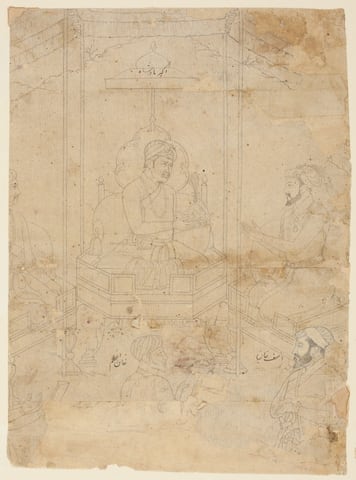
  3. A work made of ink on paper.
    Akbar Offering Timur's Crown to Shah JahanIslamic, Mughal period (1526–1857), ca. 1650–1700Courtesy of the Art Institute of Chicago
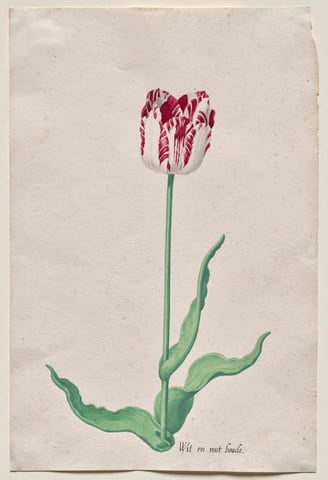
  4. Study of a Tulip (Wit en root boode), by Pieter Holsteyn II, c. 1645
    Study of a Tulip (Wit en root boode)Pieter Holsteyn II, c. 1645Courtesy of the Cleveland Museum of Art

Section 1, south wall

  1. Yukihira and Two Brinemaidens at Suma, by Okumura Masanobu, 18th century
    Yukihira and Two Brinemaidens at SumaOkumura Masanobu, 18th centuryCourtesy of The Metropolitan Museum of Art
  2. Portrait of Isabella Brant, by Peter Paul Rubens, c. 1620–25
    Portrait of Isabella BrantPeter Paul Rubens, c. 1620–25Courtesy of the Cleveland Museum of Art
  3. The image shows a landscape with trees, rocks, and water. The perspective is slightly elevated. Rocks are prominent in the central area, with various shapes and textures. Trees and foliage are depicted with detailed brushstrokes. The color scheme is sepia, creating a warm and vintage atmosphere. The scene includes water reflecting rocks, distant hills, and faint cloud formations.
    A Rocky PondLaurent de La Hyre, 1640Courtesy National Gallery of Art, Washington
  4. Aristotle with a Bust of Homer, by Rembrandt van Rijn, 1653
    Aristotle with a Bust of HomerRembrandt van Rijn, 1653Courtesy of The Metropolitan Museum of Art

Section 2, south wall
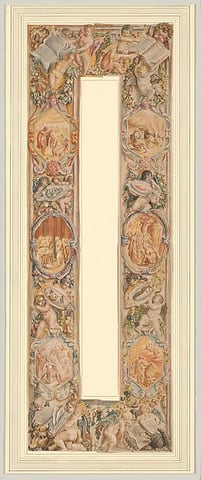
  1. Border Designs for the Mortlake "Acts of the Apostles" Tapestries, by Franz Cleyn, ca. 1626–36
    Border Designs for the Mortlake "Acts of the Apostles" TapestriesFranz Cleyn, ca. 1626–36Courtesy of The Metropolitan Museum of Art
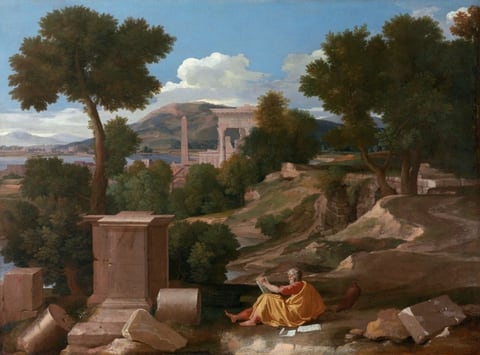
  2. Painting of Greek landscape, classical architecture, yellow, red robed man reading.
    Landscape with Saint John on PatmosNicolas Poussin, 1640Courtesy of the Art Institute of Chicago
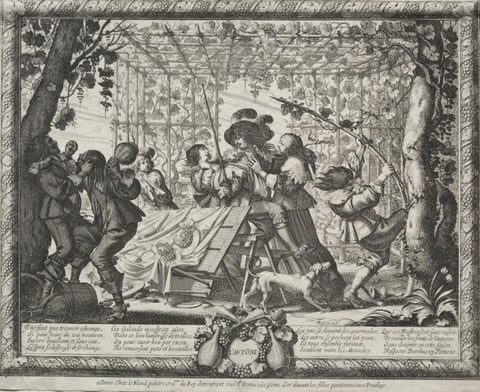
  3. The Four Seasons: Autumn, by Abraham Bosse, 1635
    The Four Seasons: AutumnAbraham Bosse, 1635Courtesy of the Cleveland Museum of Art
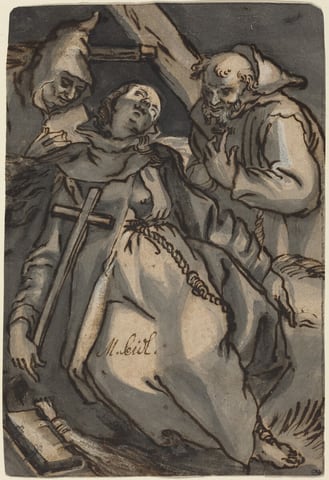
  4. The image displays three figures. The central figure is seated and supported by the other two. The central figure has wavy dark hair, eyes closed, and wears a robe with a cross. The figure on the left looks serene, while the one on the right holds onto the cross. The background is sketchy with dark and light contrast, possibly depicting a dimly lit or nighttime setting with visible wooden beams.
    Saint EuphrosyneMelchior Steidl, c. 1695Courtesy National Gallery of Art, Washington

Section 2, north wall
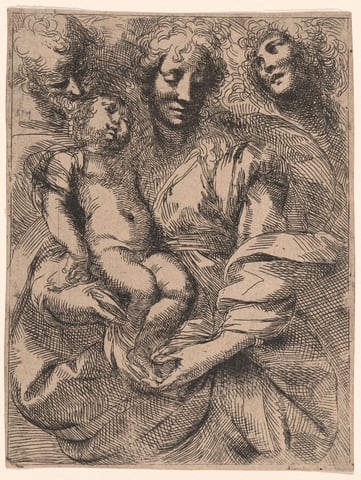
  1. A work made of etching in black on tan laid paper.
    The Holy FamilyGiulio Cesare Procaccini, 1613/15Courtesy of the Art Institute of Chicago
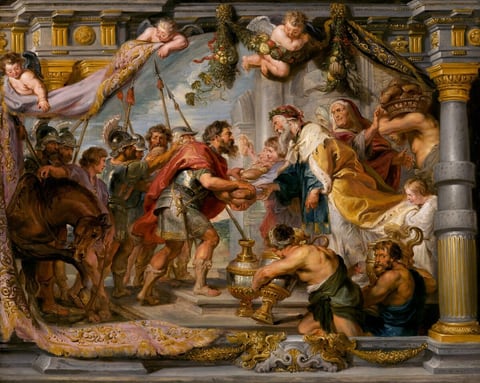
  2. This horizontal painting shows a tapestry being unfurled and held up by winged, baby-like putti against a structure with gray and gold columns, seen at the edges of the composition. Taking up most of the composition, the tapestry shows two ranks of men, women, and children gathered behind two central men, who meet at the center. All the people have light or tanned skin, and the bodies we can see are muscular. In the central pair of men, the one to our left, Abraham, faces our right in profile as he holds two loaves of bread. He has a brown beard and short, wavy hair, and dark brows over a prominent nose. He looks at the other man with dark eyes and leans toward him, to our right. Abraham wears an armored breastplate over silver chainmail edged with gold, which falls to mid-thigh. A crimson-red cape wraps around his shoulders and swirls around his back. A sword hangs by his hip, and tan sandals cover his heels and shins. Behind him are seven men and one brown horse, who gnaws at its foreleg. Most of the men are bearded and five wear armored helmets. A cleanshaven man wearing a lavender-purple tunic stands with his arm slung over the horse’s neck, holding the rein between thumb and forefinger. The man to our right, Melchizedek has a long white beard and short white hair. His red cap is encircled with a wreath of dark green leaves. He wears a long-sleeved, waist-length, aquamarine-blue garment over a white skirt. A heavy, golden-yellow cape with a broad, white fur collar and lining drapes over his shoulders, and is supported by at least one attendant. Behind and around Melchizedek are eight men, women, and children, standing near stone, gray ruins. Behind Melchizedek, one portly person wearing a dark pink mantle reaches into a basket of bread held across the shoulders of a blond, bearded, bare-chested man. Closer to us, in the lower right corner of the tapestry, one man wearing a green toga and another wearing blue kneel and sit, holding oversized silver and gold urns, the size of their torsos. The man in blue, to our right, turns to look at us over his shoulder. A third large urn sits near the other man. A view into the landscape with a low, green hill and a pale blue sky is glimpsed between the groups. The tapestry showing this scene curls over at the edges where the pudgy angels lift the top edge. The top right corner of the tapestry wraps around the edge of an unseen feature of the building, next to a gray column that rises the height of the painting up along the right edge. The border of the tapestry is rose pink with stylized gold designs. One putto with brown hair holds up the left corner, and one with light gray hair holds up the middle one arm slung over the front of the tapestry. The third putto, with blond hair, hooks an arm over a leafy garland with fruit that hangs from the cornice near the top center of the composition.
    The Meeting of Abraham and MelchizedekPeter Paul Rubens, c. 1626Courtesy National Gallery of Art, Washington

Section 3, north wall
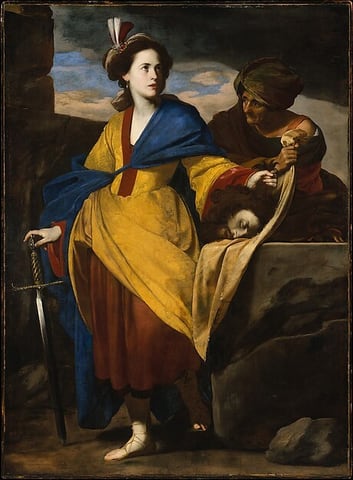
  1. Judith with the Head of Holofernes, by Massimo Stanzione, ca. 1640
    Judith with the Head of HolofernesMassimo Stanzione, ca. 1640Courtesy of The Metropolitan Museum of Art
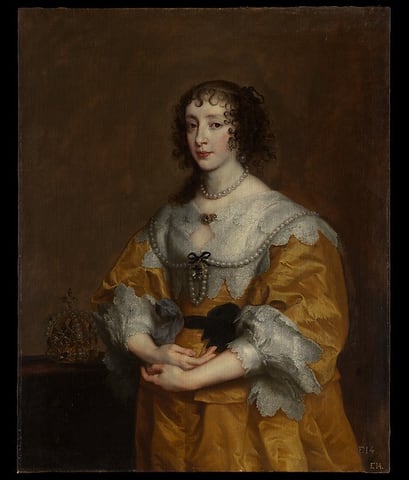
  2. Queen Henrietta Maria, by Anthony van Dyck, 1636
    Queen Henrietta MariaAnthony van Dyck, 1636Courtesy of The Metropolitan Museum of Art