Floor plan

Time and placeThe 17th century

The 17th century

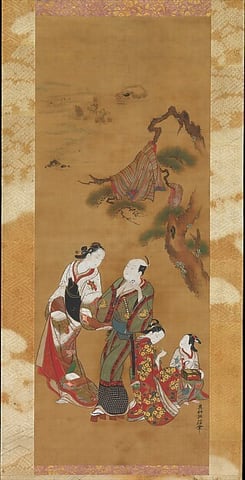
Yukihira and Two Brinemaidens at Suma, by Okumura Masanobu, 18th century
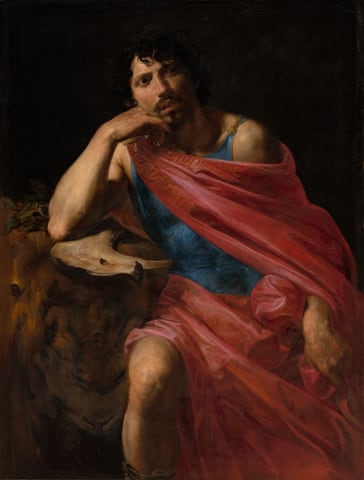
Samson, by Valentin de Boulogne, 1630–31
A work made of oil on canvas.
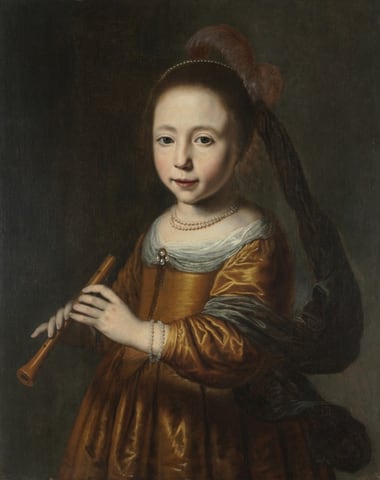
Portrait of Elizabeth Spiegel, by Dirck Dircksz. Santvoort, 1639
Portrait of a Woman, by Govaert Flinck, 1646
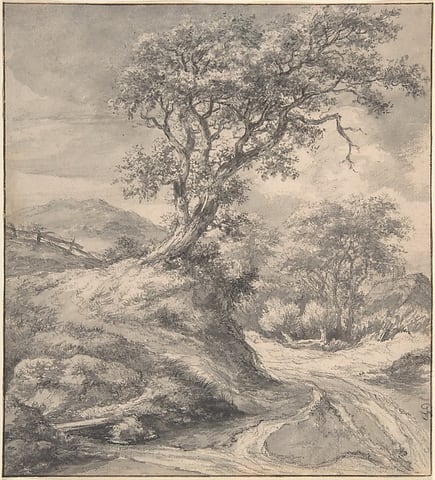
Dune Landscape with Oak Tree, by Jacob van Ruisdael, 1650–55
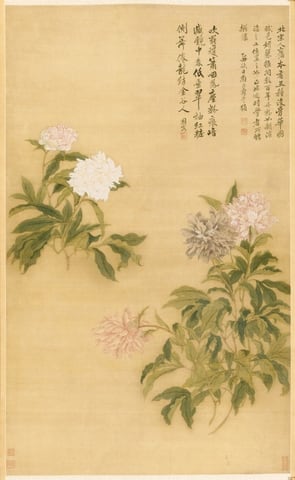
Herbaceous Peony, by Yun Shouping, 1685
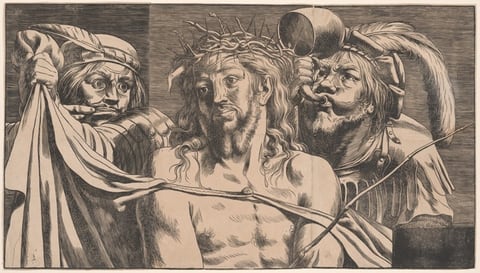
A work made of woodcut on three joined sheets of ivory laid paper.

The works in this room are listed below.

Works in this room

Works made in the 17th century, anywhere in the world.

Section 1, north wall

  1. Yukihira and Two Brinemaidens at Suma, by Okumura Masanobu, 18th century
    Yukihira and Two Brinemaidens at SumaOkumura Masanobu, 18th centuryCourtesy of The Metropolitan Museum of Art
  2. Samson, by Valentin de Boulogne, 1630–31
    SamsonValentin de Boulogne, 1630–31Courtesy of the Cleveland Museum of Art
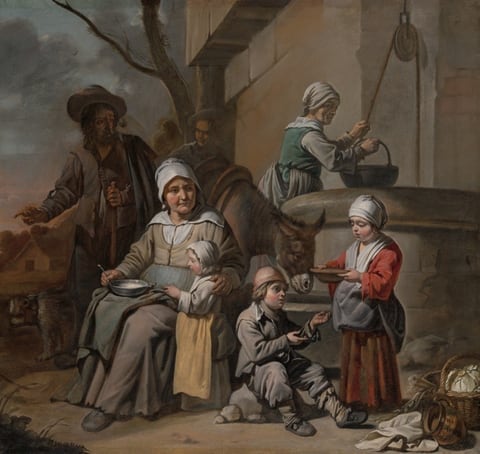
  3. A work made of oil on canvas.
    Peasant Family at a WellThe Master of the Children's Caps, 1650/60Courtesy of the Art Institute of Chicago
  4. Portrait of Elizabeth Spiegel, by Dirck Dircksz. Santvoort, 1639
    Portrait of Elizabeth SpiegelDirck Dircksz. Santvoort, 1639Courtesy of the Cleveland Museum of Art

Section 1, south wall

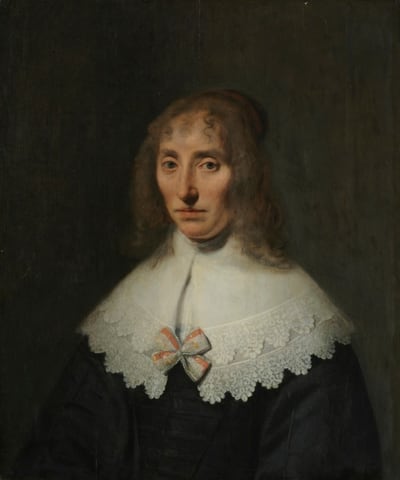
  1. Portrait of a Woman, by Govaert Flinck, 1646
    Portrait of a WomanGovaert Flinck, 1646Courtesy of the Cleveland Museum of Art
  2. Dune Landscape with Oak Tree, by Jacob van Ruisdael, 1650–55
    Dune Landscape with Oak TreeJacob van Ruisdael, 1650–55Courtesy of The Metropolitan Museum of Art
  3. Herbaceous Peony, by Yun Shouping, 1685
    Herbaceous PeonyYun Shouping, 1685Courtesy of the Cleveland Museum of Art
  4. A work made of woodcut on three joined sheets of ivory laid paper.
    The Mocking of ChristWerner van den Valckert, c. 1620Courtesy of the Art Institute of Chicago

Section 2, south wall
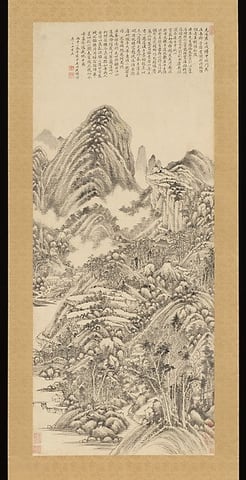
  1. Landscape in the style of Huang Gongwang, by Wang Shimin, 1666
    Landscape in the style of Huang GongwangWang Shimin, 1666Courtesy of The Metropolitan Museum of Art
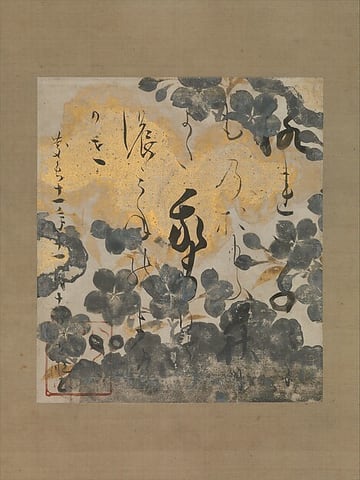
  2. Poem by Kamo no Chōmei with Underpainting of Cherry Blossoms, by Hon'ami Kōetsu, 1606
    Poem by Kamo no Chōmei with Underpainting of Cherry BlossomsHon'ami Kōetsu, 1606Courtesy of The Metropolitan Museum of Art
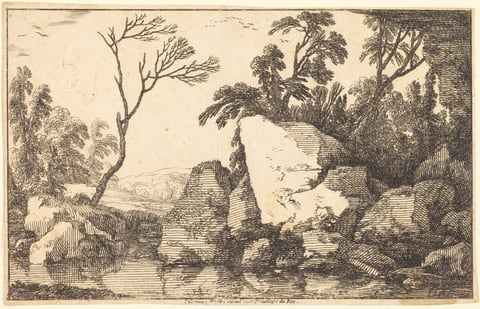
  3. The image is a landscape view with a natural scene depicted in fine etching. The horizon is situated towards the middle of the composition, where the land gently rises, and a subtle outline of distant hills is visible. Large rocks and foliage are depicted close to us, with a lone, barren tree extending upwards on the left side. The etching features intricate and well-defined brushstrokes, including thin lines and cross-hatching to create texture and depth. The color palette is monochromatic, with dark tones against a lighter background. In the distance, additional clusters of trees can be seen, rendered with similar linework to convey movement and detail.
    A Rocky PondLaurent de La Hyre, 1640Courtesy National Gallery of Art, Washington
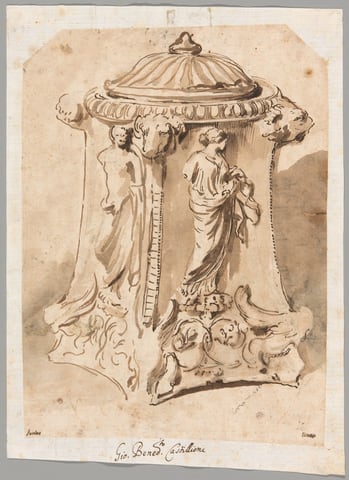
  4. A work made of pen and brown ink and brush and brown wash, over graphite, on cream laid paper laid down on off-white laid paper.
    Antique Carved Marble Candelabra BaseAndrea di Lione, 1642/44 or 1647/51Courtesy of the Art Institute of Chicago

Section 2, north wall
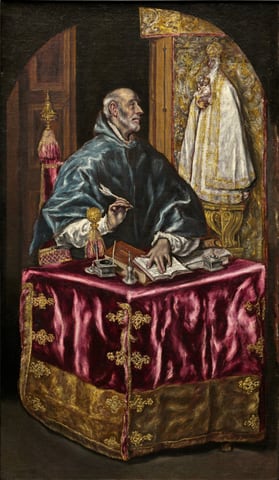
  1. A light-skinned man wearing a voluminous, ocean-blue, hooded robe sits at a cloth-draped writing table and looks up, fingers splayed over an open book and a pen held in his other hand, in this vertical painting. The man and desk take up most of the composition, which has an arched top. The man’s shoulders and body are angled to our right, and he looks off in that direction in profile. His balding head is rimmed with white hair curving over the large ear we can see, and he has a trimmed white and gray beard and mustache. His prominent nose is pointed, and his lips are closed. Light glints off the robe he wears so it shimmers in shades of topaz, aquamarine, and midnight blue. Voluminous white sleeves emerge under the mantle and are edged with narrow lace cuffs. His left hand, to our right, rests on an open book, which is propped against one or two other tomes. Near the edge of the table, two quills stand in the corners of a lidded inkwell, and a round, silver blotter, shaped like an upside-down chalice, and a lidded silver box sit nearby. The man’s chair has a tall post next to his shoulder to our left with a teardrop-shaped, gold finial. A second post, near his wrist, is lower and topped with a gold orb. The chair is draped in the same deep, raspberry-pink of the square table at which he sits. The tablecloth is edged with a wide band of gold along the bottom, and filigree-like gold decorations line the seams or folds at the corners. Brushstrokes are visible in many areas, especially in the colorfully charged blue and pink fabric. Beyond the man, to our right, a statuette of a person wearing a long, white robe over a white dress holds a baby. The clothing is edged with gold, and she wears a sphere-like gold crown. The baby also wears white and holds up one hand. The statuette stands on a platform supported by S-shaped corbels, and could have a projecting, squared awning over the top. This area is more loosely painted so some details are difficult to make out. In the background to our left, a wooden door stands open next to a dark space just behind the man’s head, so his profile is picked out against the shadow. The floor beneath is earth brown.
    Saint IldefonsoEl Greco, c. 1603/1614Courtesy National Gallery of Art, Washington
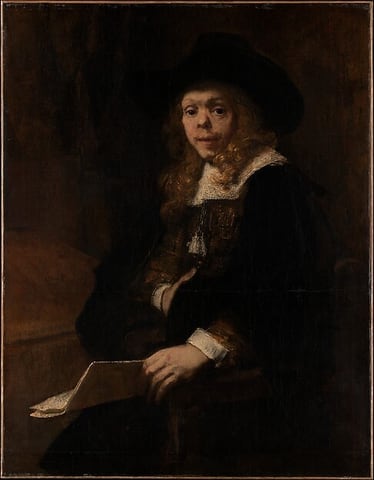
  2. Portrait of Gerard de Lairesse, by Rembrandt van Rijn, 1665–67
    Portrait of Gerard de LairesseRembrandt van Rijn, 1665–67Courtesy of The Metropolitan Museum of Art
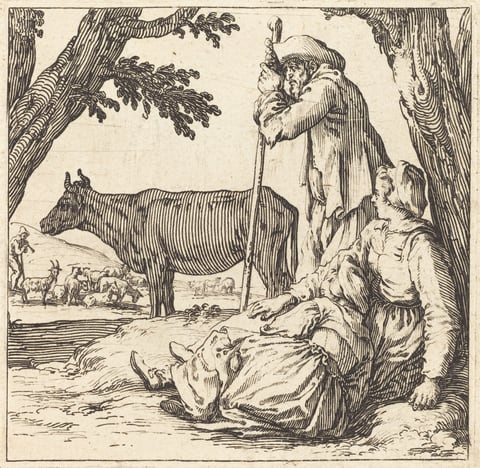
  3. The image has an elevated perspective showing two figures with animals in the scene. One person is leaning against a tree with a stick, while the other is seated on the ground. A cow is between them and other livestock in the middle distance. A person in the distance is tending to the animals. The horizon is low in the image, hidden by rolling hills. The artwork is in monochrome with fine linework, creating texture through hatching and cross-hatching, emphasizing depth and dimensionality.
    Peasant Couple with CowJacques Callot, c. 1621Courtesy National Gallery of Art, Washington
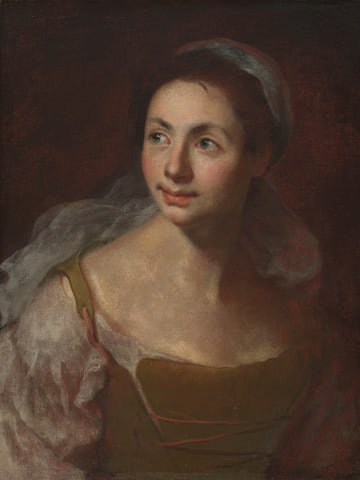
  4. A work made of oil on canvas.
    Portrait of a GirlFrancesco Solimena, c. 1700Courtesy of the Art Institute of Chicago