Floor plan

Time and placeThe 17th century

The 17th century

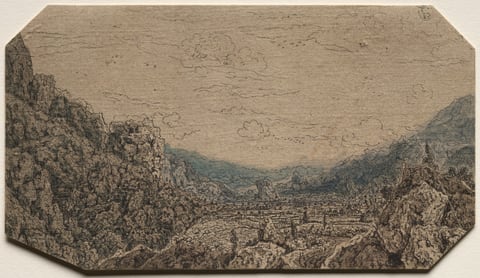
Enclosed Valley, by Hercules Seghers, c. 1623–30
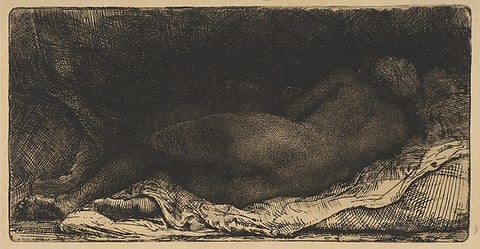
Reclining Female Nude, by Rembrandt van Rijn, 1658
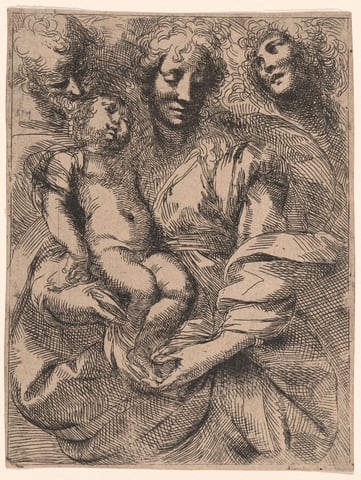
A work made of etching in black on tan laid paper.
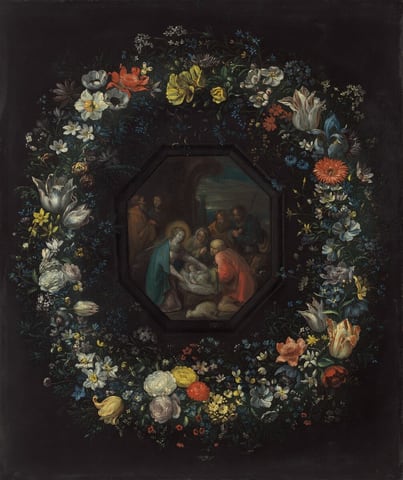
A scene with seven men and women gathered around an infant is enclosed in an eight-sided, octagonal painted frame, which is surrounded by a wreath of flowers in this vertical painting. The painted black frame-within-a-frame resembles molding. The people in the scene have pale skin and wear robes in shades of teal blue, burnt orange, red, muted purple, or red. A woman reaching for the bed on which the child lies and the child have gold halos. Others crouch or bend toward the child, and one pair, to our left, turn toward each other, presumably talking. The nighttime-blue sky is streaked with nickel-gray clouds beyond a partially ruined stone arch. A lamb with all four feet tired together lies at the foot of the child’s bed. The wreath surrounding the painting-within-a-painting is dense with tulips, roses, daffodils, poppies, violets, and other flowers and greenery painted in shades of lemon and butter yellow, opal and pearl white, brick and coral red, and sky and slate blue against an inky-black background. One artist signed the painting-within-a-painting near the bottom left corner, “FF F.” The second artist who painted this signed his initials, “HDB”, on the bottom edge of the painted frame.
A work made of black chalk, with touches of white chalk, on ivory laid paper.
Hanging scroll
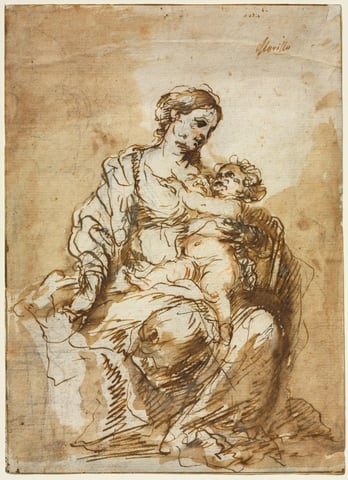
Madonna Nursing the Christ Child, by Bartolomé Esteban Murillo, c. 1670–72
A work made of oil on canvas.

The works in this room are listed below.

Works in this room

Works made in the 17th century, anywhere in the world.

Section 1, north wall

  1. Enclosed Valley, by Hercules Seghers, c. 1623–30
    Enclosed ValleyHercules Seghers, c. 1623–30Courtesy of the Cleveland Museum of Art
  2. Reclining Female Nude, by Rembrandt van Rijn, 1658
    Reclining Female NudeRembrandt van Rijn, 1658Courtesy of The Metropolitan Museum of Art
  3. A work made of etching in black on tan laid paper.
    The Holy FamilyGiulio Cesare Procaccini, 1613/15Courtesy of the Art Institute of Chicago
  4. A scene with seven men and women gathered around an infant is enclosed in an eight-sided, octagonal painted frame, which is surrounded by a wreath of flowers in this vertical painting. The painted black frame-within-a-frame resembles molding. The people in the scene have pale skin and wear robes in shades of teal blue, burnt orange, red, muted purple, or red. A woman reaching for the bed on which the child lies and the child have gold halos. Others crouch or bend toward the child, and one pair, to our left, turn toward each other, presumably talking. The nighttime-blue sky is streaked with nickel-gray clouds beyond a partially ruined stone arch. A lamb with all four feet tired together lies at the foot of the child’s bed. The wreath surrounding the painting-within-a-painting is dense with tulips, roses, daffodils, poppies, violets, and other flowers and greenery painted in shades of lemon and butter yellow, opal and pearl white, brick and coral red, and sky and slate blue against an inky-black background. One artist signed the painting-within-a-painting near the bottom left corner, “FF F.” The second artist who painted this signed his initials, “HDB”, on the bottom edge of the painted frame.
    Garland of Flowers with Adoration of the ShepherdsFrans Francken the Younger, c. 1625/1630Courtesy National Gallery of Art, Washington

Section 1, south wall

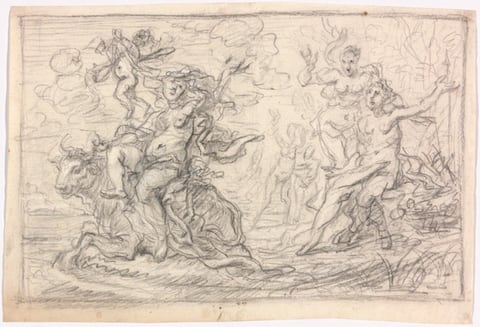
  1. A work made of black chalk, with touches of white chalk, on ivory laid paper.
    The Rape of EuropaCornelis Schut, I, 1635/40Courtesy of the Art Institute of Chicago
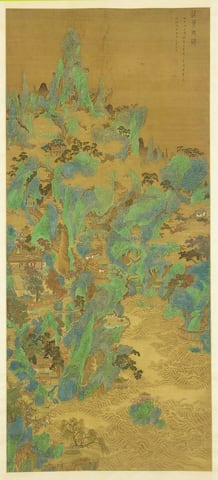
  2. Hanging scroll
    The palaces and gate towers of PenglaiZhu Dan, 1683Courtesy of the National Museum of Asian Art, Smithsonian Institution
  3. Madonna Nursing the Christ Child, by Bartolomé Esteban Murillo, c. 1670–72
    Madonna Nursing the Christ ChildBartolomé Esteban Murillo, c. 1670–72Courtesy of the Cleveland Museum of Art
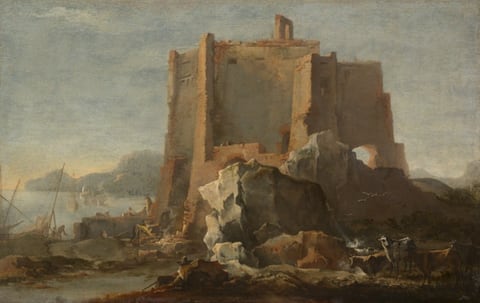
  4. A work made of oil on canvas.
    Landscape with Rock and FortressDomenico Gargiuli (Micco Spadaro), c. 1645Courtesy of the Art Institute of Chicago

Section 2, south wall
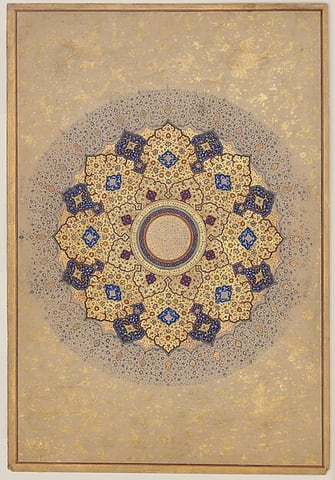
  1. "Rosette Bearing the Names and Titles of Shah Jahan", Folio from the Shah Jahan Album, recto: ca. 1645; verso: ca. 1630–40
    "Rosette Bearing the Names and Titles of Shah Jahan", Folio from the Shah Jahan AlbumUnrecorded maker, recto: ca. 1645; verso: ca. 1630–40Courtesy of The Metropolitan Museum of Art
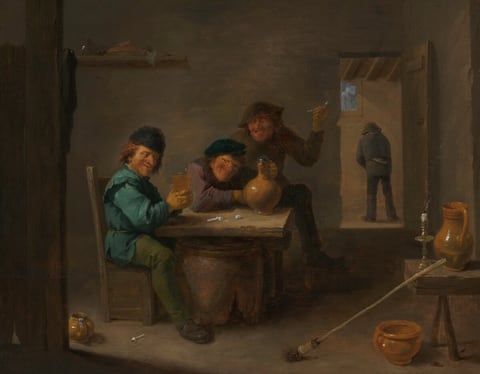
  2. Three pale-skinned people gather around a wooden table in a dimly lit tavern as a fourth person urinates against a wall in a back room in this horizontal painting. The table is a square board resting on a broken barrel. All three men at the table have prominent, reddened noses set in wide faces, and they wear clothing and hats in tones of spruce blue, olive green, muted purple, gray, or brown. One man sits on the left side of the table, holding a glass of beer with both hands. He wears what might be a furry cap. His face is turned slightly toward us but he looks down and to our right. The other seated man is across from us. He grins widely as he hunches over one forearm and holds the neck of a lidded ceramic jug with his other hand. He has a long, chunky chin and stares out at us from under a prominent brow ridge. The third man here stands behind, holding up a white clay pipe. His mouth is open, his eyes slitted, possibly crossed, and he hunches down. One foot rests on a low wooden box, a foot warmer. Another white clay pipe and the broken bowl of a pipe sit on the table, and another pipe lies by the first man’s feet. Also across the floor are two pots and a stubby broom, the long handle of which lies against a table holding a brass candlestick. A wisp of smoke rises from the wick in the candle stub. A shelf hung on the wall near the upper left corner of the painting holds a glass vessel and perhaps a plate. Two wooden beams line the left edge of the composition, and a cloth is draped over a nail there. The floor and wall are nearly uniform taupe gray. A rectangular doorway opens into the next room, in the top right corner of the painting. There a man stands facing the wall with both hands down in front of his torso. A window is set high in the wall there and the timbered ceiling is visible. The artist signed the lower left corner the painting, “D Teniers f.” The first two digits of the date read “16.”
    Peasants in a TavernDavid Teniers the Younger, c. 1633Courtesy National Gallery of Art, Washington
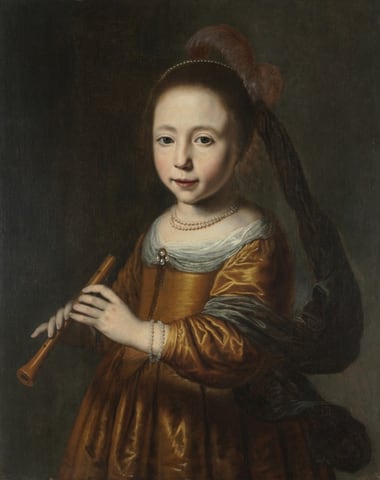
  3. Portrait of Elizabeth Spiegel, by Dirck Dircksz. Santvoort, 1639
    Portrait of Elizabeth SpiegelDirck Dircksz. Santvoort, 1639Courtesy of the Cleveland Museum of Art
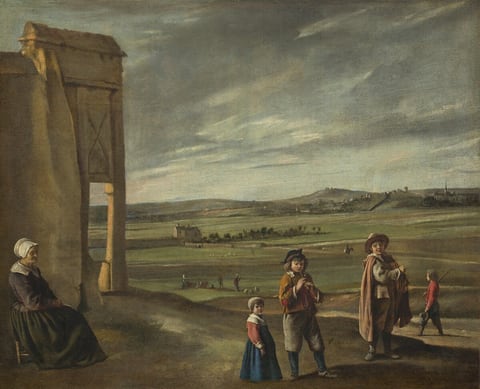
  4. An elderly woman sits on a small stool and four children stand along the foreground of a landscape with rolling, olive-green fields leading back to low, slate-gray mountains in this nearly square painting. The horizon comes about halfway up the painting, and the sky above is filled with a sheet of steel-gray clouds that break to reveal patches of ice-blue sky. Closest to us and along the left edge of the painting, the woman sits near a structure with a fragment of wall and a column that could be made from tan-colored stone. The woman faces our right in profile and looks at or toward three children gathered on a low hill to our right. Her lined face is partially cast in shadow by her white bonnet, but her skin is yellowed where the light falls across the side closer to us. A wide, white collar lies over the shoulders of her muted, plum-purple jacket, which is tied with a narrow red belt. Her hands rest in the lap of her full, moss-green skirt that falls to her feet and covers most of the stool. To our right, two boys and a little girl stand on a low hill. They all stand with their bodies angled to our right, and all have pale skin and brown hair. To our left in the trio, the young girl wears a royal-blue dress with brick-red, long sleeves and a wide, white collar, cuffs, and cap. Next to her, a slightly older boy wearing gray knee-britches, a honey-orange jacket with a white collar, and a blue tricorn hat looks down and plays a thin pipe. His jacket is torn at the elbows, revealing a red shirt beneath. To our right, the oldest boy wears a brown cloak over a gray jacket, tan trousers, and a tan brimmed hat. He holds his right arm, closer to us, across his chest as he touches an instrument nestled in the crook of his other elbow. Another bareheaded boy wearing a red shirt and blue trousers walks beyond this trio, holding a short pole over one shoulder and a brimmed hat in his other hand. He walks to our left and looks to the horizon. More people with sheep, cows, and a person on horseback dot the rolling fields that stretch back to low hills. One house sits next to a line of trees to the left of center, in the middle distance, and more buildings, including a church spire, cluster on the horizon to our right.
    Landscape with PeasantsLouis Le Nain, c. 1640Courtesy National Gallery of Art, Washington

Section 2, north wall
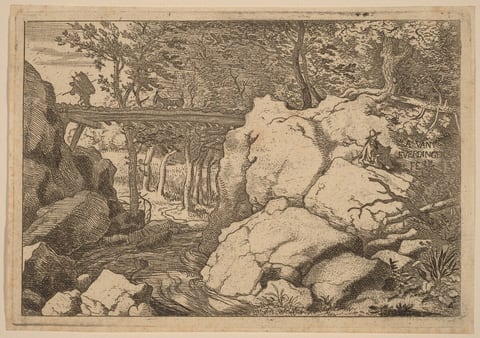
  1. The image shows a landscape with rocky terrain, trees, and a stream. In the foreground, there is a bridge with a traveler and a dog crossing over the stream. The scene features detailed linework and cross-hatching to depict texture. The color palette is monochrome brown, resembling an etching or drawing style.
    Goat on a small BridgeAllart van Everdingen, probably c. 1645/1656Courtesy National Gallery of Art, Washington
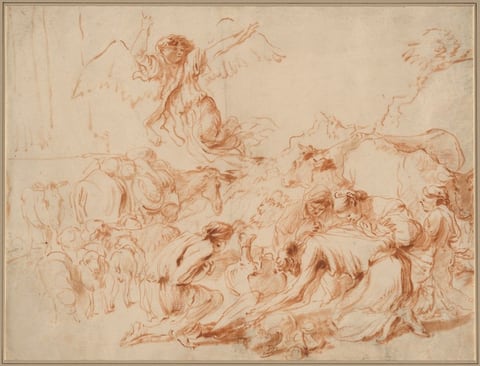
  2. A work made of red oil paint on ivory laid paper.
    The Angel Departing from the Family of Tobit (?)Giovanni Benedetto Castiglione, c. 1655Courtesy of the Art Institute of Chicago
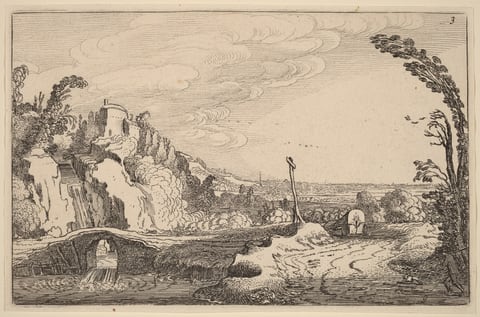
  3. The image shows a pastoral scene in black and white with fine line work. A small bridge with a circular archway crosses a stream. A dirt path winds through the landscape flanked by grass and bushes. A rocky cliff ascends on the left with a tower-like structure partially obscured by vegetation. The horizon features a cloudy sky, with swirling lines indicating motion. In the distance, a tall, thin structure, possibly a spire or chimney, stands amid faint hills and trees. The scene conveys a serene atmosphere through hatching and cross-hatching techniques.
    Cascade under a Stone BridgeJan van de Velde II, c. 1616Courtesy National Gallery of Art, Washington
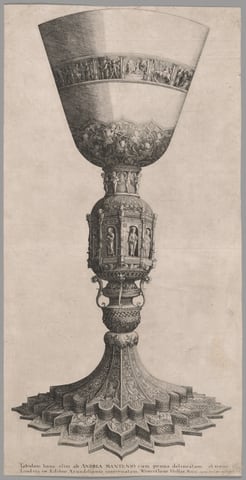
  4. A work made of etching on ivory laid paper.
    A ChaliceWenceslaus Hollar, 1640Courtesy of the Art Institute of Chicago