Floor plan

Time and place18th-century Britain
18th-century Britain
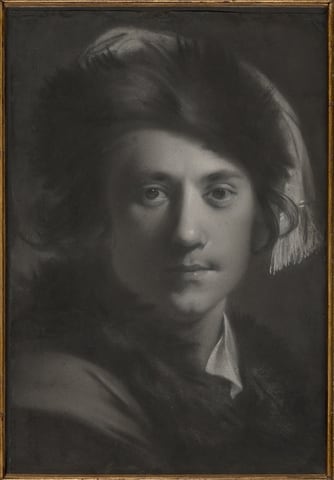
Black, gray pastel portrait of man in a fur hat.
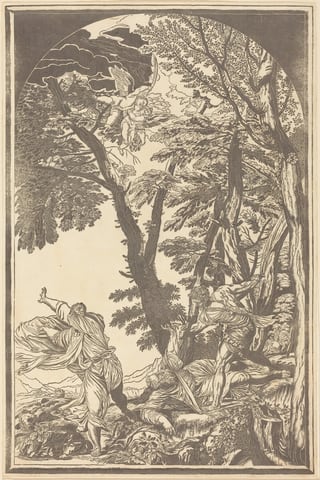
This drawing depicts multiple figures in a forest setting. An angelic figure hovers at the top with wings outstretched. The forest below is filled with intricately detailed trees. Figures on the ground are in dynamic poses, one showing surprise or fear, and another reaching upwards. The composition is detailed with flowing garments and textured foliage, evoking tension and animation.
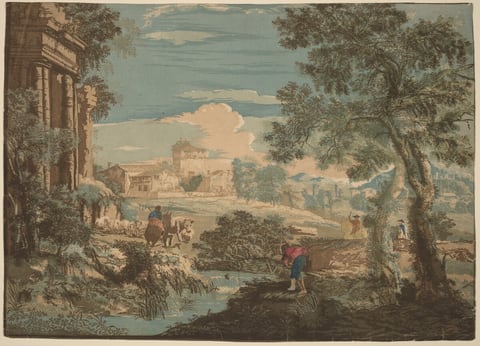
The image shows a landscape scene from an elevated viewpoint. There are large columns of a classical ruin and a leafy tree on the left. On the right, there is a spreading tree with intricate leaves. In the background, there is a pastoral landscape with figures and animals. A shepherd and a cow are guiding a flock of sheep, and buildings can be seen in the distance. The horizon divides the image into sky and earth. The brushstrokes are detailed, capturing textures effectively. The color palette consists of earthy tones with touches of brighter colors on the figures' clothing.
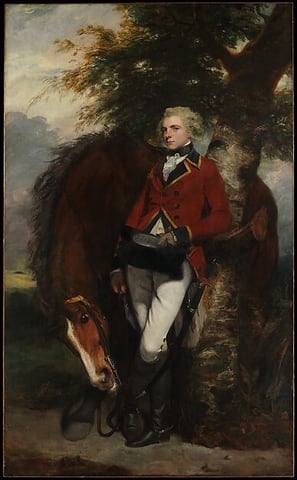
Captain George K. H. Coussmaker (1759–1801), by Joshua Reynolds, 1782
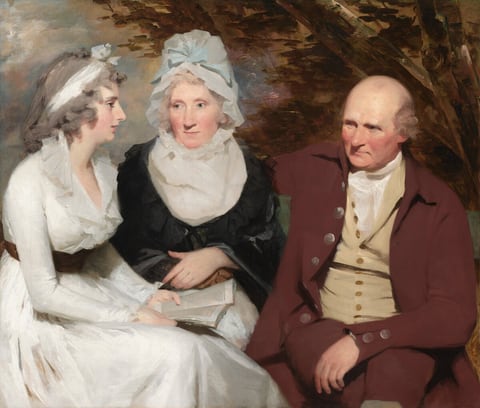
John Johnstone, Betty Johnstone, and Miss Wedderburn, by Sir Henry Raeburn, c. 1790/1795
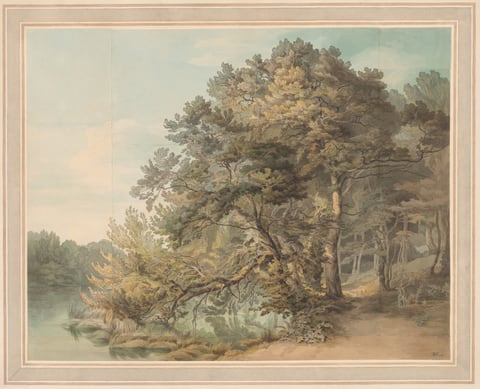
The image shows a forest by a serene, tree-lined body of water. The horizon is high with tall trees extending close to it, creating a sense of depth. The brushstrokes and watercolor application are delicate, capturing textures of leaves and water gently. The color palette includes muted greens, soft browns, and hints of blue and cream. Closest to us is a dense cluster of trees on the right, curving over the water. Across the water, other tree clusters and shrubs recede into the misty background towards the left.

The works in this room are listed below.

Works in this room

Works made in Britain in the 18th century.

First room, north wall

  1. Black, gray pastel portrait of man in a fur hat.
    Self-Portrait in a Fur CapJoseph Wright of Derby, 1765/68Courtesy of the Art Institute of Chicago
  2. This drawing depicts multiple figures in a forest setting. An angelic figure hovers at the top with wings outstretched. The forest below is filled with intricately detailed trees. Figures on the ground are in dynamic poses, one showing surprise or fear, and another reaching upwards. The composition is detailed with flowing garments and textured foliage, evoking tension and animation.
    The Death of Saint Peter MartyrJohn Baptist Jackson, 1739Courtesy National Gallery of Art, Washington
  3. The image shows a landscape scene from an elevated viewpoint. There are large columns of a classical ruin and a leafy tree on the left. On the right, there is a spreading tree with intricate leaves. In the background, there is a pastoral landscape with figures and animals. A shepherd and a cow are guiding a flock of sheep, and buildings can be seen in the distance. The horizon divides the image into sky and earth. The brushstrokes are detailed, capturing textures effectively. The color palette consists of earthy tones with touches of brighter colors on the figures' clothing.
    Heroic Landscape with Fisherman, Cows, and HorsemenJohn Baptist Jackson, 1744Courtesy National Gallery of Art, Washington

First room, south wall

  1. Captain George K. H. Coussmaker (1759–1801), by Joshua Reynolds, 1782
    Captain George K. H. Coussmaker (1759–1801)Joshua Reynolds, 1782Courtesy of The Metropolitan Museum of Art
  2. John Johnstone, Betty Johnstone, and Miss Wedderburn, by Sir Henry Raeburn, c. 1790/1795
    John Johnstone, Betty Johnstone, and Miss WedderburnSir Henry Raeburn, c. 1790/1795Courtesy National Gallery of Art, Washington
  3. The image shows a forest by a serene, tree-lined body of water. The horizon is high with tall trees extending close to it, creating a sense of depth. The brushstrokes and watercolor application are delicate, capturing textures of leaves and water gently. The color palette includes muted greens, soft browns, and hints of blue and cream. Closest to us is a dense cluster of trees on the right, curving over the water. Across the water, other tree clusters and shrubs recede into the misty background towards the left.
    Peamore, DevonJohn White Abbott, 1799Courtesy National Gallery of Art, Washington

Second room, south wall
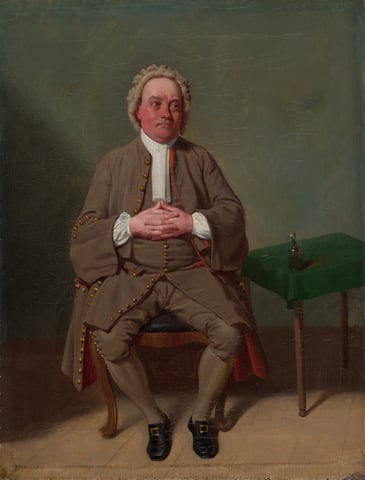
  1. A work made of oil on canvas.
    Mr. Quick as Vellum in Addison's DrummerSamuel De Wilde, 1792Courtesy of the Art Institute of Chicago
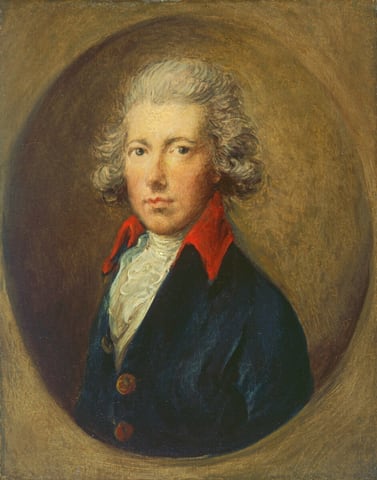
  2. The image depicts a portrait of an individual with the upper half of their body visible. The person is facing forward with their head slightly turned to the side, looking directly at the viewer. They have a fair complexion, with distinct facial features, including a rounded face and closed lips. The hair is styled in an 18th-century manner, with curls around the ears. They are wearing a dark coat with red lapels and brass buttons, over a white shirt with ruffled details. There are no visible jewelry or objects in their hands. The background is a textured, earth-toned surface.
    William PittGainsborough Dupont, 1787/1796Courtesy National Gallery of Art, Washington
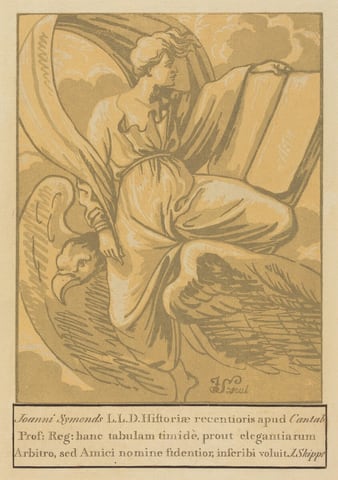
  3. This is a drawing of a winged figure seated on a bird. The image depicts a figure with flowing robes, wings outstretched, holding an open book in one hand. The figure appears to be looking off to the side, with a serene expression. The lower part of the image includes a bird upon which the figure is seated. The bird's head is turned slightly upwards, following the direction in which the figure is gazing. The image is rendered in a warm, monochromatic palette. In the lower section of the image, there is some text, likely Latin.
    Saint John the EvangelistJohn Skippe, 1771Courtesy National Gallery of Art, Washington
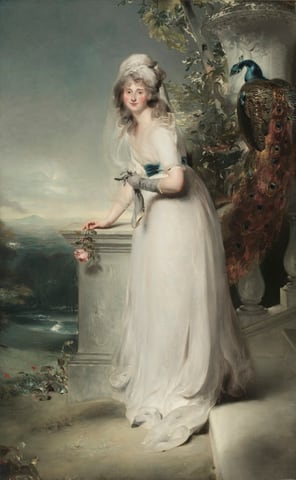
  4. Portrait of Catherine Grey, Lady Manners, by Thomas Lawrence, 1794
    Portrait of Catherine Grey, Lady MannersThomas Lawrence, 1794Courtesy of the Cleveland Museum of Art

Second room, north wall
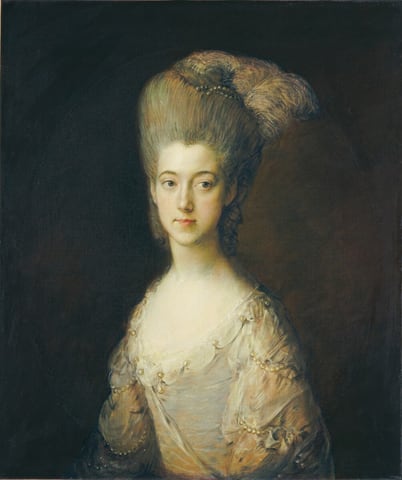
  1. Shown from the waist up, a young, pale-skinned woman with her gray hair piled high atop her head is lit starkly against a dark background in this vertical portrait painting. The woman’s shoulders are angled to our left. Her face is square to us, but she looks off to our right from the corners of her eyes, which are gray rimmed with golden brown around the pupils. She has a thin face, smooth cheeks, a bow-shaped pink mouth, and a narrow chin. Her hair is mostly swept up high under a bank of pearl-white feathers and some sparkling ornaments. A few ringlets hang down the back of her neck. The bodice of her white dress scoops low across her chest and sits just above her sloping shoulders. The dress is adorned with pearls on the sleeves and around the neckline, and the fabric shimmers from silvery white to pale gold. The background is earth-brown around her face and deepens to almost black in the corners.
    Mrs. Paul Cobb MethuenThomas Gainsborough, c. 1776/1777Courtesy National Gallery of Art, Washington
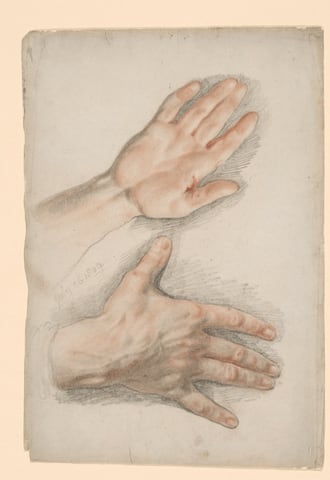
  2. A work made of red and black chalk on gray wove paper.
    Two Studies of a Right HandThomas Lawrence, July 26, 1800Courtesy of the Art Institute of Chicago
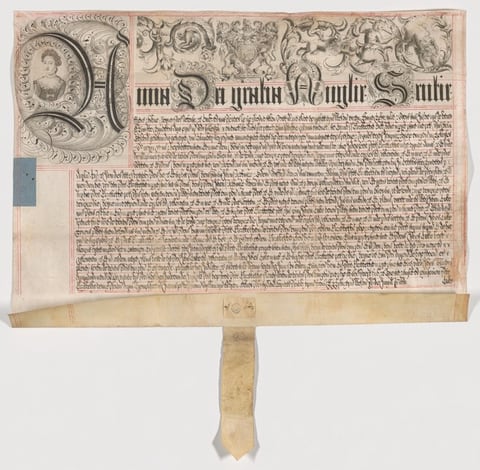
  3. A work made of engraved letterhead, pen and ink calligraphy, and graphite ruling on parchment, folded with strap and (missing) seal.
    Recovery Document (Land Title Grant)Unrecorded British maker, 1702/14 (Queen Anne period)Courtesy of the Art Institute of Chicago
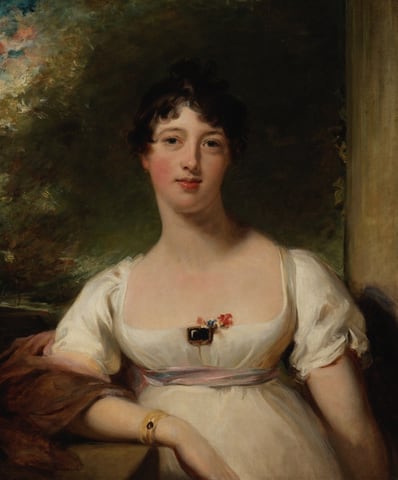
  4. A work made of oil on canvas.
    Anna Maria Dashwood, later Marchioness of ElyThomas Lawrence, c. 1805Courtesy of the Art Institute of Chicago

Third room, north wall
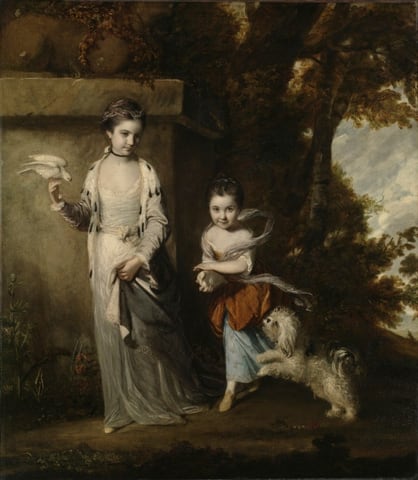
  1. Portrait of the Ladies Amabel and Mary Jemima Yorke, by Joshua Reynolds, c. 1761
    Portrait of the Ladies Amabel and Mary Jemima YorkeJoshua Reynolds, c. 1761Courtesy of the Cleveland Museum of Art
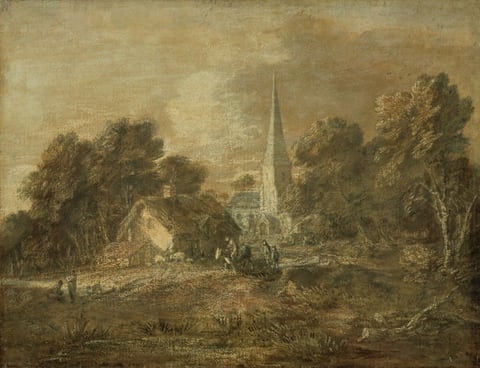
  2. A work made of varnished gouache, over black and red chalks, on cream laid paper, laid down on canvas, stretched on a wooden stretcher and varnished again.
    Wooded Landscape with Village SceneThomas Gainsborough, early 1770s (not later than 1772)Courtesy of the Art Institute of Chicago