Floor plan

Time and place18th-century Italy

18th-century Italy

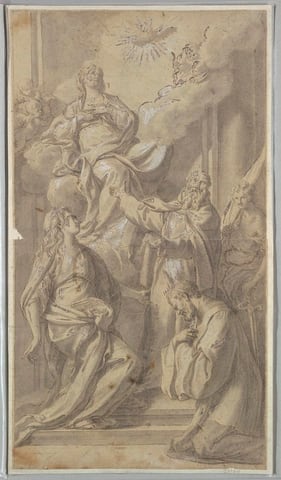
MADONNA AND SAINTS
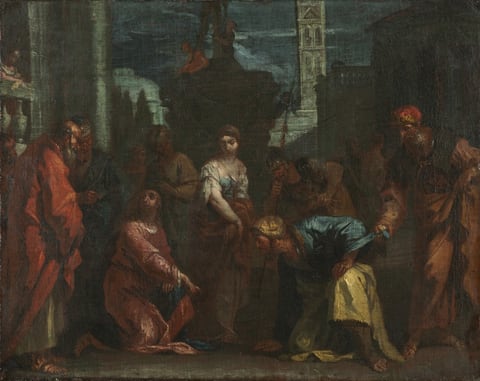
Christ and the Woman Taken in Adultery, by Sebastiano Ricci, mid-1700s
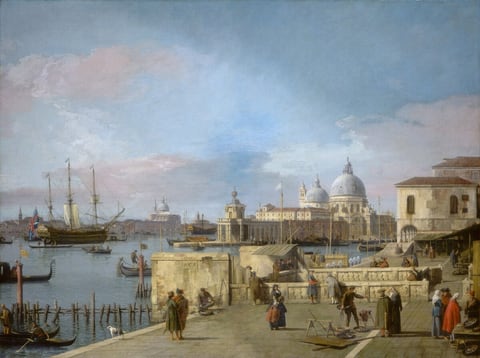
We look slightly down onto a port-side town along a canal, with a church across the water from us in this horizontal landscape painting. A bright blue sky with billowing white, pink, and gray clouds fills the top two-thirds of the painting. Below, a three-masted ship with all but one sail furled is surrounded by a couple dozen black long, low boats, gondolas, and one or two other sailboats. People stand and walk mostly in pairs and trios along the stone walkway under us, which extends into the distance to our right. The women all wear long dresses and most of the men wear suits with knee-length jackets with tails or capes, and hats. The clothing is painted in shades of brick and terracotta red, pine green, royal blue, and gray. The walkway is interrupted by two low walls that partition off an area near us. The angled roofs of stalls line the walkway in the farther distance before it is again interrupted, this time by a two-story, cream-colored building. The walkway continues as a narrower path under an arched arcade on the lower level of that building, alongside the water. On the far side of the canal, to our left and in the distance, a cluster of ivory-white buildings includes a structure with two stone-blue domes. More buildings extend into the deep distance to our left.
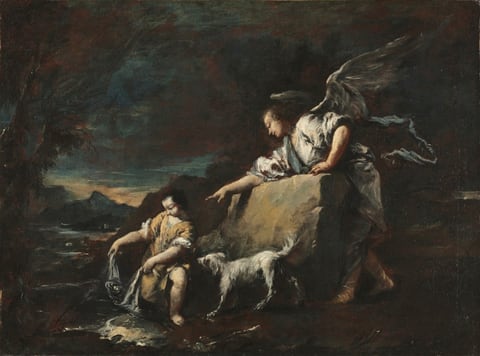
Tobias and the Angel, by Francesco Guardi, 1750s
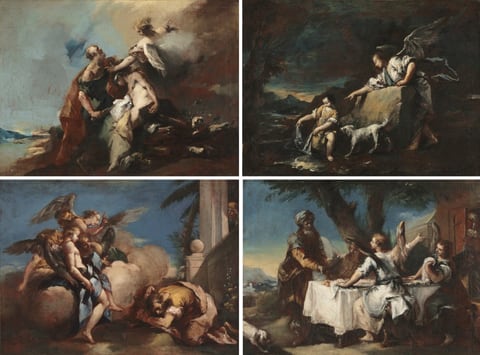
The Sacrifice of Isaac, Tobias and the Angel, The Angels Appearing to Abraham, Abraham Welcoming the Three Angels (painting series), by Francesco Guardi, 1750s
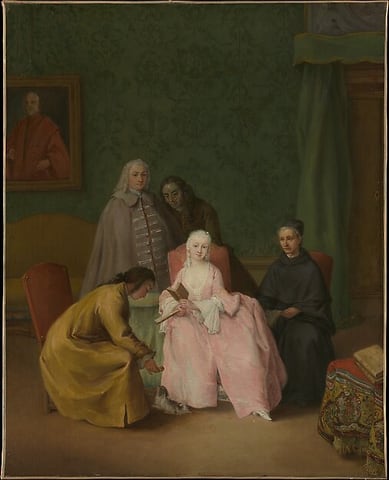
The Visit, by Pietro Longhi, 1746

The works in this room are listed below.

Works in this room

Works made in Italy in the 18th century.

First room, north wall

  1. MADONNA AND SAINTS
    Madonna and SaintsSebastiano Conca, ca. 1730Courtesy of Cooper Hewitt, Smithsonian Design Museum
  2. Christ and the Woman Taken in Adultery, by Sebastiano Ricci, mid-1700s
    Christ and the Woman Taken in AdulterySebastiano Ricci, mid-1700sCourtesy of the Cleveland Museum of Art
  3. We look slightly down onto a port-side town along a canal, with a church across the water from us in this horizontal landscape painting. A bright blue sky with billowing white, pink, and gray clouds fills the top two-thirds of the painting. Below, a three-masted ship with all but one sail furled is surrounded by a couple dozen black long, low boats, gondolas, and one or two other sailboats. People stand and walk mostly in pairs and trios along the stone walkway under us, which extends into the distance to our right. The women all wear long dresses and most of the men wear suits with knee-length jackets with tails or capes, and hats. The clothing is painted in shades of brick and terracotta red, pine green, royal blue, and gray. The walkway is interrupted by two low walls that partition off an area near us. The angled roofs of stalls line the walkway in the farther distance before it is again interrupted, this time by a two-story, cream-colored building. The walkway continues as a narrower path under an arched arcade on the lower level of that building, alongside the water. On the far side of the canal, to our left and in the distance, a cluster of ivory-white buildings includes a structure with two stone-blue domes. More buildings extend into the deep distance to our left.
    Entrance to the Grand Canal from the Molo, VeniceCanaletto, 1742/1744Courtesy National Gallery of Art, Washington

First room, south wall

  1. Tobias and the Angel, by Francesco Guardi, 1750s
    Tobias and the AngelFrancesco Guardi, 1750sCourtesy of the Cleveland Museum of Art
  2. The Sacrifice of Isaac, Tobias and the Angel, The Angels Appearing to Abraham, Abraham Welcoming the Three Angels (painting series), by Francesco Guardi, 1750s
    The Sacrifice of Isaac, Tobias and the Angel, The Angels Appearing to Abraham, Abraham Welcoming the Three Angels (painting series)Francesco Guardi, 1750sCourtesy of the Cleveland Museum of Art
  3. The Visit, by Pietro Longhi, 1746
    The VisitPietro Longhi, 1746Courtesy of The Metropolitan Museum of Art

Second room, south wall
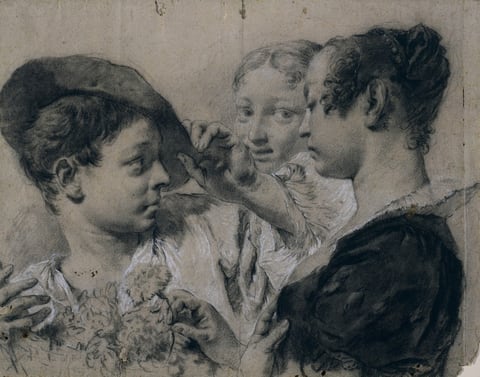
  1. A Young Woman Buying a Pink from a Young Man, by Giovanni Battista Piazzetta, c. 1740
    A Young Woman Buying a Pink from a Young ManGiovanni Battista Piazzetta, c. 1740Courtesy of the Cleveland Museum of Art
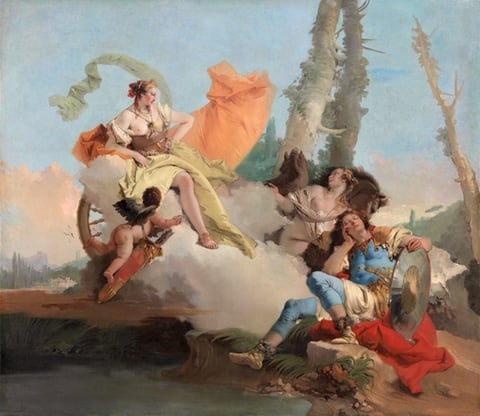
  2. Large painting of soldier asleep outdoors surrounded by two women and a cupid.
    Armida Encounters the Sleeping RinaldoGiovanni Battista Tiepolo, c. 1742–45Courtesy of the Art Institute of Chicago

Second room, north wall
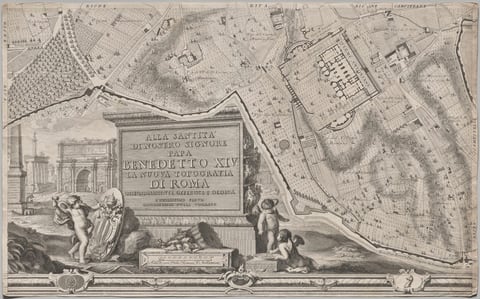
  1. Nuova pianta di Roma data in luce da Giambattista Nolli l’anno MDCCXLVII, known as La Pianta Grande di Roma, by Giovanni Battista Nolli, 1748
    Nuova pianta di Roma data in luce da Giambattista Nolli l’anno MDCCXLVII, known as La Pianta Grande di RomaGiovanni Battista Nolli, 1748Courtesy of the Cleveland Museum of Art
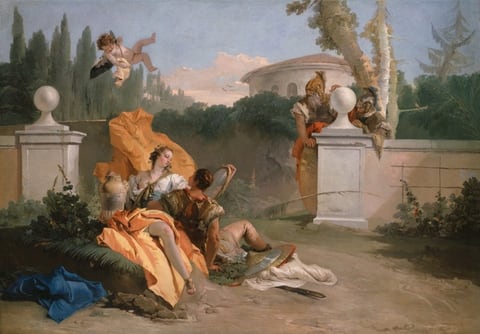
  2. A work made of oil on canvas.
    Rinaldo and Armida in Her GardenGiovanni Battista Tiepolo, c. 1742–45Courtesy of the Art Institute of Chicago

Third room, north wall
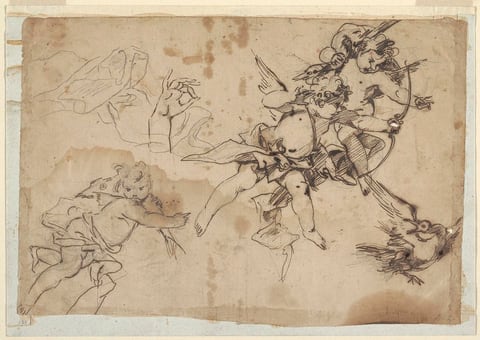
  1. STUDY FOR A PAINTING ON THEME OF CALLISTO
    Study for a Painting on Theme of CallistoFilippo Falciatore, ca. 1750Courtesy of Cooper Hewitt, Smithsonian Design Museum
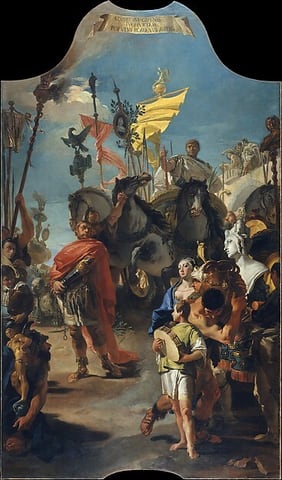
  2. The Triumph of Marius, by Giovanni Battista Tiepolo, 1729
    The Triumph of MariusGiovanni Battista Tiepolo, 1729Courtesy of The Metropolitan Museum of Art
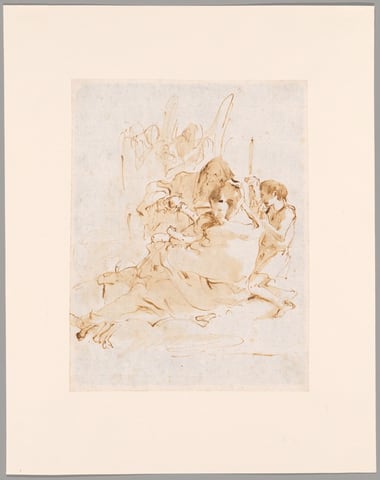
  3. A work made of pen and brown ink and brush and brown ink wash on ivory laid paper.
    Holy Family with St. John and Two AngelsGiovanni Battista Tiepolo, n.d.Courtesy of the Art Institute of Chicago

Third room, south wall
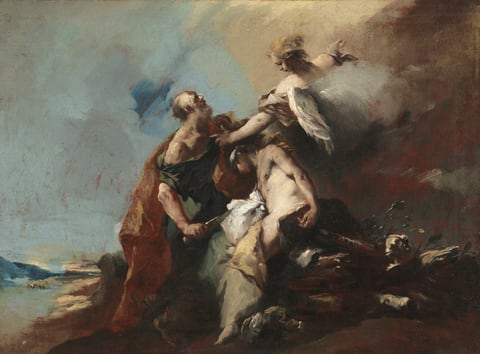
  1. The Sacrifice of Isaac, by Francesco Guardi, 1750s
    The Sacrifice of IsaacFrancesco Guardi, 1750sCourtesy of the Cleveland Museum of Art
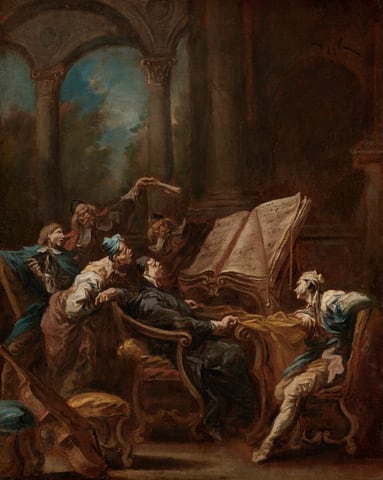
  2. This is a painting of a group engaged in a music session, all looking towards a large open music book in a grand, architectural setting. Behind the group are tall, ornate columns and an arched background that opens up to show a cloudy blue sky. Most of the people have open mouths as if they are singing, while one man in the back seems to be conducting, holding a up roll of paper. Some of the people in the group are seated in cushioned wooden chairs, and a yellowish cloth is draped over the surface that the large book rests on. There is a string instrument similar to a cello near the bottom left corner. The colors used are rich, earthy browns, yellows, and reds, with elements of blue and white clothing. All of the people have pale skin, and two have long white mustaches.
    The ChoristersAlessandro Magnasco, c. 1740/1745Courtesy National Gallery of Art, Washington
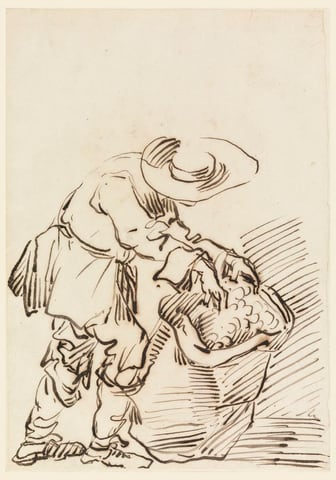
  3. WORKING PEASANT
    Working PeasantCarlo Marchionni, 1728–78Courtesy of Cooper Hewitt, Smithsonian Design Museum