Floor plan

Time and place18th-century Italy

18th-century Italy

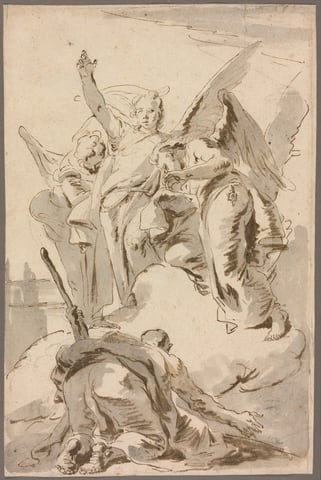
A work made of pen and brown ink and brush and brown and gray wash, over black chalk, on ivory laid paper.
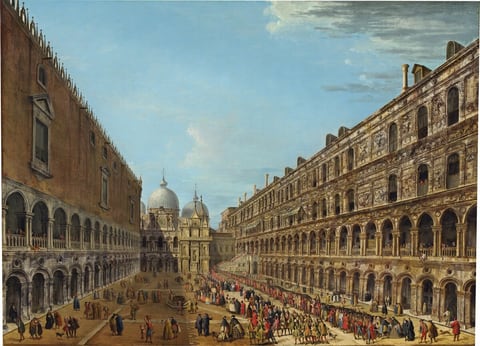
This painting depicts a square seen from above, surrounded by elegant architectural structures. On the left side, there is a large building with a red-brown facade and arched white windows with columns. On the right, there is an ornate off-white structure with arches and detailed stonework. Both of these long buildings stretch from the sides of the painting towards the center, where they converge at a gray building with tall spires and large blue domes behind it. In the square there are countless people in colorful attire, wearing shades of pink, red, blue, green, yellow, black, and blue. There are men, women, and children, and those with visible faces all appear to have light skin. Some wear white masks with bird-like noses. On the right, there is a long line of people engaging in a procession or gathering. People also line the windows of the two buildings on either side of the square. The painting is incredibly detailed, capturing architectural elements and the bustling crowd. The color palette features earthy tones for the architecture and vibrant colors for the people, all set below a pale blue sky with a few white-and-gray clouds.
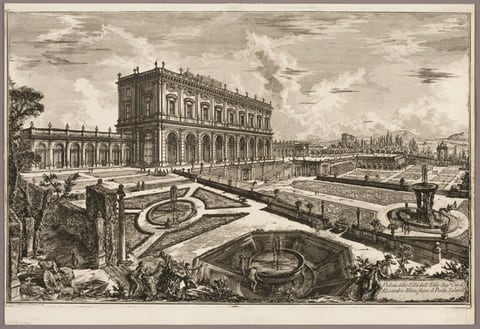
A work made of etching on ivory laid paper.
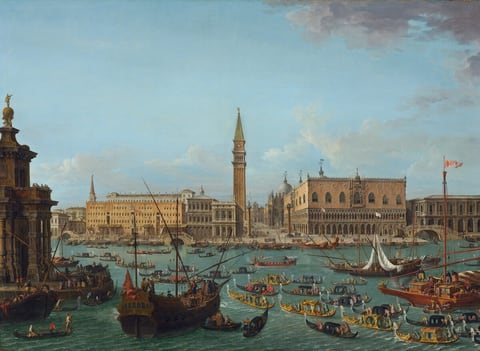
The painting depicts many large and small ships on blue-green water. Gondolas in shades of gold, black, red, and blue drift across the water, small people on them pushing long poles through the water. There are also large sailboats and long boats with several rowers. They create a colorful mix. On the left, a large brown building with columns is visible. Some of the boats pull up to it, and many people in colorful clothing are visible on the shore. Behind the water are more large buildings in shades of brown, cream, and tan, with even more people visible on the streets below them. There is a large tower in the center of the painting, and several blue domes are visible in the distance. The sky is light blue, with white and gray clouds drifting across it.
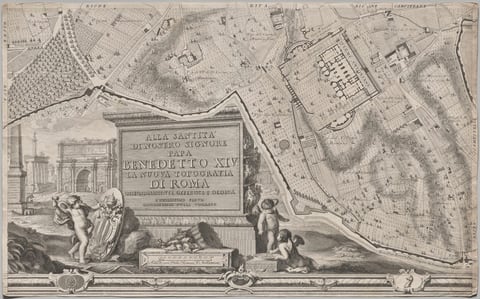
Nuova pianta di Roma data in luce da Giambattista Nolli l’anno MDCCXLVII, known as La Pianta Grande di Roma, by Giovanni Battista Nolli, 1748
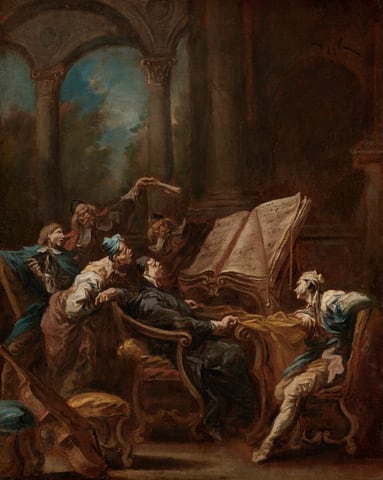
This is a painting of a group engaged in a music session, all looking towards a large open music book in a grand, architectural setting. Behind the group are tall, ornate columns and an arched background that opens up to show a cloudy blue sky. Most of the people have open mouths as if they are singing, while one man in the back seems to be conducting, holding a up roll of paper. Some of the people in the group are seated in cushioned wooden chairs, and a yellowish cloth is draped over the surface that the large book rests on. There is a string instrument similar to a cello near the bottom left corner. The colors used are rich, earthy browns, yellows, and reds, with elements of blue and white clothing. All of the people have pale skin, and two have long white mustaches.

The works in this room are listed below.

Works in this room

Works made in Italy in the 18th century.

Section 1, north wall

  1. A work made of pen and brown ink and brush and brown and gray wash, over black chalk, on ivory laid paper.
    Three Angels Appearing to AbrahamGiovanni Battista Tiepolo, c. 1726Courtesy of the Art Institute of Chicago
  2. This painting depicts a square seen from above, surrounded by elegant architectural structures. On the left side, there is a large building with a red-brown facade and arched white windows with columns. On the right, there is an ornate off-white structure with arches and detailed stonework. Both of these long buildings stretch from the sides of the painting towards the center, where they converge at a gray building with tall spires and large blue domes behind it. In the square there are countless people in colorful attire, wearing shades of pink, red, blue, green, yellow, black, and blue. There are men, women, and children, and those with visible faces all appear to have light skin. Some wear white masks with bird-like noses. On the right, there is a long line of people engaging in a procession or gathering. People also line the windows of the two buildings on either side of the square. The painting is incredibly detailed, capturing architectural elements and the bustling crowd. The color palette features earthy tones for the architecture and vibrant colors for the people, all set below a pale blue sky with a few white-and-gray clouds.
    Procession in the Courtyard of the Ducal Palace, VeniceAntonio Joli, 1742 or afterCourtesy National Gallery of Art, Washington
  3. A work made of etching on ivory laid paper.
    View of the Villa of His Eminence Cardinal Alessandro Albani, outside Porta Salaria, from Views of RomeGiovanni Battista Piranesi, 1769, published 1800–07Courtesy of the Art Institute of Chicago

Section 1, south wall

  1. The painting depicts many large and small ships on blue-green water. Gondolas in shades of gold, black, red, and blue drift across the water, small people on them pushing long poles through the water. There are also large sailboats and long boats with several rowers. They create a colorful mix. On the left, a large brown building with columns is visible. Some of the boats pull up to it, and many people in colorful clothing are visible on the shore. Behind the water are more large buildings in shades of brown, cream, and tan, with even more people visible on the streets below them. There is a large tower in the center of the painting, and several blue domes are visible in the distance. The sky is light blue, with white and gray clouds drifting across it.
    Procession of Gondolas in the Bacino di San Marco, VeniceAntonio Joli, 1742 or afterCourtesy National Gallery of Art, Washington
  2. Nuova pianta di Roma data in luce da Giambattista Nolli l’anno MDCCXLVII, known as La Pianta Grande di Roma, by Giovanni Battista Nolli, 1748
    Nuova pianta di Roma data in luce da Giambattista Nolli l’anno MDCCXLVII, known as La Pianta Grande di RomaGiovanni Battista Nolli, 1748Courtesy of the Cleveland Museum of Art
  3. This is a painting of a group engaged in a music session, all looking towards a large open music book in a grand, architectural setting. Behind the group are tall, ornate columns and an arched background that opens up to show a cloudy blue sky. Most of the people have open mouths as if they are singing, while one man in the back seems to be conducting, holding a up roll of paper. Some of the people in the group are seated in cushioned wooden chairs, and a yellowish cloth is draped over the surface that the large book rests on. There is a string instrument similar to a cello near the bottom left corner. The colors used are rich, earthy browns, yellows, and reds, with elements of blue and white clothing. All of the people have pale skin, and two have long white mustaches.
    The ChoristersAlessandro Magnasco, c. 1740/1745Courtesy National Gallery of Art, Washington

Section 2, south wall
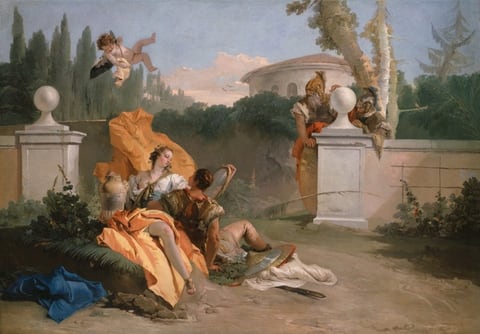
  1. A work made of oil on canvas.
    Rinaldo and Armida in Her GardenGiovanni Battista Tiepolo, c. 1742–45Courtesy of the Art Institute of Chicago
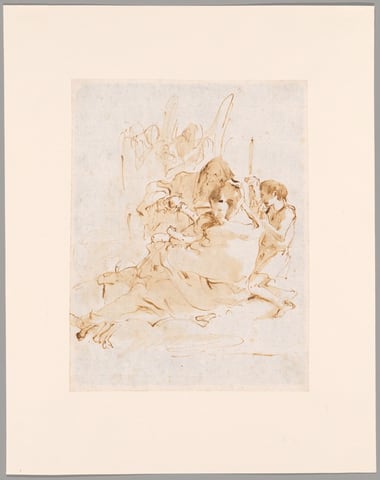
  2. A work made of pen and brown ink and brush and brown ink wash on ivory laid paper.
    Holy Family with St. John and Two AngelsGiovanni Battista Tiepolo, n.d.Courtesy of the Art Institute of Chicago

Section 2, north wall
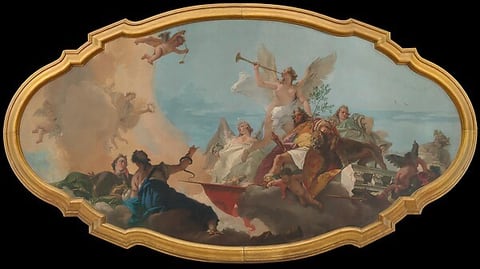
  1. The Glorification of the Barbaro Family, by Giovanni Battista Tiepolo, ca. 1750
    The Glorification of the Barbaro FamilyGiovanni Battista Tiepolo, ca. 1750Courtesy of The Metropolitan Museum of Art
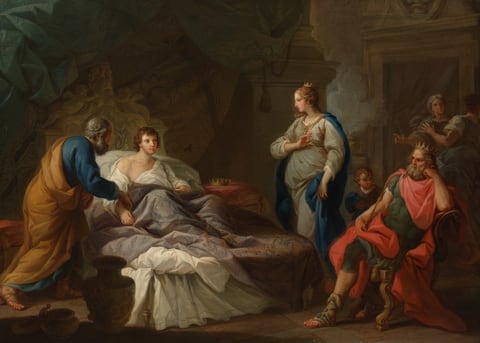
  2. A work made of oil on canvas.
    Antiochus Yearning for StratoniceStefano Pozzi, c. 1740Courtesy of the Art Institute of Chicago

Section 3, north wall
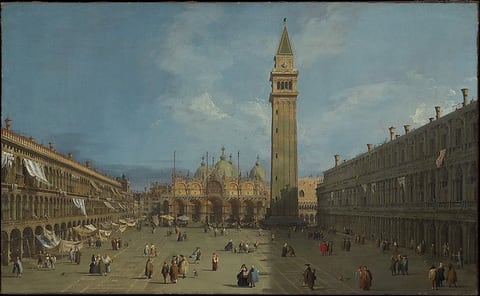
  1. Piazza San Marco, by Canaletto, late 1720s
    Piazza San MarcoCanaletto, late 1720sCourtesy of The Metropolitan Museum of Art
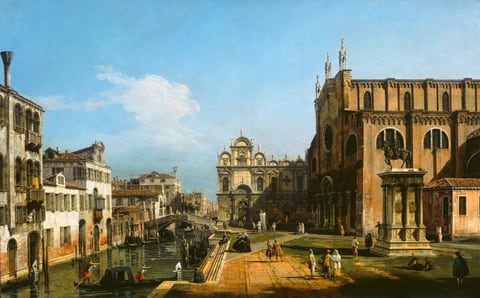
  2. People walk, sit, or stand on a plaza along a canal lined on the far side with buildings in this horizontal landscape painting. The canal begins in the lower left corner and angles slightly right as it travels to the horizon, which comes about a third of the way up this composition. One, two, three, or four-story buildings line the canal to the left into the far distance. Arched doorways give direct access to the water, and one person leans out an upper-story window. The buildings are reflected in the gently rippling water, which is painted in shades of olive green. A stepped bridge crosses the canal in the near distance, and two gondoliers guide a long, narrow boat to a platform alongside the plaza in the bottom left corner of the composition. People walk or stand singly or in pairs on the plaza in the bottom right quadrant of the painting. The women wear dresses with long skirts and head coverings in shades of black, white, yellow, or pale pink. The men wear hats, jackets, capes, stockings, and slacks in shades of peanut brown, muted yellow, red, blue, or white. The people all appear to have pale, peachy skin. A statue of a man riding a horse rests on a towering platform in a grassy patch to our right. Beyond it is the blocky form of a red brick church. One man in a pair standing on the plaza gestures toward the entrance with a walking stick and others approach the central entrance. Sunlight streams across the scene from the upper right, throwing the church façade into shadow and casting a deep shadow across the face of another building that encloses the far side of the plaza. That second building has arched windows and doors, statues lining the roofline, and a winged lion over the entrance. A fat cloud trundles across a mostly empty vibrant blue sky above.
    The Campo di SS. Giovanni e Paolo, VeniceBernardo Bellotto, 1743/1747Courtesy National Gallery of Art, Washington
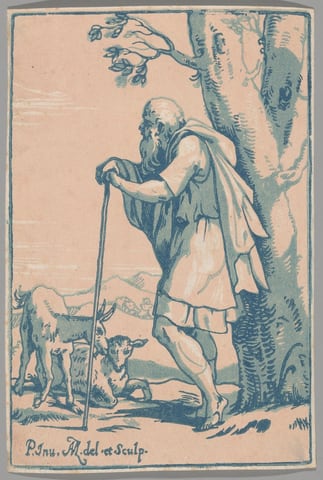
  3. A work made of chiaroscuro woodcut, from three blocks in pink, dark blue, and light blue, on cream laid paper.
    The Old ShepherdConte Antonio Maria Zanetti, the Elder, 1722Courtesy of the Art Institute of Chicago

Section 3, south wall
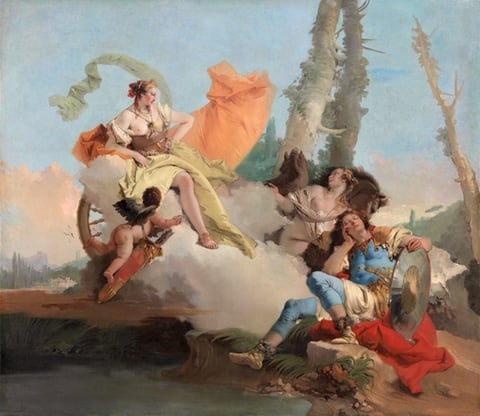
  1. Large painting of soldier asleep outdoors surrounded by two women and a cupid.
    Armida Encounters the Sleeping RinaldoGiovanni Battista Tiepolo, c. 1742–45Courtesy of the Art Institute of Chicago
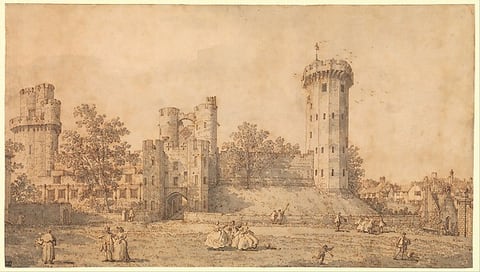
  2. Warwick Castle: The East Front, by Canaletto, 1752
    Warwick Castle: The East FrontCanaletto, 1752Courtesy of The Metropolitan Museum of Art
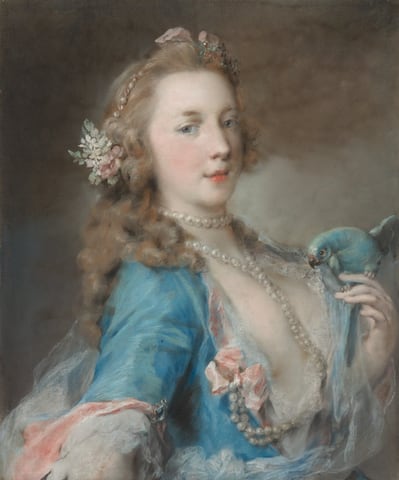
  3. A pastel drawing of woman in blue and pink dress with blue parrot.
    A Young Lady with a ParrotRosalba Carriera, c. 1730Courtesy of the Art Institute of Chicago