Skip to content
Ochre Editions
ArtArtistsCollectionsGalleriesDrops
SearchSign inCart (0)
The galleries · Time and place

18th-century Italy

Works made in Italy in the 18th century.

49 works · hang 261 ·

Share 18th-century Italy, in the galleries

The rooms are imagined; every work on their walls is real.

Walk this roomRehang this room

First room, north wall

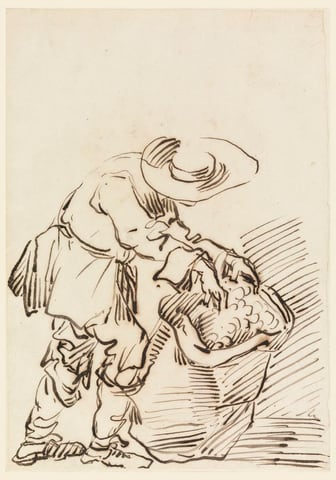
  1. WORKING PEASANT
    Working PeasantCarlo Marchionni, 1728–78Courtesy of Cooper Hewitt, Smithsonian Design Museum
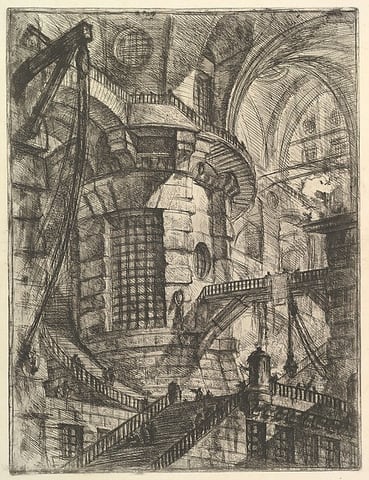
  2. The Round Tower, from "Carceri d'invenzione" (Imaginary Prisons), by Giovanni Battista Piranesi, ca. 1749–50
    The Round Tower, from "Carceri d'invenzione" (Imaginary Prisons)Giovanni Battista Piranesi, ca. 1749–50Courtesy of The Metropolitan Museum of Art
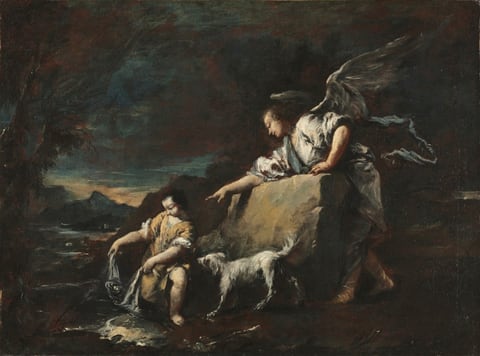
  3. Tobias and the Angel, by Francesco Guardi, 1750s
    Tobias and the AngelFrancesco Guardi, 1750sCourtesy of the Cleveland Museum of Art
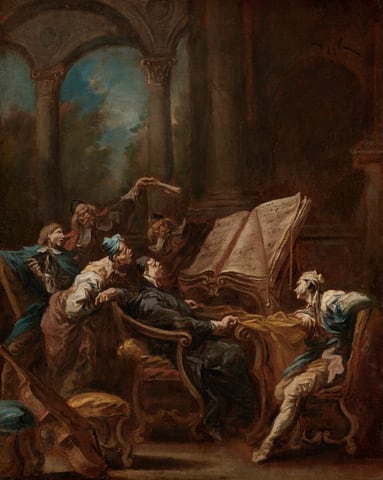
  4. This is a painting of a group engaged in a music session, all looking towards a large open music book in a grand, architectural setting. Behind the group are tall, ornate columns and an arched background that opens up to show a cloudy blue sky. Most of the people have open mouths as if they are singing, while one man in the back seems to be conducting, holding a up roll of paper. Some of the people in the group are seated in cushioned wooden chairs, and a yellowish cloth is draped over the surface that the large book rests on. There is a string instrument similar to a cello near the bottom left corner. The colors used are rich, earthy browns, yellows, and reds, with elements of blue and white clothing. All of the people have pale skin, and two have long white mustaches.
    The ChoristersAlessandro Magnasco, c. 1740/1745Courtesy National Gallery of Art, Washington

First room, south wall
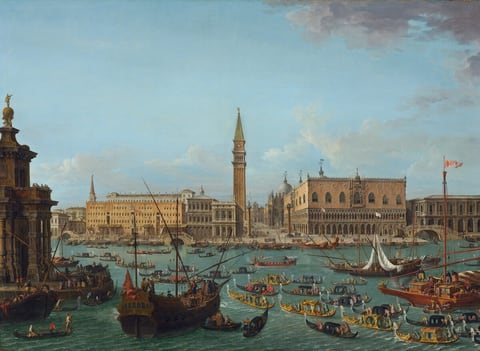
  1. The painting depicts many large and small ships on blue-green water. Gondolas in shades of gold, black, red, and blue drift across the water, small people on them pushing long poles through the water. There are also large sailboats and long boats with several rowers. They create a colorful mix. On the left, a large brown building with columns is visible. Some of the boats pull up to it, and many people in colorful clothing are visible on the shore. Behind the water are more large buildings in shades of brown, cream, and tan, with even more people visible on the streets below them. There is a large tower in the center of the painting, and several blue domes are visible in the distance. The sky is light blue, with white and gray clouds drifting across it.
    Procession of Gondolas in the Bacino di San Marco, VeniceAntonio Joli, 1742 or afterCourtesy National Gallery of Art, Washington

  2. We look up through an opening surrounded by a stone ledge, with clusters of people and clouds swirling into a blue sky up and away from us in this vertical, rectangular painting. From a distance, the scene looks like a complete illusion but up close, the people, clouds, and architecture are sketchily painted. The ledge running around the opening has a gold, oval medallion at each corner. Appearing to be carved from white stone, two bearded men with long hair recline against each medallion, flanking them to each side in front of large shells that curve up over the people and frames them. A few architectural structures extend up into the sky, including a pointed obelisk in the lower left corner, a pair of columns at the upper right, and what seems to be the mast of a ship at the top left. Most of the people have pale skin but some have more tan complexions, and a few, including those wearing feather headdresses near the upper left corner, have brown skin. The people wear windswept robes of pale, butter yellow, robin’s egg blue, rose pink, and ivory. The eye may drawn to a few vignettes, such as the man holding a rearing, chestnut-brown horse on the illusionistic ledge near the lower right, a nun wearing a white robe and holding a cross above him in the clouds, and, farthest away, a crowned person sitting on a throne.
    Wealth and Benefits of the Spanish Monarchy under Charles IIIGiovanni Battista Tiepolo, 1762Courtesy National Gallery of Art, Washington

Second room, south wall
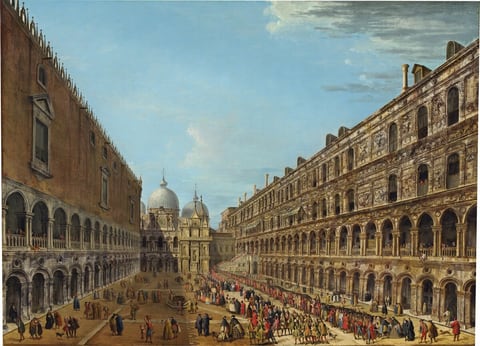
  1. This painting depicts a square seen from above, surrounded by elegant architectural structures. On the left side, there is a large building with a red-brown facade and arched white windows with columns. On the right, there is an ornate off-white structure with arches and detailed stonework. Both of these long buildings stretch from the sides of the painting towards the center, where they converge at a gray building with tall spires and large blue domes behind it. In the square there are countless people in colorful attire, wearing shades of pink, red, blue, green, yellow, black, and blue. There are men, women, and children, and those with visible faces all appear to have light skin. Some wear white masks with bird-like noses. On the right, there is a long line of people engaging in a procession or gathering. People also line the windows of the two buildings on either side of the square. The painting is incredibly detailed, capturing architectural elements and the bustling crowd. The color palette features earthy tones for the architecture and vibrant colors for the people, all set below a pale blue sky with a few white-and-gray clouds.
    Procession in the Courtyard of the Ducal Palace, VeniceAntonio Joli, 1742 or afterCourtesy National Gallery of Art, Washington
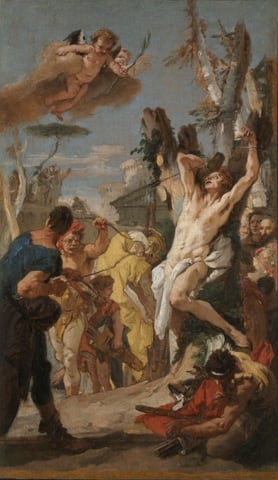
  2. Study for "The Martyrdom of Saint Sebastian" (for the Augustinian monastery at Diessen, Germany), by Giovanni Battista Tiepolo, 1739
    Study for "The Martyrdom of Saint Sebastian" (for the Augustinian monastery at Diessen, Germany)Giovanni Battista Tiepolo, 1739Courtesy of the Cleveland Museum of Art
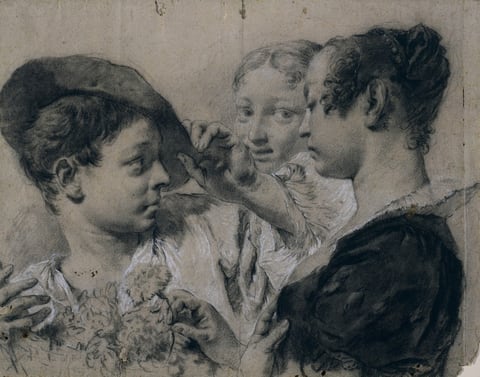
  3. A Young Woman Buying a Pink from a Young Man, by Giovanni Battista Piazzetta, c. 1740
    A Young Woman Buying a Pink from a Young ManGiovanni Battista Piazzetta, c. 1740Courtesy of the Cleveland Museum of Art

Second room, north wall
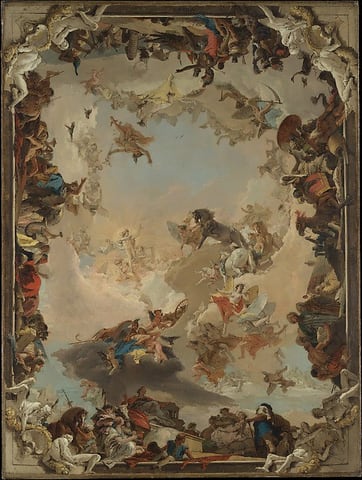
  1. Allegory of the Planets and Continents, by Giovanni Battista Tiepolo, 1752
    Allegory of the Planets and ContinentsGiovanni Battista Tiepolo, 1752Courtesy of The Metropolitan Museum of Art
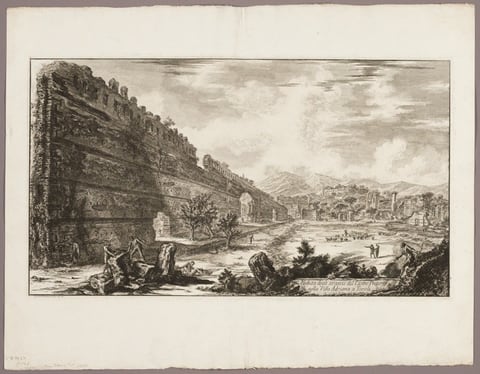
  2. A work made of etching on heavy ivory laid paper.
    View of the Remains of the Praetorian Fort [the Poecile], Hadrian's Villa, Tivoli, from Views of RomeGiovanni Battista Piranesi, 1770Courtesy of the Art Institute of Chicago
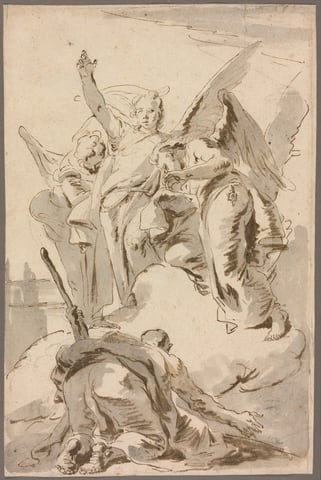
  3. A work made of pen and brown ink and brush and brown and gray wash, over black chalk, on ivory laid paper.
    Three Angels Appearing to AbrahamGiovanni Battista Tiepolo, c. 1726Courtesy of the Art Institute of Chicago

Third room, north wall
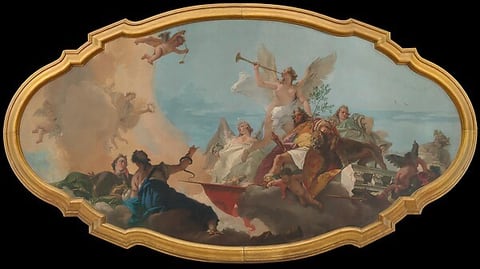
  1. The Glorification of the Barbaro Family, by Giovanni Battista Tiepolo, ca. 1750
    The Glorification of the Barbaro FamilyGiovanni Battista Tiepolo, ca. 1750Courtesy of The Metropolitan Museum of Art
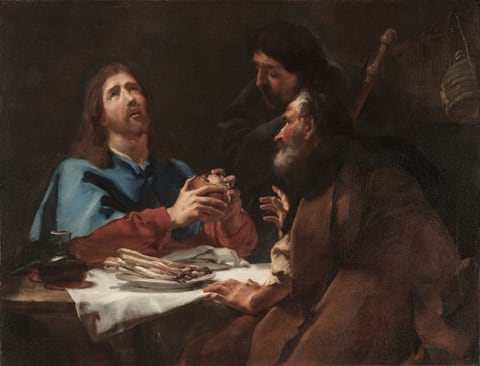
  2. The Supper at Emmaus, by Giovanni Battista Piazzetta, c. 1720
    The Supper at EmmausGiovanni Battista Piazzetta, c. 1720Courtesy of the Cleveland Museum of Art

Third room, south wall
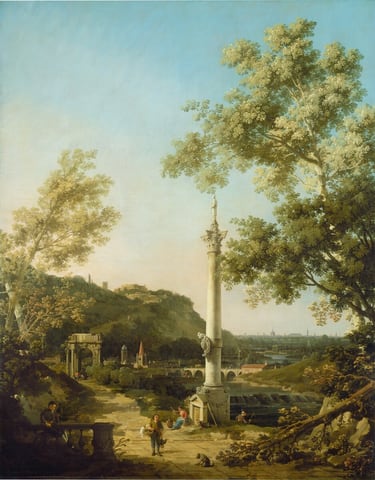
  1. We look slightly down across a sun-drenched plaza with people scattered among ruins, buildings, and around a free-standing column in this vertical landscape painting. The people we can see have light skin. Towering trees with celery, sage, and forest-green leaves frame a small plaza paved with flax-colored stones. A tree to our right almost reaches the top of the painting, and a shorter tree in front of it has toppled onto the plaza. To our left, in the lower corner, a man sits behind a shadowy balustrade, looking down. In the lower center of the painting, a man walks toward us, holding a basket over one arm and dead poultry in the other hand, and a dog sits nearby. Slightly farther back is a tall stone column with a door in its base and a statue on top. A woman wearing a red shirt and blue skirt sits on a step in front of the door. Along the left side, the plaza gives way to a tree-lined, dirt road that meanders toward a stone arch in the middle distance, and to a cluster of low buildings beyond. Two towers catch the light, one with a slate-blue dome and the other with a peach-colored steeple. Farther back from the buildings is a dark line of trees at the base of a steep green hill dotted with groves of trees, which rises high over the plaza below. Another building complex, glowing in warm tones of straw yellow, sits at its top. Small dots of red, white, and blue suggest a handful of people making their way up the hill’s wide path. A river with moss-green water pouring over a dam extends from the lower right corner into the distance along the right edge of the painting. Near the column, a man fishes at the water’s edge. The water winds back to a row of silvery-gray buildings in the far distance. Several people in red, yellow, or white, tiny in scale, dot the riverbanks and cross the bridge. A screen of thin, pale pink clouds float across the light blue sky.
    English Landscape Capriccio with a ColumnCanaletto, c. 1754Courtesy National Gallery of Art, Washington
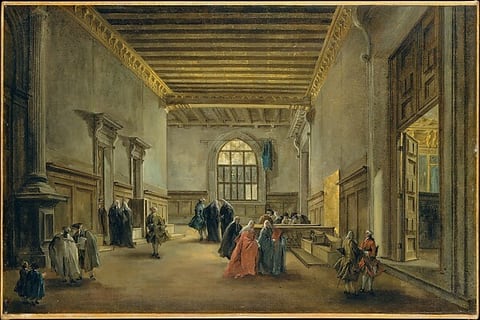
  2. The Antechamber of the Sala del Maggior Consiglio, by Francesco Guardi, ca. 1765–68
    The Antechamber of the Sala del Maggior ConsiglioFrancesco Guardi, ca. 1765–68Courtesy of The Metropolitan Museum of Art

Walk on

  • 18th-century Italy, room 2
  • More by Francesco Guardi 4 works
  • More Neoclassicism 109 works
Ochre Editions

The world's museums, on your wall. Every work here is a reproduction of a public-domain original, credited to the museum that holds it.

Shop

All artCollectionsLimited dropsPrints and framing

Help

Find an orderShippingReturnsVerify a certificate

About

About Ochre EditionsMuseum creditsFor agentsDevelopers

Legal

Terms of UseTerms of SaleLimited Editions and CertificatesPrivacy PolicyCookie PolicyAcceptable Use PolicyAgent & API TermsCopyright and DMCA PolicyPrinting Your Own PhotoVulnerability Disclosure PolicyAccessibility StatementOpen-Access Credits
© 2026 Ochre EditionsPrices in US dollars. Prints ship within the United States.