Floor plan

Time and place18th-century Italy

18th-century Italy

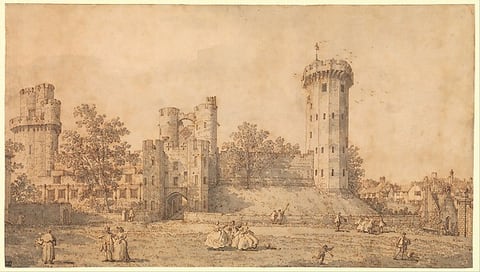
Warwick Castle: The East Front, by Canaletto, 1752
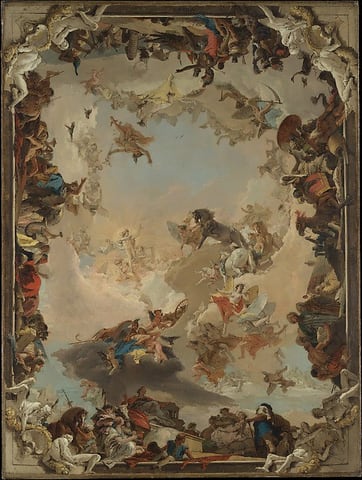
Allegory of the Planets and Continents, by Giovanni Battista Tiepolo, 1752
A work made of oil on canvas.
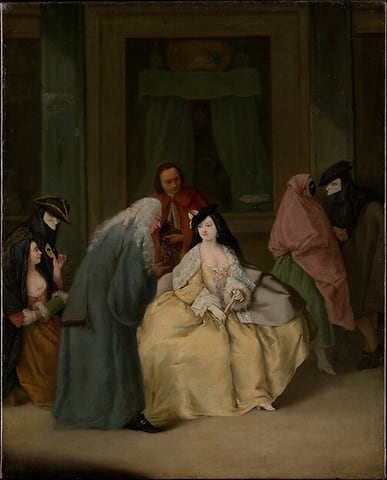
The Meeting, by Pietro Longhi, 1746
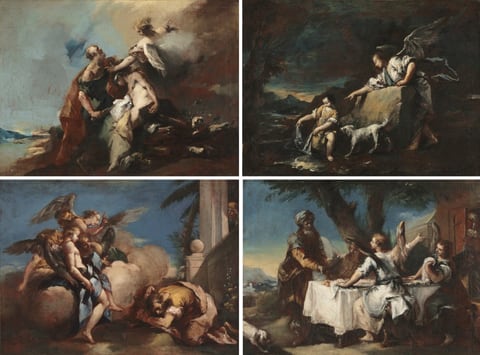
The Sacrifice of Isaac, Tobias and the Angel, The Angels Appearing to Abraham, Abraham Welcoming the Three Angels (painting series), by Francesco Guardi, 1750s

The works in this room are listed below.

Works in this room

Works made in Italy in the 18th century.

First room, north wall

  1. Warwick Castle: The East Front, by Canaletto, 1752
    Warwick Castle: The East FrontCanaletto, 1752Courtesy of The Metropolitan Museum of Art
  2. Allegory of the Planets and Continents, by Giovanni Battista Tiepolo, 1752
    Allegory of the Planets and ContinentsGiovanni Battista Tiepolo, 1752Courtesy of The Metropolitan Museum of Art

First room, south wall

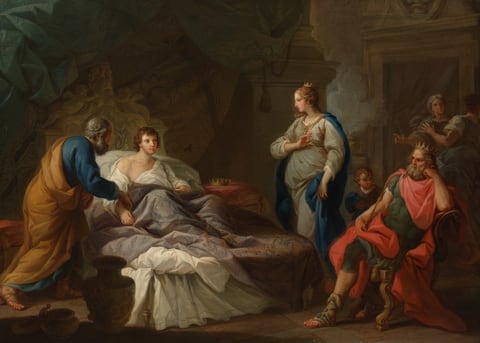
  1. A work made of oil on canvas.
    Antiochus Yearning for StratoniceStefano Pozzi, c. 1740Courtesy of the Art Institute of Chicago
  2. The Meeting, by Pietro Longhi, 1746
    The MeetingPietro Longhi, 1746Courtesy of The Metropolitan Museum of Art
  3. The Sacrifice of Isaac, Tobias and the Angel, The Angels Appearing to Abraham, Abraham Welcoming the Three Angels (painting series), by Francesco Guardi, 1750s
    The Sacrifice of Isaac, Tobias and the Angel, The Angels Appearing to Abraham, Abraham Welcoming the Three Angels (painting series)Francesco Guardi, 1750sCourtesy of the Cleveland Museum of Art

Second room, south wall
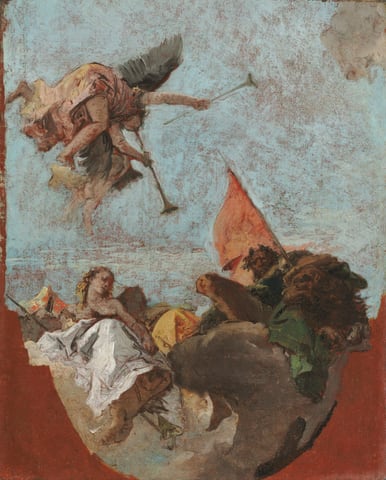
  1. Sketch for a Ceiling, by Giovanni Battista Tiepolo, 1750s
    Sketch for a CeilingGiovanni Battista Tiepolo, 1750sCourtesy of the Cleveland Museum of Art
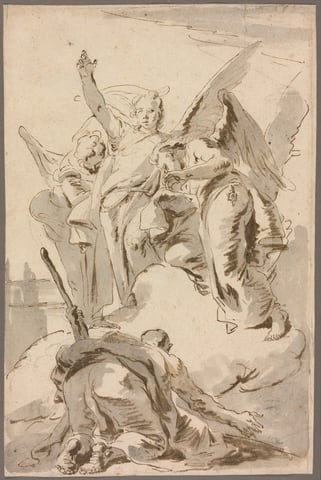
  2. A work made of pen and brown ink and brush and brown and gray wash, over black chalk, on ivory laid paper.
    Three Angels Appearing to AbrahamGiovanni Battista Tiepolo, c. 1726Courtesy of the Art Institute of Chicago
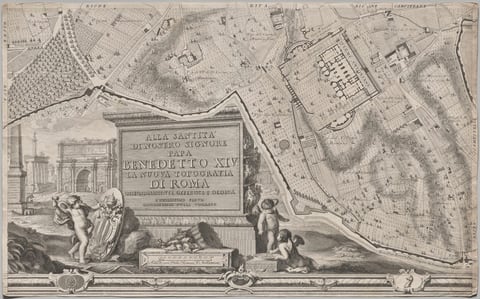
  3. Nuova pianta di Roma data in luce da Giambattista Nolli l’anno MDCCXLVII, known as La Pianta Grande di Roma, by Giovanni Battista Nolli, 1748
    Nuova pianta di Roma data in luce da Giambattista Nolli l’anno MDCCXLVII, known as La Pianta Grande di RomaGiovanni Battista Nolli, 1748Courtesy of the Cleveland Museum of Art
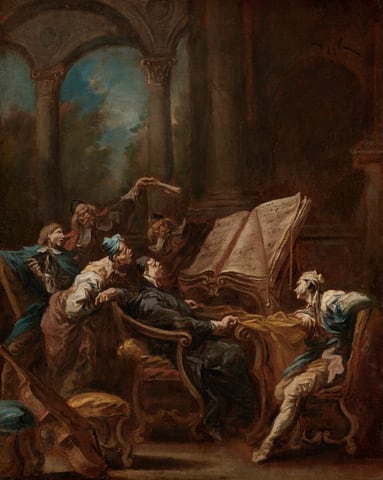
  4. This is a painting of a group engaged in a music session, all looking towards a large open music book in a grand, architectural setting. Behind the group are tall, ornate columns and an arched background that opens up to show a cloudy blue sky. Most of the people have open mouths as if they are singing, while one man in the back seems to be conducting, holding a up roll of paper. Some of the people in the group are seated in cushioned wooden chairs, and a yellowish cloth is draped over the surface that the large book rests on. There is a string instrument similar to a cello near the bottom left corner. The colors used are rich, earthy browns, yellows, and reds, with elements of blue and white clothing. All of the people have pale skin, and two have long white mustaches.
    The ChoristersAlessandro Magnasco, c. 1740/1745Courtesy National Gallery of Art, Washington

Second room, north wall
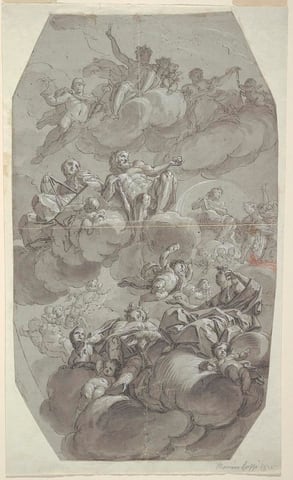
  1. STUDY FOR PAINTING, MOUNT OLYMPUS
    Study for Painting, Mount OlympusVito D'Anna, 1750–60Courtesy of Cooper Hewitt, Smithsonian Design Museum
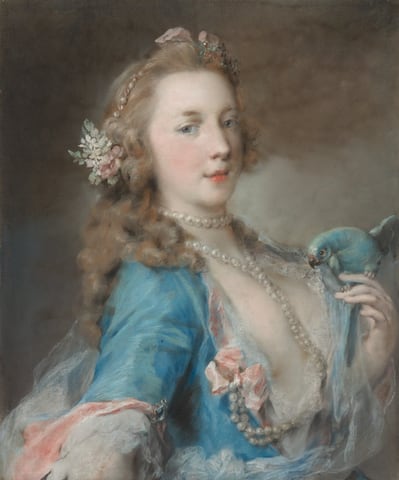
  2. A pastel drawing of woman in blue and pink dress with blue parrot.
    A Young Lady with a ParrotRosalba Carriera, c. 1730Courtesy of the Art Institute of Chicago

  3. We look up through an opening surrounded by a stone ledge, with clusters of people and clouds swirling into a blue sky up and away from us in this vertical, rectangular painting. From a distance, the scene looks like a complete illusion but up close, the people, clouds, and architecture are sketchily painted. The ledge running around the opening has a gold, oval medallion at each corner. Appearing to be carved from white stone, two bearded men with long hair recline against each medallion, flanking them to each side in front of large shells that curve up over the people and frames them. A few architectural structures extend up into the sky, including a pointed obelisk in the lower left corner, a pair of columns at the upper right, and what seems to be the mast of a ship at the top left. Most of the people have pale skin but some have more tan complexions, and a few, including those wearing feather headdresses near the upper left corner, have brown skin. The people wear windswept robes of pale, butter yellow, robin’s egg blue, rose pink, and ivory. The eye may drawn to a few vignettes, such as the man holding a rearing, chestnut-brown horse on the illusionistic ledge near the lower right, a nun wearing a white robe and holding a cross above him in the clouds, and, farthest away, a crowned person sitting on a throne.
    Wealth and Benefits of the Spanish Monarchy under Charles IIIGiovanni Battista Tiepolo, 1762Courtesy National Gallery of Art, Washington

  4. Portrait of a Boy, ca. 1800
    Portrait of a BoyUnrecorded Italian maker, ca. 1800Courtesy of the Smithsonian American Art Museum

Third room, north wall
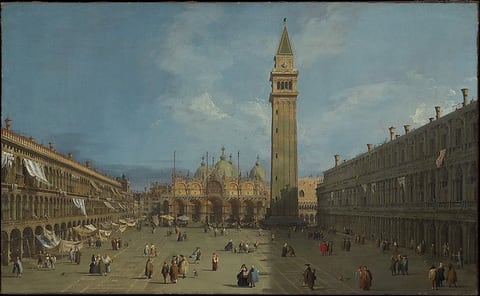
  1. Piazza San Marco, by Canaletto, late 1720s
    Piazza San MarcoCanaletto, late 1720sCourtesy of The Metropolitan Museum of Art
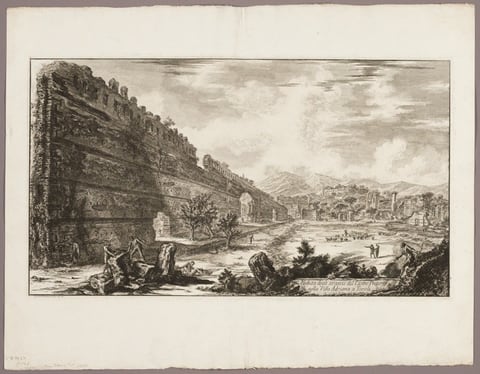
  2. A work made of etching on heavy ivory laid paper.
    View of the Remains of the Praetorian Fort [the Poecile], Hadrian's Villa, Tivoli, from Views of RomeGiovanni Battista Piranesi, 1770Courtesy of the Art Institute of Chicago
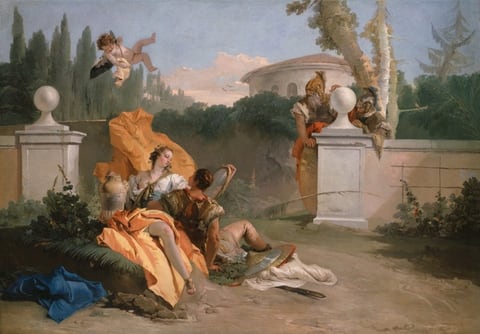
  3. A work made of oil on canvas.
    Rinaldo and Armida in Her GardenGiovanni Battista Tiepolo, c. 1742–45Courtesy of the Art Institute of Chicago