Floor plan

Time and place18th-century Italy

18th-century Italy

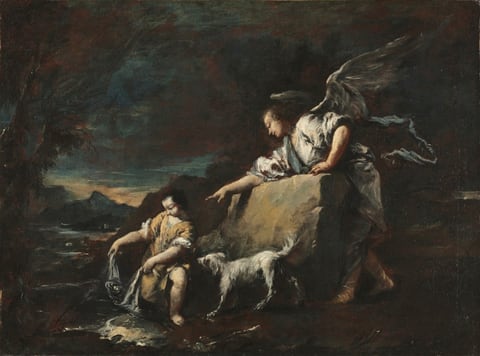
Tobias and the Angel, by Francesco Guardi, 1750s
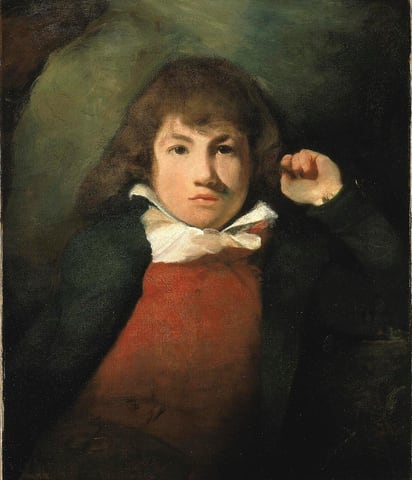
Portrait of a Boy, ca. 1800
The Letter, by Pietro Longhi, 1746
A work made of oil on canvas.
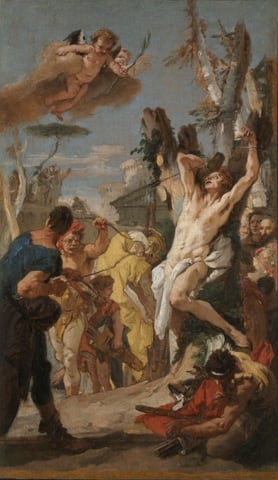
Study for "The Martyrdom of Saint Sebastian" (for the Augustinian monastery at Diessen, Germany), by Giovanni Battista Tiepolo, 1739
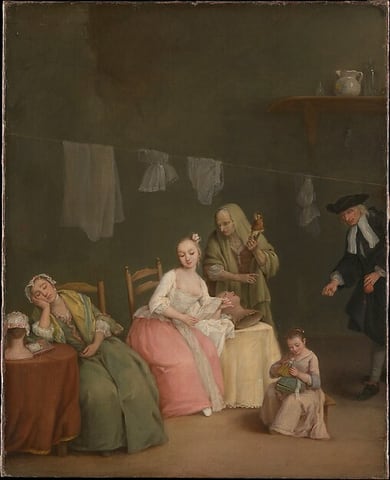
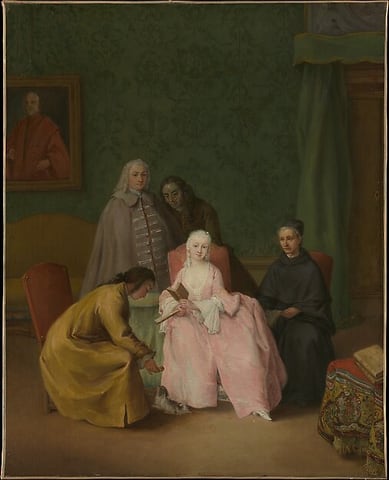
The Visit, by Pietro Longhi, 1746

The works in this room are listed below.

Works in this room

Works made in Italy in the 18th century.

First room, north wall

  1. Tobias and the Angel, by Francesco Guardi, 1750s
    Tobias and the AngelFrancesco Guardi, 1750sCourtesy of the Cleveland Museum of Art
  2. Portrait of a Boy, ca. 1800
    Portrait of a BoyUnrecorded Italian maker, ca. 1800Courtesy of the Smithsonian American Art Museum
  3. The Letter, by Pietro Longhi, 1746
    The LetterPietro Longhi, 1746Courtesy of The Metropolitan Museum of Art

First room, south wall

  1. A work made of oil on canvas.
    Rinaldo and Armida in Her GardenGiovanni Battista Tiepolo, c. 1742–45Courtesy of the Art Institute of Chicago
  2. Study for "The Martyrdom of Saint Sebastian" (for the Augustinian monastery at Diessen, Germany), by Giovanni Battista Tiepolo, 1739
    Study for "The Martyrdom of Saint Sebastian" (for the Augustinian monastery at Diessen, Germany)Giovanni Battista Tiepolo, 1739Courtesy of the Cleveland Museum of Art
  3. The Visit, by Pietro Longhi, 1746
    The VisitPietro Longhi, 1746Courtesy of The Metropolitan Museum of Art

Second room, south wall
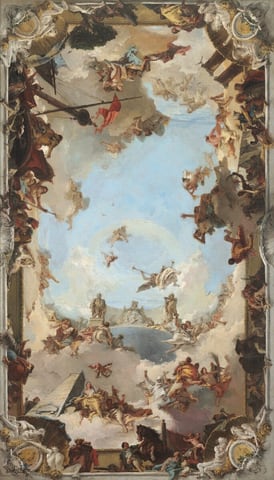
  1. We look up through an opening surrounded by a stone ledge, with clusters of people and clouds swirling into a blue sky up and away from us in this vertical, rectangular painting. From a distance, the scene looks like a complete illusion but up close, the people, clouds, and architecture are sketchily painted. The ledge running around the opening has a gold, oval medallion at each corner. Appearing to be carved from white stone, two bearded men with long hair recline against each medallion, flanking them to each side in front of large shells that curve up over the people and frames them. A few architectural structures extend up into the sky, including a pointed obelisk in the lower left corner, a pair of columns at the upper right, and what seems to be the mast of a ship at the top left. Most of the people have pale skin but some have more tan complexions, and a few, including those wearing feather headdresses near the upper left corner, have brown skin. The people wear windswept robes of pale, butter yellow, robin’s egg blue, rose pink, and ivory. The eye may drawn to a few vignettes, such as the man holding a rearing, chestnut-brown horse on the illusionistic ledge near the lower right, a nun wearing a white robe and holding a cross above him in the clouds, and, farthest away, a crowned person sitting on a throne.
    Wealth and Benefits of the Spanish Monarchy under Charles IIIGiovanni Battista Tiepolo, 1762Courtesy National Gallery of Art, Washington
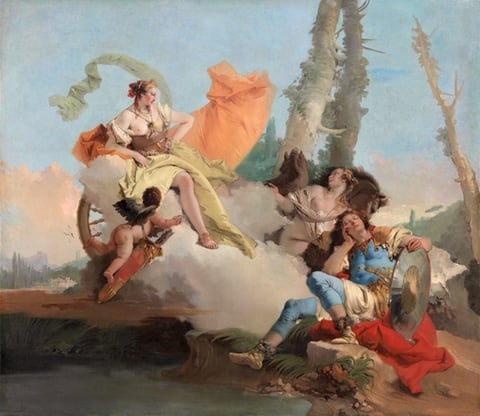
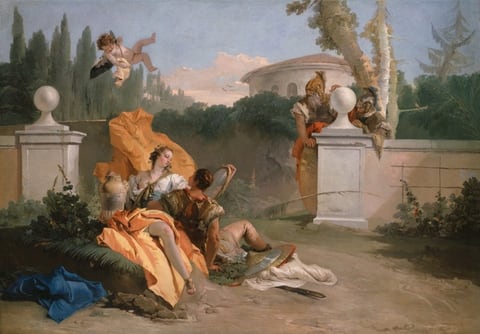
  2. Large painting of soldier asleep outdoors surrounded by two women and a cupid.
    Armida Encounters the Sleeping RinaldoGiovanni Battista Tiepolo, c. 1742–45Courtesy of the Art Institute of Chicago

Second room, north wall
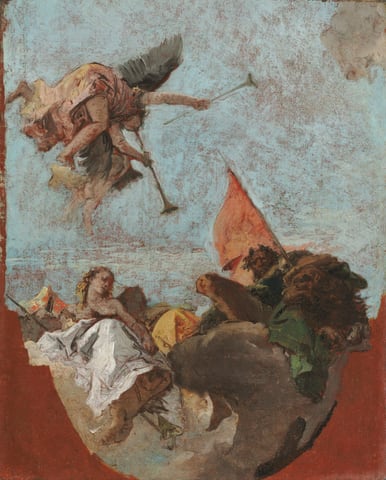
  1. Sketch for a Ceiling, by Giovanni Battista Tiepolo, 1750s
    Sketch for a CeilingGiovanni Battista Tiepolo, 1750sCourtesy of the Cleveland Museum of Art
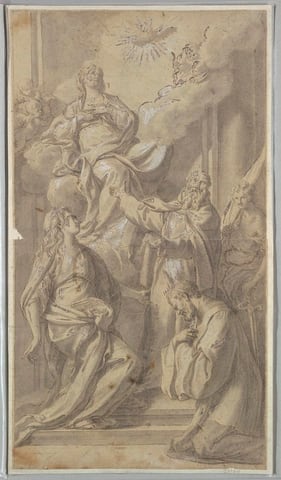
  2. MADONNA AND SAINTS
    Madonna and SaintsSebastiano Conca, ca. 1730Courtesy of Cooper Hewitt, Smithsonian Design Museum
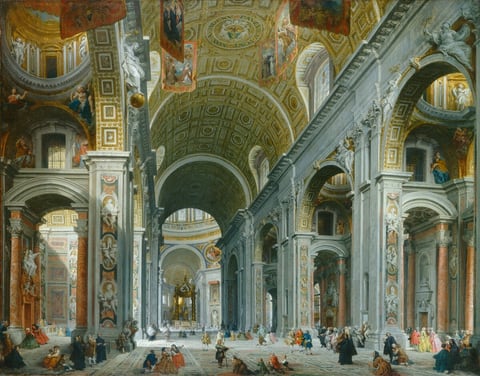
  3. The soaring, gilded vault of a central aisle of the inside of a church fills this horizontal painting. The ceiling of the nave curves up and away from us like a tunnel. It is lined with coffers, which have inset panels, decorated with gold. The light-filled nave angles down from the top center of the composition toward the lower left as it moves away from us. The white stone pillars supporting the barrel vault are intricately carved and decorated with pudgy, winged cherubs holding portraits of men, and aisles run parallel to the central nave to our left and right. In the side aisles, pink marble columns flank altars in chapels. At the far end of the church, the nave is interrupted where it opens into the light-filled crossing, before continuing beyond. Marking the space where the long hall of the church is intersected by a shorter arm to create a cross shape is a structure made of four twisting columns supporting a pointed canopy, all cast in bronze. Tiny men and women pray or gather in pairs and small groups along the nave. Some wear tattered clothing and others are elegantly dressed.
    Interior of Saint Peter's, RomeGiovanni Paolo Panini, c. 1754Courtesy National Gallery of Art, Washington

Third room, north wall
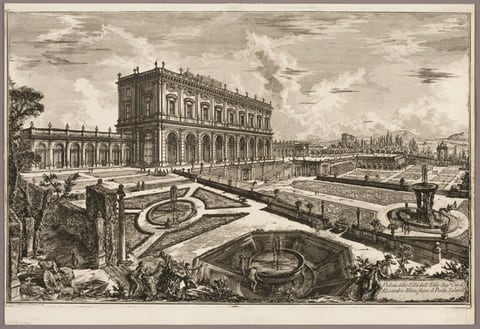
  1. A work made of etching on ivory laid paper.
    View of the Villa of His Eminence Cardinal Alessandro Albani, outside Porta Salaria, from Views of RomeGiovanni Battista Piranesi, 1769, published 1800–07Courtesy of the Art Institute of Chicago
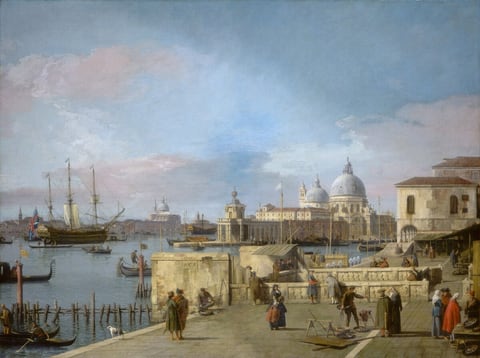
  2. We look slightly down onto a port-side town along a canal, with a church across the water from us in this horizontal landscape painting. A bright blue sky with billowing white, pink, and gray clouds fills the top two-thirds of the painting. Below, a three-masted ship with all but one sail furled is surrounded by a couple dozen black long, low boats, gondolas, and one or two other sailboats. People stand and walk mostly in pairs and trios along the stone walkway under us, which extends into the distance to our right. The women all wear long dresses and most of the men wear suits with knee-length jackets with tails or capes, and hats. The clothing is painted in shades of brick and terracotta red, pine green, royal blue, and gray. The walkway is interrupted by two low walls that partition off an area near us. The angled roofs of stalls line the walkway in the farther distance before it is again interrupted, this time by a two-story, cream-colored building. The walkway continues as a narrower path under an arched arcade on the lower level of that building, alongside the water. On the far side of the canal, to our left and in the distance, a cluster of ivory-white buildings includes a structure with two stone-blue domes. More buildings extend into the deep distance to our left.
    Entrance to the Grand Canal from the Molo, VeniceCanaletto, 1742/1744Courtesy National Gallery of Art, Washington
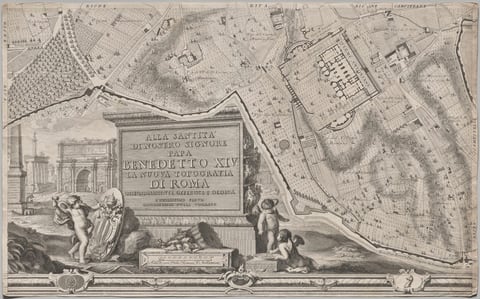
  3. Nuova pianta di Roma data in luce da Giambattista Nolli l’anno MDCCXLVII, known as La Pianta Grande di Roma, by Giovanni Battista Nolli, 1748
    Nuova pianta di Roma data in luce da Giambattista Nolli l’anno MDCCXLVII, known as La Pianta Grande di RomaGiovanni Battista Nolli, 1748Courtesy of the Cleveland Museum of Art

Third room, south wall
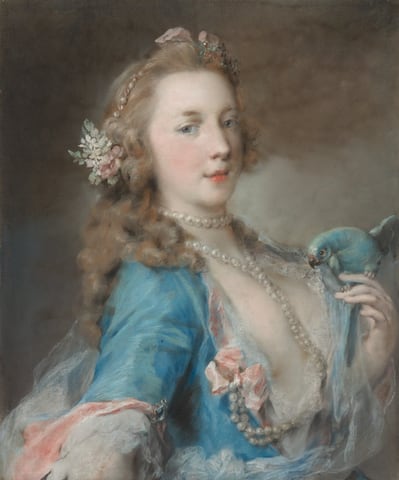
  1. A pastel drawing of woman in blue and pink dress with blue parrot.
    A Young Lady with a ParrotRosalba Carriera, c. 1730Courtesy of the Art Institute of Chicago
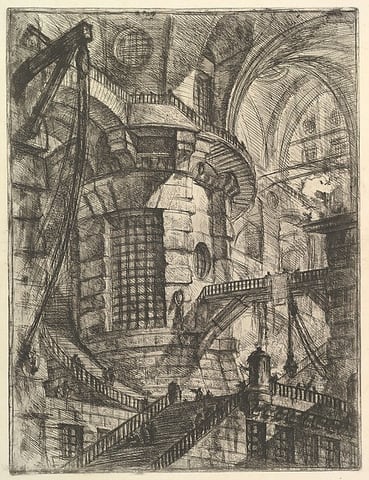
  2. The Round Tower, from "Carceri d'invenzione" (Imaginary Prisons), by Giovanni Battista Piranesi, ca. 1749–50
    The Round Tower, from "Carceri d'invenzione" (Imaginary Prisons)Giovanni Battista Piranesi, ca. 1749–50Courtesy of The Metropolitan Museum of Art