Floor plan

Time and place19th-century Britain
19th-century Britain
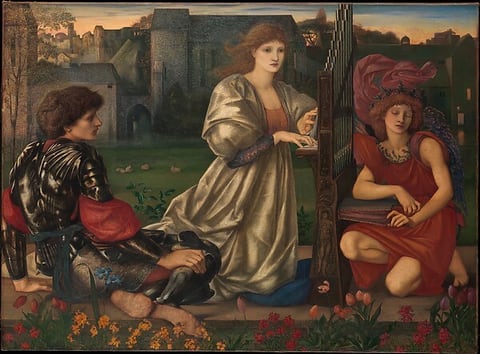
The Love Song, by Sir Edward Burne-Jones, 1868–77
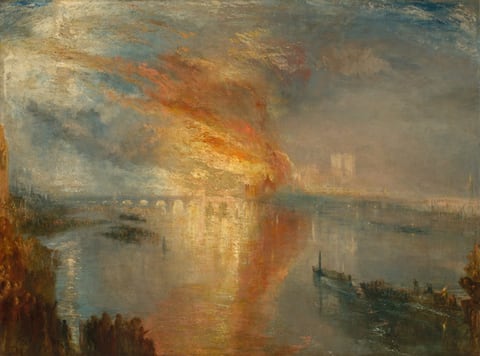
The Burning of the Houses of Lords and Commons, 16 October 1834, by Joseph Mallord William Turner, 1835
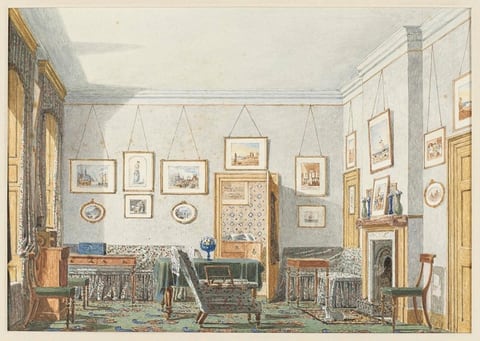
GEORGE JAMES DRUMMOND'S ROOM AT OXFORD, 1853
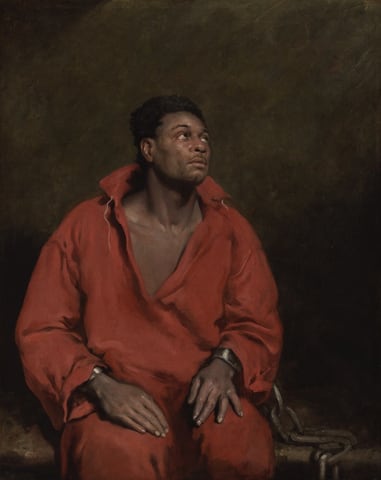
Painting of a dark-skinned man seated and wearing a red open-necked tunic. He looks up to the right. His wrists are shackled and a large chain rests at his right, running down the bench he sits upon.
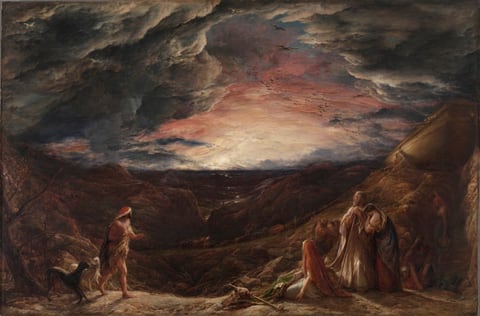
Noah: The Eve of the Deluge, by John Linnell, 1848
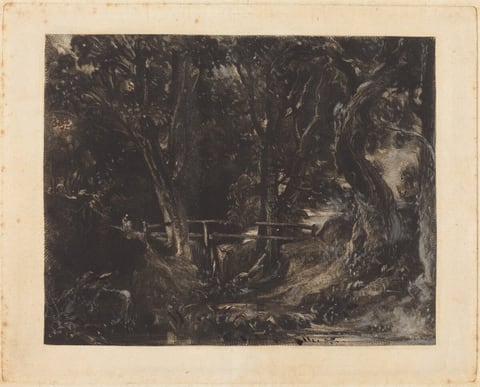
The image shows a landscape scene with a frontal view of a dense forest. A wooden bridge spans across a narrow ravine or creek. The painting features vigorous and textural brushstrokes with dark tones creating a shadowy effect. The color palette includes deep blacks, dark browns, and occasional highlights of light filtering through the canopy. In the distance, lighter areas suggest a path leading further into the woods, surrounded by trees and undergrowth.

The works in this room are listed below.

Works in this room

Works made in Britain in the 19th century.

Section 1, north wall

  1. The Love Song, by Sir Edward Burne-Jones, 1868–77
    The Love SongSir Edward Burne-Jones, 1868–77Courtesy of The Metropolitan Museum of Art
  2. The Burning of the Houses of Lords and Commons, 16 October 1834, by Joseph Mallord William Turner, 1835
    The Burning of the Houses of Lords and Commons, 16 October 1834Joseph Mallord William Turner, 1835Courtesy of the Cleveland Museum of Art
  3. GEORGE JAMES DRUMMOND'S ROOM AT OXFORD, 1853
    George James Drummond's Room at Oxford, 1853George Pyne, 1853Courtesy of Cooper Hewitt, Smithsonian Design Museum

Section 1, south wall

  1. Painting of a dark-skinned man seated and wearing a red open-necked tunic. He looks up to the right. His wrists are shackled and a large chain rests at his right, running down the bench he sits upon.
    The Captive Slave (Ira Aldridge)John Philip Simpson, 1827Courtesy of the Art Institute of Chicago
  2. Noah: The Eve of the Deluge, by John Linnell, 1848
    Noah: The Eve of the DelugeJohn Linnell, 1848Courtesy of the Cleveland Museum of Art
  3. The image shows a landscape scene with a frontal view of a dense forest. A wooden bridge spans across a narrow ravine or creek. The painting features vigorous and textural brushstrokes with dark tones creating a shadowy effect. The color palette includes deep blacks, dark browns, and occasional highlights of light filtering through the canopy. In the distance, lighter areas suggest a path leading further into the woods, surrounded by trees and undergrowth.
    A Dell at Helmingham Park, SuffolkDavid Lucas, 1830Courtesy National Gallery of Art, Washington

Section 2, south wall
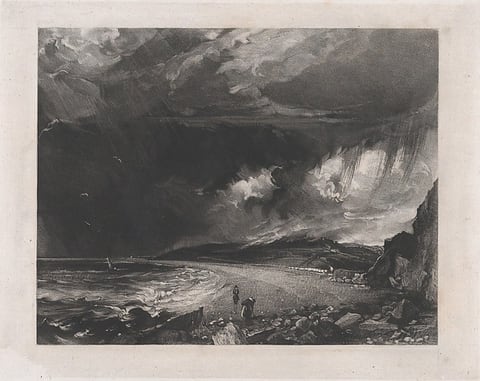
  1. Weymouth Bay, by David Lucas, 1830
    Weymouth BayDavid Lucas, 1830Courtesy of The Metropolitan Museum of Art
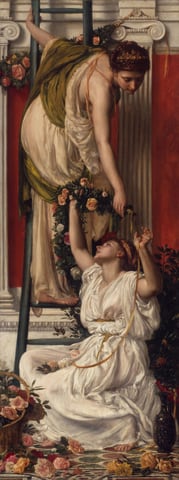
  2. A work made of oil on canvas.
    The FestivalSir John Edward Poynter, 1875Courtesy of the Art Institute of Chicago
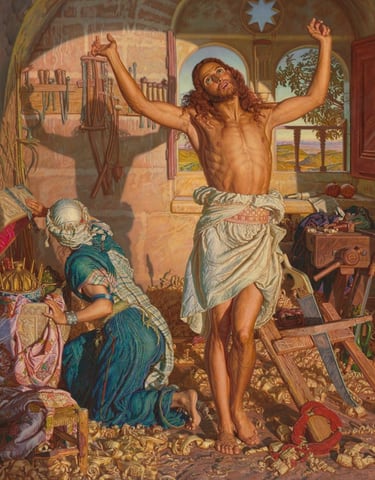
  3. A work made of oil on panel.
    The Shadow of DeathWilliam Holman Hunt, 1873-74Courtesy of the Art Institute of Chicago
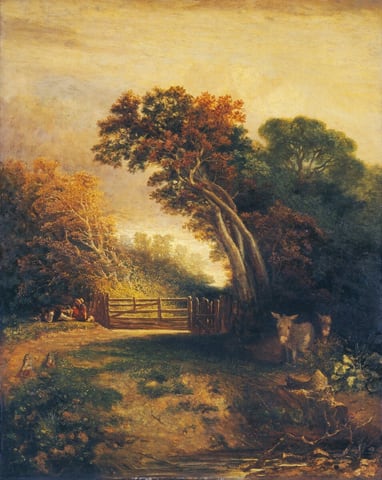
  4. This painting shows a serene pastoral scene with trees, a wooden gate, and foliage extending towards the horizon. Closest to us, there is a low riverbank with some tree branches in the water. Up a grassy dirt hill, two donkeys are visible off to the right, partially hidden by vegetation. On the left, a dirt path leads to the wooden gate. To the left of the gate, two people sit on the grass with a wicker basket between them. The tall trees that rise in the background have leaves in shades of green, yellow, and dark orange. The sky above the scene is yellow with some hints of light blue, and golden light shines down on the landscape.
    Landscape with Picnickers and Donkeys by a GateJoseph Paul, c. 1830-1880Courtesy National Gallery of Art, Washington

Section 2, north wall
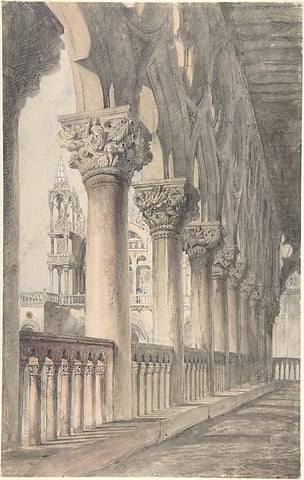
  1. Loggia of the Ducal Palace, Venice, by John Ruskin, 1849–50
    Loggia of the Ducal Palace, VeniceJohn Ruskin, 1849–50Courtesy of The Metropolitan Museum of Art
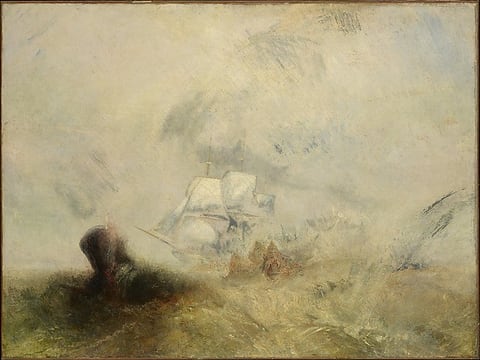
  2. Whalers, by Joseph Mallord William Turner, ca. 1845
    WhalersJoseph Mallord William Turner, ca. 1845Courtesy of The Metropolitan Museum of Art
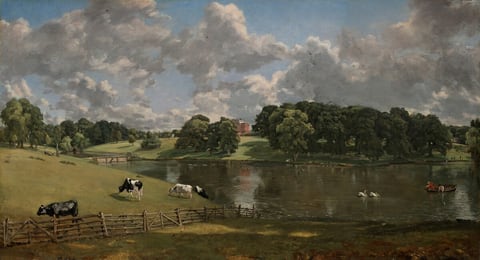
  3. We look out onto a landscape with low, grassy hills to the left, a lake to the right, and a brick building in the center distance below a sky filled with towering white clouds in this horizontal painting. A wooden fence closer to us crosses the landscape from the lower left corner and disappears where the land slopes down to meet the water at the center of the painting. Several black and white cows graze in the field beyond the fence to our left. Two men in a wooden boat pull in nets on the lake to our right near a pair of swans. The lake crosses the composition in the near distance, disappearing into a culvert farther back. A donkey pulls a small carriage with two people near a bridge that crosses the lake in the distance to our left. The brick manor house is visible through a break in the full, deep green trees that line the horizon, which comes halfway up the composition. The clouds cast noticeable shadows in the brightly sunlit scene.
    Wivenhoe Park, EssexJohn Constable, 1816Courtesy National Gallery of Art, Washington

Section 3, north wall
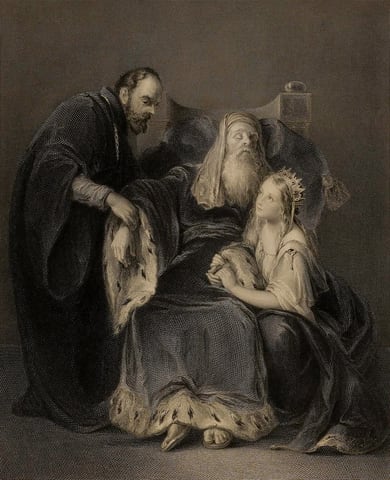
  1. Lear and Cordelia, by Richard Hatfield, 1845
    Lear and CordeliaRichard Hatfield, 1845Courtesy of the Smithsonian American Art Museum
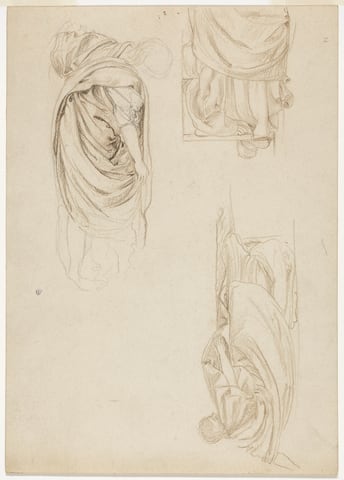
  2. A work made of brown and black chalks on cream wove paper.
    Study for FestivalSir John Edward Poynter, c. 1875Courtesy of the Art Institute of Chicago
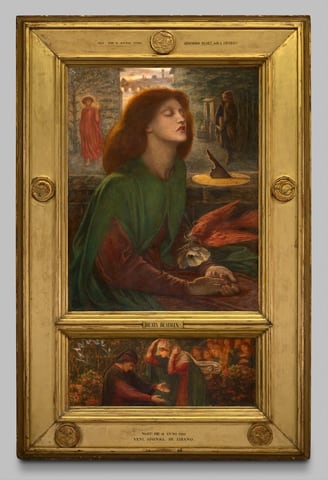
  3. Serene red-haired woman, framed with allegorical symbols of red bird, sundial.
    Beata BeatrixDante Gabriel Rossetti, 1871–72Courtesy of the Art Institute of Chicago