Floor plan

Time and place19th-century Britain
19th-century Britain
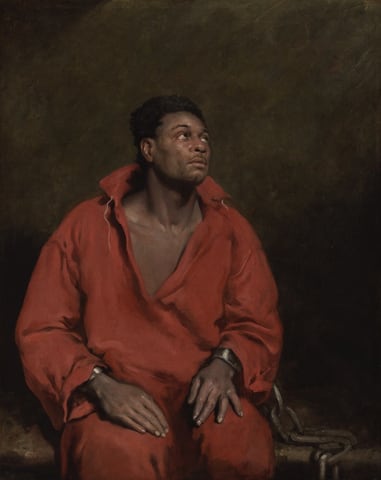
Painting of a dark-skinned man seated and wearing a red open-necked tunic. He looks up to the right. His wrists are shackled and a large chain rests at his right, running down the bench he sits upon.
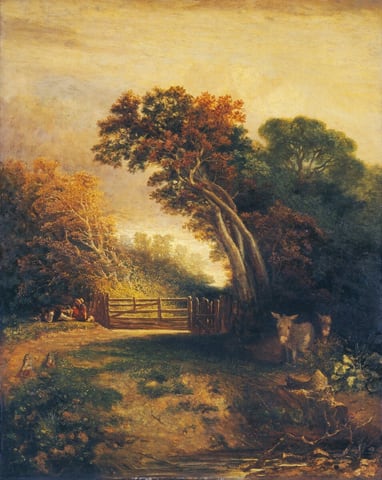
This painting shows a serene pastoral scene with trees, a wooden gate, and foliage extending towards the horizon. Closest to us, there is a low riverbank with some tree branches in the water. Up a grassy dirt hill, two donkeys are visible off to the right, partially hidden by vegetation. On the left, a dirt path leads to the wooden gate. To the left of the gate, two people sit on the grass with a wicker basket between them. The tall trees that rise in the background have leaves in shades of green, yellow, and dark orange. The sky above the scene is yellow with some hints of light blue, and golden light shines down on the landscape.
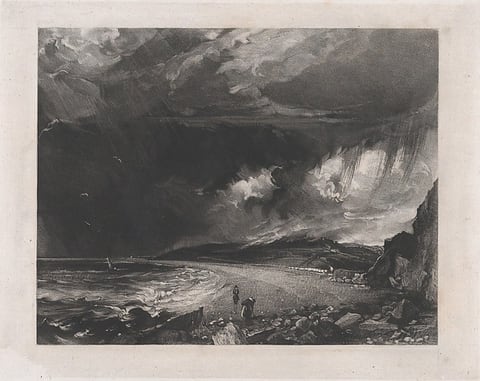
Weymouth Bay, by David Lucas, 1830
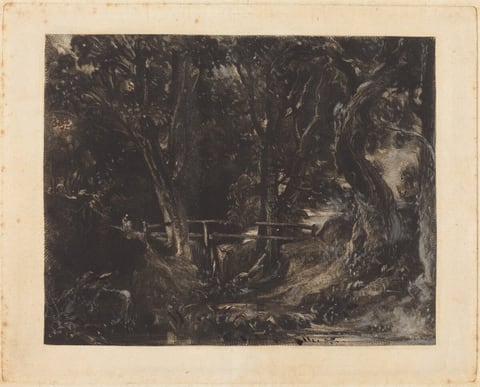
The image shows a landscape scene with a frontal view of a dense forest. A wooden bridge spans across a narrow ravine or creek. The painting features vigorous and textural brushstrokes with dark tones creating a shadowy effect. The color palette includes deep blacks, dark browns, and occasional highlights of light filtering through the canopy. In the distance, lighter areas suggest a path leading further into the woods, surrounded by trees and undergrowth.
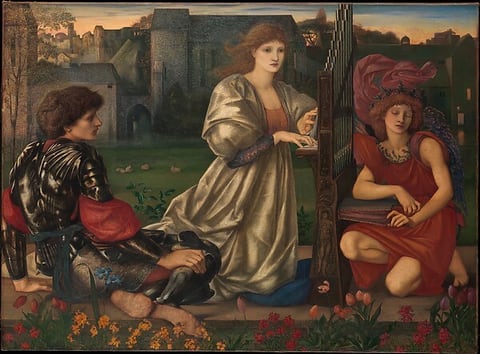
The Love Song, by Sir Edward Burne-Jones, 1868–77
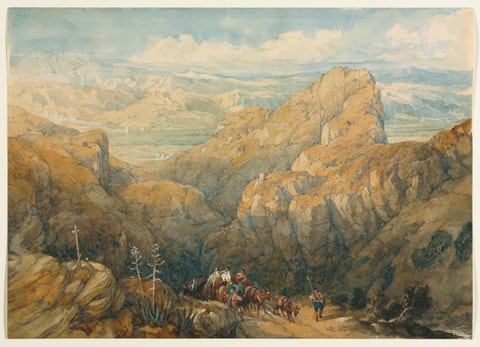
Descent into the Plain of Granada, by David Roberts, 1834
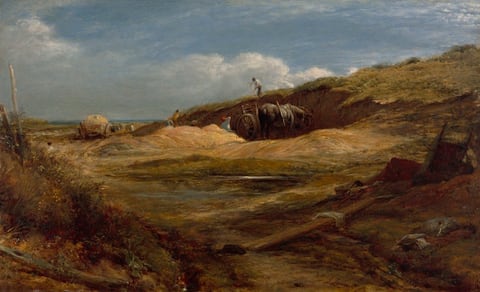
A work made of oil on panel.
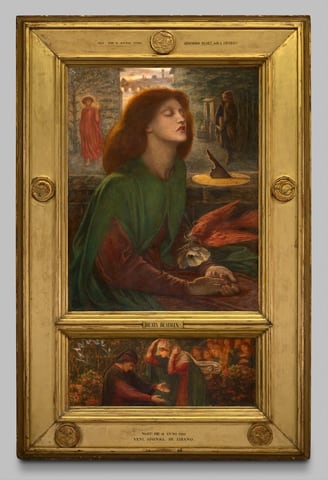
Serene red-haired woman, framed with allegorical symbols of red bird, sundial.

The works in this room are listed below.

Works in this room

Works made in Britain in the 19th century.

Section 1, north wall

  1. Painting of a dark-skinned man seated and wearing a red open-necked tunic. He looks up to the right. His wrists are shackled and a large chain rests at his right, running down the bench he sits upon.
    The Captive Slave (Ira Aldridge)John Philip Simpson, 1827Courtesy of the Art Institute of Chicago
  2. This painting shows a serene pastoral scene with trees, a wooden gate, and foliage extending towards the horizon. Closest to us, there is a low riverbank with some tree branches in the water. Up a grassy dirt hill, two donkeys are visible off to the right, partially hidden by vegetation. On the left, a dirt path leads to the wooden gate. To the left of the gate, two people sit on the grass with a wicker basket between them. The tall trees that rise in the background have leaves in shades of green, yellow, and dark orange. The sky above the scene is yellow with some hints of light blue, and golden light shines down on the landscape.
    Landscape with Picnickers and Donkeys by a GateJoseph Paul, c. 1830-1880Courtesy National Gallery of Art, Washington
  3. Weymouth Bay, by David Lucas, 1830
    Weymouth BayDavid Lucas, 1830Courtesy of The Metropolitan Museum of Art
  4. The image shows a landscape scene with a frontal view of a dense forest. A wooden bridge spans across a narrow ravine or creek. The painting features vigorous and textural brushstrokes with dark tones creating a shadowy effect. The color palette includes deep blacks, dark browns, and occasional highlights of light filtering through the canopy. In the distance, lighter areas suggest a path leading further into the woods, surrounded by trees and undergrowth.
    A Dell at Helmingham Park, SuffolkDavid Lucas, 1830Courtesy National Gallery of Art, Washington

Section 1, south wall

  1. The Love Song, by Sir Edward Burne-Jones, 1868–77
    The Love SongSir Edward Burne-Jones, 1868–77Courtesy of The Metropolitan Museum of Art
  2. Descent into the Plain of Granada, by David Roberts, 1834
    Descent into the Plain of GranadaDavid Roberts, 1834Courtesy of the Cleveland Museum of Art
  3. A work made of oil on panel.
    The Sand Pits, Hampstead HeathJohn Linnell, 1834Courtesy of the Art Institute of Chicago
  4. Serene red-haired woman, framed with allegorical symbols of red bird, sundial.
    Beata BeatrixDante Gabriel Rossetti, 1871–72Courtesy of the Art Institute of Chicago

Section 2, south wall
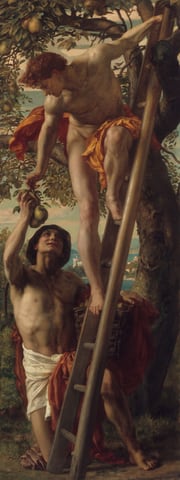
  1. A work made of oil on canvas.
    The Golden AgeSir John Edward Poynter, 1875Courtesy of the Art Institute of Chicago
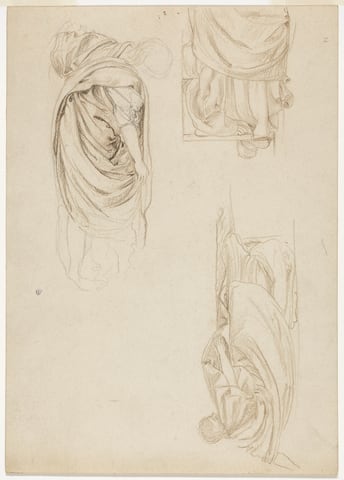
  2. A work made of brown and black chalks on cream wove paper.
    Study for FestivalSir John Edward Poynter, c. 1875Courtesy of the Art Institute of Chicago
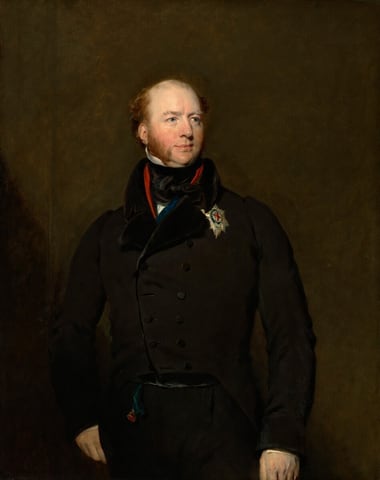
  3. The image displays a man in a portrait from the waist up, in a three-quarter view. He is facing slightly to the right and looking into the distance with a calm expression. The man has fair skin, light reddish-brown hair, sideburns, a defined nose, and a slightly upturned chin. He is wearing a black double-breasted coat with a high collar, a dark waistcoat, a white shirt, and a medal on his chest with an insignia and ribbon. The background is plain and deep brown.
    Francis Charles Seymour-Conway, 3rd Marquess of HertfordThomas Lawrence, c. 1822/1823Courtesy National Gallery of Art, Washington

Section 2, north wall
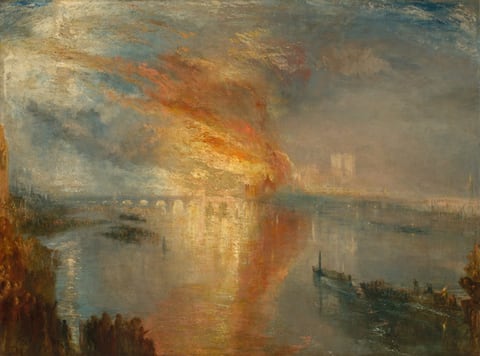
  1. The Burning of the Houses of Lords and Commons, 16 October 1834, by Joseph Mallord William Turner, 1835
    The Burning of the Houses of Lords and Commons, 16 October 1834Joseph Mallord William Turner, 1835Courtesy of the Cleveland Museum of Art
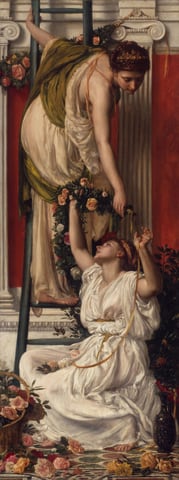
  2. A work made of oil on canvas.
    The FestivalSir John Edward Poynter, 1875Courtesy of the Art Institute of Chicago
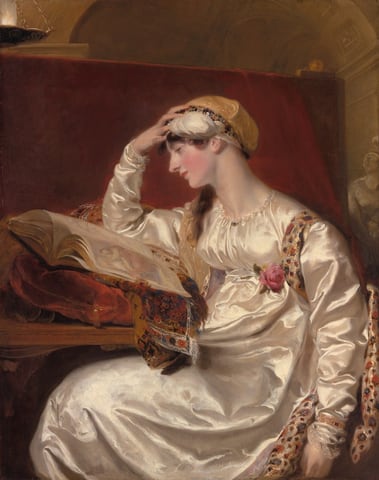
  3. A light-skinned woman in a long, shiny white dress sits at a desk reading a book. The book is propped on a large red pillow. Her head is propped in her hand.
    Isabella WolffThomas Lawrence, 1803–15Courtesy of the Art Institute of Chicago

Section 3, north wall
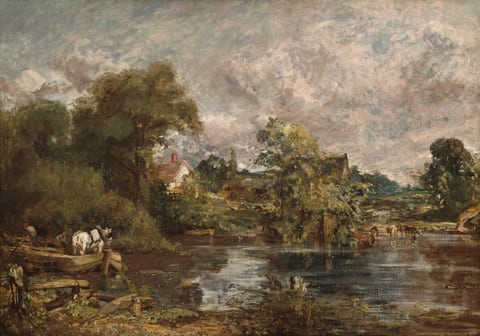
  1. From a grassy riverbank, we look across the placid surface of a river lined along the far bank with trees and farm animals in this horizontal landscape painting. The scene is painted loosely with brushstrokes visible throughout, so some details are difficult to make out. For the surface of the river, russet-brown and steel-gray paint skims lightly across the canvas and leaves some unpainted areas visible, creating the effect of light shimmering on the still water. On our left, a shallow wooden barge is propelled along the stream by two men in red caps with long poles. The boat carries a white horse wearing blinders and a harness. The riverbank beyond is lined with pale, sage-green grass tinged with gold, growing in front of a tangle of darker green trees and bushes. Across the water from us near the middle of the picture, a small rowboat sits in the shallows at the foot of a steep riverbank. Above, a white cottage with a reddish roof and chimney is tucked behind the trees, with a wooden rack full of hay next to it. Nearby, a plow and wheeled cart, highlighted with strokes of white, sit near more mounds of hay. Rocky fields reach into the distance. The vista is blocked to our right by another clump of trees and a rocky outcropping, rising from the stream, to our right of center. The steep, dark roof of a farmhouse is barely visible among the trees. Along the riverside to our right, a small group of cinnamon-brown and cream-white cows stand at water's edge. A rolling pasture stretches behind them to meet blue hills in the distance. Above, in the upper third of the painting, mottled white, pale rose, and gray clouds rolling across a steel-gray sky are reflected in the water below.
    The White HorseJohn Constable, 1818-1819Courtesy National Gallery of Art, Washington
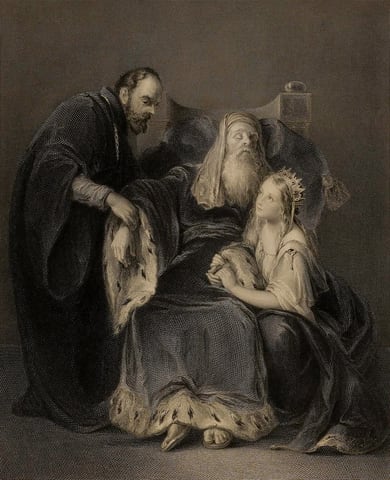
  2. Lear and Cordelia, by Richard Hatfield, 1845
    Lear and CordeliaRichard Hatfield, 1845Courtesy of the Smithsonian American Art Museum