Floor plan

Time and place19th-century Britain
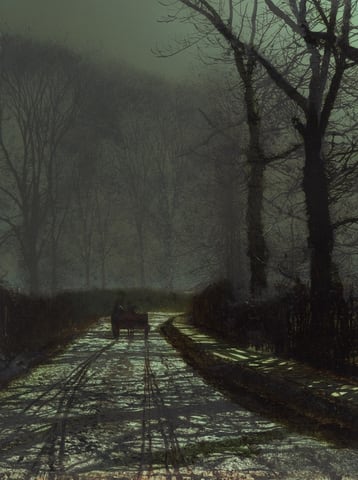
19th-century Britain
A work made of oil on paperboard.
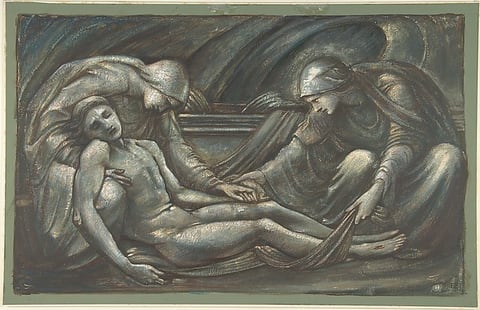
The Entombment, by Sir Edward Burne-Jones, 1879
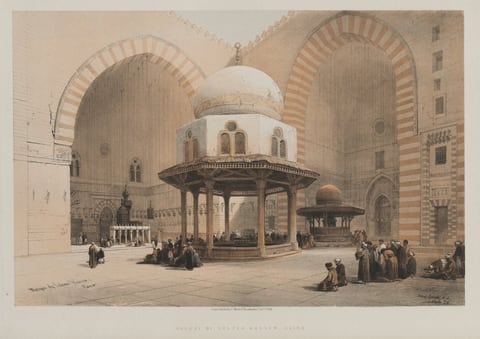
Egypt & Nubia, Volume III, No. 8: Mosque of Sultan Hassan, Cairo, by Louis Haghe, 1842–49
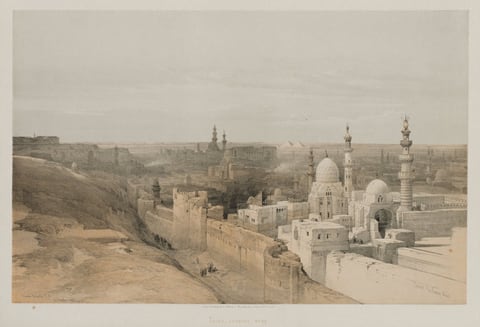
Egypt and Nubia, Volume III, No. 26, Cairo, Looking West, by Louis Haghe, 1848
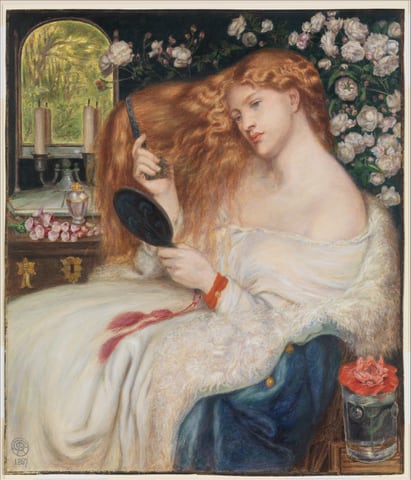
Lady Lilith, by Dante Gabriel Rossetti, 1867
A work made of oil on canvas.
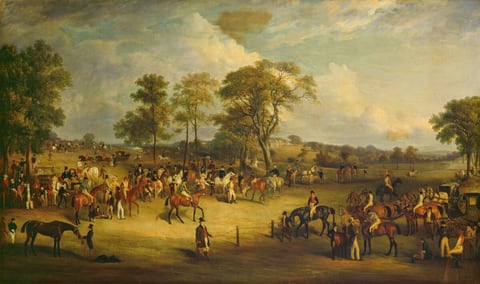
The painting depicts an equestrian scene with people and horses in a green landscape. There are several people on horseback, and others standing by horses. Some people are also sitting in horse-drawn carriages. The horses are in a variety of colors, and the people wear formal clothing like suit jackets, top hats, vests, or colorful dresses. People fill the middle of the scene and the green hills that rise to the left, while a wide path is marked off on the right, bordered by fences. There are some tall trees around the area, with people gathering below them. In the distance, a large white building with columns and blue roofs can be seen. There is also a white tent partially behind a hill on the left. The sky above is blue and filled with white and gray clouds.

The works in this room are listed below.

Works in this room

Works made in Britain in the 19th century.

First room, north wall

  1. A work made of oil on paperboard.
    Lane Scene at NightJohn Atkinson Grimshaw, 1872Courtesy of the Art Institute of Chicago
  2. The Entombment, by Sir Edward Burne-Jones, 1879
    The EntombmentSir Edward Burne-Jones, 1879Courtesy of The Metropolitan Museum of Art
  3. Egypt & Nubia, Volume III, No. 8: Mosque of Sultan Hassan, Cairo, by Louis Haghe, 1842–49
    Egypt & Nubia, Volume III, No. 8: Mosque of Sultan Hassan, CairoLouis Haghe, 1842–49Courtesy of the Cleveland Museum of Art
  4. Egypt and Nubia, Volume III, No. 26, Cairo, Looking West, by Louis Haghe, 1848
    Egypt and Nubia, Volume III, No. 26, Cairo, Looking WestLouis Haghe, 1848Courtesy of the Cleveland Museum of Art

First room, south wall

  1. Lady Lilith, by Dante Gabriel Rossetti, 1867
    Lady LilithDante Gabriel Rossetti, 1867Courtesy of The Metropolitan Museum of Art
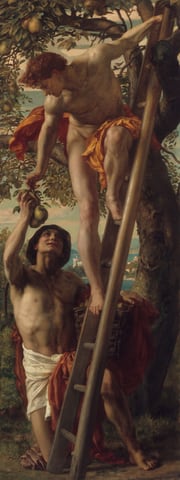
  2. A work made of oil on canvas.
    The Golden AgeSir John Edward Poynter, 1875Courtesy of the Art Institute of Chicago
  3. The painting depicts an equestrian scene with people and horses in a green landscape. There are several people on horseback, and others standing by horses. Some people are also sitting in horse-drawn carriages. The horses are in a variety of colors, and the people wear formal clothing like suit jackets, top hats, vests, or colorful dresses. People fill the middle of the scene and the green hills that rise to the left, while a wide path is marked off on the right, bordered by fences. There are some tall trees around the area, with people gathering below them. In the distance, a large white building with columns and blue roofs can be seen. There is also a white tent partially behind a hill on the left. The sky above is blue and filled with white and gray clouds.
    Heaton Park RacesJohn Ferneley, 1829Courtesy National Gallery of Art, Washington

Second room, south wall
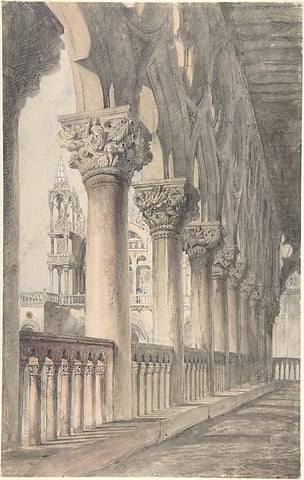
  1. Loggia of the Ducal Palace, Venice, by John Ruskin, 1849–50
    Loggia of the Ducal Palace, VeniceJohn Ruskin, 1849–50Courtesy of The Metropolitan Museum of Art
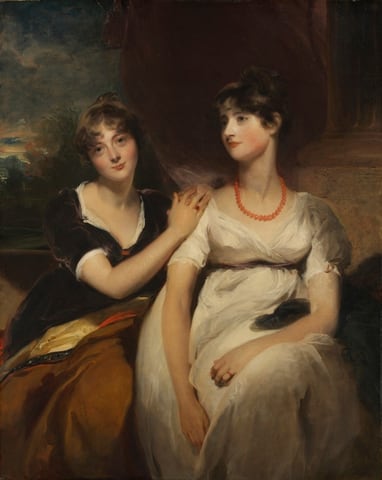
  2. Portrait of Charlotte and Sarah Carteret-Hardy, by Thomas Lawrence, 1801
    Portrait of Charlotte and Sarah Carteret-HardyThomas Lawrence, 1801Courtesy of the Cleveland Museum of Art
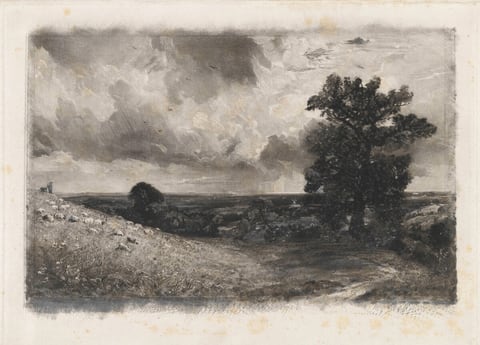
  3. The image shows a landscape with a rolling hill in the foreground sloping downward. The horizon is high, providing a view over fields and sky. Sheep graze on the hill, tended by a person. A large, dark tree is on the right. Brushstrokes vary in the sky and land, with broad strokes for clouds and finer ones for grass and foliage. The color palette is mainly black, white, and shades of grey, highlighting light and shadow.
    NoonDavid Lucas, 1830Courtesy National Gallery of Art, Washington
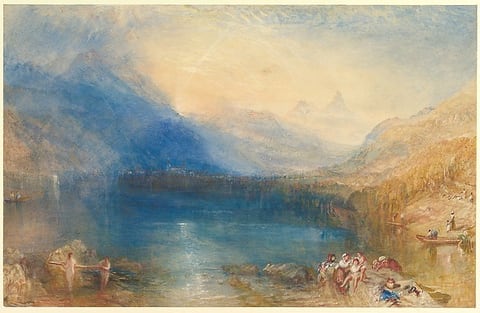
  4. The Lake of Zug, by Joseph Mallord William Turner, 1843
    The Lake of ZugJoseph Mallord William Turner, 1843Courtesy of The Metropolitan Museum of Art

Second room, north wall
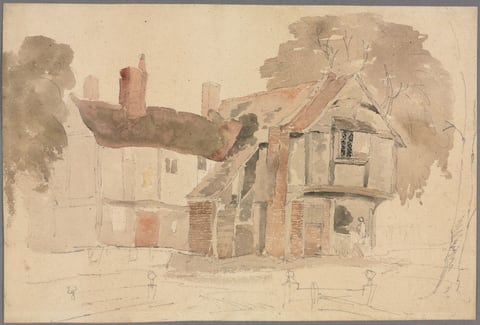
  1. Bray Church Yard, by John Varley, 1807
    Bray Church YardJohn Varley, 1807Courtesy of the Cleveland Museum of Art
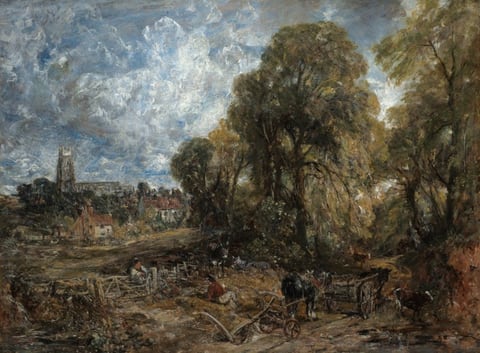
  2. Large English country landscape painting, farmers with horses, green trees.
    Stoke-by-NaylandJohn Constable, 1836Courtesy of the Art Institute of Chicago
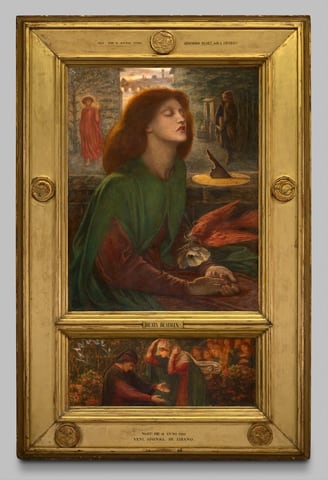
  3. Serene red-haired woman, framed with allegorical symbols of red bird, sundial.
    Beata BeatrixDante Gabriel Rossetti, 1871–72Courtesy of the Art Institute of Chicago

Third room, north wall
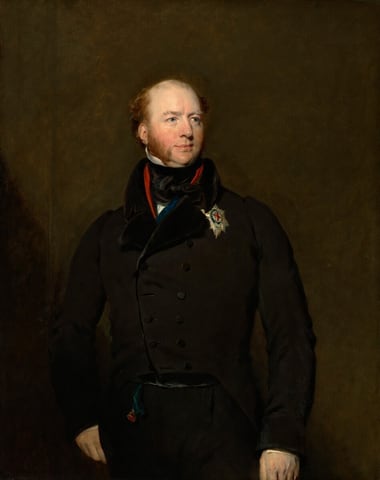
  1. The image displays a man in a portrait from the waist up, in a three-quarter view. He is facing slightly to the right and looking into the distance with a calm expression. The man has fair skin, light reddish-brown hair, sideburns, a defined nose, and a slightly upturned chin. He is wearing a black double-breasted coat with a high collar, a dark waistcoat, a white shirt, and a medal on his chest with an insignia and ribbon. The background is plain and deep brown.
    Francis Charles Seymour-Conway, 3rd Marquess of HertfordThomas Lawrence, c. 1822/1823Courtesy National Gallery of Art, Washington
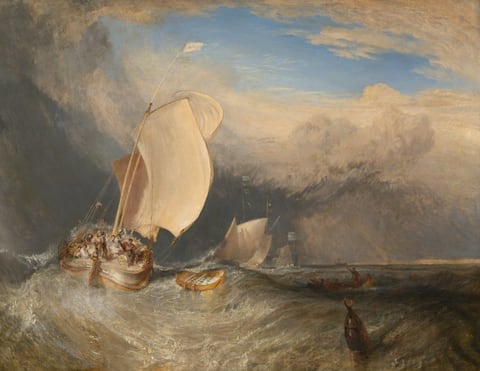
  2. Large marine landscape of boats on rough waves, storm clouds.
    Fishing Boats with Hucksters Bargaining for FishJoseph Mallord William Turner, 1837–38Courtesy of the Art Institute of Chicago