Floor plan

Time and place19th-century Britain
19th-century Britain
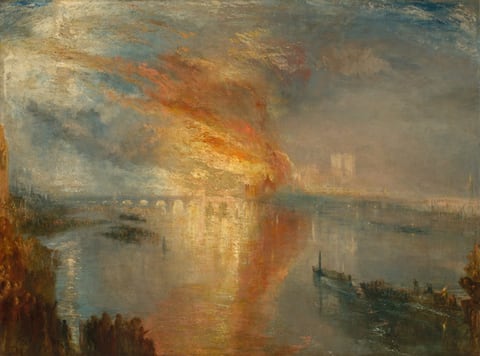
The Burning of the Houses of Lords and Commons, 16 October 1834, by Joseph Mallord William Turner, 1835
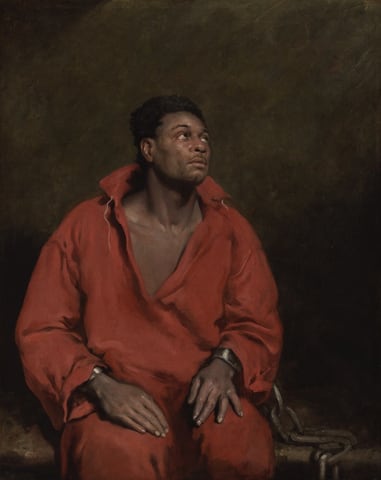
Painting of a dark-skinned man seated and wearing a red open-necked tunic. He looks up to the right. His wrists are shackled and a large chain rests at his right, running down the bench he sits upon.
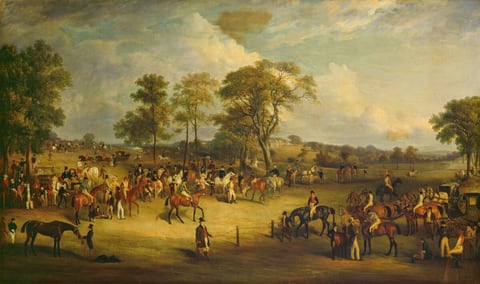
The painting depicts an equestrian scene with people and horses in a green landscape. There are several people on horseback, and others standing by horses. Some people are also sitting in horse-drawn carriages. The horses are in a variety of colors, and the people wear formal clothing like suit jackets, top hats, vests, or colorful dresses. People fill the middle of the scene and the green hills that rise to the left, while a wide path is marked off on the right, bordered by fences. There are some tall trees around the area, with people gathering below them. In the distance, a large white building with columns and blue roofs can be seen. There is also a white tent partially behind a hill on the left. The sky above is blue and filled with white and gray clouds.
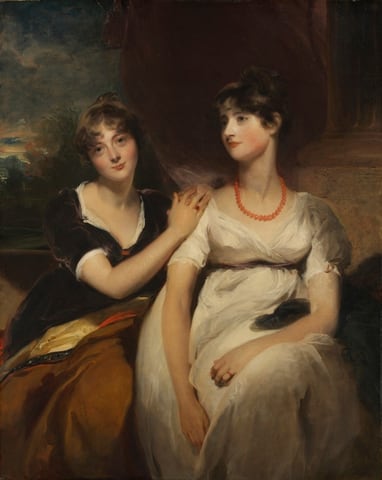
Portrait of Charlotte and Sarah Carteret-Hardy, by Thomas Lawrence, 1801
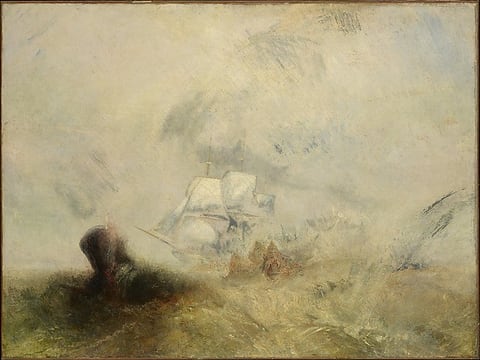
Whalers, by Joseph Mallord William Turner, ca. 1845
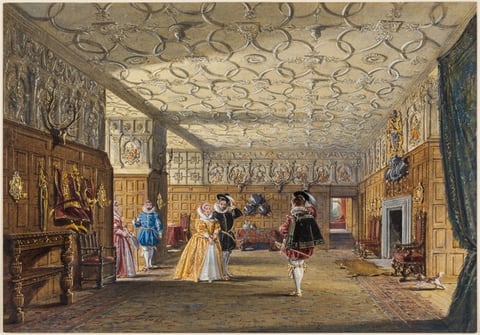
A work made of watercolor and gouache, heightened with white gouache, over graphite selectively gum varnished on cream wove card.

The works in this room are listed below.

Works in this room

Works made in Britain in the 19th century.

Section 1, north wall

  1. The Burning of the Houses of Lords and Commons, 16 October 1834, by Joseph Mallord William Turner, 1835
    The Burning of the Houses of Lords and Commons, 16 October 1834Joseph Mallord William Turner, 1835Courtesy of the Cleveland Museum of Art
  2. Painting of a dark-skinned man seated and wearing a red open-necked tunic. He looks up to the right. His wrists are shackled and a large chain rests at his right, running down the bench he sits upon.
    The Captive Slave (Ira Aldridge)John Philip Simpson, 1827Courtesy of the Art Institute of Chicago
  3. The painting depicts an equestrian scene with people and horses in a green landscape. There are several people on horseback, and others standing by horses. Some people are also sitting in horse-drawn carriages. The horses are in a variety of colors, and the people wear formal clothing like suit jackets, top hats, vests, or colorful dresses. People fill the middle of the scene and the green hills that rise to the left, while a wide path is marked off on the right, bordered by fences. There are some tall trees around the area, with people gathering below them. In the distance, a large white building with columns and blue roofs can be seen. There is also a white tent partially behind a hill on the left. The sky above is blue and filled with white and gray clouds.
    Heaton Park RacesJohn Ferneley, 1829Courtesy National Gallery of Art, Washington

Section 1, south wall

  1. Portrait of Charlotte and Sarah Carteret-Hardy, by Thomas Lawrence, 1801
    Portrait of Charlotte and Sarah Carteret-HardyThomas Lawrence, 1801Courtesy of the Cleveland Museum of Art
  2. Whalers, by Joseph Mallord William Turner, ca. 1845
    WhalersJoseph Mallord William Turner, ca. 1845Courtesy of The Metropolitan Museum of Art
  3. A work made of watercolor and gouache, heightened with white gouache, over graphite selectively gum varnished on cream wove card.
    The Hall, Levens, WestmorelandJoseph Nash, n.d.Courtesy of the Art Institute of Chicago

Section 2, south wall
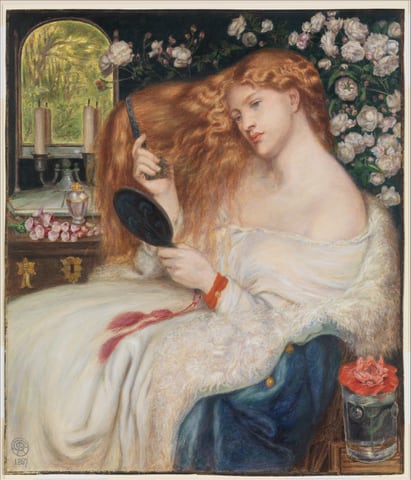
  1. Lady Lilith, by Dante Gabriel Rossetti, 1867
    Lady LilithDante Gabriel Rossetti, 1867Courtesy of The Metropolitan Museum of Art
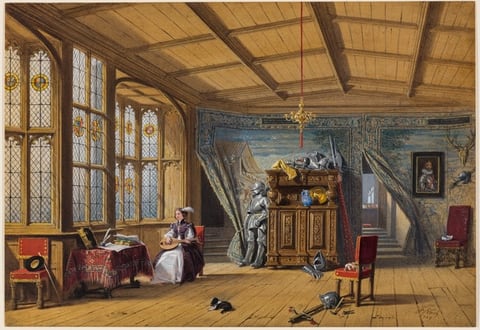
  2. A work made of watercolor and gouache, with touches of brush and black ink, heightened with white gouache, over graphite on cream wove paper.
    Room Leading to the Chapel, Knowle, KentJoseph Nash, 1869Courtesy of the Art Institute of Chicago
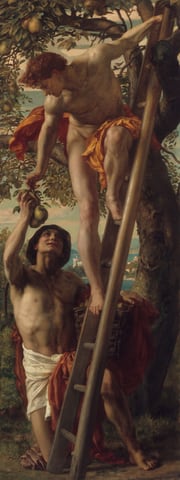
  3. A work made of oil on canvas.
    The Golden AgeSir John Edward Poynter, 1875Courtesy of the Art Institute of Chicago
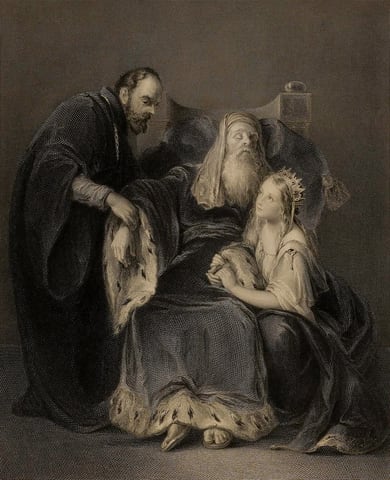
  4. Lear and Cordelia, by Richard Hatfield, 1845
    Lear and CordeliaRichard Hatfield, 1845Courtesy of the Smithsonian American Art Museum

Section 2, north wall
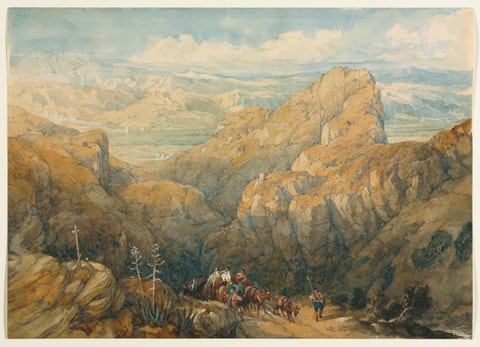
  1. Descent into the Plain of Granada, by David Roberts, 1834
    Descent into the Plain of GranadaDavid Roberts, 1834Courtesy of the Cleveland Museum of Art
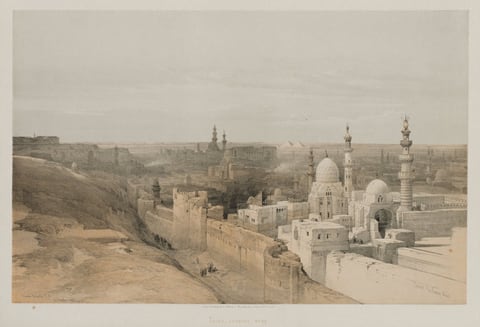
  2. Egypt and Nubia, Volume III, No. 26, Cairo, Looking West, by Louis Haghe, 1848
    Egypt and Nubia, Volume III, No. 26, Cairo, Looking WestLouis Haghe, 1848Courtesy of the Cleveland Museum of Art
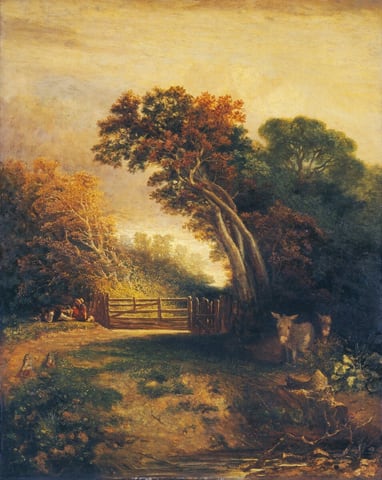
  3. This painting shows a serene pastoral scene with trees, a wooden gate, and foliage extending towards the horizon. Closest to us, there is a low riverbank with some tree branches in the water. Up a grassy dirt hill, two donkeys are visible off to the right, partially hidden by vegetation. On the left, a dirt path leads to the wooden gate. To the left of the gate, two people sit on the grass with a wicker basket between them. The tall trees that rise in the background have leaves in shades of green, yellow, and dark orange. The sky above the scene is yellow with some hints of light blue, and golden light shines down on the landscape.
    Landscape with Picnickers and Donkeys by a GateJoseph Paul, c. 1830-1880Courtesy National Gallery of Art, Washington
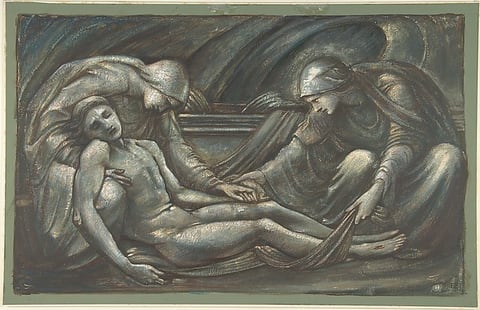
  4. The Entombment, by Sir Edward Burne-Jones, 1879
    The EntombmentSir Edward Burne-Jones, 1879Courtesy of The Metropolitan Museum of Art

Section 3, north wall
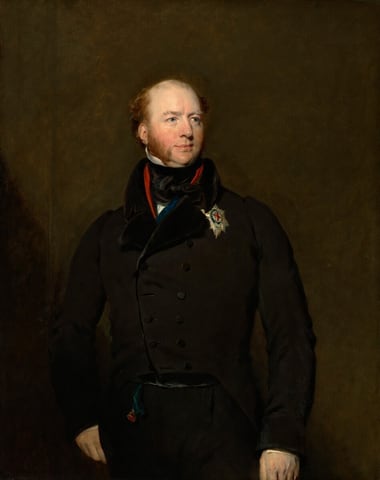
  1. The image displays a man in a portrait from the waist up, in a three-quarter view. He is facing slightly to the right and looking into the distance with a calm expression. The man has fair skin, light reddish-brown hair, sideburns, a defined nose, and a slightly upturned chin. He is wearing a black double-breasted coat with a high collar, a dark waistcoat, a white shirt, and a medal on his chest with an insignia and ribbon. The background is plain and deep brown.
    Francis Charles Seymour-Conway, 3rd Marquess of HertfordThomas Lawrence, c. 1822/1823Courtesy National Gallery of Art, Washington
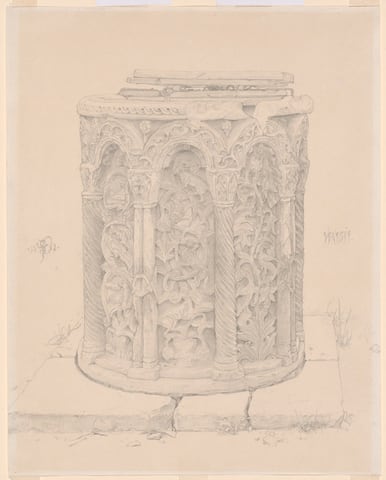
  2. A work made of graphite on ivory wove paper.
    A Byzantine Well-headFrederic Leighton, 1st Baron Leighton of Stretton, 1852Courtesy of the Art Institute of Chicago