Floor plan

Time and place19th-century United States
19th-century United States
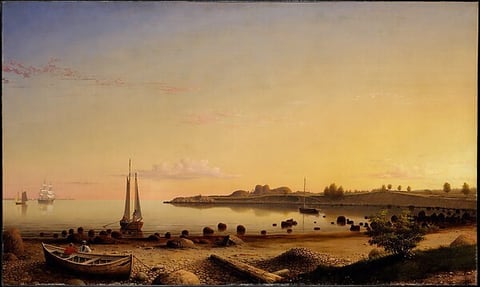
Stage Fort across Gloucester Harbor, by Fitz Henry Lane, 1862
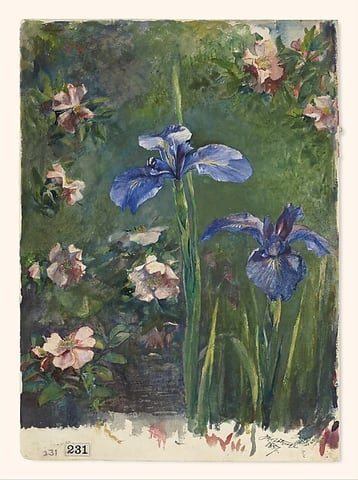
Wild Roses and Irises, by John La Farge, 1887
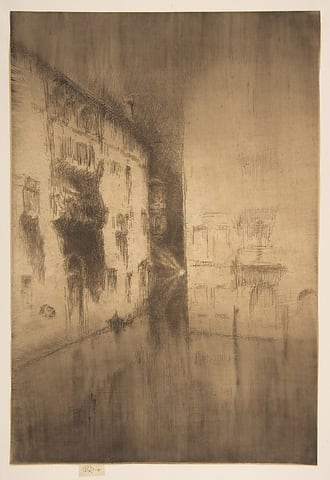
Nocturne: Palaces, by James McNeill Whistler, 1879–80
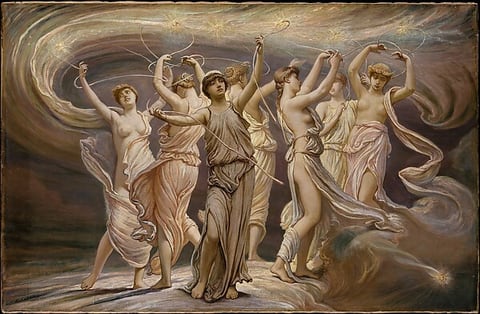
The Pleiades, by Elihu Vedder, 1885
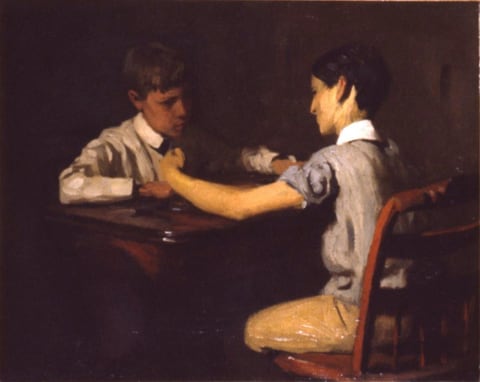
Checker Players, by Thomas Anshutz, ca. 1895
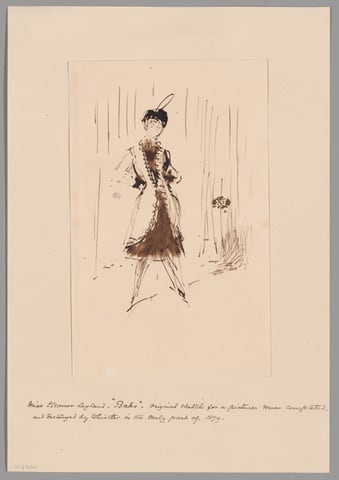
A work made of pen and brown ink, with brush and brown ink, on cream pseudo-laid paper tipped onto cream wove paper.
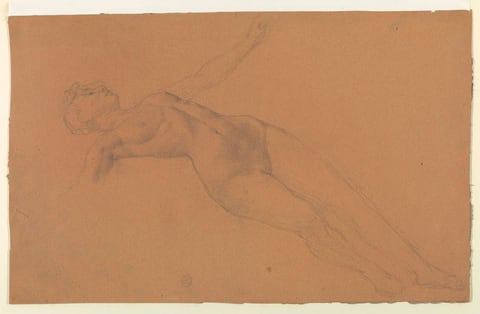
STUDY FOR "DIANA AND HER ATTENDANTS AMONG THE CONSTELLATIONS"

The works in this room are listed below.

Works in this room

Works made in the United States in the 19th century.

Section 1, north wall

  1. Stage Fort across Gloucester Harbor, by Fitz Henry Lane, 1862
    Stage Fort across Gloucester HarborFitz Henry Lane, 1862Courtesy of The Metropolitan Museum of Art
  2. Wild Roses and Irises, by John La Farge, 1887
    Wild Roses and IrisesJohn La Farge, 1887Courtesy of The Metropolitan Museum of Art
  3. Nocturne: Palaces, by James McNeill Whistler, 1879–80
    Nocturne: PalacesJames McNeill Whistler, 1879–80Courtesy of The Metropolitan Museum of Art

Section 1, south wall

  1. The Pleiades, by Elihu Vedder, 1885
    The PleiadesElihu Vedder, 1885Courtesy of The Metropolitan Museum of Art
  2. Checker Players, by Thomas Anshutz, ca. 1895
    Checker PlayersThomas Anshutz, ca. 1895Courtesy of the Smithsonian American Art Museum
  3. A work made of pen and brown ink, with brush and brown ink, on cream pseudo-laid paper tipped onto cream wove paper.
    Study for "The Blue Girl: Portrait of Miss Elinor Leyland"James McNeill Whistler, c. 1879Courtesy of the Art Institute of Chicago
  4. STUDY FOR "DIANA AND HER ATTENDANTS AMONG THE CONSTELLATIONS"
    Study for "Diana and Her Attendants among the Constellations"Francis Augustus Lathrop, ca. 1894Courtesy of Cooper Hewitt, Smithsonian Design Museum

Section 2, south wall
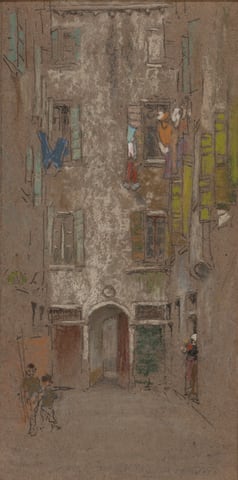
  1. A work made of pastel and black chalk on brown wove paper with fibrous inclusions.
    Corte del ParadisoJames McNeill Whistler, 1880Courtesy of the Art Institute of Chicago
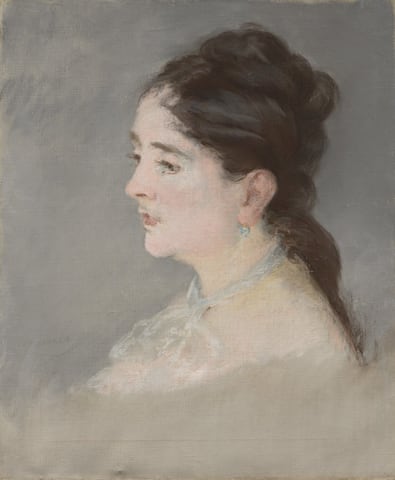
  2. Claire Campbell, by Édouard Manet, 1876
    Claire CampbellÉdouard Manet, 1876Courtesy of the Cleveland Museum of Art
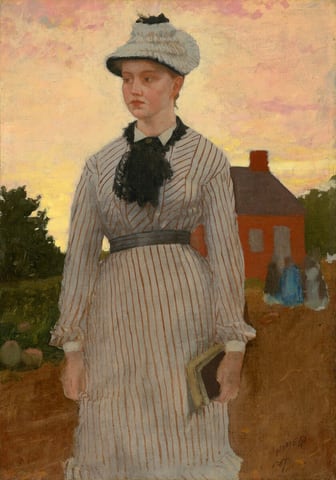
  3. Shown from the knees up, a pale-skinned woman stands close to us with a red schoolhouse in the distance under a sunset sky in this vertical painting. The woman’s body faces us, but she turns her head to look off to the left with light brown eyes. She has a short, straight nose, full pink lips, and a round face. Her blond hair is pulled up under a round white hat layered with ruffles, which lies like a pancake over the top of her head. Her white dress is vertically striped with thin rust-red lines and has a long-sleeved, tight-fitting bodice and a long skirt. A dark gray belt is cinched around her narrow waist, and she wears a black, lacy ruffle around her neck. The woman’s arms hang by her sides, and she holds two paperback-sized books in her left hand, to our right. An earth-brown lawn stretches back to the schoolhouse, which has crimson-red walls, a chimney, and a dark gray roof. Three forms painted with a few streaks of dark or light gray or topaz blue suggest people standing near the door of the schoolhouse. Trees and a grassy lawn beyond the building are loosely painted with blended strokes. The sky is shaded pale lemon yellow and light peach with touches of rose pink. The artist signed and dated the lower right corner, “HOMER 1873.”
    The Red School HouseWinslow Homer, 1873Courtesy National Gallery of Art, Washington
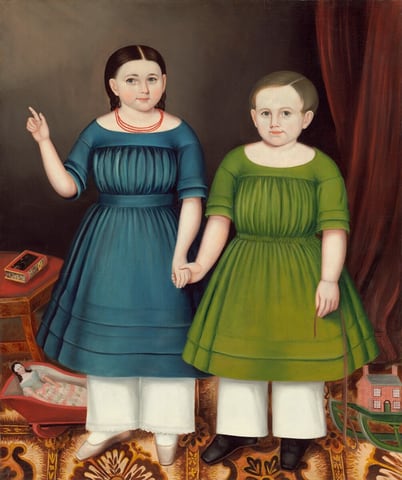
  4. The image features two young children standing side by side. The child on the left extends one arm sideways and has the other arm lowered, while the child on the right has both arms relaxed by their sides, one holding a string. Both children have round faces with light complexions; the child on the left has dark brown hair styled in waves down to the shoulders, while the child on the right has light brown hair. The child on the left is dressed in a blue dress with a loosely gathered waist and short sleeves, white stockings, white shoes, and a red beaded necklace. The child on the right wears a green dress with similar design features, white stockings, and black shoes. Near their feet are a toy doll in a red cradle and a small toy house. In the background, there is a plain dark wall, a deep red drapery, a carpet with elaborate patterns, and a small wooden table with a box on top.
    Mary and Francis WilcoxJoseph Whiting Stock, 1845Courtesy National Gallery of Art, Washington

Section 2, north wall
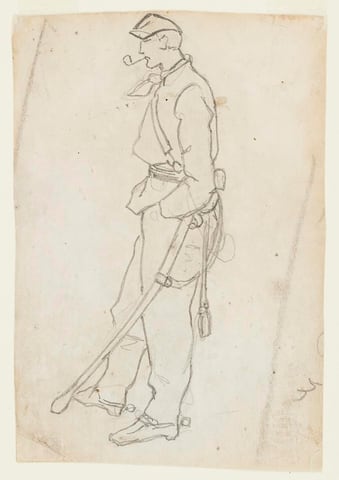
  1. SOLDIER WITH SWORD AND PIPE
    Soldier with Sword and PipeWinslow Homer, 1862Courtesy of Cooper Hewitt, Smithsonian Design Museum
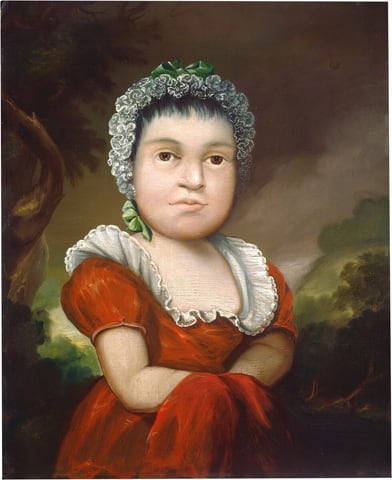
  2. A pale-skinned child wearing a short-sleeved red dress and a white bonnet stands before a shadowy green forest under dark clouds in this vertical portrait painting. The child’s over-large head is out of scale with the rest of her body. She looks toward us with brown eyes in her wide, round-jawed face. She has a broad nose, and her pale lips are set in a line. Her lace bonnet lines her black hair like frothy seafoam and is tied with spring-green bows at the top and under her right ear, to our left. The low neckline of her crimson dress is lined with a wide white ruffle. Red fabric covers her hands, which are gathered in front of her waist. Gray clouds sweep over the hazy green forest in the background. A gnarled tree grows up the left side of the painting, framing the girl.
    Portrait of a ChildEdward Hicks, c. 1840Courtesy National Gallery of Art, Washington
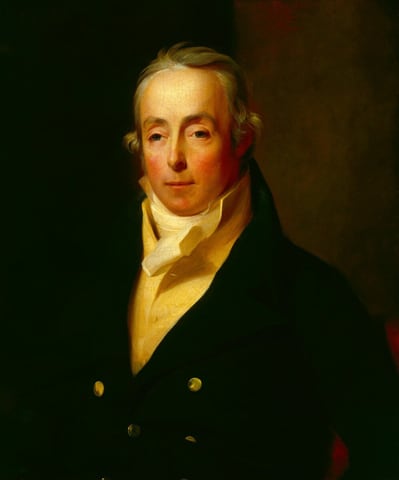
  3. This painting is a portrait of a man from the waist up. He is facing us, with pale skin, thin lips, rosy cheeks, light green eyes, and gray hair styled into curls around his ears. He has a neutral expression. The man is wearing a dark coat with gold buttons on the front, with a pale-yellow shirt underneath and a white cravat around his neck. The background is a dark and indistinct brown color.
    Abraham KintzingThomas Sully, 1815Courtesy National Gallery of Art, Washington

Section 3, north wall
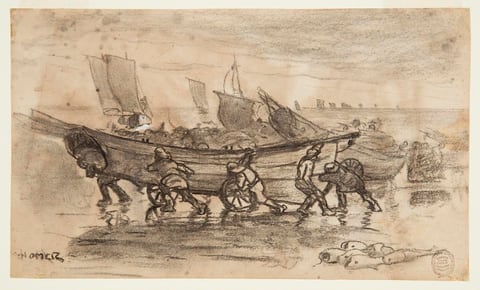
  1. FISHERMEN BEACHING A DORY, CULLERCOATS, ENGLAND
    Fishermen Beaching a Dory, Cullercoats, EnglandWinslow Homer, 1881Courtesy of Cooper Hewitt, Smithsonian Design Museum
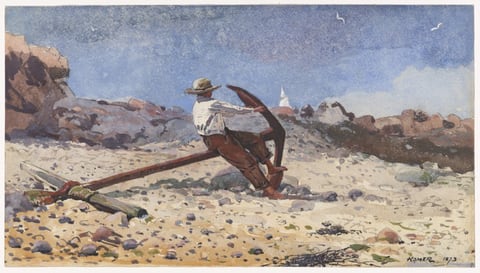
  2. Boy with Anchor, by Winslow Homer, 1873
    Boy with AnchorWinslow Homer, 1873Courtesy of the Cleveland Museum of Art