Skip to content
Ochre Editions
ArtArtistsCollectionsGalleriesDrops
SearchSign inCart (0)
The galleries · Time and place

The 19th century

Works made in the 19th century, anywhere in the world.

731 works · hang 1953 ·

Share The 19th century, in the galleries

The rooms are imagined; every work on their walls is real.

Walk this roomRehang this room

Section 1, north wall

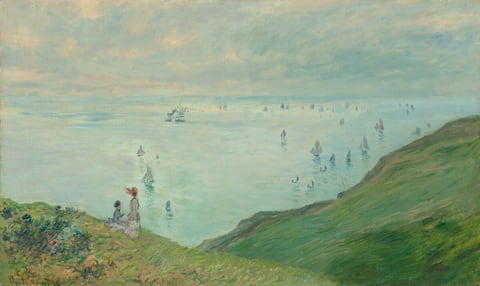
  1. From a high perspective, we look beyond two overlapping, emerald-green hills to a body of powder-blue water dotted with sailboats in this loosely painted horizontal landscape. Closest to us, the hills create a shallow V that spans the lower third of the composition, with the right-hand hill rising to more than halfway up the right edge. The hills are painted with dashes and long strokes mostly in seafoam, shamrock, and celery green, with some swipes of peach, goldenrod yellow, and royal blue. On the hill to our left, one woman sits and the other stands next to her. They wear hats, long-sleeved, fitted jackets, and long skirts in tones of dusky pink and dove gray. A touch of peach on the seated woman, to our left, gives the impression of a pale face. A red veil or scarf at the back of the other woman’s hat is lifted, as if in the wind. The water is painted with blended strokes of pale blue, light turquoise, smoky mauve pink, and touches of soft peach. The horizon comes two-thirds of the way up the composition, and the sky is painted with the same tones of blue, green, and peach to suggest a screen of clouds. Triangles and dashes of slate blue suggest about three dozen sailboats, rowboats, and one steamship in the rippling water. Squiggles of teal and sage green create reflections for some of the boats. The brushstrokes are visible throughout. In some areas, the paint is so thinly applied that the texture of the canvas shows through, especially in the sky. The artist signed the work in the lower left corner: “Claude Monet 82.”
    Cliffs at PourvilleClaude Monet, 1882Courtesy National Gallery of Art, Washington
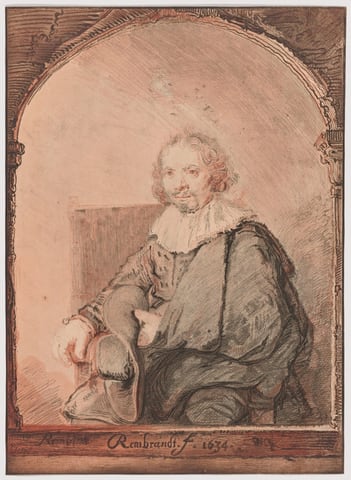
  2. A work made of soft ground etching, hard ground etching, aquatint, and roulette, printed from two plates in red-brown and black, on ivory laid paper.
    Portrait of a Man in an Armchair, from Collection d'imitations de Dessins d'après les Principaux Maîtres Hollandais et FlamandsChristian Josi, 1826Courtesy of the Art Institute of Chicago
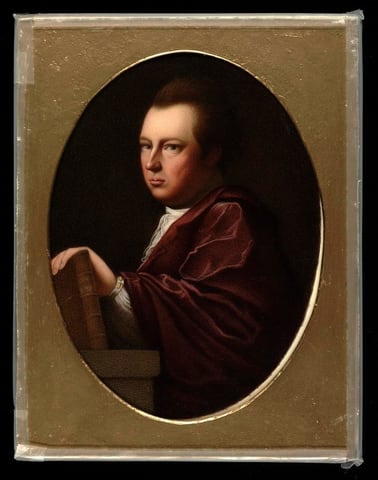
  3. Peter Bounetheau, by Henry Brintnell Bounetheau, ca. 1820
    Peter BounetheauHenry Brintnell Bounetheau, ca. 1820Courtesy of the Smithsonian American Art Museum
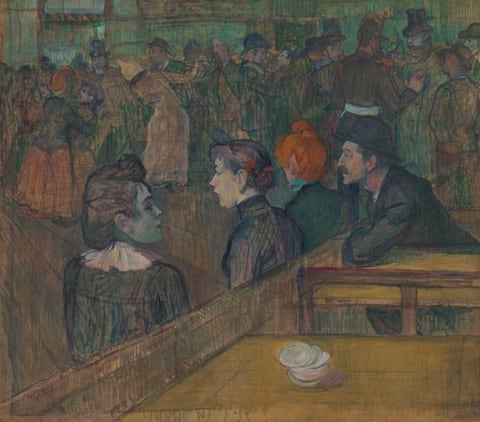
  4. A scene in brown and green tones of people dancing indoors. In the foreground, three women stand near boothed tables while a man sits.
    Moulin de la GaletteHenri de Toulouse-Lautrec, 1889Courtesy of the Art Institute of Chicago

Section 1, south wall
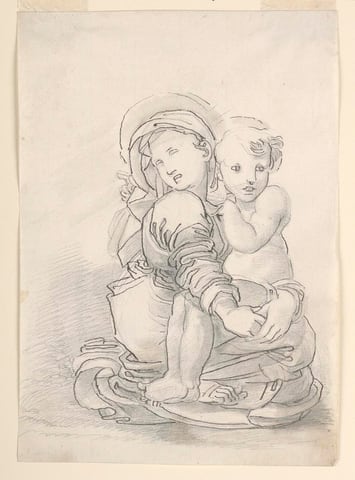
  1. THE VIRGIN WITH THE CHILD
    The Virgin with the ChildFortunato Duranti, 1820–1850Courtesy of Cooper Hewitt, Smithsonian Design Museum
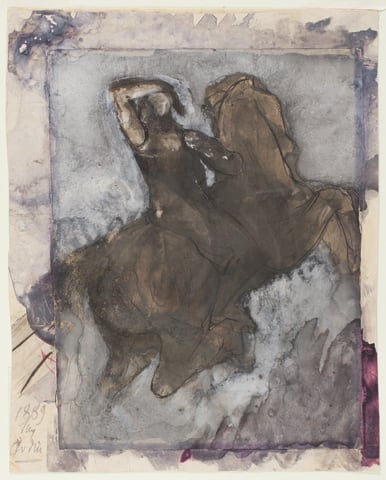
  2. A work made of gouache, with pen and brown and black ink and traces of magenta ink (faded), over graphite (recto), and graphite (verso) on cream wove paper, tipped onto cream wove paper.
    Horseman (recto); Horse and Rider (verso)Auguste Rodin, 1889Courtesy of the Art Institute of Chicago
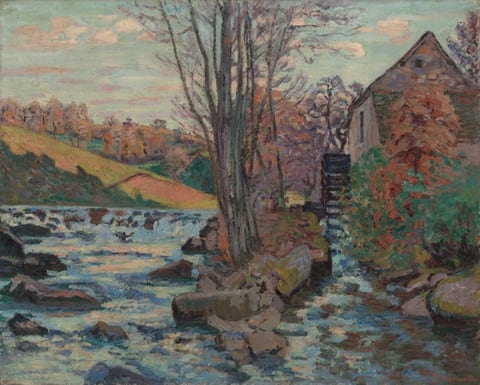
  3. A work made of oil on canvas.
    Mill of Pont MaupuitJean Baptiste Armand Guillaumin, c. 1900Courtesy of the Art Institute of Chicago
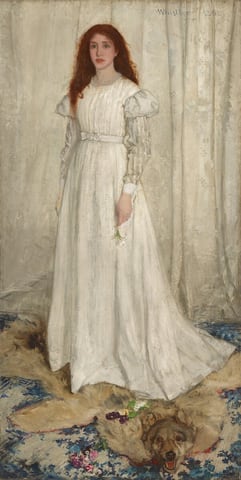
  4. A young woman with pale, peachy skin, wearing a long, flowing white dress, stands in front of a white curtain in this vertical portrait painting. Her auburn-red hair cascades down over and behind her shoulders. She looks to our left with green eyes, and her pink, full lips are closed. Her dress has puffed shoulders above a white-on-white striped pattern on the long sleeves. She stands on an animal pelt; it is not clear whether it is a wolf or a bear. The pelt spans the width of the painting and overlaps a blue patterned carpet. The animal’s mouth gapes to show sharp teeth. Its glassy eyes are wide open, and it seems to look at us. The edges of the animal skin are red. The woman holds a white lily by her side in her left hand, while yellow and purple flowers lie scattered on the pelt.
    Symphony in White, No. 1: The White GirlJames McNeill Whistler, 1861-1863, 1872Courtesy National Gallery of Art, Washington

Section 2, south wall
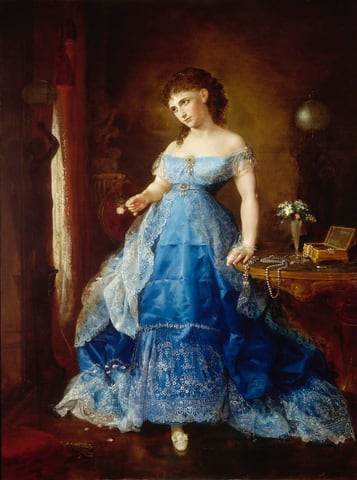
  1. We Both Must Fade (Mrs. Fithian), by Lilly Martin Spencer, 1869
    We Both Must Fade (Mrs. Fithian)Lilly Martin Spencer, 1869Courtesy of the Smithsonian American Art Museum
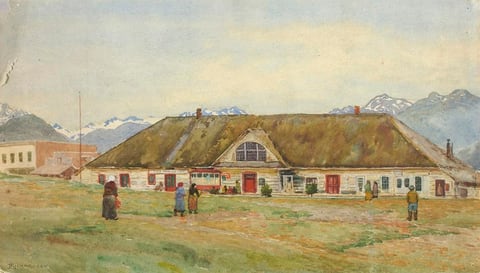
  2. Old Russian Trading Post, Sitka, by Theodore J. Richardson, ca. 1880-1914
    Old Russian Trading Post, SitkaTheodore J. Richardson, ca. 1880-1914Courtesy of the Smithsonian American Art Museum
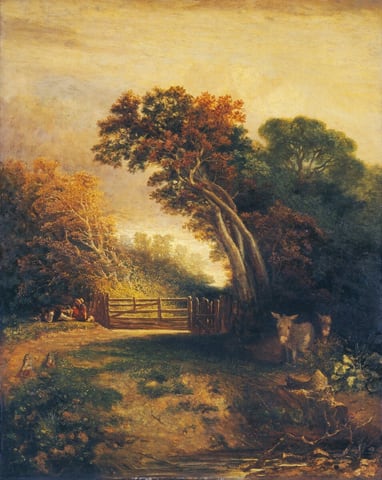
  3. This painting shows a serene pastoral scene with trees, a wooden gate, and foliage extending towards the horizon. Closest to us, there is a low riverbank with some tree branches in the water. Up a grassy dirt hill, two donkeys are visible off to the right, partially hidden by vegetation. On the left, a dirt path leads to the wooden gate. To the left of the gate, two people sit on the grass with a wicker basket between them. The tall trees that rise in the background have leaves in shades of green, yellow, and dark orange. The sky above the scene is yellow with some hints of light blue, and golden light shines down on the landscape.
    Landscape with Picnickers and Donkeys by a GateJoseph Paul, c. 1830-1880Courtesy National Gallery of Art, Washington
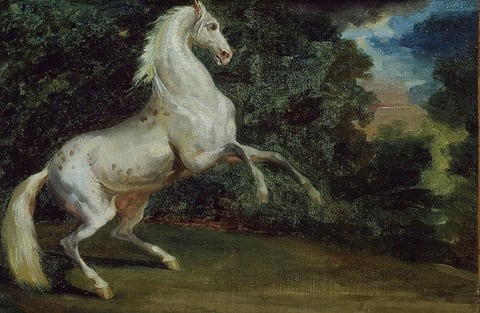
  4. A work made of oil on canvas.
    Prancing HorseFollower of Jean Louis André Théodore Géricault, 1808–12Courtesy of the Art Institute of Chicago

Section 2, north wall
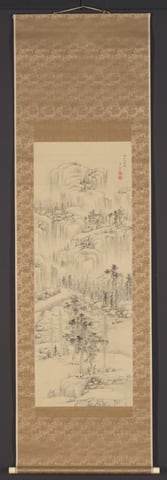
  1. A work made of hanging scroll; ink on silk.
    Trees in the Clouds on Layered Mountains (Jûzan umbokuzu)Nakabayashi Chikutô, 1853Courtesy of the Art Institute of Chicago
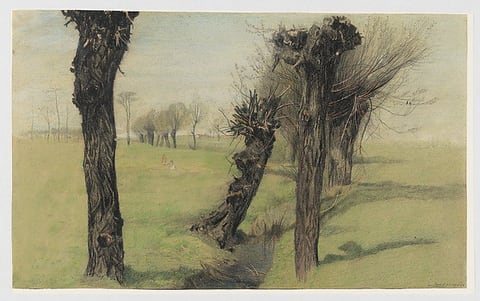
  2. Willow trees at a brook (Weidenbach near Neuostra), by Emilie Mediz-Pelikan, 1895
    Willow trees at a brook (Weidenbach near Neuostra)Emilie Mediz-Pelikan, 1895Courtesy of The Metropolitan Museum of Art
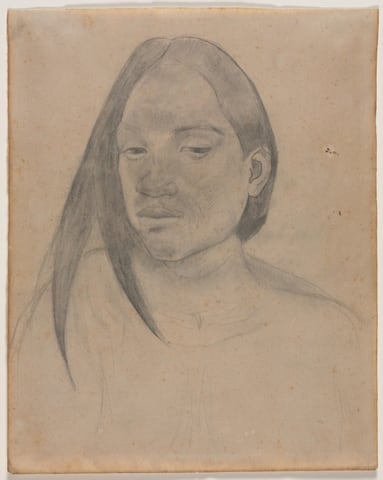
  3. Head of a Tahitian Woman, by Paul Gauguin, 1891
    Head of a Tahitian WomanPaul Gauguin, 1891Courtesy of the Cleveland Museum of Art
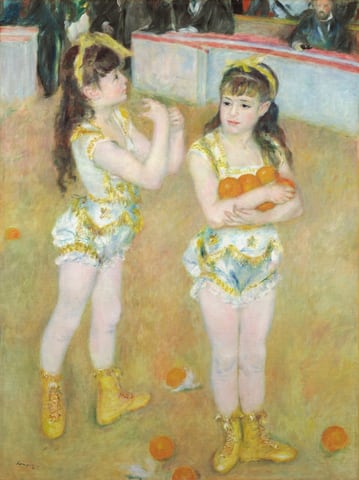
  4. Two girls in acrobatic uniforms stand in an arena, one holds oranges.
    Acrobats at the Cirque Fernando (Francisca and Angelina Wartenberg)Pierre-Auguste Renoir, 1879Courtesy of the Art Institute of Chicago

Walk on

  • The 19th century, room 2
  • More by Pierre-Auguste Renoir 12 works
  • More Impressionism 53 works
Ochre Editions

The world's museums, on your wall. Every work here is a reproduction of a public-domain original, credited to the museum that holds it.

Shop

All artCollectionsLimited dropsPrints and framing

Help

Find an orderShippingReturnsVerify a certificate

About

About Ochre EditionsMuseum creditsFor agentsDevelopers

Legal

Terms of UseTerms of SaleLimited Editions and CertificatesPrivacy PolicyCookie PolicyAcceptable Use PolicyAgent & API TermsCopyright and DMCA PolicyPrinting Your Own PhotoVulnerability Disclosure PolicyAccessibility StatementOpen-Access Credits
© 2026 Ochre EditionsPrices in US dollars. Prints ship within the United States.