Floor plan

Time and placeThe 20th century

The 20th century

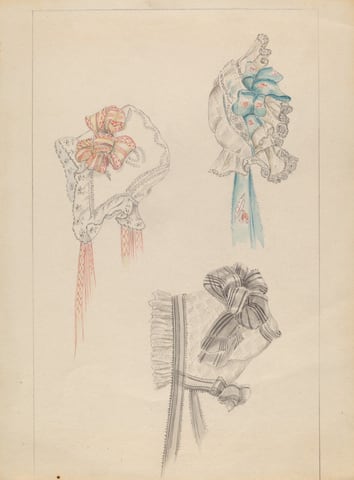
This is a drawing of three decorative bonnets. The drawing features three different hat designs, each embellished with lace, ribbon, and bow details. The upper left bonnet is adorned with pink hues and intricate lace, displaying a floral-like bow. The top right bonnet showcases a turquoise ribbon and bow, surrounded by soft lace. The lower bonnet is in grayscale, with shadowing for dimension, featuring a checkered ribbon. Each hat is detailed with line work and shading, conveying elegance.
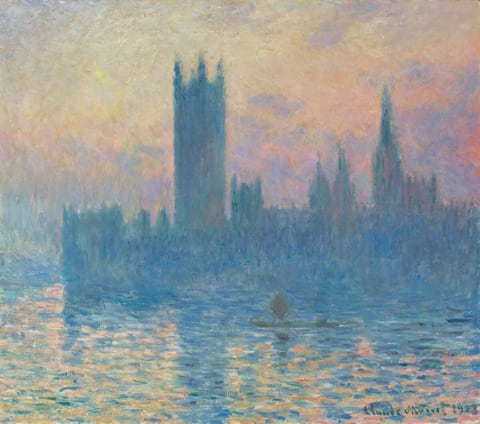
A row of spire-like structures of different heights is silhouetted in azure blue against a soft pink, yellow, peach, and lavender-purple sunset and reflected in a rippling river in this nearly square landscape painting. Along the horizon, the buildings stretch from our right, almost fully across the canvas, and are painted with vertical brushstrokes in cool shades of blue. The sky behind the towers seems hazy with intermingling, pastel-colored clouds. The buildings are reflected in the river, which fills the bottom third of the painting. The surface of the water is painted with short, horizontal brushstrokes in azure blue for the buildings, and apricot, rose, and marigold orange for the sky’s reflection. A streak and smudge of olive-green paint on the water represents a person in a boat near the center of the painting. The artist signed and dated the work in the same olive color at the lower right: “Claude Monet 1903.”
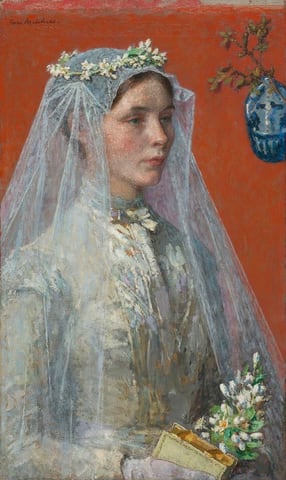
The Bride, by Gari Melchers, ca. 1907
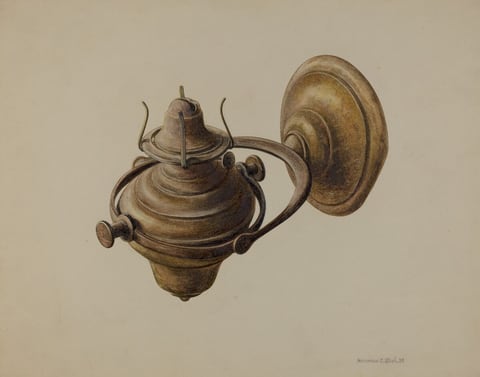
The image displays a detailed drawing of a vintage wall-mounted lamp. The color palette consists of primarily browns and earthy tones, with hints of a metallic sheen. The lamp is centered in the image, with its base attached to the right side and extending to the left. A subtle shadow and highlights give the lamp a three-dimensional appearance against a plain, light beige background.
A work made of oil on canvas.
This is a drawing of a dress design. The illustration features a dress with a square neckline, adorned with embroidery around the bust area. The dress has a high waistline with a gathered skirt. The lower part of the dress also features floral embroidery patterns. The design emphasizes fine lines and delicate patterns.
A square white tile, rotated 90 degrees, crossed by black lines intersecting at 90-degree angles. A few of the shapes thus formed—some partial squares, some rectangles—are colored in a single shade of yellow, blue, black, or red.
Painting of a pond seen up close spotted with thickly painted pink and white water lilies and a shadow across the top third of the picture.

The works in this room are listed below.

Works in this room

Works made in the 20th century, anywhere in the world.

Section 1, north wall

  1. This is a drawing of three decorative bonnets. The drawing features three different hat designs, each embellished with lace, ribbon, and bow details. The upper left bonnet is adorned with pink hues and intricate lace, displaying a floral-like bow. The top right bonnet showcases a turquoise ribbon and bow, surrounded by soft lace. The lower bonnet is in grayscale, with shadowing for dimension, featuring a checkered ribbon. Each hat is detailed with line work and shading, conveying elegance.
    CapsUnrecorded American maker, 1935/1942Courtesy National Gallery of Art, Washington
  2. A row of spire-like structures of different heights is silhouetted in azure blue against a soft pink, yellow, peach, and lavender-purple sunset and reflected in a rippling river in this nearly square landscape painting. Along the horizon, the buildings stretch from our right, almost fully across the canvas, and are painted with vertical brushstrokes in cool shades of blue. The sky behind the towers seems hazy with intermingling, pastel-colored clouds. The buildings are reflected in the river, which fills the bottom third of the painting. The surface of the water is painted with short, horizontal brushstrokes in azure blue for the buildings, and apricot, rose, and marigold orange for the sky’s reflection. A streak and smudge of olive-green paint on the water represents a person in a boat near the center of the painting. The artist signed and dated the work in the same olive color at the lower right: “Claude Monet 1903.”
    The Houses of Parliament, SunsetClaude Monet, 1903Courtesy National Gallery of Art, Washington
  3. The Bride, by Gari Melchers, ca. 1907
    The BrideGari Melchers, ca. 1907Courtesy of the Smithsonian American Art Museum
  4. The image displays a detailed drawing of a vintage wall-mounted lamp. The color palette consists of primarily browns and earthy tones, with hints of a metallic sheen. The lamp is centered in the image, with its base attached to the right side and extending to the left. A subtle shadow and highlights give the lamp a three-dimensional appearance against a plain, light beige background.
    Binnacle LampHerman O. Stroh, 1938Courtesy National Gallery of Art, Washington

Section 1, south wall

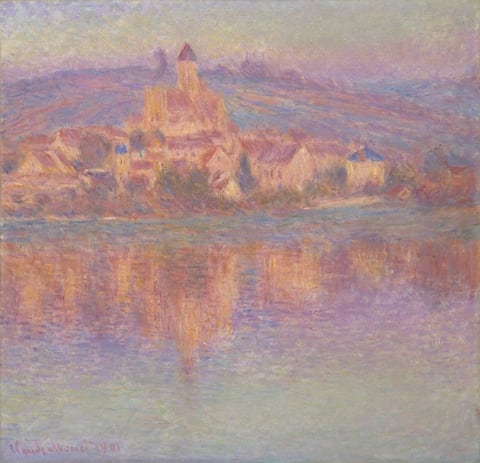
  1. A work made of oil on canvas.
    VétheuilClaude Monet, 1901Courtesy of the Art Institute of Chicago
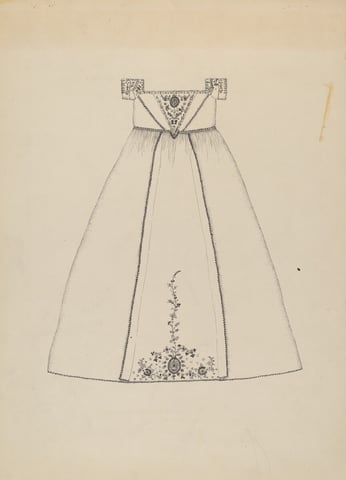
  2. This is a drawing of a dress design. The illustration features a dress with a square neckline, adorned with embroidery around the bust area. The dress has a high waistline with a gathered skirt. The lower part of the dress also features floral embroidery patterns. The design emphasizes fine lines and delicate patterns.
    Baptismal DressEvelyn Bailey, c. 1936Courtesy National Gallery of Art, Washington
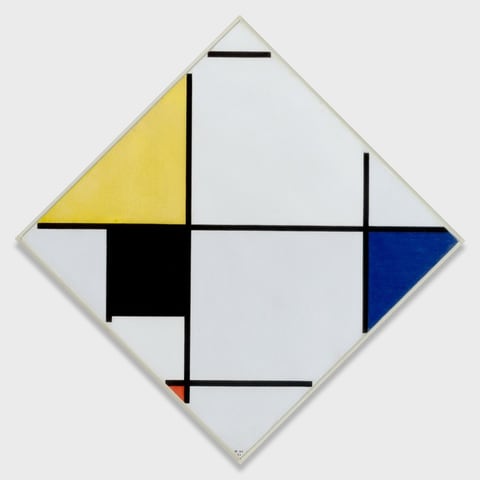
  3. A square white tile, rotated 90 degrees, crossed by black lines intersecting at 90-degree angles. A few of the shapes thus formed—some partial squares, some rectangles—are colored in a single shade of yellow, blue, black, or red.
    Lozenge Composition with Yellow, Black, Blue, Red, and GrayPiet Mondrian, 1921Courtesy of the Art Institute of Chicago
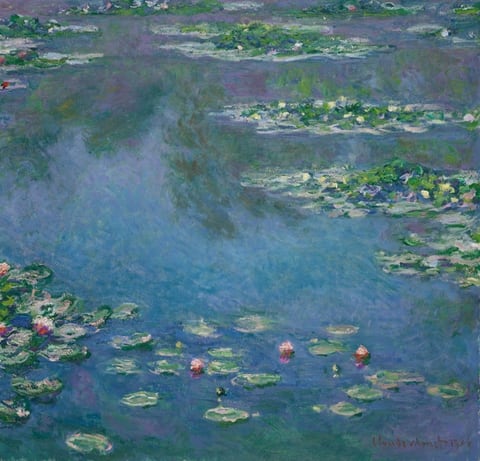
  4. Painting of a pond seen up close spotted with thickly painted pink and white water lilies and a shadow across the top third of the picture.
    Water LiliesClaude Monet, 1906Courtesy of the Art Institute of Chicago

Section 2, south wall
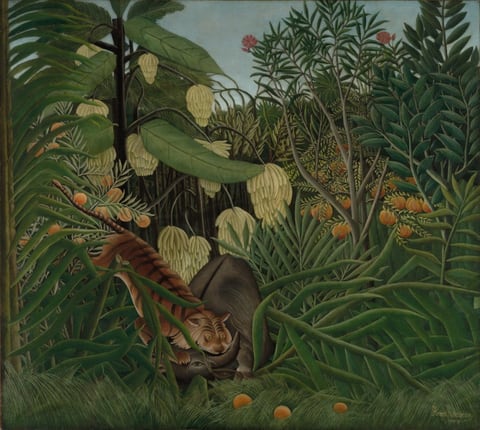
  1. Fight Between a Tiger and a Buffalo, by Henri Rousseau, 1908
    Fight Between a Tiger and a BuffaloHenri Rousseau, 1908Courtesy of the Cleveland Museum of Art
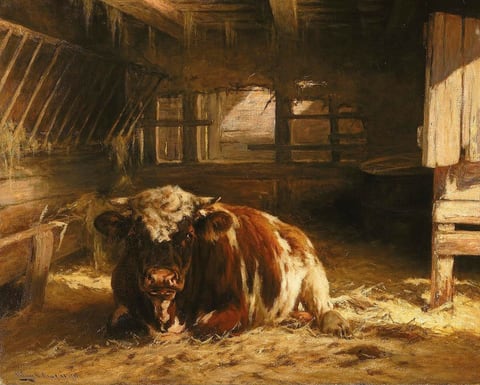
  2. My Day at Home, by William H. Howe, 1906
    My Day at HomeWilliam H. Howe, 1906Courtesy of the Smithsonian American Art Museum
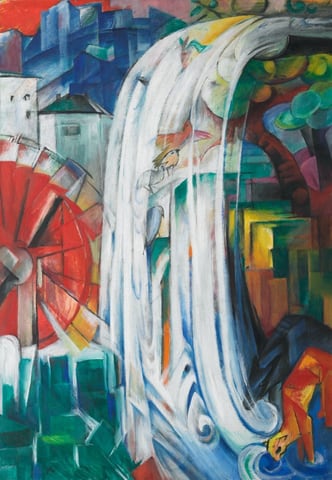
  3. Vibrantly colored geometric painting of a central white and blue waterfall with birds visible through it. A stylized red jungle cat and black wild boar drink at bottom right. Red water wheel at left, angular blue and white cityscape top at left, tree top at right.
    The Bewitched MillFranz Marc, 1913Courtesy of the Art Institute of Chicago

Section 2, north wall
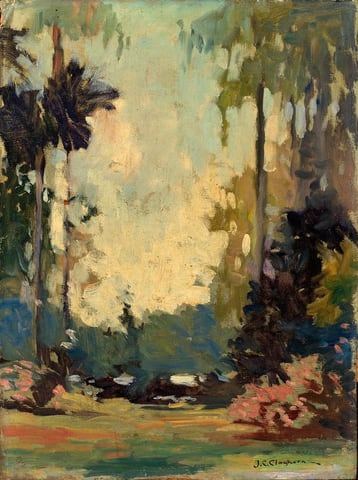
  1. A Florida Park, by Joseph C. Claghorn, before 1935
    A Florida ParkJoseph C. Claghorn, before 1935Courtesy of the Smithsonian American Art Museum
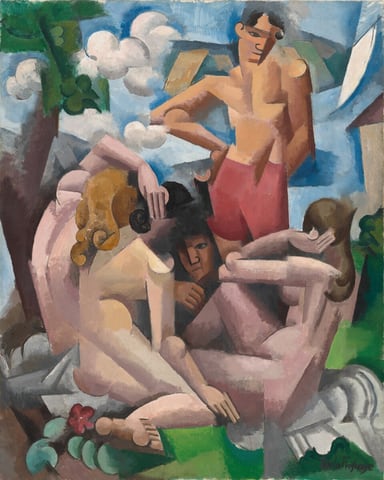
  2. This painting depicts a group of men and women created by a collection of angular, geometric shapes with flat planes and blocks of color. One person is standing, and they appear to be a bare-chested man with tan skin and short, dark hair, who is wearing red shorts. He has his hand on his hip and looks off to the right. At his feet appear to be several seated people, although they are only partially visible. Three women with pale skin seem to be facing away from us; we can see their legs, arms, and torsos, although these don't all fit together. The woman on the left has blonde hair, the woman on the right has brown hair, and the woman between them has short black hair. None of their faces are visible. In the middle of this group, at the center of the painting, we see the face and hand of another person who is looking to the left. This person has light brown skin, and we can't see the rest of their body. Surrounding elements include a blue sky with abstract cloud forms, an angular tree on the left, and patches of brown, white, and green on the ground, with one red flower. A tan rectangle under a red triangle on the right edge suggests a building.
    The BathersRoger de La Fresnaye, 1912Courtesy National Gallery of Art, Washington
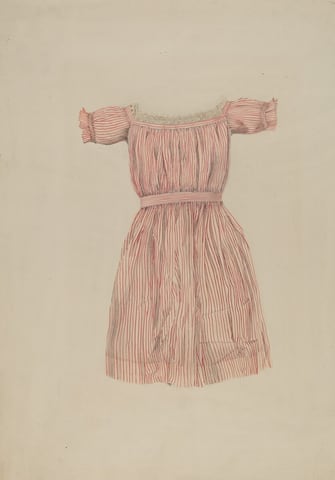
  3. The image shows a dress with a pink and white vertical striped pattern. The color palette is predominantly soft pinks and whites with subtle shading for light and shadow effects on the fabric. The dress is positioned at the center of the image, with sleeves extending slightly outward to the sides.
    Child's DressLucien Verbeke, c. 1937Courtesy National Gallery of Art, Washington

Section 3, north wall
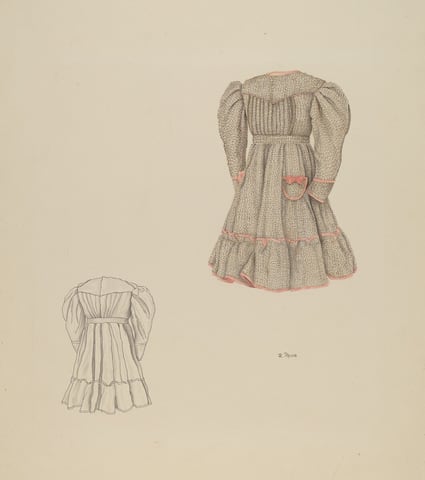
  1. The image depicts a detailed illustration of a dress with exaggerated puff sleeves and ruffles towards the bottom. It is created using a dotted pattern with red accents around the edges and seams. The color palette consists of mostly muted tones with touches of red. The dress is positioned in the upper right quadrant of the image, while a smaller, less detailed sketch of the same dress without colors is located in the lower left quadrant.
    Child's DressRay Price, c. 1937Courtesy National Gallery of Art, Washington
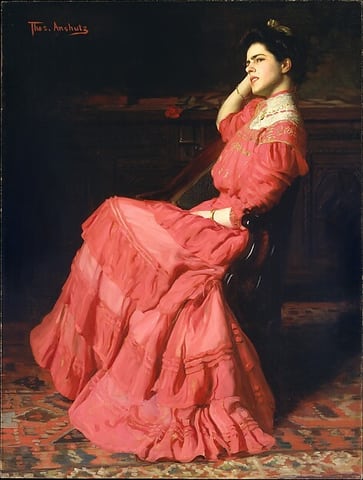
  2. A Rose, by Thomas Anshutz, 1907
    A RoseThomas Anshutz, 1907Courtesy of The Metropolitan Museum of Art