Floor plan

Time and placeThe 20th century

The 20th century

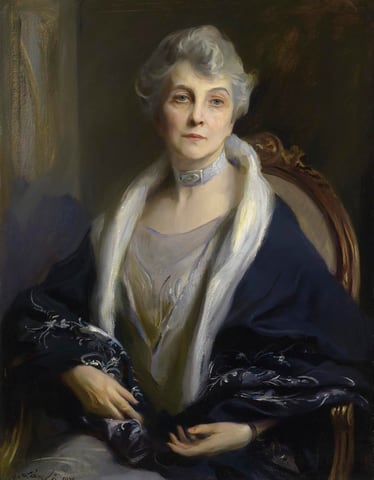
Artist: Philip Alexius de László, Sitter: Clara Margaret Cook Kellogg, Current owner: National Portrait Gallery, Smithsonian Institution
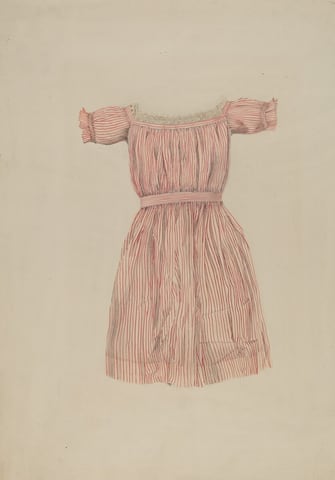
The image shows a dress with a pink and white vertical striped pattern. The color palette is predominantly soft pinks and whites with subtle shading for light and shadow effects on the fabric. The dress is positioned at the center of the image, with sleeves extending slightly outward to the sides.
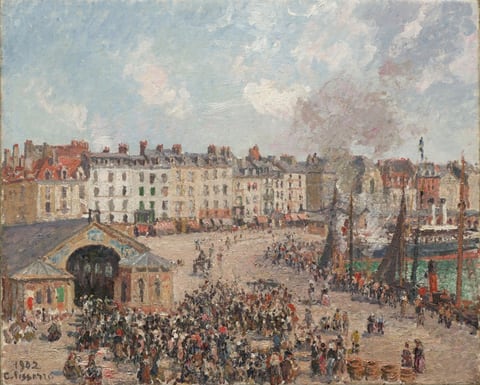
Fishmarket, by Camille Pissarro, 1902
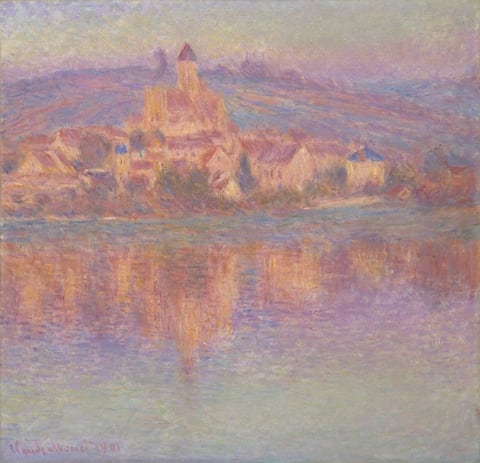
A work made of oil on canvas.
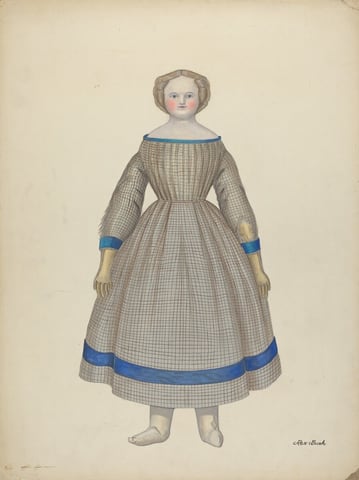
The image depicts a person standing upright. The person has a round face with a small mouth and rosy cheeks, and their hair is styled smoothly with a middle part. They are wearing a long-sleeved dress with a checkered pattern in subdued colors, highlighted with blue bands around the sleeves and hem. The dress has a fitted bodice and a full skirt. Bare feet are visible under the dress. The background is plain and neutral, and there is a signature in the lower right corner.
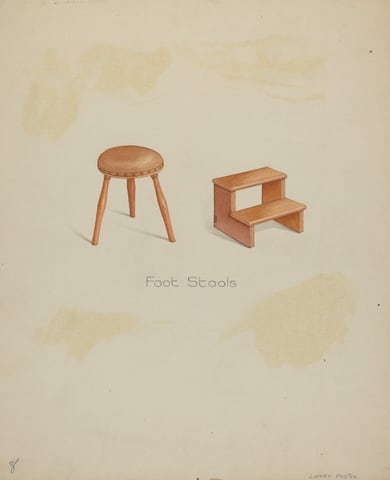
The image shows two foot stools. One is a round stool with four legs and the other is a small two-step wooden staircase. The color palette includes shades of brown and tan against a light beige background. The round stool is positioned to the left, and the step-stool is to the right. Both are labeled with the words "Foot Stools" below them.
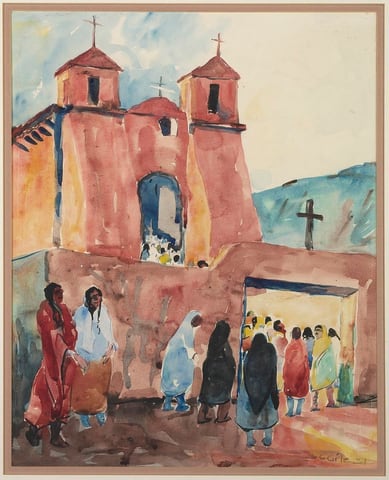
Church, Rancho de Taos, by Selden Connor Gile, 1931
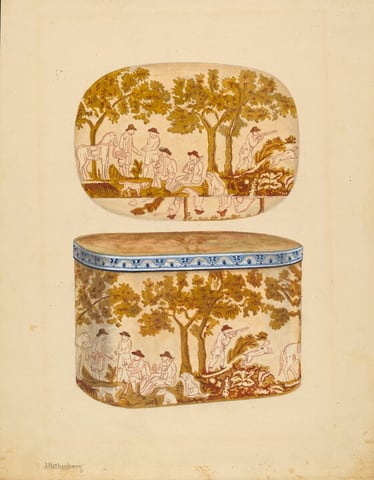
This is a painting of a decorative box with pastoral scenes. The box has an oval lid and rectangular base adorned with intricate pastoral scenes in earthy tones. The scenes depict landscapes with trees, hills, and figures engaged in various activities against a warm backdrop. The lid has a similar scene, creating a cohesive decorative theme. The style resembles 19th-century European art focusing on pastoral genre scenes and decorative arts. The artwork delicately balances detail and composition, evoking calm and nostalgia.

The works in this room are listed below.

Works in this room

Works made in the 20th century, anywhere in the world.

Section 1, north wall

  1. Artist: Philip Alexius de László, Sitter: Clara Margaret Cook Kellogg, Current owner: National Portrait Gallery, Smithsonian Institution
    Clara Cook KelloggPhilip Alexius de László, 1929Courtesy of the National Portrait Gallery, Smithsonian Institution
  2. The image shows a dress with a pink and white vertical striped pattern. The color palette is predominantly soft pinks and whites with subtle shading for light and shadow effects on the fabric. The dress is positioned at the center of the image, with sleeves extending slightly outward to the sides.
    Child's DressLucien Verbeke, c. 1937Courtesy National Gallery of Art, Washington
  3. Fishmarket, by Camille Pissarro, 1902
    FishmarketCamille Pissarro, 1902Courtesy of the Cleveland Museum of Art
  4. A work made of oil on canvas.
    VétheuilClaude Monet, 1901Courtesy of the Art Institute of Chicago

Section 1, south wall

  1. The image depicts a person standing upright. The person has a round face with a small mouth and rosy cheeks, and their hair is styled smoothly with a middle part. They are wearing a long-sleeved dress with a checkered pattern in subdued colors, highlighted with blue bands around the sleeves and hem. The dress has a fitted bodice and a full skirt. Bare feet are visible under the dress. The background is plain and neutral, and there is a signature in the lower right corner.
    Doll - "Emily"Rex F. Bush, c. 1938Courtesy National Gallery of Art, Washington
  2. The image shows two foot stools. One is a round stool with four legs and the other is a small two-step wooden staircase. The color palette includes shades of brown and tan against a light beige background. The round stool is positioned to the left, and the step-stool is to the right. Both are labeled with the words "Foot Stools" below them.
    Shaker StoolsLawrence Foster, 1935/1942Courtesy National Gallery of Art, Washington
  3. Church, Rancho de Taos, by Selden Connor Gile, 1931
    Church, Rancho de TaosSelden Connor Gile, 1931Courtesy of the Smithsonian American Art Museum
  4. This is a painting of a decorative box with pastoral scenes. The box has an oval lid and rectangular base adorned with intricate pastoral scenes in earthy tones. The scenes depict landscapes with trees, hills, and figures engaged in various activities against a warm backdrop. The lid has a similar scene, creating a cohesive decorative theme. The style resembles 19th-century European art focusing on pastoral genre scenes and decorative arts. The artwork delicately balances detail and composition, evoking calm and nostalgia.
    BandboxJohn Tarantino, c. 1937Courtesy National Gallery of Art, Washington

Section 2, south wall
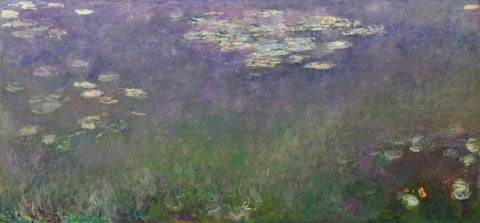
  1. Water Lilies (Agapanthus), by Claude Monet, c. 1915–26
    Water Lilies (Agapanthus)Claude Monet, c. 1915–26Courtesy of the Cleveland Museum of Art
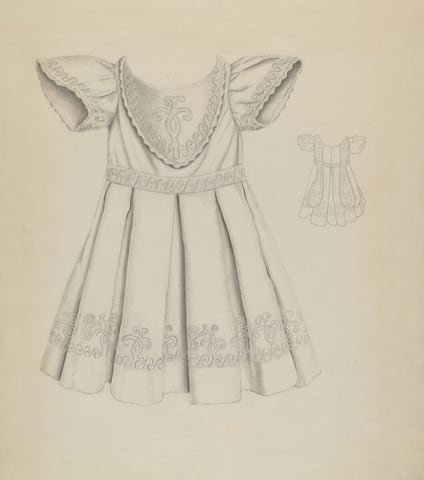
  2. The image shows a detailed sketch of a dress with short, puffed sleeves and a decorative neckline. There is a smaller sketch of the same dress to the right. The color palette is monochrome gray scale, with darker gray outlines and details against a light gray background. The main dress is centered, with the smaller sketch positioned to the right.
    Child's DressRay Price, c. 1937Courtesy National Gallery of Art, Washington
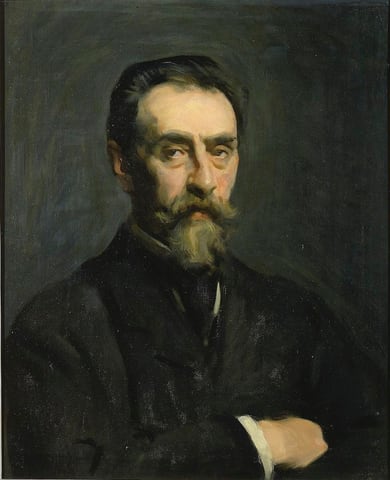
  3. Portrait of William E. Norton, by William Penhallow Henderson, 1901
    Portrait of William E. NortonWilliam Penhallow Henderson, 1901Courtesy of the Smithsonian American Art Museum

Section 2, north wall
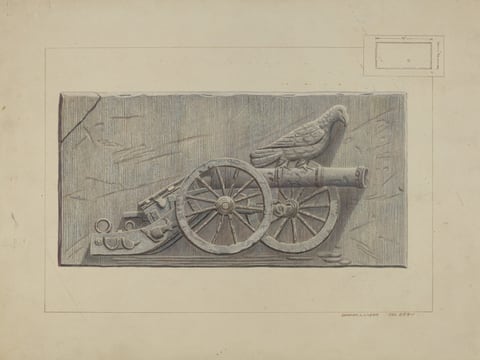
  1. This image shows an engraved design featuring a cannon with large wheels next to an eagle perched on top, situated on the left side of a rectangular stone slab. The color scheme is predominantly grayscale with subtle hints of blue and gray tones throughout the stone surface. The cannon is positioned slightly to the left in the composition, with its barrel pointing to the right, while the eagle is perched on the cannon barrel facing forward, wings tucked close to its body. To accompany the cannon, a stack of cannonballs is carved on the lower left, further anchoring the scene within the carved rectangle.
    Bas ReliefEdward L. Loper, c. 1938Courtesy National Gallery of Art, Washington
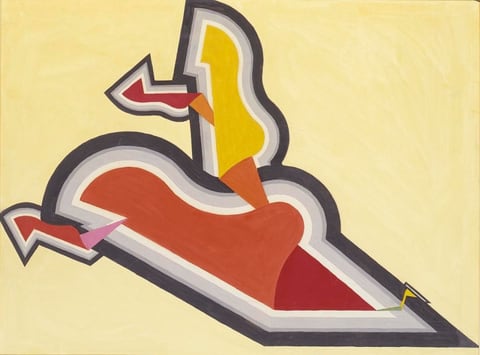
  2. Study in Rhythm: Red and Gold, by Joseph Schillinger, ca. 1934
    Study in Rhythm: Red and GoldJoseph Schillinger, ca. 1934Courtesy of the Smithsonian American Art Museum
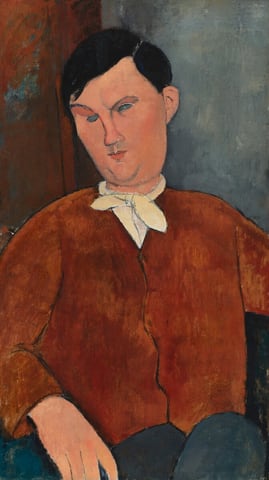
  3. Shown from the lap up, a person with peach-colored skin sits facing us as he looks down and to our left in this vertical, stylized, portrait painting. The person’s clothing and features are outlined with thin black lines, and areas are filled in with mottled, streaked color painted with visible strokes. The person has a round face with a double chin and a small red mouth. The eyes are painted as slate-blue slivers under thin brows, one of which is cocked. The man’s short black hair is parted to one side and combed across the top of his head. He wears a white cravat tied at his neck under a rust-red jacket or shirt. Two rounded, muted blue forms below suggest crossed knees. The man’s right elbow rests next to his body, and that hand is near his lap. The background is painted with pecan brown on the left third and gray-blue on the right two-thirds.
    Monsieur DeleuAmedeo Modigliani, 1916Courtesy National Gallery of Art, Washington

Section 3, north wall
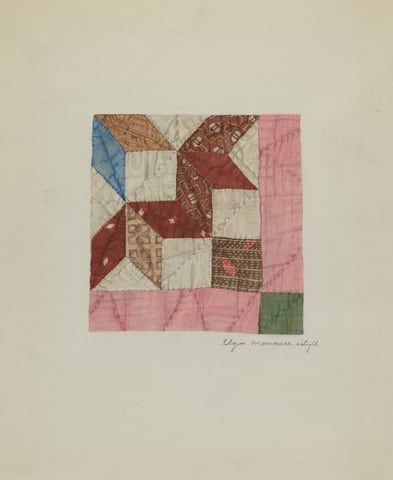
  1. This is a painting of a quilt design pattern. The image depicts a square quilt block featuring a variety of geometric shapes and patterns pieced together. The quilt features a mix of colors, including blues, reds, browns, and a pink border, with intricate patterns in the fabric segments. The textures and colors create an intricate optical composition resembling different geometric forms and depth. The piece is delicately framed within a larger white space, which emphasizes the detail of the quilt pattern. This is in the style of a traditional textile or quilting pattern illustrator.
    Cotton Bed QuiltElgin Moncure Styll, c. 1941Courtesy National Gallery of Art, Washington
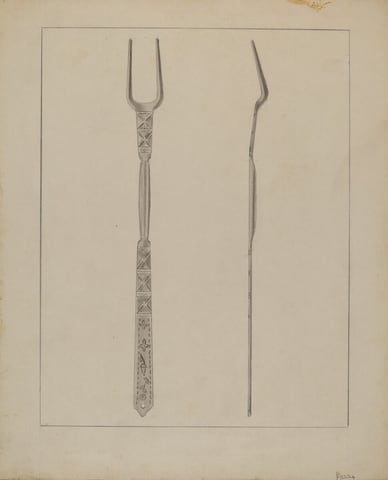
  2. This is a drawing of a tool with intricate patterns. The tool appears elongated with a pronged end, and features symmetrical geometric designs etched along the handle. The drawing also includes a side profile showing its slender form.
    ForkAnthony Zuccarello, c. 1936Courtesy National Gallery of Art, Washington