Floor plan

Time and placeThe 20th century

The 20th century

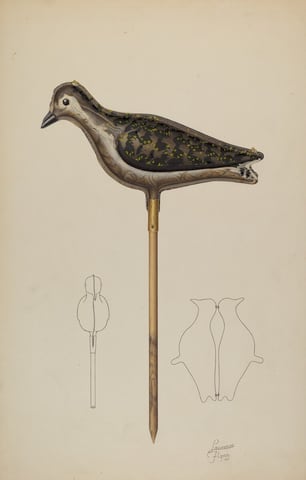
The image shows a painted decoy of a bird mounted on a wooden stake. The decoy has intricate details with spots of yellow and green on top of a dark body. The colors are naturalistic with brown, black, yellow, white, and beige. In the lower left section of the image, there are two line drawings of a bird.
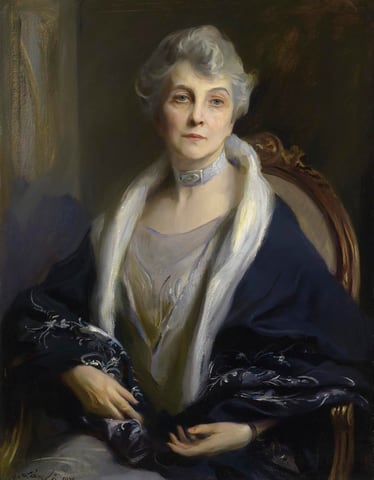
Artist: Philip Alexius de László, Sitter: Clara Margaret Cook Kellogg, Current owner: National Portrait Gallery, Smithsonian Institution
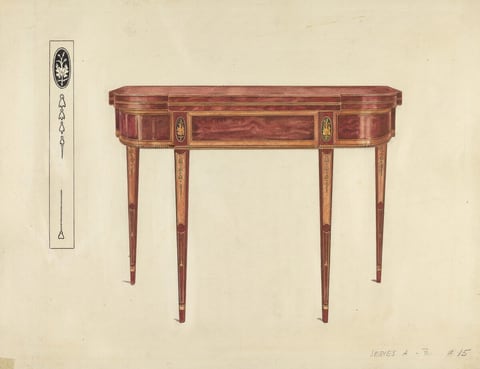
The image shows a wooden side table with a smooth surface and four tapered legs, as well as a decorative drawer front. The table has a rich brown color with gold accents and black inlay details. It is positioned towards the center of the image. On the left, there are design patterns in an oval shape and a thin line drawing. The background is off-white. There are handwritten numbers and letters at the bottom right corner of the image.
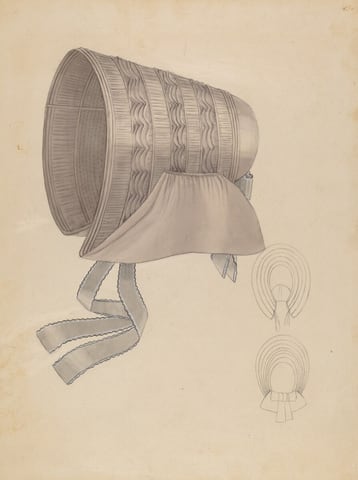
This is an image of a bonnet and its details. The drawing showcases a bonnet with intricate design and texture. The bonnet is viewed from the side, revealing its woven structure with patterns representing fabric pleats or folds. It has a long ribbon hanging from the back, depicted with flowing lines. There are also two smaller sketches showing the bonnet from the back, emphasizing its shape and construction. The background is plain.
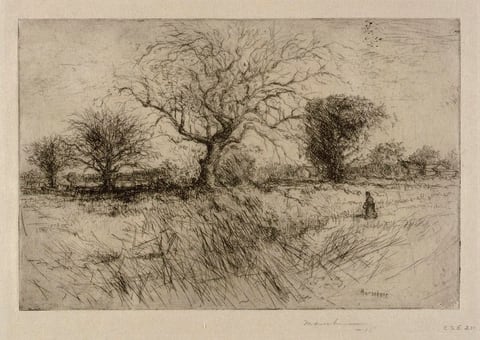
The Old Orchard, by Arthur A. Marschner, 1915
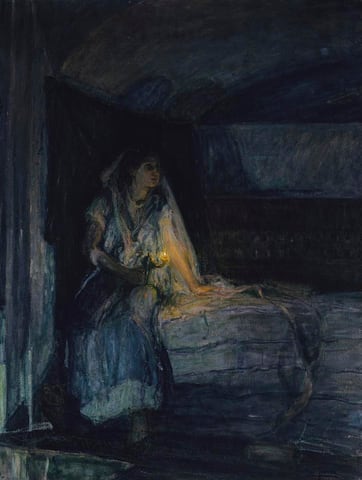
Mary, by Henry Ossawa Tanner, ca. 1914
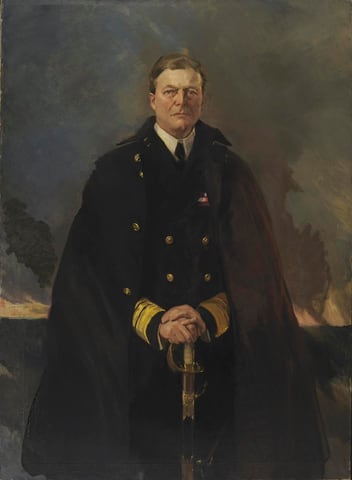
Admiral Sir David Beatty, Lord Beatty, by Cecilia Beaux, ca. 1920
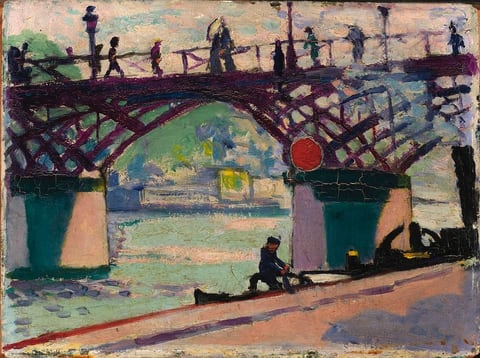
Pont des Arts, by H. Lyman Saÿen, 1908-1911

The works in this room are listed below.

Works in this room

Works made in the 20th century, anywhere in the world.

Section 1, north wall

  1. The image shows a painted decoy of a bird mounted on a wooden stake. The decoy has intricate details with spots of yellow and green on top of a dark body. The colors are naturalistic with brown, black, yellow, white, and beige. In the lower left section of the image, there are two line drawings of a bird.
    Snipe DecoyLawrence Flynn, 1941Courtesy National Gallery of Art, Washington
  2. Artist: Philip Alexius de László, Sitter: Clara Margaret Cook Kellogg, Current owner: National Portrait Gallery, Smithsonian Institution
    Clara Cook KelloggPhilip Alexius de László, 1929Courtesy of the National Portrait Gallery, Smithsonian Institution
  3. The image shows a wooden side table with a smooth surface and four tapered legs, as well as a decorative drawer front. The table has a rich brown color with gold accents and black inlay details. It is positioned towards the center of the image. On the left, there are design patterns in an oval shape and a thin line drawing. The background is off-white. There are handwritten numbers and letters at the bottom right corner of the image.
    Card TableFlorence Choate, c. 1953Courtesy National Gallery of Art, Washington
  4. This is an image of a bonnet and its details. The drawing showcases a bonnet with intricate design and texture. The bonnet is viewed from the side, revealing its woven structure with patterns representing fabric pleats or folds. It has a long ribbon hanging from the back, depicted with flowing lines. There are also two smaller sketches showing the bonnet from the back, emphasizing its shape and construction. The background is plain.
    BonnetBessie Forman, c. 1936Courtesy National Gallery of Art, Washington

Section 1, south wall

  1. The Old Orchard, by Arthur A. Marschner, 1915
    The Old OrchardArthur A. Marschner, 1915Courtesy of the Smithsonian American Art Museum
  2. Mary, by Henry Ossawa Tanner, ca. 1914
    MaryHenry Ossawa Tanner, ca. 1914Courtesy of the Smithsonian American Art Museum
  3. Admiral Sir David Beatty, Lord Beatty, by Cecilia Beaux, ca. 1920
    Admiral Sir David Beatty, Lord BeattyCecilia Beaux, ca. 1920Courtesy of the Smithsonian American Art Museum
  4. Pont des Arts, by H. Lyman Saÿen, 1908-1911
    Pont des ArtsH. Lyman Saÿen, 1908-1911Courtesy of the Smithsonian American Art Museum

Section 2, south wall
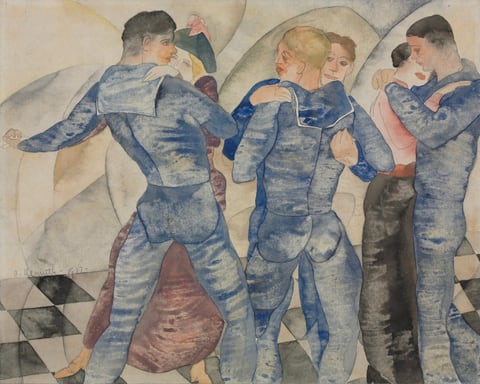
  1. Dancing Sailors, by Charles Demuth, 1917
    Dancing SailorsCharles Demuth, 1917Courtesy of the Cleveland Museum of Art
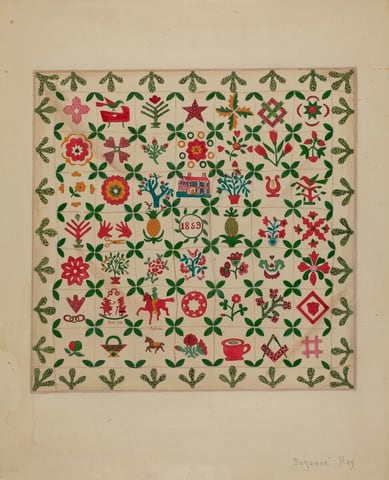
  2. This is a painting of a decorative quilt pattern. The image shows a grid of square sections with various colorful motifs including stars, flowers, a horse, a house, and a cup. The design features vibrant colors, symmetrical patterns, and a central section with the date "1859". The quilt border has leaf-like patterns creating a frame around the central grid. The style is folk art.
    Applique QuiltSuzanne Roy, 1938Courtesy National Gallery of Art, Washington
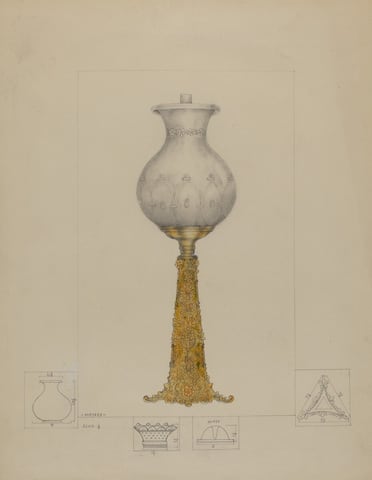
  3. This is a drawing of a decorative vase design. The central focus of the image is a detailed drawing of a vase with a bulbous body and a flared top, placed on an intricately designed tall stand. The stand features elaborate ornate patterns, giving it an almost floral appearance with its swirling details and golden hue. The vase itself has subtle decorative elements engraved or painted around its surface. Surrounding the primary image are additional sketches showcasing different parts and views of the vase, such as its profile, the pattern, and cross-sectional diagrams. These supplementary sketches provide further insight into the structural and decorative design aspects of the vase. The careful attention to scale and detail suggests this is a design blueprint for a piece of decorative art.
    Metal Base LampHenry Meyers, c. 1936Courtesy National Gallery of Art, Washington
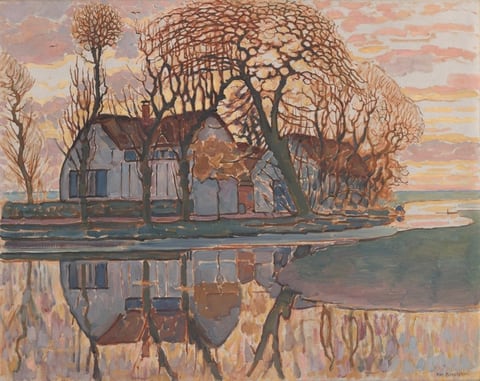
  4. A work made of oil on canvas.
    Farm near DuivendrechtPiet Mondrian, c. 1916Courtesy of the Art Institute of Chicago

Section 2, north wall
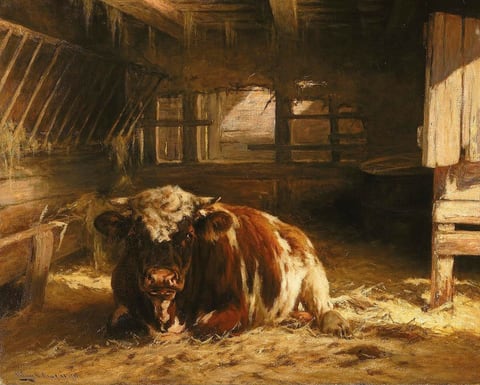
  1. My Day at Home, by William H. Howe, 1906
    My Day at HomeWilliam H. Howe, 1906Courtesy of the Smithsonian American Art Museum
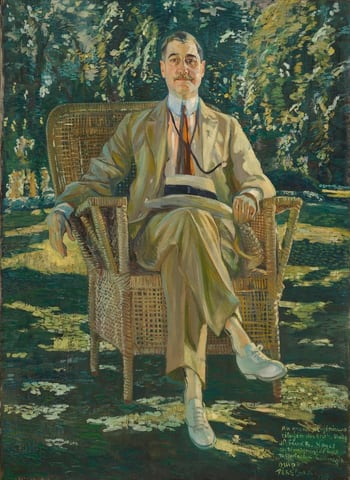
  2. Artist: Ossip Perelma, Sitter: Frank Brett Noyes, Current owner: National Portrait Gallery, Smithsonian Institution
    Frank Brett NoyesOssip Perelma, 1917Courtesy of the National Portrait Gallery, Smithsonian Institution

Section 3, north wall
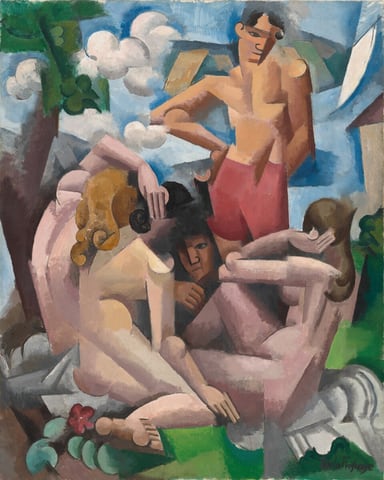
  1. This painting depicts a group of men and women created by a collection of angular, geometric shapes with flat planes and blocks of color. One person is standing, and they appear to be a bare-chested man with tan skin and short, dark hair, who is wearing red shorts. He has his hand on his hip and looks off to the right. At his feet appear to be several seated people, although they are only partially visible. Three women with pale skin seem to be facing away from us; we can see their legs, arms, and torsos, although these don't all fit together. The woman on the left has blonde hair, the woman on the right has brown hair, and the woman between them has short black hair. None of their faces are visible. In the middle of this group, at the center of the painting, we see the face and hand of another person who is looking to the left. This person has light brown skin, and we can't see the rest of their body. Surrounding elements include a blue sky with abstract cloud forms, an angular tree on the left, and patches of brown, white, and green on the ground, with one red flower. A tan rectangle under a red triangle on the right edge suggests a building.
    The BathersRoger de La Fresnaye, 1912Courtesy National Gallery of Art, Washington
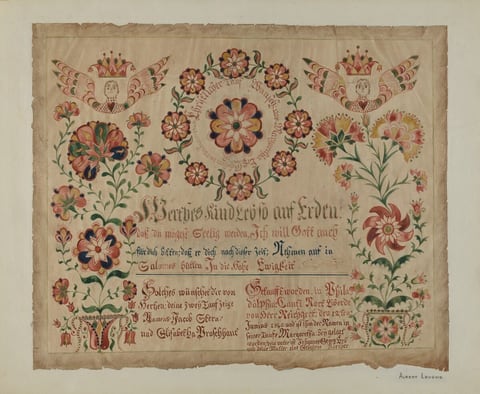
  2. This is a painting of a colorful floral design with text. The artwork features stylized flowers in shades of red, green, and yellow scattered across the page. In the center, there is calligraphic text in varying boldness and fonts, likely in German. Two symmetrical bird-like figures with human faces and crowns are above the text. The piece combines imagery with artistic lettering in a style reminiscent of traditional Pennsylvania German fraktur. The artwork is bordered by a thin line, suggesting it's part of a larger artifact or document.
    Pa. German Birth CertificateAlbert Levone, c. 1940Courtesy National Gallery of Art, Washington