Skip to content
Ochre Editions
ArtArtistsCollectionsGalleriesDrops
SearchSign inCart (0)
The galleries · Time and place

The 20th century

Works made in the 20th century, anywhere in the world.

189 works · hang 5634 ·

Share The 20th century, in the galleries

The rooms are imagined; every work on their walls is real.

Walk this roomRehang this room

Section 1, north wall

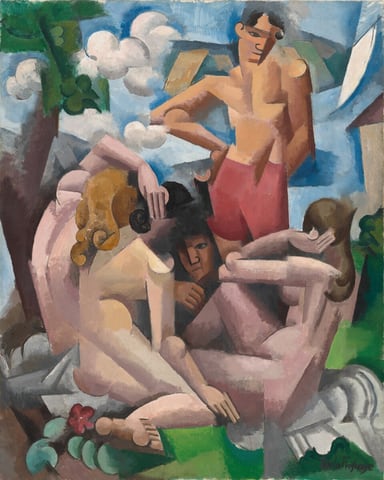
  1. This painting depicts a group of men and women created by a collection of angular, geometric shapes with flat planes and blocks of color. One person is standing, and they appear to be a bare-chested man with tan skin and short, dark hair, who is wearing red shorts. He has his hand on his hip and looks off to the right. At his feet appear to be several seated people, although they are only partially visible. Three women with pale skin seem to be facing away from us; we can see their legs, arms, and torsos, although these don't all fit together. The woman on the left has blonde hair, the woman on the right has brown hair, and the woman between them has short black hair. None of their faces are visible. In the middle of this group, at the center of the painting, we see the face and hand of another person who is looking to the left. This person has light brown skin, and we can't see the rest of their body. Surrounding elements include a blue sky with abstract cloud forms, an angular tree on the left, and patches of brown, white, and green on the ground, with one red flower. A tan rectangle under a red triangle on the right edge suggests a building.
    The BathersRoger de La Fresnaye, 1912Courtesy National Gallery of Art, Washington
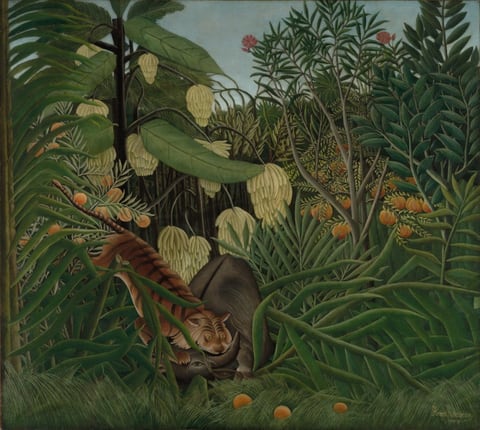
  2. Fight Between a Tiger and a Buffalo, by Henri Rousseau, 1908
    Fight Between a Tiger and a BuffaloHenri Rousseau, 1908Courtesy of the Cleveland Museum of Art
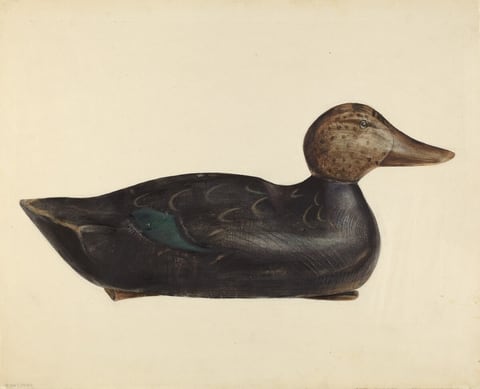
  3. The image shows a wooden duck decoy against a plain, light-colored background. The duck is crafted in various shades of brown, black, and green with subtle highlights in lighter tones. The duck is facing to the right side of the frame, with its head slightly tilted upward.
    DecoyMina Lowry, c. 1940Courtesy National Gallery of Art, Washington

Section 1, south wall
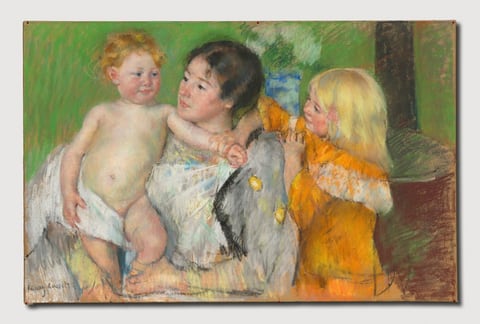
  1. After the Bath, by Mary Cassatt, 1901
    After the BathMary Cassatt, 1901Courtesy of the Cleveland Museum of Art
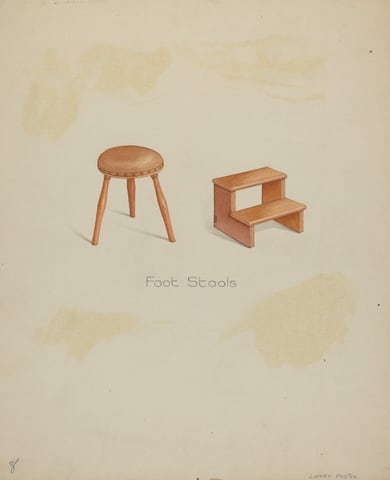
  2. The image shows two foot stools. One is a round stool with four legs and the other is a small two-step wooden staircase. The color palette includes shades of brown and tan against a light beige background. The round stool is positioned to the left, and the step-stool is to the right. Both are labeled with the words "Foot Stools" below them.
    Shaker StoolsLawrence Foster, 1935/1942Courtesy National Gallery of Art, Washington
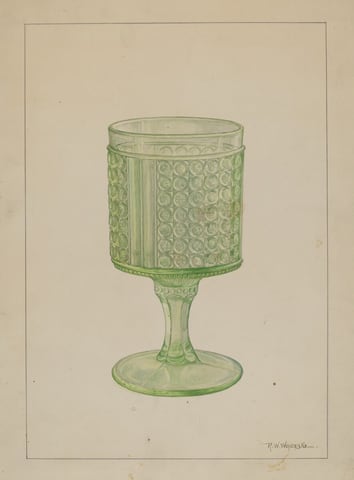
  3. The image shows a green glass goblet with a textured, bubble-like pattern on the cup and a smooth stem. The color palette consists of shades of green with varying tones, depending on the glass's thickness and pattern. The goblet is positioned centrally, seen straight-on with the cup's pattern visible across its surface. It rests on a flat surface, slightly above the center of the image.
    GobletRonau William Woiceske, 1935/1942Courtesy National Gallery of Art, Washington
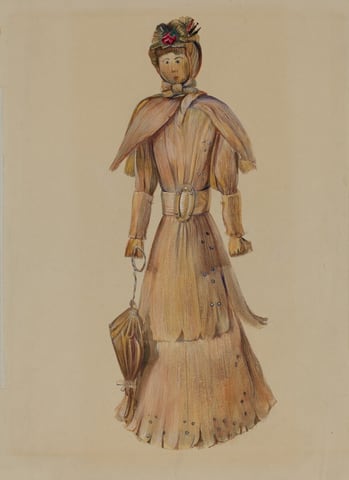
  4. The image shows a person standing upright. They have a round face with simple facial features, wearing a hat with a red flower and dark ribbon. Their outfit includes a belted dress or coat, pleated texture, a cape, and arm coverings. The person is holding a matching umbrella in their right hand. The background is plain and light tan.
    Corn Husk DollMina Lowry, c. 1936Courtesy National Gallery of Art, Washington

Section 2, south wall
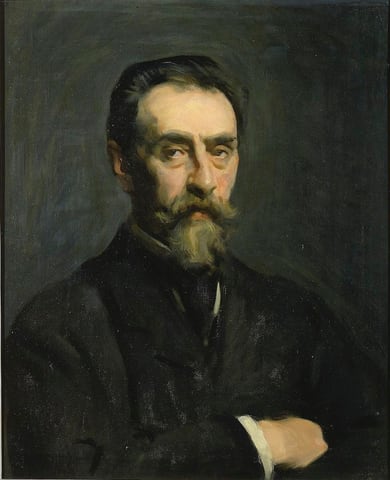
  1. Portrait of William E. Norton, by William Penhallow Henderson, 1901
    Portrait of William E. NortonWilliam Penhallow Henderson, 1901Courtesy of the Smithsonian American Art Museum
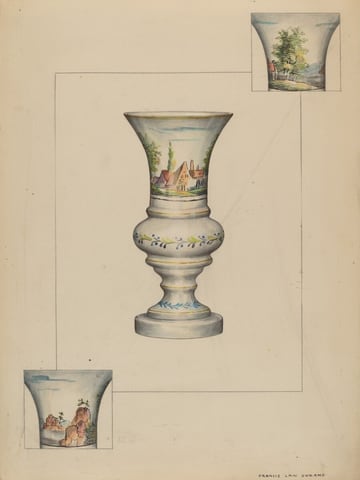
  2. The image shows a large, intricately designed vase with a bulbous base and flared top at the center. The vase is decorated with painted scenes of a town or village. The color scheme includes shades of blue, green, brown, and touches of yellow and red. Surrounding the vase are two smaller detailed sections showing close-ups of the painted scenes on it. The main vase image is enclosed within a boxed outline on the page.
    Fire Lighter VaseFrancis Law Durand, 1935/1942Courtesy National Gallery of Art, Washington
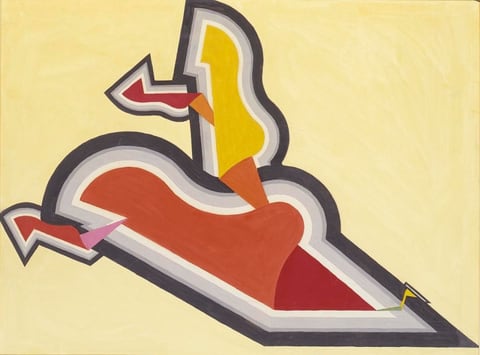
  3. Study in Rhythm: Red and Gold, by Joseph Schillinger, ca. 1934
    Study in Rhythm: Red and GoldJoseph Schillinger, ca. 1934Courtesy of the Smithsonian American Art Museum
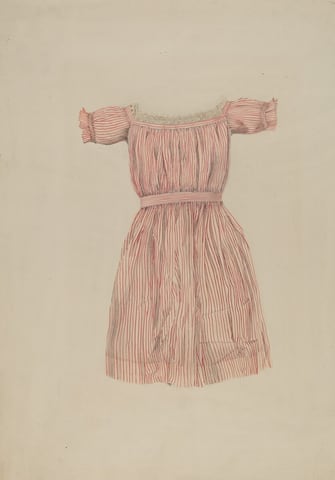
  4. The image shows a dress with a pink and white vertical striped pattern. The color palette is predominantly soft pinks and whites with subtle shading for light and shadow effects on the fabric. The dress is positioned at the center of the image, with sleeves extending slightly outward to the sides.
    Child's DressLucien Verbeke, c. 1937Courtesy National Gallery of Art, Washington

Section 2, north wall
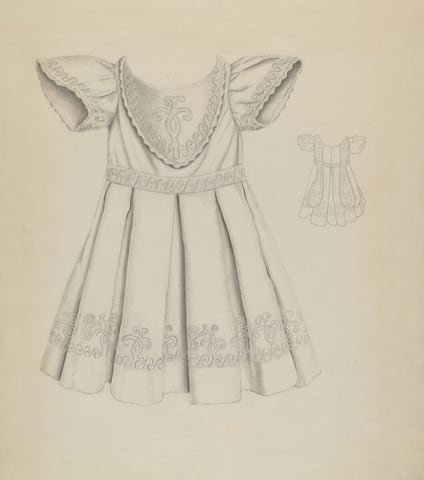
  1. The image shows a detailed sketch of a dress with short, puffed sleeves and a decorative neckline. There is a smaller sketch of the same dress to the right. The color palette is monochrome gray scale, with darker gray outlines and details against a light gray background. The main dress is centered, with the smaller sketch positioned to the right.
    Child's DressRay Price, c. 1937Courtesy National Gallery of Art, Washington
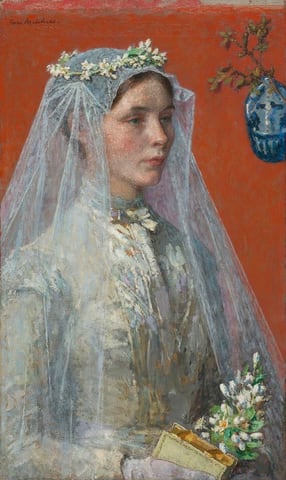
  2. The Bride, by Gari Melchers, ca. 1907
    The BrideGari Melchers, ca. 1907Courtesy of the Smithsonian American Art Museum
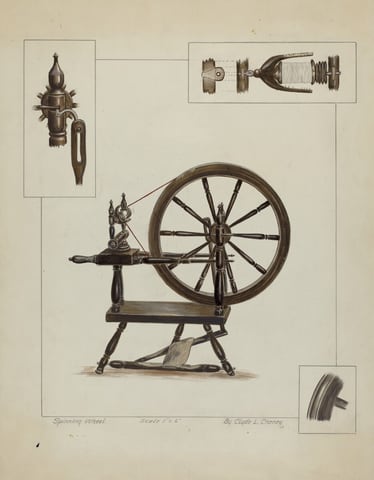
  3. The image shows a spinning wheel with intricate details, surrounded by smaller insets highlighting specific components. The color palette consists of muted browns, greens, and beiges. The spinning wheel is positioned in the center, with its circular wheel on the right and the spinning mechanism on the left. Detailed insets are placed around the spinning wheel, each showing different mechanical elements.
    Spinning WheelClyde L. Cheney, 1935/1942Courtesy National Gallery of Art, Washington

Section 3, north wall
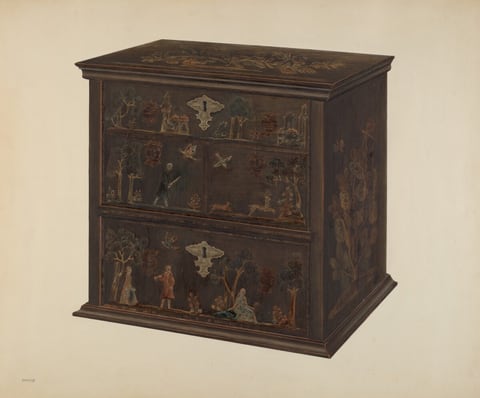
  1. This is a painting of a decorative wooden chest. The chest has intricate designs, such as painted figures, trees, and animals, creating a narrative scene on its front side, and floral motifs on its sides. The craftsmanship suggests it is an ornate object, potentially used for storage or as an ornamental piece. The painting focuses on the texture and details of the wood and decoration with precision, in a traditional arts and crafts or folk art style, emphasizing fine detail and storytelling through imagery on functional furniture.
    Jewel CabinetCharles Henning, c. 1939Courtesy National Gallery of Art, Washington
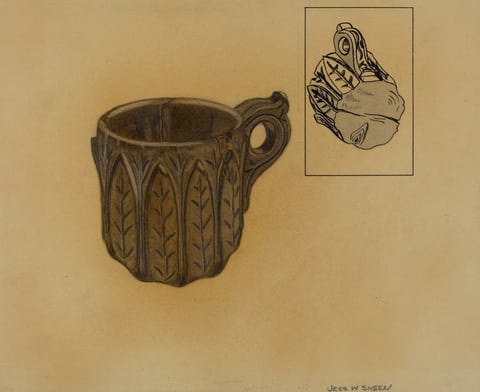
  2. The image shows an illustration of a decorative cup with a relief design and handle to the left. The cup is brown with leaf patterns. The background is light tan. In the top right corner, there is a sketch of the cup's underside.
    Wooden Shaving MugJesse W. Skeen, c. 1936Courtesy National Gallery of Art, Washington

Walk on

  • The 20th century, room 2
  • Jesse W. Skeen's contemporaries 8 works
  • More American folk and design 90 works
Ochre Editions

The world's museums, on your wall. Every work here is a reproduction of a public-domain original, credited to the museum that holds it.

Shop

All artCollectionsLimited dropsPrints and framing

Help

Find an orderShippingReturnsVerify a certificate

About

About Ochre EditionsMuseum creditsFor agentsDevelopers

Legal

Terms of UseTerms of SaleLimited Editions and CertificatesPrivacy PolicyCookie PolicyAcceptable Use PolicyAgent & API TermsCopyright and DMCA PolicyPrinting Your Own PhotoVulnerability Disclosure PolicyAccessibility StatementOpen-Access Credits
© 2026 Ochre EditionsPrices in US dollars. Prints ship within the United States.