Floor plan

East wing: The Nineteenth CenturyImpressionism

Impressionism

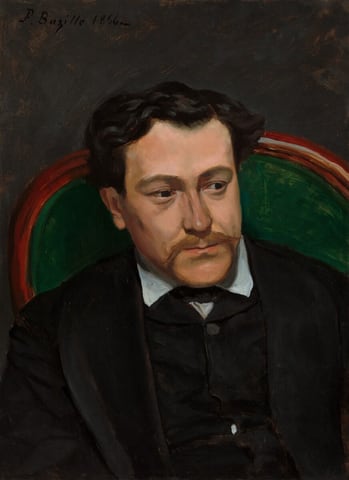
Shown from the chest up, a pale-skinned man in a suit sits in a high-backed chair, looking slightly to our right in this vertical portrait painting. His eyes and head are both turned slightly to our right, with only one ear visible on our left. His shoulder on our right and the right side of the chair are slightly cut off by the edge of the painting. He has a straight nose, high cheekbones, and pale pink closed lips. His eyes are dark, with small shadows beneath them. His black, wavy hair is parted on our right and cropped short on the sides of his head, with thick, defined waves on top. He has a light brown mustache that extends past the edge of his lips and flips up at the ends and a small, thin goatee. Beneath his chin, the collar of his white shirt is visible. The man wears an open suit jacket with a black vest, which folds slightly just below his chest, revealing a glimpse of his white shirt beneath it in a gap between buttons. The chair is only visible from the man’s shoulders up and ends at his forehead. It has a curved, round top back with a red frame and dark green upholstery. The part of the red frame on the right side of the painting has white and yellow highlights. The background is dark gray with visible brushstrokes. The artist signed and dated the painting at the top left, “F. Bazille. 1866.”
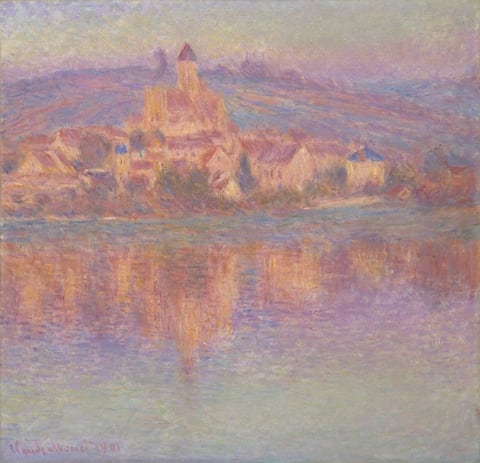
A work made of oil on canvas.
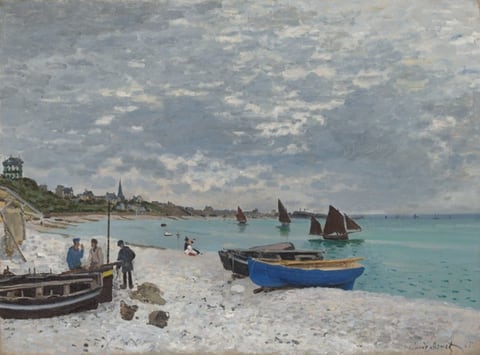
Painting of a beach on a cloudy day with several sailboats on the water, a few rowboats on the shore, and two groupings of people on the sand.
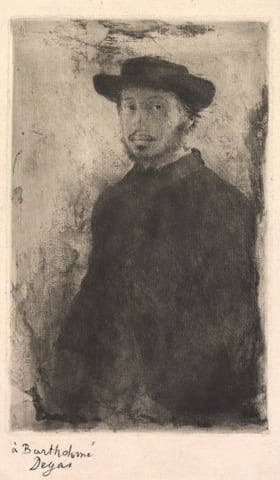
Self-Portrait, by Edgar Degas, 1857
A work made of oil on canvas.
Impressionist painting of seated man, girl with brown, black hues.

The works in this room are listed below.

Works in this room

Painters in 1870s Paris who worked quickly, often outdoors, to catch light as it changed.

First room, north wall

  1. Shown from the chest up, a pale-skinned man in a suit sits in a high-backed chair, looking slightly to our right in this vertical portrait painting. His eyes and head are both turned slightly to our right, with only one ear visible on our left. His shoulder on our right and the right side of the chair are slightly cut off by the edge of the painting. He has a straight nose, high cheekbones, and pale pink closed lips. His eyes are dark, with small shadows beneath them. His black, wavy hair is parted on our right and cropped short on the sides of his head, with thick, defined waves on top. He has a light brown mustache that extends past the edge of his lips and flips up at the ends and a small, thin goatee. Beneath his chin, the collar of his white shirt is visible. The man wears an open suit jacket with a black vest, which folds slightly just below his chest, revealing a glimpse of his white shirt beneath it in a gap between buttons. The chair is only visible from the man’s shoulders up and ends at his forehead. It has a curved, round top back with a red frame and dark green upholstery. The part of the red frame on the right side of the painting has white and yellow highlights. The background is dark gray with visible brushstrokes. The artist signed and dated the painting at the top left, “F. Bazille. 1866.”
    Edouard BlauFrédéric Bazille, probably 1869Courtesy National Gallery of Art, Washington
  2. A work made of oil on canvas.
    VétheuilClaude Monet, 1901Courtesy of the Art Institute of Chicago
  3. Painting of a beach on a cloudy day with several sailboats on the water, a few rowboats on the shore, and two groupings of people on the sand.
    The Beach at Sainte-AdresseClaude Monet, 1867Courtesy of the Art Institute of Chicago

First room, south wall

  1. Self-Portrait, by Edgar Degas, 1857
    Self-PortraitEdgar Degas, 1857Courtesy of the Cleveland Museum of Art
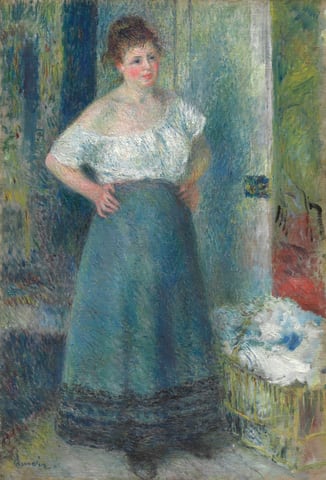
  2. A work made of oil on canvas.
    The LaundressPierre-Auguste Renoir, 1877–79Courtesy of the Art Institute of Chicago
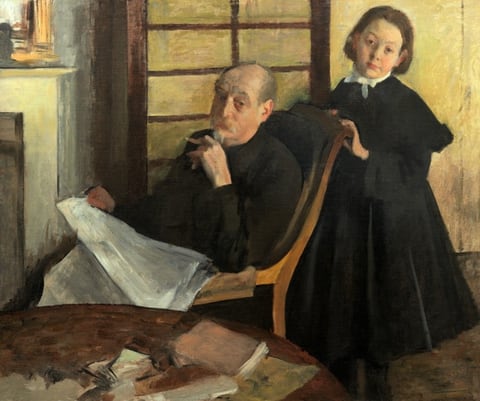
  3. Impressionist painting of seated man, girl with brown, black hues.
    Henri Degas and His Niece Lucie Degas (The Artist's Uncle and Cousin)Edgar Degas, 1875–76Courtesy of the Art Institute of Chicago

Second room, south wall
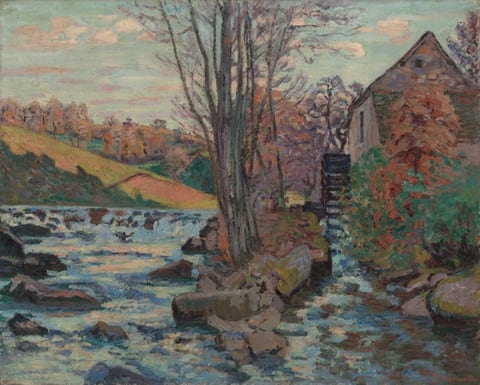
  1. A work made of oil on canvas.
    Mill of Pont MaupuitJean Baptiste Armand Guillaumin, c. 1900Courtesy of the Art Institute of Chicago
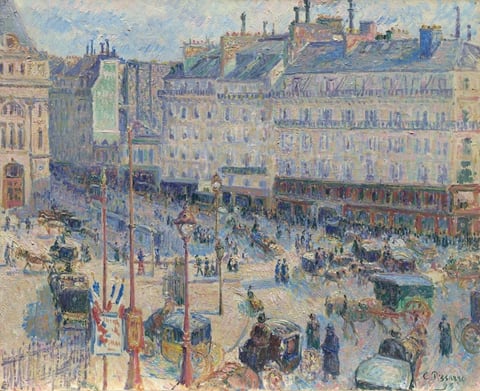
  2. A work made of oil on canvas.
    The Place du Havre, ParisCamille Pissarro, 1893Courtesy of the Art Institute of Chicago
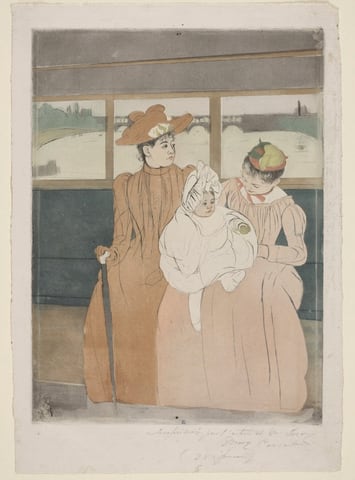
  3. In the Omnibus, by Mary Cassatt, 1890–91
    In the OmnibusMary Cassatt, 1890–91Courtesy of the Cleveland Museum of Art

Second room, north wall
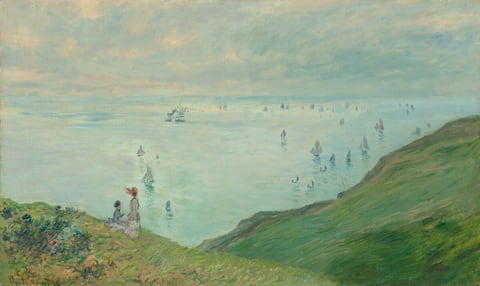
  1. From a high perspective, we look beyond two overlapping, emerald-green hills to a body of powder-blue water dotted with sailboats in this loosely painted horizontal landscape. Closest to us, the hills create a shallow V that spans the lower third of the composition, with the right-hand hill rising to more than halfway up the right edge. The hills are painted with dashes and long strokes mostly in seafoam, shamrock, and celery green, with some swipes of peach, goldenrod yellow, and royal blue. On the hill to our left, one woman sits and the other stands next to her. They wear hats, long-sleeved, fitted jackets, and long skirts in tones of dusky pink and dove gray. A touch of peach on the seated woman, to our left, gives the impression of a pale face. A red veil or scarf at the back of the other woman’s hat is lifted, as if in the wind. The water is painted with blended strokes of pale blue, light turquoise, smoky mauve pink, and touches of soft peach. The horizon comes two-thirds of the way up the composition, and the sky is painted with the same tones of blue, green, and peach to suggest a screen of clouds. Triangles and dashes of slate blue suggest about three dozen sailboats, rowboats, and one steamship in the rippling water. Squiggles of teal and sage green create reflections for some of the boats. The brushstrokes are visible throughout. In some areas, the paint is so thinly applied that the texture of the canvas shows through, especially in the sky. The artist signed the work in the lower left corner: “Claude Monet 82.”
    Cliffs at PourvilleClaude Monet, 1882Courtesy National Gallery of Art, Washington
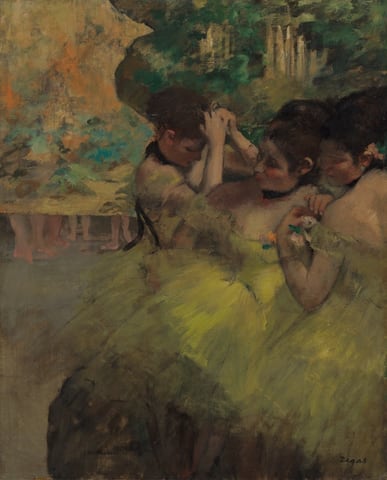
  2. Three light-skinned, dark-haired ballerinas, painted in muted tones, wear off-the-shoulder yellow leotards and tutus as they huddle near each other. One adjusts her costume, while one holds her hands clasped above her head. At left is a painted screen with four pairs of feet visible underneath.
    Yellow Dancers (In the Wings)Edgar Degas, 1874–76Courtesy of the Art Institute of Chicago
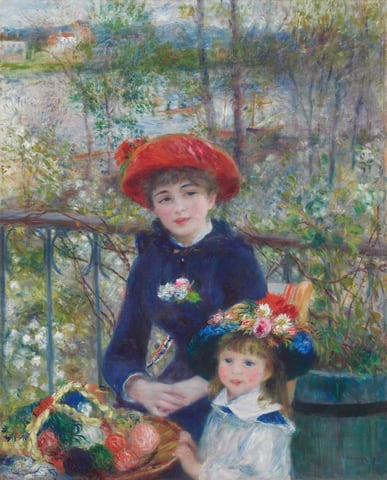
  3. Impressionist painting of two girls on balcony, bright flower hat, knitting basket.
    Two Sisters (On the Terrace)Pierre-Auguste Renoir, 1881Courtesy of the Art Institute of Chicago

Third room, north wall
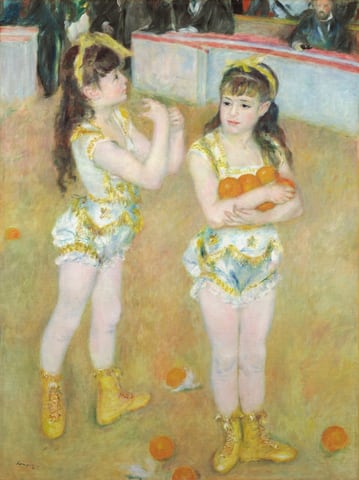
  1. Two girls in acrobatic uniforms stand in an arena, one holds oranges.
    Acrobats at the Cirque Fernando (Francisca and Angelina Wartenberg)Pierre-Auguste Renoir, 1879Courtesy of the Art Institute of Chicago
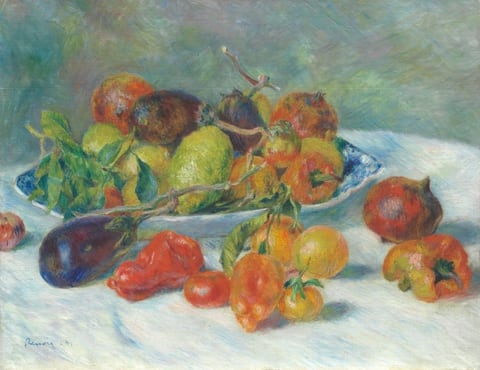
  2. A work made of oil on canvas.
    Fruits of the MidiPierre-Auguste Renoir, 1881Courtesy of the Art Institute of Chicago
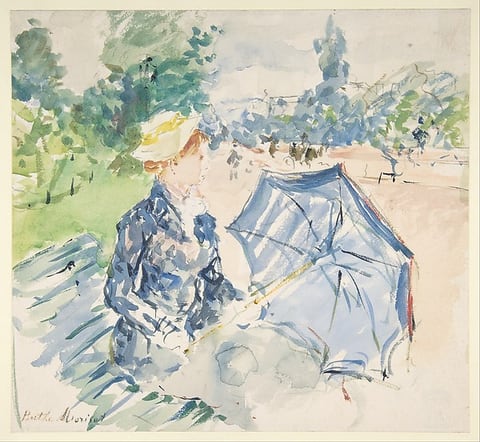
  3. A Woman Seated at a Bench on the Avenue du Bois, by Berthe Morisot, 1885
    A Woman Seated at a Bench on the Avenue du BoisBerthe Morisot, 1885Courtesy of The Metropolitan Museum of Art
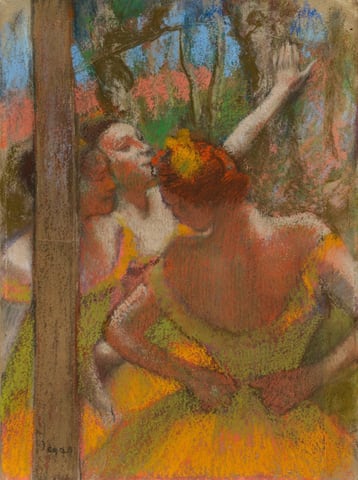
  4. Dancers, by Edgar Degas, c. 1896
    DancersEdgar Degas, c. 1896Courtesy of the Cleveland Museum of Art