Floor plan

East wing: The Nineteenth CenturyImpressionism

Impressionism

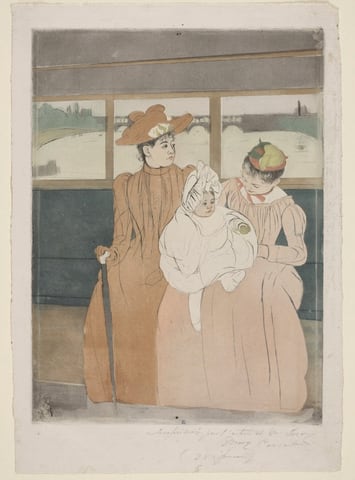
In the Omnibus, by Mary Cassatt, 1890–91
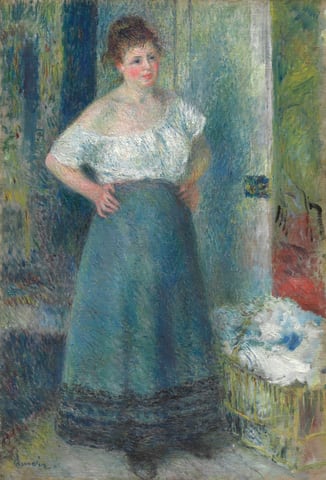
A work made of oil on canvas.
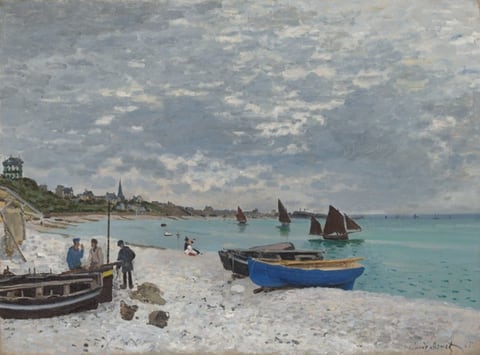
Painting of a beach on a cloudy day with several sailboats on the water, a few rowboats on the shore, and two groupings of people on the sand.
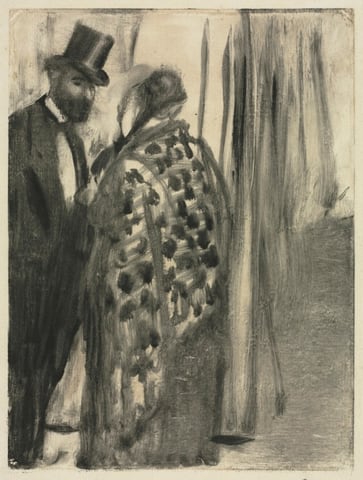
Conversation: Ludovic Halévy and Madame Cardinal (The Conversation) for "La Famille Cardinal" by Ludovic Halévy, by Edgar Degas, c. 1880–83
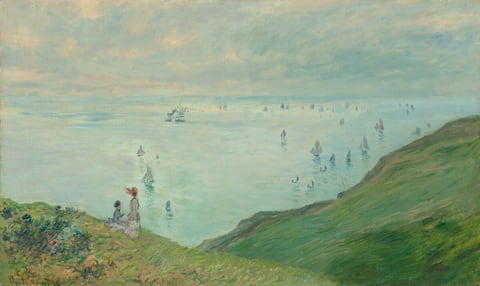
From a high perspective, we look beyond two overlapping, emerald-green hills to a body of powder-blue water dotted with sailboats in this loosely painted horizontal landscape. Closest to us, the hills create a shallow V that spans the lower third of the composition, with the right-hand hill rising to more than halfway up the right edge. The hills are painted with dashes and long strokes mostly in seafoam, shamrock, and celery green, with some swipes of peach, goldenrod yellow, and royal blue. On the hill to our left, one woman sits and the other stands next to her. They wear hats, long-sleeved, fitted jackets, and long skirts in tones of dusky pink and dove gray. A touch of peach on the seated woman, to our left, gives the impression of a pale face. A red veil or scarf at the back of the other woman’s hat is lifted, as if in the wind. The water is painted with blended strokes of pale blue, light turquoise, smoky mauve pink, and touches of soft peach. The horizon comes two-thirds of the way up the composition, and the sky is painted with the same tones of blue, green, and peach to suggest a screen of clouds. Triangles and dashes of slate blue suggest about three dozen sailboats, rowboats, and one steamship in the rippling water. Squiggles of teal and sage green create reflections for some of the boats. The brushstrokes are visible throughout. In some areas, the paint is so thinly applied that the texture of the canvas shows through, especially in the sky. The artist signed the work in the lower left corner: “Claude Monet 82.”
Roses in a Vase, by Pierre-Auguste Renoir, c. 1890
A work made of oil on canvas.

The works in this room are listed below.

Works in this room

Painters in 1870s Paris who worked quickly, often outdoors, to catch light as it changed.

First room, north wall

  1. In the Omnibus, by Mary Cassatt, 1890–91
    In the OmnibusMary Cassatt, 1890–91Courtesy of the Cleveland Museum of Art
  2. A work made of oil on canvas.
    The LaundressPierre-Auguste Renoir, 1877–79Courtesy of the Art Institute of Chicago
  3. Painting of a beach on a cloudy day with several sailboats on the water, a few rowboats on the shore, and two groupings of people on the sand.
    The Beach at Sainte-AdresseClaude Monet, 1867Courtesy of the Art Institute of Chicago
  4. Conversation: Ludovic Halévy and Madame Cardinal (The Conversation) for "La Famille Cardinal" by Ludovic Halévy, by Edgar Degas, c. 1880–83
    Conversation: Ludovic Halévy and Madame Cardinal (The Conversation) for "La Famille Cardinal" by Ludovic HalévyEdgar Degas, c. 1880–83Courtesy of the Cleveland Museum of Art

First room, south wall

  1. From a high perspective, we look beyond two overlapping, emerald-green hills to a body of powder-blue water dotted with sailboats in this loosely painted horizontal landscape. Closest to us, the hills create a shallow V that spans the lower third of the composition, with the right-hand hill rising to more than halfway up the right edge. The hills are painted with dashes and long strokes mostly in seafoam, shamrock, and celery green, with some swipes of peach, goldenrod yellow, and royal blue. On the hill to our left, one woman sits and the other stands next to her. They wear hats, long-sleeved, fitted jackets, and long skirts in tones of dusky pink and dove gray. A touch of peach on the seated woman, to our left, gives the impression of a pale face. A red veil or scarf at the back of the other woman’s hat is lifted, as if in the wind. The water is painted with blended strokes of pale blue, light turquoise, smoky mauve pink, and touches of soft peach. The horizon comes two-thirds of the way up the composition, and the sky is painted with the same tones of blue, green, and peach to suggest a screen of clouds. Triangles and dashes of slate blue suggest about three dozen sailboats, rowboats, and one steamship in the rippling water. Squiggles of teal and sage green create reflections for some of the boats. The brushstrokes are visible throughout. In some areas, the paint is so thinly applied that the texture of the canvas shows through, especially in the sky. The artist signed the work in the lower left corner: “Claude Monet 82.”
    Cliffs at PourvilleClaude Monet, 1882Courtesy National Gallery of Art, Washington
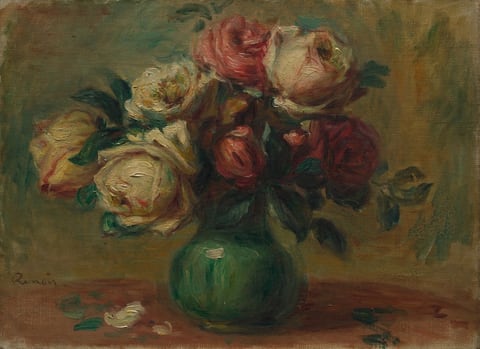
  2. Roses in a Vase, by Pierre-Auguste Renoir, c. 1890
    Roses in a VasePierre-Auguste Renoir, c. 1890Courtesy of the Cleveland Museum of Art
  3. A work made of oil on canvas.
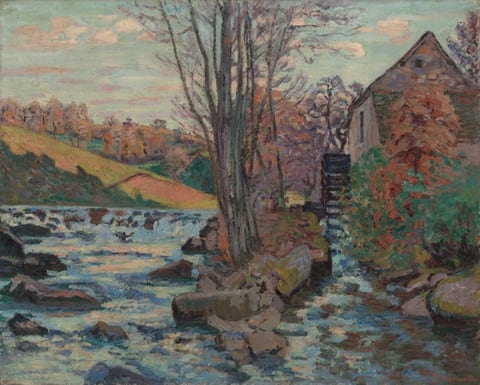
    Mill of Pont MaupuitJean Baptiste Armand Guillaumin, c. 1900Courtesy of the Art Institute of Chicago

Second room, south wall
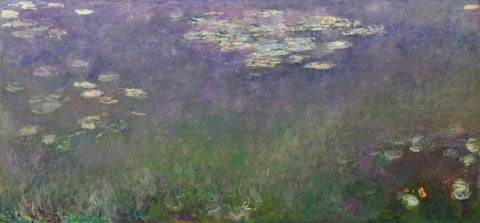
  1. Water Lilies (Agapanthus), by Claude Monet, c. 1915–26
    Water Lilies (Agapanthus)Claude Monet, c. 1915–26Courtesy of the Cleveland Museum of Art
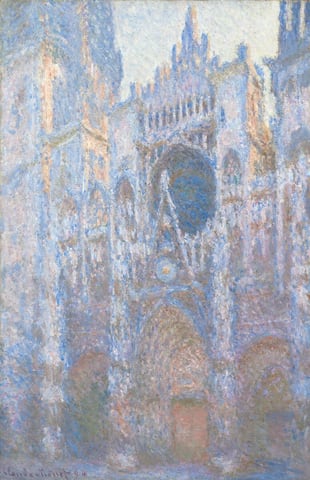
  2. We look up at the exterior of a church that soars the height of this vertical painting. The church is painted with visible dabs and strokes of azure blue, peach, lavender purple, and camel brown to create a blurred look, as if seeing a reflection in the rippling surface of a puddle. The church façade is angled to our left, away from us. The main door and its surround takes up the center of the composition, where a rectangular door is set within nested, pointed arches that lead up to a narrow, tall, triangular gable. The point of that gable overlaps the round, dark rose window, which is the same width as the portal surround below. Spires flank the central section and rise precipitously off the top edge of the painting. The sky above is painted with daubs of white and pale blue. The artist signed and dated the lower left, “Claude Monet 94.”
    Rouen Cathedral, West FaçadeClaude Monet, 1894Courtesy National Gallery of Art, Washington

Second room, north wall
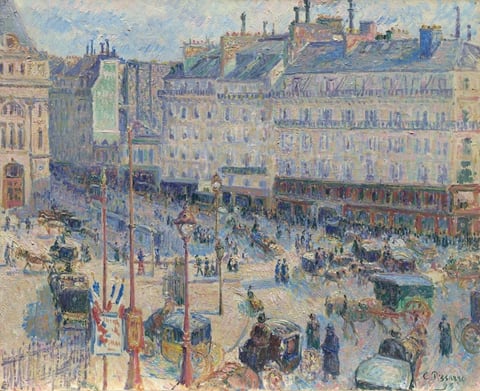
  1. A work made of oil on canvas.
    The Place du Havre, ParisCamille Pissarro, 1893Courtesy of the Art Institute of Chicago
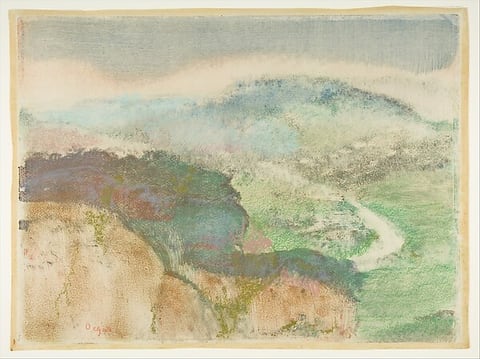
  2. Landscape, by Edgar Degas, 1892
    LandscapeEdgar Degas, 1892Courtesy of The Metropolitan Museum of Art
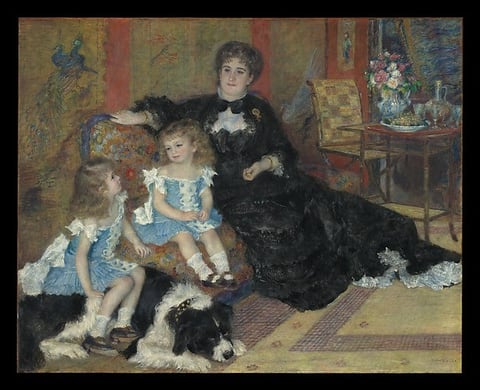
  3. Madame Georges Charpentier (Marguerite-Louise Lemonnier, 1848–1904) and Her Children, Georgette-Berthe (1872–1945) and Paul-Emile-Charles (1875–1895), by Pierre-Auguste Renoir, 1878
    Madame Georges Charpentier (Marguerite-Louise Lemonnier, 1848–1904) and Her Children, Georgette-Berthe (1872–1945) and Paul-Emile-Charles (1875–1895)Pierre-Auguste Renoir, 1878Courtesy of The Metropolitan Museum of Art

Third room, north wall
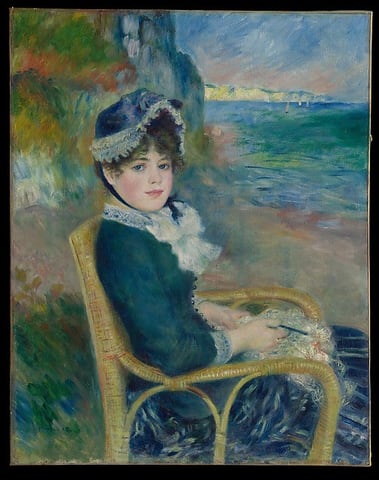
  1. By the Seashore, by Pierre-Auguste Renoir, 1883
    By the SeashorePierre-Auguste Renoir, 1883Courtesy of The Metropolitan Museum of Art
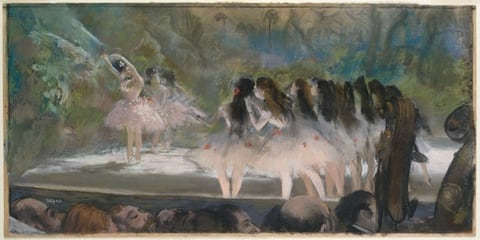
  2. Color pastel drawing of ballerinas in tutus on stage, watched by audience.
    Ballet at the Paris OpéraEdgar Degas, 1877Courtesy of the Art Institute of Chicago

Third room, south wall
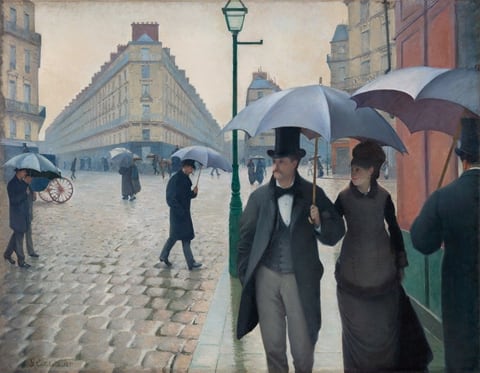
  1. Life-size painting of an urban scene in Paris. A man in a top hat holding an umbrella and a woman in a long fashionable dark dress walk arm in arm toward the viewer as other city dwellers with umbrellas walk in various directions across cobblestone roads and sidewalks.
    Paris Street; Rainy DayGustave Caillebotte, 1877Courtesy of the Art Institute of Chicago
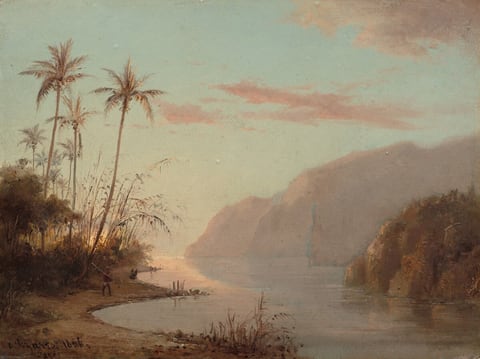
  2. A wide creek winds between a tree-lined bank to our left and hazy mountains to our right in this horizontal landscape painting. The riverbank curves deeply like a backward capital letter B. Marshy grasses grow in tufts, and palm and other trees grow in a grove to our left. One brown-skinned person wearing only a white cloth around the hips carries a long stick near the shoreline. Dabs of brown and muted dark pink suggest other people farther along the riverside. Tree-covered boulders jut into the creek from our right. A band of rocky, mountains are smoky mauve-pink across the rightmost two-thirds of the horizon, which comes a third of the way up the composition. The butter-yellow sun is low on the horizon to our right, peeking through the grove of palm trees. The light pours across the placid surface of the creek, creating a soft yellow streak next to the reflection of the mountain ridge. A few heather-pink clouds drift across the pale turquoise sky. The artist signed and dated the painting in the lower left corner, “C. Pizarro. 1856. Paris.”
    A Creek in St. Thomas (Virgin Islands)Camille Pissarro, 1856Courtesy National Gallery of Art, Washington