Floor plan

East wing: The Nineteenth CenturyImpressionism

Impressionism

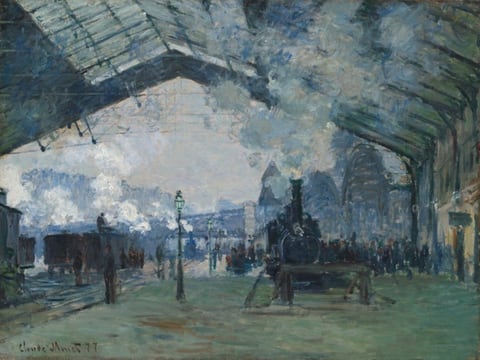
Loosely painted image of an open-air train station. On the right, a parked train gives off an enormous plumb of white smoke, making the scene look as though it were full of clouds. A huddled mass of barely discernible people crowd around the train on both sides of the tracks. Blue, green, and gray tones dominate.
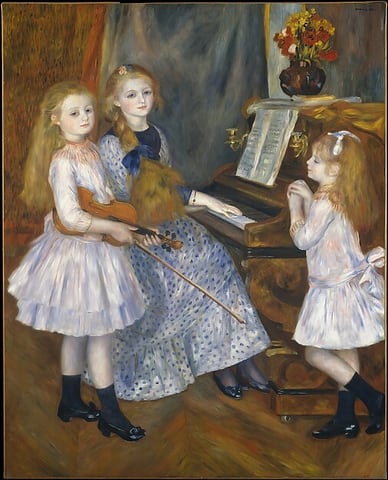
The Daughters of Catulle Mendès, Huguette (1871–1964), Claudine (1876–1937), and Helyonne (1879–1955), by Pierre-Auguste Renoir, 1888
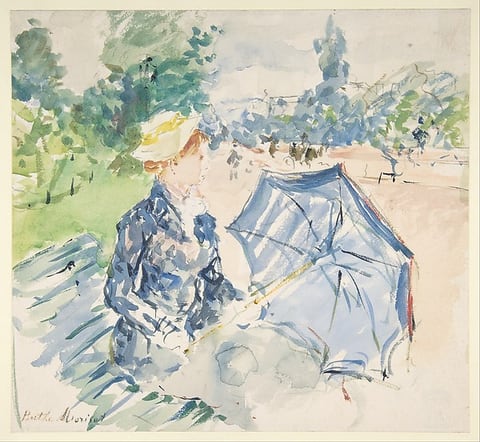
A Woman Seated at a Bench on the Avenue du Bois, by Berthe Morisot, 1885
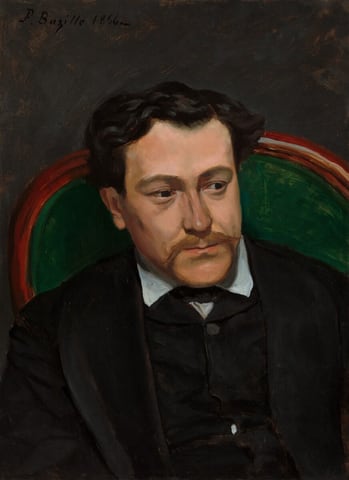
Shown from the chest up, a pale-skinned man in a suit sits in a high-backed chair, looking slightly to our right in this vertical portrait painting. His eyes and head are both turned slightly to our right, with only one ear visible on our left. His shoulder on our right and the right side of the chair are slightly cut off by the edge of the painting. He has a straight nose, high cheekbones, and pale pink closed lips. His eyes are dark, with small shadows beneath them. His black, wavy hair is parted on our right and cropped short on the sides of his head, with thick, defined waves on top. He has a light brown mustache that extends past the edge of his lips and flips up at the ends and a small, thin goatee. Beneath his chin, the collar of his white shirt is visible. The man wears an open suit jacket with a black vest, which folds slightly just below his chest, revealing a glimpse of his white shirt beneath it in a gap between buttons. The chair is only visible from the man’s shoulders up and ends at his forehead. It has a curved, round top back with a red frame and dark green upholstery. The part of the red frame on the right side of the painting has white and yellow highlights. The background is dark gray with visible brushstrokes. The artist signed and dated the painting at the top left, “F. Bazille. 1866.”
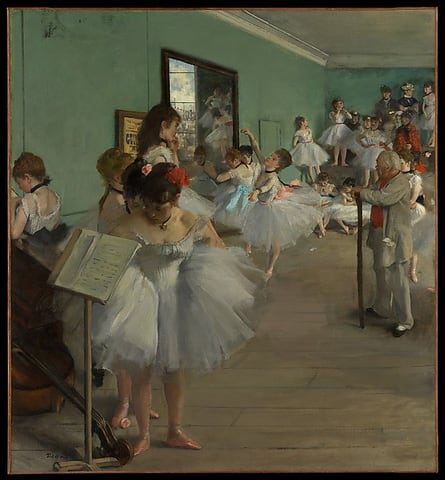
The Dance Class, by Edgar Degas, 1874
A work made of oil on canvas.
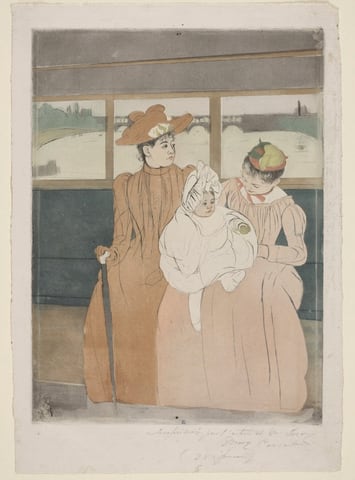
In the Omnibus, by Mary Cassatt, 1890–91

The works in this room are listed below.

Works in this room

Painters in 1870s Paris who worked quickly, often outdoors, to catch light as it changed.

First room, north wall

  1. Loosely painted image of an open-air train station. On the right, a parked train gives off an enormous plumb of white smoke, making the scene look as though it were full of clouds. A huddled mass of barely discernible people crowd around the train on both sides of the tracks. Blue, green, and gray tones dominate.
    Arrival of the Normandy Train, Gare Saint-LazareClaude Monet, 1877Courtesy of the Art Institute of Chicago
  2. The Daughters of Catulle Mendès, Huguette (1871–1964), Claudine (1876–1937), and Helyonne (1879–1955), by Pierre-Auguste Renoir, 1888
    The Daughters of Catulle Mendès, Huguette (1871–1964), Claudine (1876–1937), and Helyonne (1879–1955)Pierre-Auguste Renoir, 1888Courtesy of The Metropolitan Museum of Art
  3. A Woman Seated at a Bench on the Avenue du Bois, by Berthe Morisot, 1885
    A Woman Seated at a Bench on the Avenue du BoisBerthe Morisot, 1885Courtesy of The Metropolitan Museum of Art

First room, south wall

  1. Shown from the chest up, a pale-skinned man in a suit sits in a high-backed chair, looking slightly to our right in this vertical portrait painting. His eyes and head are both turned slightly to our right, with only one ear visible on our left. His shoulder on our right and the right side of the chair are slightly cut off by the edge of the painting. He has a straight nose, high cheekbones, and pale pink closed lips. His eyes are dark, with small shadows beneath them. His black, wavy hair is parted on our right and cropped short on the sides of his head, with thick, defined waves on top. He has a light brown mustache that extends past the edge of his lips and flips up at the ends and a small, thin goatee. Beneath his chin, the collar of his white shirt is visible. The man wears an open suit jacket with a black vest, which folds slightly just below his chest, revealing a glimpse of his white shirt beneath it in a gap between buttons. The chair is only visible from the man’s shoulders up and ends at his forehead. It has a curved, round top back with a red frame and dark green upholstery. The part of the red frame on the right side of the painting has white and yellow highlights. The background is dark gray with visible brushstrokes. The artist signed and dated the painting at the top left, “F. Bazille. 1866.”
    Edouard BlauFrédéric Bazille, probably 1869Courtesy National Gallery of Art, Washington
  2. The Dance Class, by Edgar Degas, 1874
    The Dance ClassEdgar Degas, 1874Courtesy of The Metropolitan Museum of Art
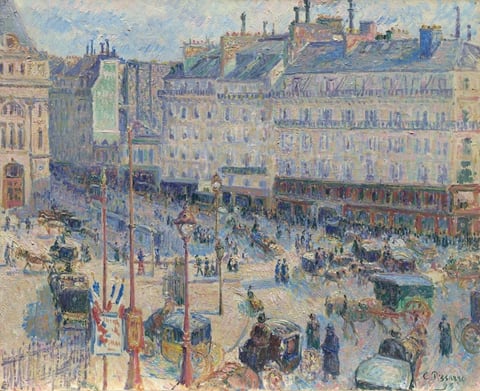
  3. A work made of oil on canvas.
    The Place du Havre, ParisCamille Pissarro, 1893Courtesy of the Art Institute of Chicago
  4. In the Omnibus, by Mary Cassatt, 1890–91
    In the OmnibusMary Cassatt, 1890–91Courtesy of the Cleveland Museum of Art

Second room, south wall
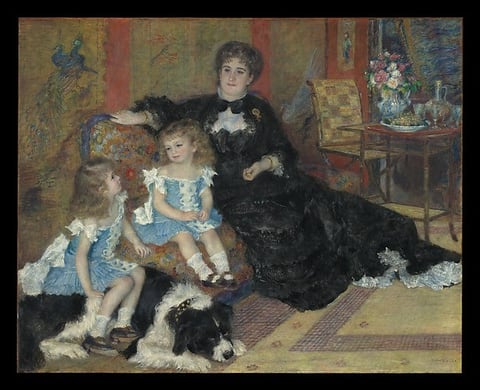
  1. Madame Georges Charpentier (Marguerite-Louise Lemonnier, 1848–1904) and Her Children, Georgette-Berthe (1872–1945) and Paul-Emile-Charles (1875–1895), by Pierre-Auguste Renoir, 1878
    Madame Georges Charpentier (Marguerite-Louise Lemonnier, 1848–1904) and Her Children, Georgette-Berthe (1872–1945) and Paul-Emile-Charles (1875–1895)Pierre-Auguste Renoir, 1878Courtesy of The Metropolitan Museum of Art
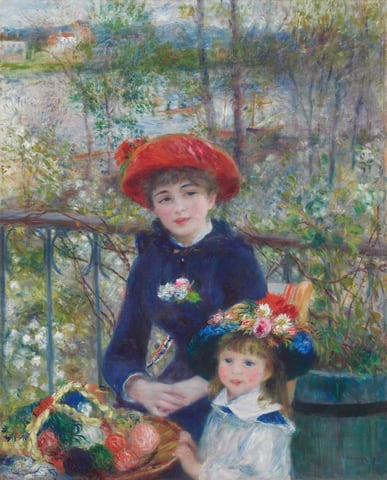
  2. Impressionist painting of two girls on balcony, bright flower hat, knitting basket.
    Two Sisters (On the Terrace)Pierre-Auguste Renoir, 1881Courtesy of the Art Institute of Chicago
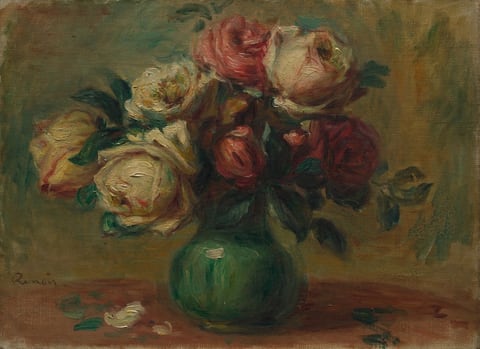
  3. Roses in a Vase, by Pierre-Auguste Renoir, c. 1890
    Roses in a VasePierre-Auguste Renoir, c. 1890Courtesy of the Cleveland Museum of Art

Second room, north wall
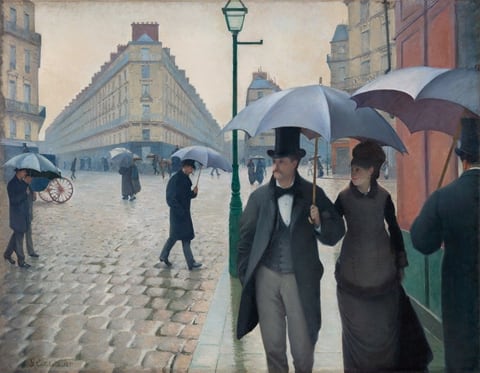
  1. Life-size painting of an urban scene in Paris. A man in a top hat holding an umbrella and a woman in a long fashionable dark dress walk arm in arm toward the viewer as other city dwellers with umbrellas walk in various directions across cobblestone roads and sidewalks.
    Paris Street; Rainy DayGustave Caillebotte, 1877Courtesy of the Art Institute of Chicago
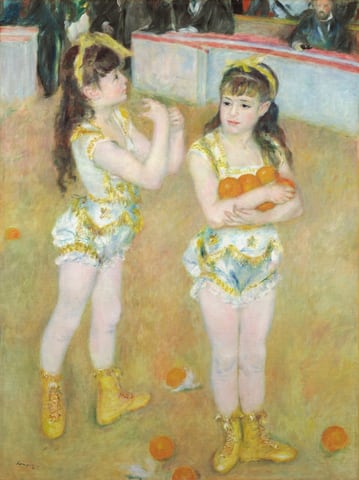
  2. Two girls in acrobatic uniforms stand in an arena, one holds oranges.
    Acrobats at the Cirque Fernando (Francisca and Angelina Wartenberg)Pierre-Auguste Renoir, 1879Courtesy of the Art Institute of Chicago

Third room, north wall
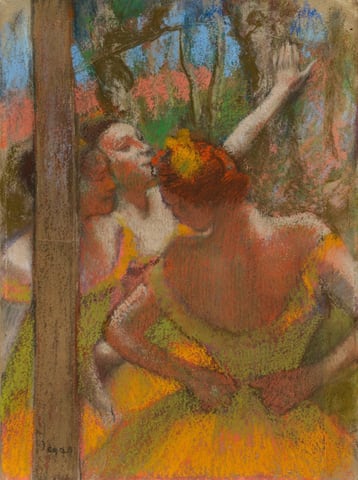
  1. Dancers, by Edgar Degas, c. 1896
    DancersEdgar Degas, c. 1896Courtesy of the Cleveland Museum of Art
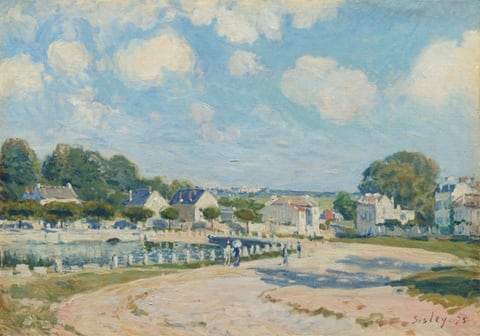
  2. A work made of oil on canvas.
    Watering Place at MarlyAlfred Sisley, 1875Courtesy of the Art Institute of Chicago
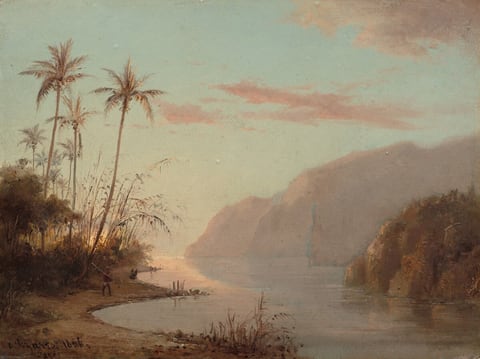
  3. A wide creek winds between a tree-lined bank to our left and hazy mountains to our right in this horizontal landscape painting. The riverbank curves deeply like a backward capital letter B. Marshy grasses grow in tufts, and palm and other trees grow in a grove to our left. One brown-skinned person wearing only a white cloth around the hips carries a long stick near the shoreline. Dabs of brown and muted dark pink suggest other people farther along the riverside. Tree-covered boulders jut into the creek from our right. A band of rocky, mountains are smoky mauve-pink across the rightmost two-thirds of the horizon, which comes a third of the way up the composition. The butter-yellow sun is low on the horizon to our right, peeking through the grove of palm trees. The light pours across the placid surface of the creek, creating a soft yellow streak next to the reflection of the mountain ridge. A few heather-pink clouds drift across the pale turquoise sky. The artist signed and dated the painting in the lower left corner, “C. Pizarro. 1856. Paris.”
    A Creek in St. Thomas (Virgin Islands)Camille Pissarro, 1856Courtesy National Gallery of Art, Washington
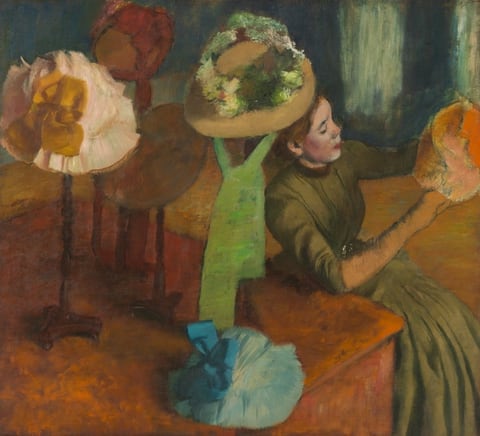
  4. Impressionist painting of woman wearing green dress trying on hats.
    The Millinery ShopEdgar Degas, 1879-86Courtesy of the Art Institute of Chicago