Floor plan

East wing: The Nineteenth CenturyImpressionism

Impressionism

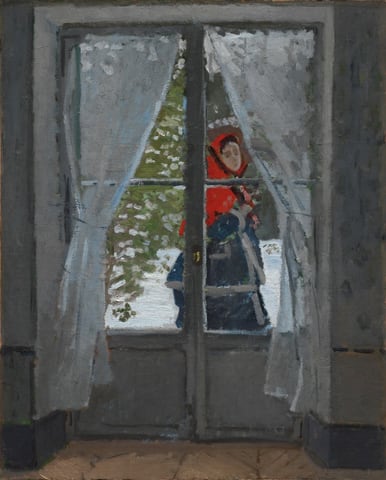
The Red Kerchief, by Claude Monet, c. 1868–73
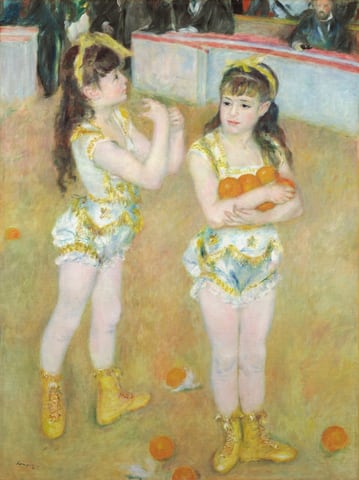
Two girls in acrobatic uniforms stand in an arena, one holds oranges.
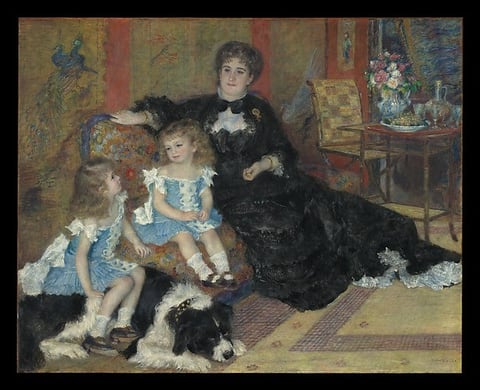
Madame Georges Charpentier (Marguerite-Louise Lemonnier, 1848–1904) and Her Children, Georgette-Berthe (1872–1945) and Paul-Emile-Charles (1875–1895), by Pierre-Auguste Renoir, 1878
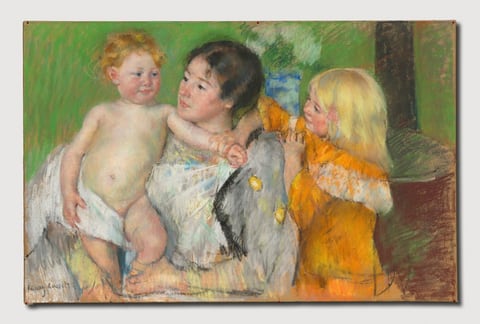
After the Bath, by Mary Cassatt, 1901
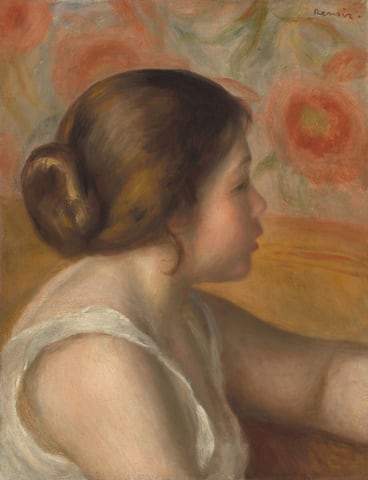
This painting shows a young woman's upper body from the torso up. She is seated and facing the right, with her face seen in profile and one arm bent in front of her, seeming to rest on a brown table or surface. She has pale skin, round, rosy cheeks, a small nose, and pink lips that are slightly parted. Her brown hair is styled into a smooth, glossy bun at the nape of her neck. She is wearing a white garment with thin straps over her shoulders. The background features a yellow section on the bottom half, and on the top half is a colorful, abstract pattern with large, soft, swirling forms in shades of orange and red on a blue-gray background with hints of green.

The works in this room are listed below.

Works in this room

Painters in 1870s Paris who worked quickly, often outdoors, to catch light as it changed.

First room, north wall

  1. The Red Kerchief, by Claude Monet, c. 1868–73
    The Red KerchiefClaude Monet, c. 1868–73Courtesy of the Cleveland Museum of Art
  2. Two girls in acrobatic uniforms stand in an arena, one holds oranges.
    Acrobats at the Cirque Fernando (Francisca and Angelina Wartenberg)Pierre-Auguste Renoir, 1879Courtesy of the Art Institute of Chicago

First room, south wall

  1. Madame Georges Charpentier (Marguerite-Louise Lemonnier, 1848–1904) and Her Children, Georgette-Berthe (1872–1945) and Paul-Emile-Charles (1875–1895), by Pierre-Auguste Renoir, 1878
    Madame Georges Charpentier (Marguerite-Louise Lemonnier, 1848–1904) and Her Children, Georgette-Berthe (1872–1945) and Paul-Emile-Charles (1875–1895)Pierre-Auguste Renoir, 1878Courtesy of The Metropolitan Museum of Art
  2. After the Bath, by Mary Cassatt, 1901
    After the BathMary Cassatt, 1901Courtesy of the Cleveland Museum of Art
  3. This painting shows a young woman's upper body from the torso up. She is seated and facing the right, with her face seen in profile and one arm bent in front of her, seeming to rest on a brown table or surface. She has pale skin, round, rosy cheeks, a small nose, and pink lips that are slightly parted. Her brown hair is styled into a smooth, glossy bun at the nape of her neck. She is wearing a white garment with thin straps over her shoulders. The background features a yellow section on the bottom half, and on the top half is a colorful, abstract pattern with large, soft, swirling forms in shades of orange and red on a blue-gray background with hints of green.
    Head of a Young GirlPierre-Auguste Renoir, c. 1890Courtesy National Gallery of Art, Washington

Second room, south wall
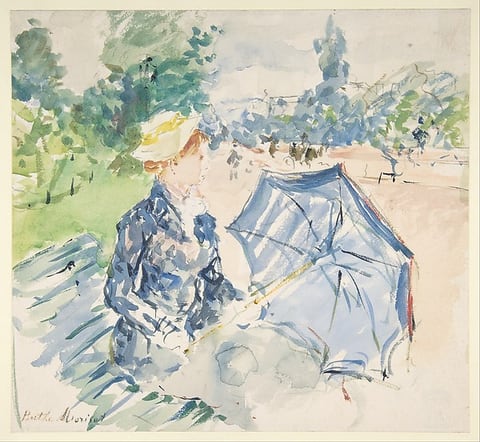
  1. A Woman Seated at a Bench on the Avenue du Bois, by Berthe Morisot, 1885
    A Woman Seated at a Bench on the Avenue du BoisBerthe Morisot, 1885Courtesy of The Metropolitan Museum of Art
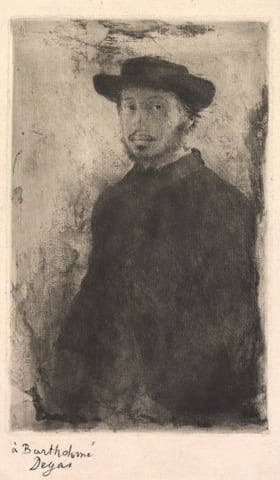
  2. Self-Portrait, by Edgar Degas, 1857
    Self-PortraitEdgar Degas, 1857Courtesy of the Cleveland Museum of Art
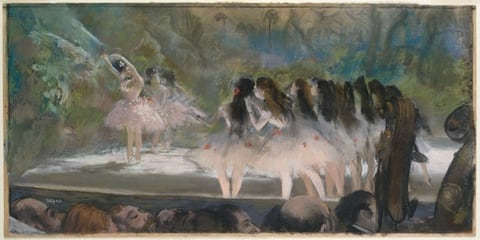
  3. Color pastel drawing of ballerinas in tutus on stage, watched by audience.
    Ballet at the Paris OpéraEdgar Degas, 1877Courtesy of the Art Institute of Chicago
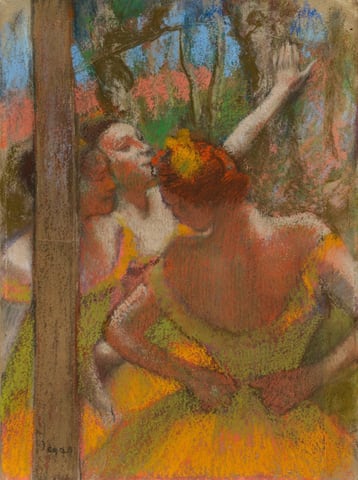
  4. Dancers, by Edgar Degas, c. 1896
    DancersEdgar Degas, c. 1896Courtesy of the Cleveland Museum of Art

Second room, north wall
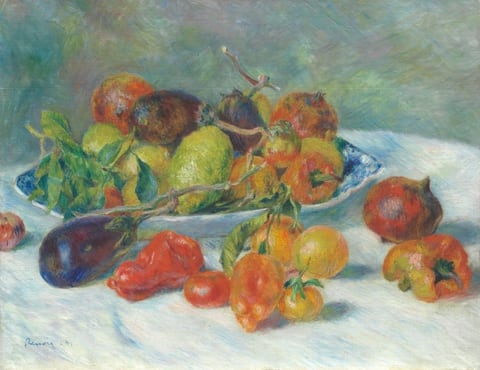
  1. A work made of oil on canvas.
    Fruits of the MidiPierre-Auguste Renoir, 1881Courtesy of the Art Institute of Chicago
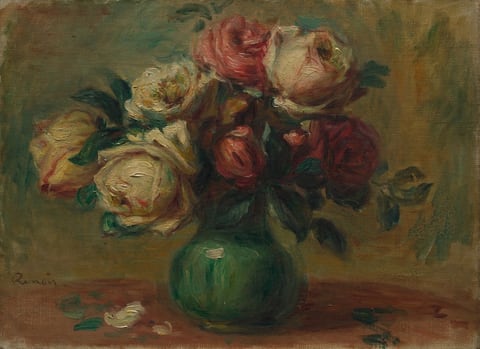
  2. Roses in a Vase, by Pierre-Auguste Renoir, c. 1890
    Roses in a VasePierre-Auguste Renoir, c. 1890Courtesy of the Cleveland Museum of Art
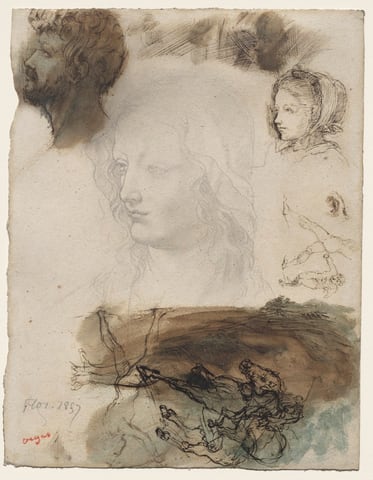
  3. Sheet of Studies and Sketches, by Edgar Degas, 1858
    Sheet of Studies and SketchesEdgar Degas, 1858Courtesy of the Cleveland Museum of Art
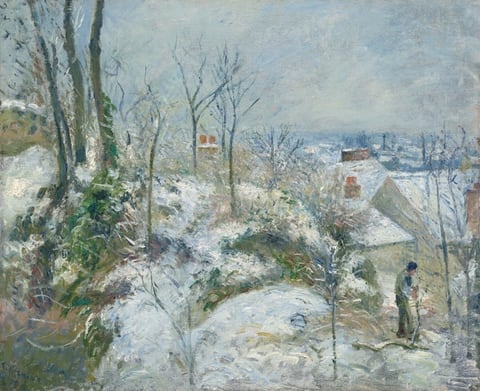
  4. A work made of oil on canvas.
    Rabbit Warren at Pontoise, SnowCamille Pissarro, 1879Courtesy of the Art Institute of Chicago

Third room, north wall
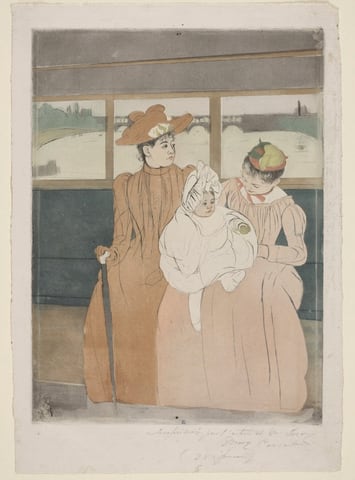
  1. In the Omnibus, by Mary Cassatt, 1890–91
    In the OmnibusMary Cassatt, 1890–91Courtesy of the Cleveland Museum of Art
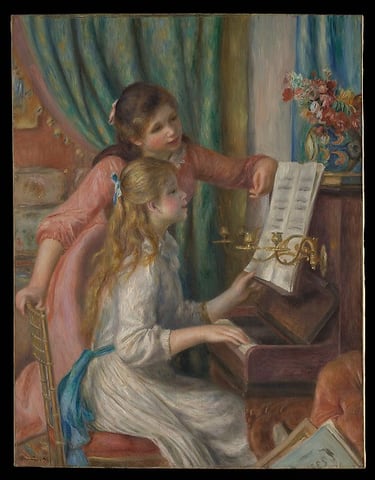
  2. Two Young Girls at the Piano, by Pierre-Auguste Renoir, 1892
    Two Young Girls at the PianoPierre-Auguste Renoir, 1892Courtesy of The Metropolitan Museum of Art
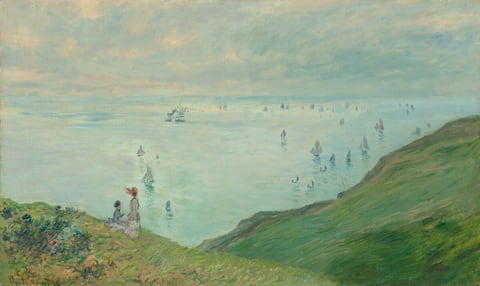
  3. From a high perspective, we look beyond two overlapping, emerald-green hills to a body of powder-blue water dotted with sailboats in this loosely painted horizontal landscape. Closest to us, the hills create a shallow V that spans the lower third of the composition, with the right-hand hill rising to more than halfway up the right edge. The hills are painted with dashes and long strokes mostly in seafoam, shamrock, and celery green, with some swipes of peach, goldenrod yellow, and royal blue. On the hill to our left, one woman sits and the other stands next to her. They wear hats, long-sleeved, fitted jackets, and long skirts in tones of dusky pink and dove gray. A touch of peach on the seated woman, to our left, gives the impression of a pale face. A red veil or scarf at the back of the other woman’s hat is lifted, as if in the wind. The water is painted with blended strokes of pale blue, light turquoise, smoky mauve pink, and touches of soft peach. The horizon comes two-thirds of the way up the composition, and the sky is painted with the same tones of blue, green, and peach to suggest a screen of clouds. Triangles and dashes of slate blue suggest about three dozen sailboats, rowboats, and one steamship in the rippling water. Squiggles of teal and sage green create reflections for some of the boats. The brushstrokes are visible throughout. In some areas, the paint is so thinly applied that the texture of the canvas shows through, especially in the sky. The artist signed the work in the lower left corner: “Claude Monet 82.”
    Cliffs at PourvilleClaude Monet, 1882Courtesy National Gallery of Art, Washington