Floor plan

East wing: The Nineteenth CenturyImpressionism

Impressionism

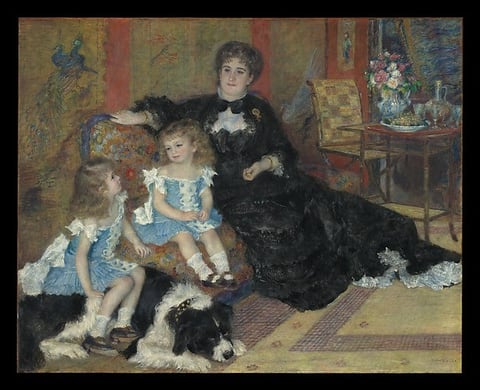
Madame Georges Charpentier (Marguerite-Louise Lemonnier, 1848–1904) and Her Children, Georgette-Berthe (1872–1945) and Paul-Emile-Charles (1875–1895), by Pierre-Auguste Renoir, 1878
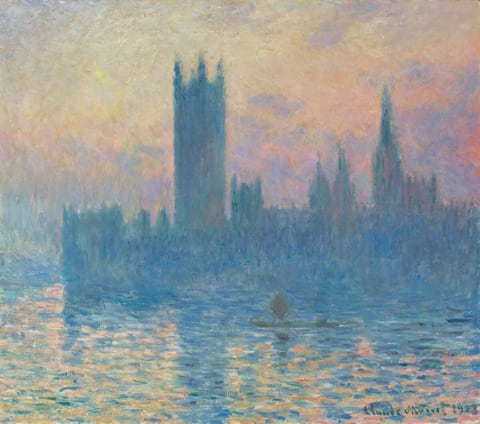
A row of spire-like structures of different heights is silhouetted in azure blue against a soft pink, yellow, peach, and lavender-purple sunset and reflected in a rippling river in this nearly square landscape painting. Along the horizon, the buildings stretch from our right, almost fully across the canvas, and are painted with vertical brushstrokes in cool shades of blue. The sky behind the towers seems hazy with intermingling, pastel-colored clouds. The buildings are reflected in the river, which fills the bottom third of the painting. The surface of the water is painted with short, horizontal brushstrokes in azure blue for the buildings, and apricot, rose, and marigold orange for the sky’s reflection. A streak and smudge of olive-green paint on the water represents a person in a boat near the center of the painting. The artist signed and dated the work in the same olive color at the lower right: “Claude Monet 1903.”
A work made of oil on canvas.
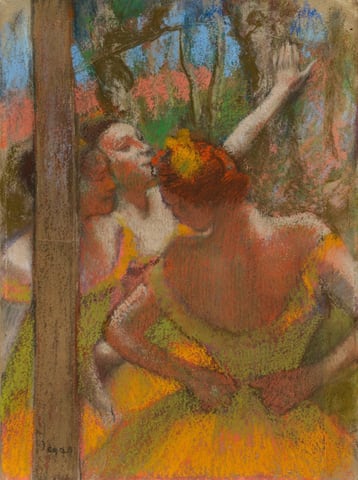
Dancers, by Edgar Degas, c. 1896
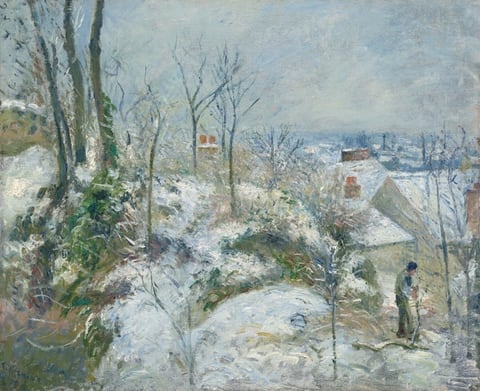
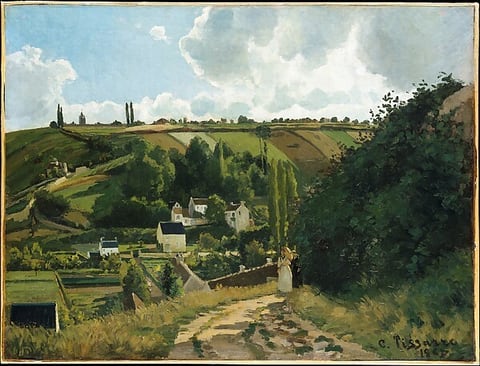
Jalais Hill, Pontoise, by Camille Pissarro, 1867

The works in this room are listed below.

Works in this room

Painters in 1870s Paris who worked quickly, often outdoors, to catch light as it changed.

First room, north wall

  1. Madame Georges Charpentier (Marguerite-Louise Lemonnier, 1848–1904) and Her Children, Georgette-Berthe (1872–1945) and Paul-Emile-Charles (1875–1895), by Pierre-Auguste Renoir, 1878
    Madame Georges Charpentier (Marguerite-Louise Lemonnier, 1848–1904) and Her Children, Georgette-Berthe (1872–1945) and Paul-Emile-Charles (1875–1895)Pierre-Auguste Renoir, 1878Courtesy of The Metropolitan Museum of Art
  2. A row of spire-like structures of different heights is silhouetted in azure blue against a soft pink, yellow, peach, and lavender-purple sunset and reflected in a rippling river in this nearly square landscape painting. Along the horizon, the buildings stretch from our right, almost fully across the canvas, and are painted with vertical brushstrokes in cool shades of blue. The sky behind the towers seems hazy with intermingling, pastel-colored clouds. The buildings are reflected in the river, which fills the bottom third of the painting. The surface of the water is painted with short, horizontal brushstrokes in azure blue for the buildings, and apricot, rose, and marigold orange for the sky’s reflection. A streak and smudge of olive-green paint on the water represents a person in a boat near the center of the painting. The artist signed and dated the work in the same olive color at the lower right: “Claude Monet 1903.”
    The Houses of Parliament, SunsetClaude Monet, 1903Courtesy National Gallery of Art, Washington

First room, south wall

  1. A work made of oil on canvas.
    Rabbit Warren at Pontoise, SnowCamille Pissarro, 1879Courtesy of the Art Institute of Chicago
  2. Dancers, by Edgar Degas, c. 1896
    DancersEdgar Degas, c. 1896Courtesy of the Cleveland Museum of Art
  3. Jalais Hill, Pontoise, by Camille Pissarro, 1867
    Jalais Hill, PontoiseCamille Pissarro, 1867Courtesy of The Metropolitan Museum of Art

Second room, south wall
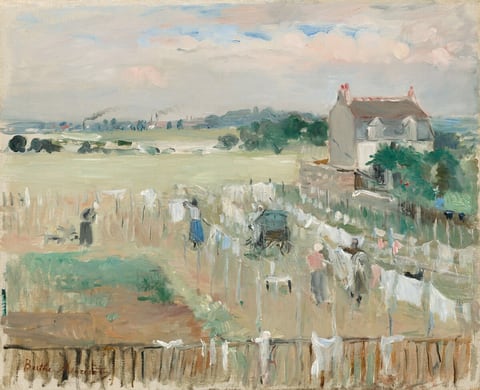
  1. We look down onto a landscape where several laundry lines have been draped mostly with white sheets or cloth to dry in a flat, grassy yard in front of a rustic house and a distant town in this horizontal painting. The scene is created entirely with thick, visible brushstrokes that creates a sense of texture on the canvas’s surface and makes many details difficult to make out. The forms of at least three women wearing skirts hang laundry out along the lines, and a person wearing trousers tends to a flat piece of green ground near the lower left corner. A few pieces of white cloth have been draped over the wooden fence that runs along the bottom edge of the canvas. A dove-gray cart with wooden carriage wheels rests, tipped forward, at the center of the laundry lines. To our right and just beyond the laundry lines, a two-story ivory and slate-blue house with a gray peaked roof sits behind a grove of emerald-green trees. The laundry field and the grassy plane beyond is painted with a pale celery green with long, horizontal strokes. Dabs of moss green and a white streak interrupt the field in the distance. Beyond that, touches of steel and silvery-gray paint suggest smokestacks and smoke in a town along the horizon, which comes about three-quarters of the way up this composition. A few patches of vivid blue sky peek through a screen of shell-pink and cream-white clouds above. The artist signed the work in brick-red paint in the lower left corner, “Berthe Morisot.”
    Hanging the Laundry out to DryBerthe Morisot, 1875Courtesy National Gallery of Art, Washington
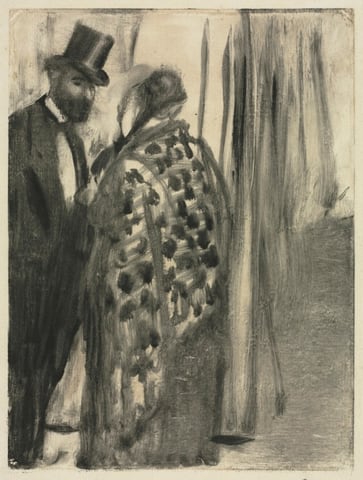
  2. Conversation: Ludovic Halévy and Madame Cardinal (The Conversation) for "La Famille Cardinal" by Ludovic Halévy, by Edgar Degas, c. 1880–83
    Conversation: Ludovic Halévy and Madame Cardinal (The Conversation) for "La Famille Cardinal" by Ludovic HalévyEdgar Degas, c. 1880–83Courtesy of the Cleveland Museum of Art
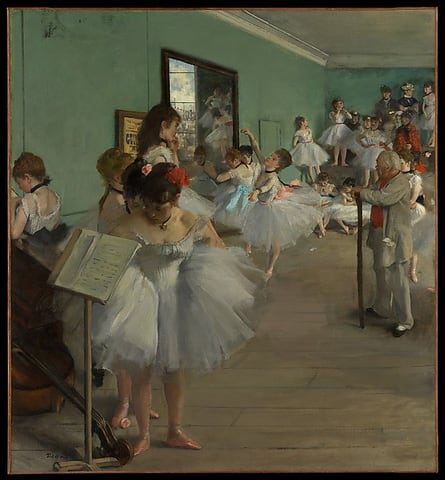
  3. The Dance Class, by Edgar Degas, 1874
    The Dance ClassEdgar Degas, 1874Courtesy of The Metropolitan Museum of Art
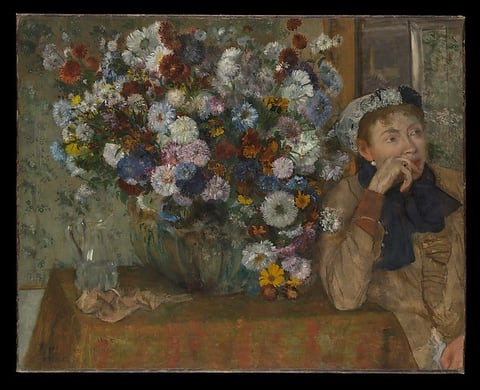
  4. A Woman Seated beside a Vase of Flowers (Madame Paul Valpinçon?), by Edgar Degas, 1865
    A Woman Seated beside a Vase of Flowers (Madame Paul Valpinçon?)Edgar Degas, 1865Courtesy of The Metropolitan Museum of Art

Second room, north wall
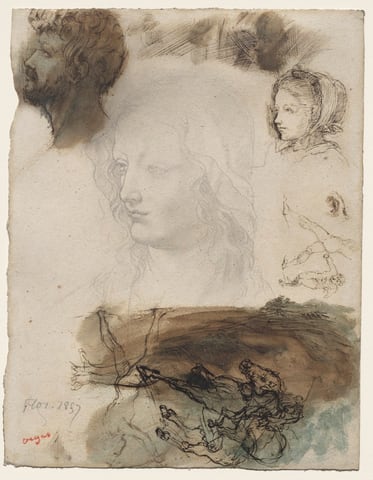
  1. Sheet of Studies and Sketches, by Edgar Degas, 1858
    Sheet of Studies and SketchesEdgar Degas, 1858Courtesy of the Cleveland Museum of Art
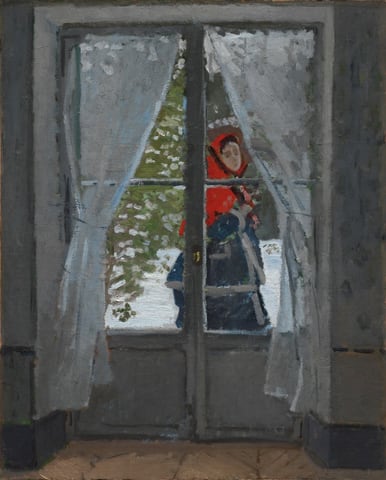
  2. The Red Kerchief, by Claude Monet, c. 1868–73
    The Red KerchiefClaude Monet, c. 1868–73Courtesy of the Cleveland Museum of Art
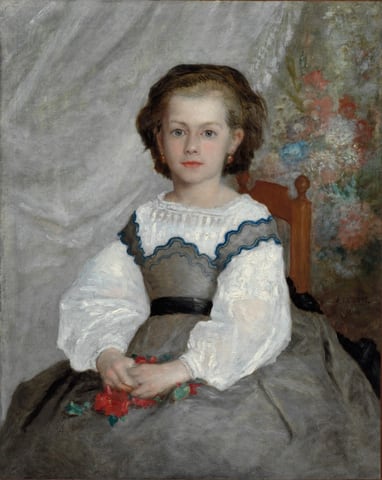
  3. Romaine Lacaux, by Pierre-Auguste Renoir, 1864
    Romaine LacauxPierre-Auguste Renoir, 1864Courtesy of the Cleveland Museum of Art
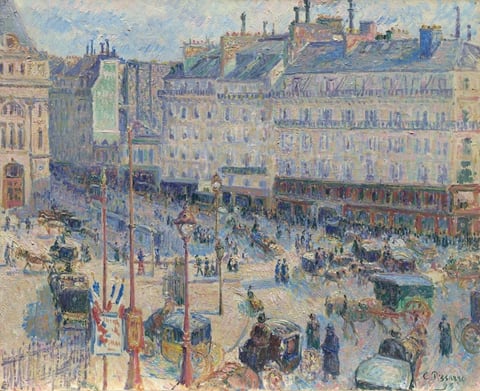
  4. A work made of oil on canvas.
    The Place du Havre, ParisCamille Pissarro, 1893Courtesy of the Art Institute of Chicago

Third room, north wall
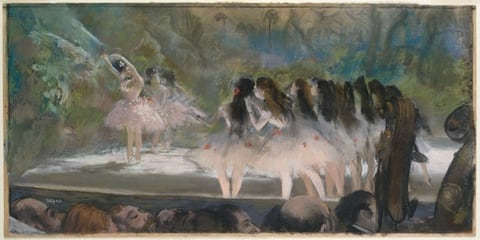
  1. Color pastel drawing of ballerinas in tutus on stage, watched by audience.
    Ballet at the Paris OpéraEdgar Degas, 1877Courtesy of the Art Institute of Chicago
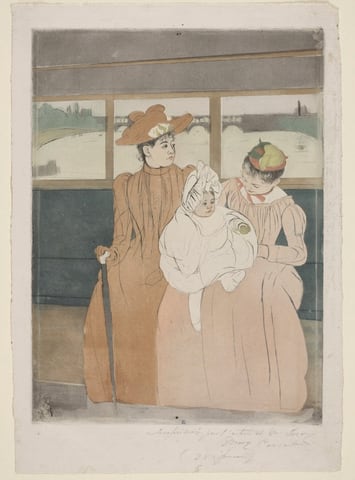
  2. In the Omnibus, by Mary Cassatt, 1890–91
    In the OmnibusMary Cassatt, 1890–91Courtesy of the Cleveland Museum of Art
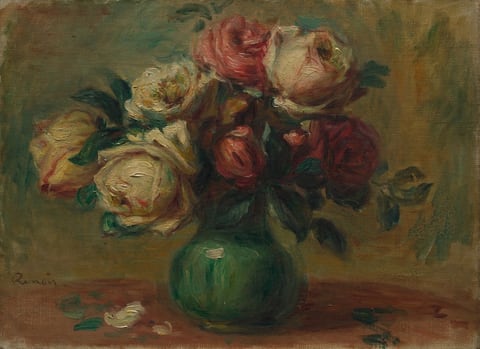
  3. Roses in a Vase, by Pierre-Auguste Renoir, c. 1890
    Roses in a VasePierre-Auguste Renoir, c. 1890Courtesy of the Cleveland Museum of Art