Floor plan

East wing: The Nineteenth CenturyImpressionism

Impressionism

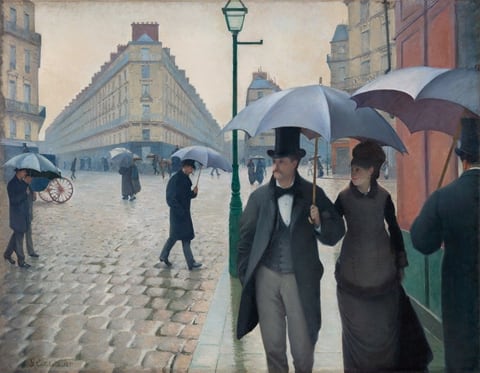
Life-size painting of an urban scene in Paris. A man in a top hat holding an umbrella and a woman in a long fashionable dark dress walk arm in arm toward the viewer as other city dwellers with umbrellas walk in various directions across cobblestone roads and sidewalks.
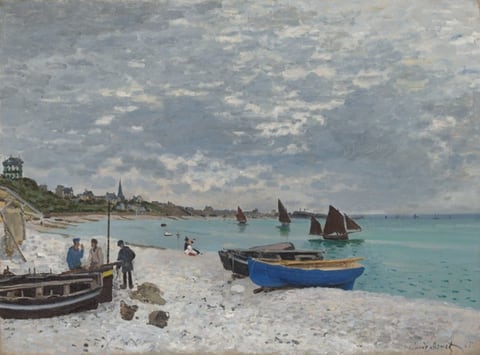
Painting of a beach on a cloudy day with several sailboats on the water, a few rowboats on the shore, and two groupings of people on the sand.
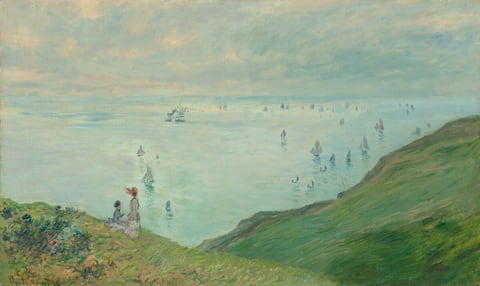
From a high perspective, we look beyond two overlapping, emerald-green hills to a body of powder-blue water dotted with sailboats in this loosely painted horizontal landscape. Closest to us, the hills create a shallow V that spans the lower third of the composition, with the right-hand hill rising to more than halfway up the right edge. The hills are painted with dashes and long strokes mostly in seafoam, shamrock, and celery green, with some swipes of peach, goldenrod yellow, and royal blue. On the hill to our left, one woman sits and the other stands next to her. They wear hats, long-sleeved, fitted jackets, and long skirts in tones of dusky pink and dove gray. A touch of peach on the seated woman, to our left, gives the impression of a pale face. A red veil or scarf at the back of the other woman’s hat is lifted, as if in the wind. The water is painted with blended strokes of pale blue, light turquoise, smoky mauve pink, and touches of soft peach. The horizon comes two-thirds of the way up the composition, and the sky is painted with the same tones of blue, green, and peach to suggest a screen of clouds. Triangles and dashes of slate blue suggest about three dozen sailboats, rowboats, and one steamship in the rippling water. Squiggles of teal and sage green create reflections for some of the boats. The brushstrokes are visible throughout. In some areas, the paint is so thinly applied that the texture of the canvas shows through, especially in the sky. The artist signed the work in the lower left corner: “Claude Monet 82.”
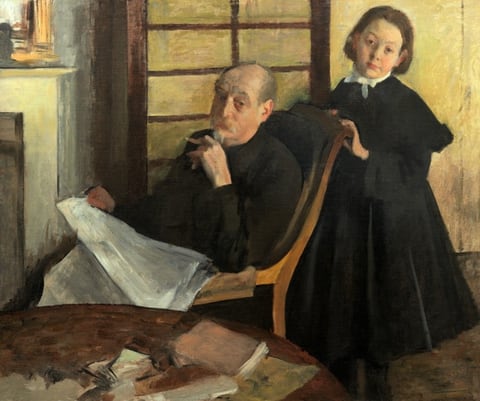
Impressionist painting of seated man, girl with brown, black hues.
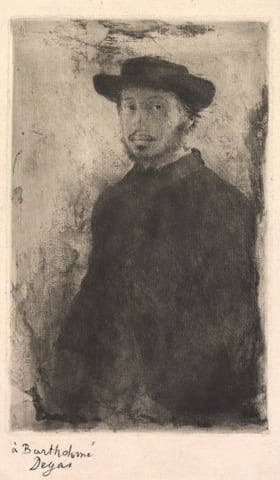
Self-Portrait, by Edgar Degas, 1857

The works in this room are listed below.

Works in this room

Painters in 1870s Paris who worked quickly, often outdoors, to catch light as it changed.

First room, north wall

  1. Life-size painting of an urban scene in Paris. A man in a top hat holding an umbrella and a woman in a long fashionable dark dress walk arm in arm toward the viewer as other city dwellers with umbrellas walk in various directions across cobblestone roads and sidewalks.
    Paris Street; Rainy DayGustave Caillebotte, 1877Courtesy of the Art Institute of Chicago
  2. Painting of a beach on a cloudy day with several sailboats on the water, a few rowboats on the shore, and two groupings of people on the sand.
    The Beach at Sainte-AdresseClaude Monet, 1867Courtesy of the Art Institute of Chicago

First room, south wall

  1. From a high perspective, we look beyond two overlapping, emerald-green hills to a body of powder-blue water dotted with sailboats in this loosely painted horizontal landscape. Closest to us, the hills create a shallow V that spans the lower third of the composition, with the right-hand hill rising to more than halfway up the right edge. The hills are painted with dashes and long strokes mostly in seafoam, shamrock, and celery green, with some swipes of peach, goldenrod yellow, and royal blue. On the hill to our left, one woman sits and the other stands next to her. They wear hats, long-sleeved, fitted jackets, and long skirts in tones of dusky pink and dove gray. A touch of peach on the seated woman, to our left, gives the impression of a pale face. A red veil or scarf at the back of the other woman’s hat is lifted, as if in the wind. The water is painted with blended strokes of pale blue, light turquoise, smoky mauve pink, and touches of soft peach. The horizon comes two-thirds of the way up the composition, and the sky is painted with the same tones of blue, green, and peach to suggest a screen of clouds. Triangles and dashes of slate blue suggest about three dozen sailboats, rowboats, and one steamship in the rippling water. Squiggles of teal and sage green create reflections for some of the boats. The brushstrokes are visible throughout. In some areas, the paint is so thinly applied that the texture of the canvas shows through, especially in the sky. The artist signed the work in the lower left corner: “Claude Monet 82.”
    Cliffs at PourvilleClaude Monet, 1882Courtesy National Gallery of Art, Washington
  2. Impressionist painting of seated man, girl with brown, black hues.
    Henri Degas and His Niece Lucie Degas (The Artist's Uncle and Cousin)Edgar Degas, 1875–76Courtesy of the Art Institute of Chicago
  3. Self-Portrait, by Edgar Degas, 1857
    Self-PortraitEdgar Degas, 1857Courtesy of the Cleveland Museum of Art

Second room, south wall
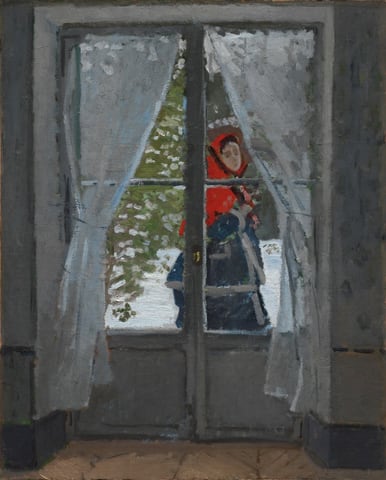
  1. The Red Kerchief, by Claude Monet, c. 1868–73
    The Red KerchiefClaude Monet, c. 1868–73Courtesy of the Cleveland Museum of Art
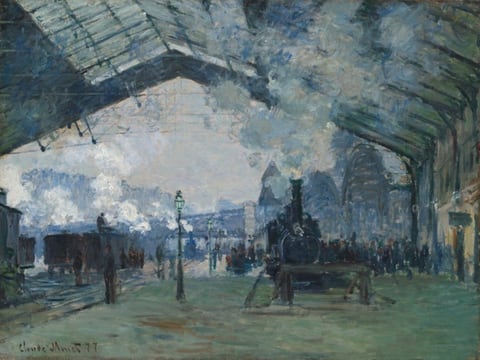
  2. Loosely painted image of an open-air train station. On the right, a parked train gives off an enormous plumb of white smoke, making the scene look as though it were full of clouds. A huddled mass of barely discernible people crowd around the train on both sides of the tracks. Blue, green, and gray tones dominate.
    Arrival of the Normandy Train, Gare Saint-LazareClaude Monet, 1877Courtesy of the Art Institute of Chicago
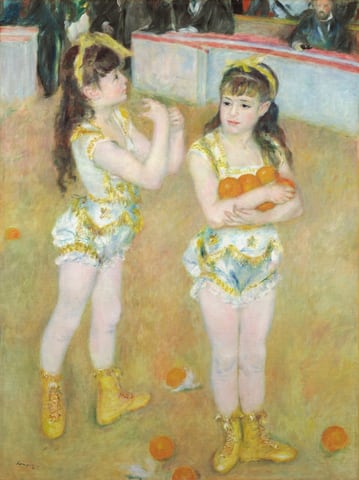
  3. Two girls in acrobatic uniforms stand in an arena, one holds oranges.
    Acrobats at the Cirque Fernando (Francisca and Angelina Wartenberg)Pierre-Auguste Renoir, 1879Courtesy of the Art Institute of Chicago

Second room, north wall
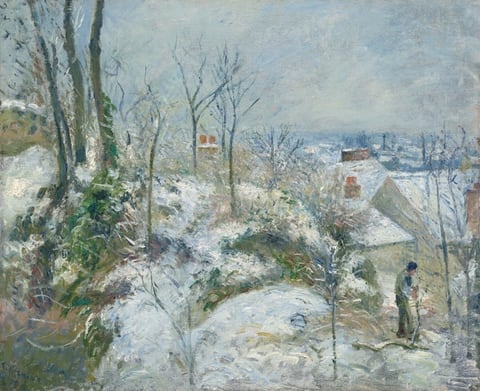
  1. A work made of oil on canvas.
    Rabbit Warren at Pontoise, SnowCamille Pissarro, 1879Courtesy of the Art Institute of Chicago
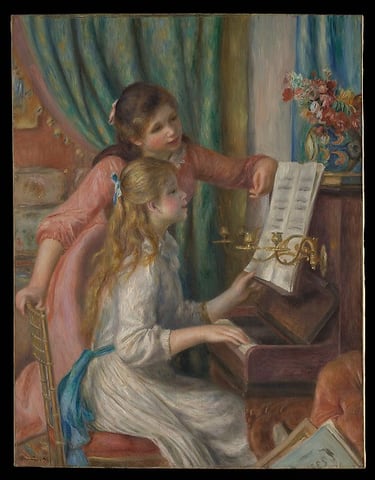
  2. Two Young Girls at the Piano, by Pierre-Auguste Renoir, 1892
    Two Young Girls at the PianoPierre-Auguste Renoir, 1892Courtesy of The Metropolitan Museum of Art
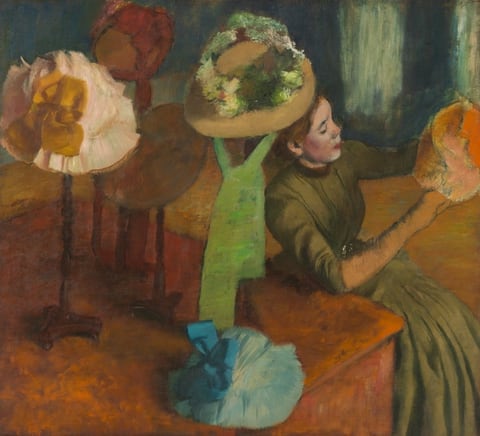
  3. Impressionist painting of woman wearing green dress trying on hats.
    The Millinery ShopEdgar Degas, 1879-86Courtesy of the Art Institute of Chicago

Third room, north wall
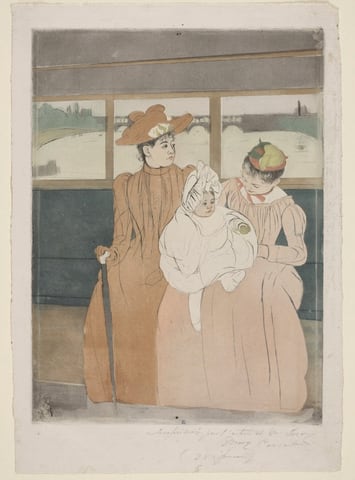
  1. In the Omnibus, by Mary Cassatt, 1890–91
    In the OmnibusMary Cassatt, 1890–91Courtesy of the Cleveland Museum of Art
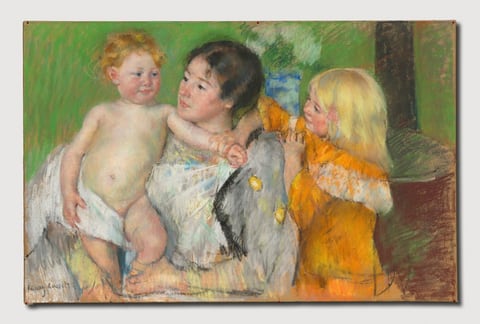
  2. After the Bath, by Mary Cassatt, 1901
    After the BathMary Cassatt, 1901Courtesy of the Cleveland Museum of Art
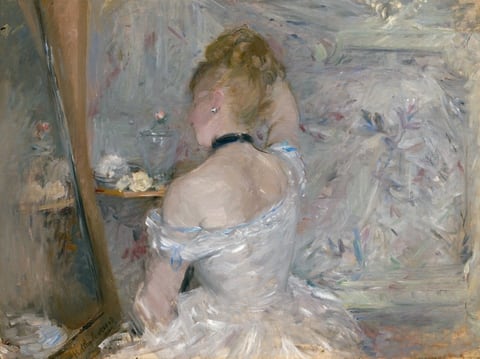
  3. Painted portrait dominated by loose, large brushstrokes of a woman, seen from the back, wearing a gauzy white off-the-shoulder dress and black choker, blond hair swept up, examining herself in a mirror at left. The background is a feathered swirl suggesting floral pattern in cool pale tones of gray, purple, pink, and blue.
    Woman at Her ToiletteBerthe Morisot, 1875–80Courtesy of the Art Institute of Chicago

Third room, south wall
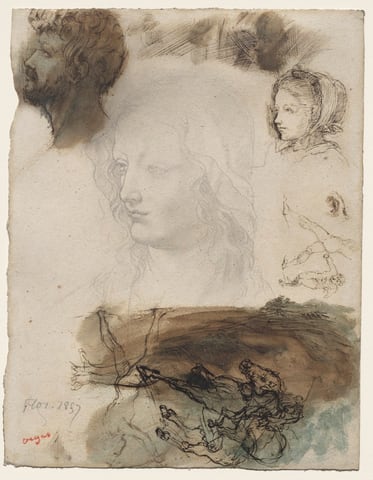
  1. Sheet of Studies and Sketches, by Edgar Degas, 1858
    Sheet of Studies and SketchesEdgar Degas, 1858Courtesy of the Cleveland Museum of Art
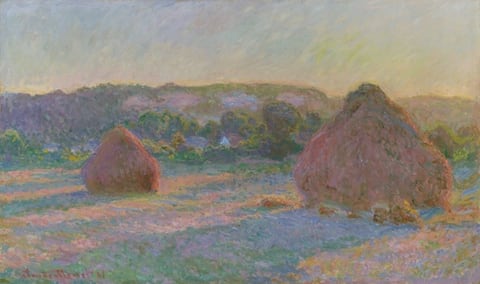
  2. Painting composed of short, dense brushstrokes depicts two domed stacks of wheat that cast long shadows on a field. The angled light indicates either a rising or setting sun.
    Stacks of Wheat (End of Summer)Claude Monet, 1890–91Courtesy of the Art Institute of Chicago