Skip to content
Ochre Editions
ArtArtistsCollectionsGalleriesDrops
SearchSign inCart (0)
The galleries · East wing: The Nineteenth Century

Impressionism

Painters in 1870s Paris who worked quickly, often outdoors, to catch light as it changed.

53 works · hang 723 ·

Share Impressionism, in the galleries

The rooms are imagined; every work on their walls is real.

Walk this roomRehang this room

First room, north wall

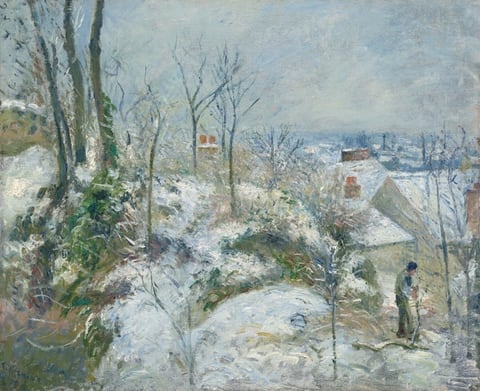
  1. A work made of oil on canvas.
    Rabbit Warren at Pontoise, SnowCamille Pissarro, 1879Courtesy of the Art Institute of Chicago
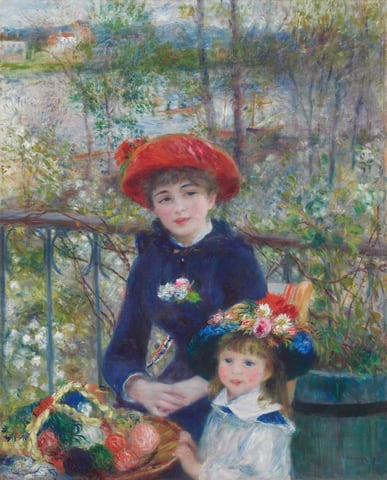
  2. Impressionist painting of two girls on balcony, bright flower hat, knitting basket.
    Two Sisters (On the Terrace)Pierre-Auguste Renoir, 1881Courtesy of the Art Institute of Chicago
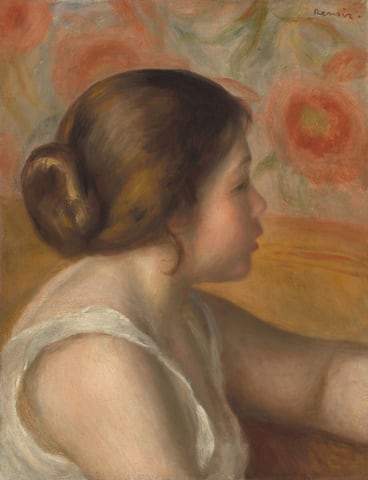
  3. This painting shows a young woman's upper body from the torso up. She is seated and facing the right, with her face seen in profile and one arm bent in front of her, seeming to rest on a brown table or surface. She has pale skin, round, rosy cheeks, a small nose, and pink lips that are slightly parted. Her brown hair is styled into a smooth, glossy bun at the nape of her neck. She is wearing a white garment with thin straps over her shoulders. The background features a yellow section on the bottom half, and on the top half is a colorful, abstract pattern with large, soft, swirling forms in shades of orange and red on a blue-gray background with hints of green.
    Head of a Young GirlPierre-Auguste Renoir, c. 1890Courtesy National Gallery of Art, Washington

First room, south wall
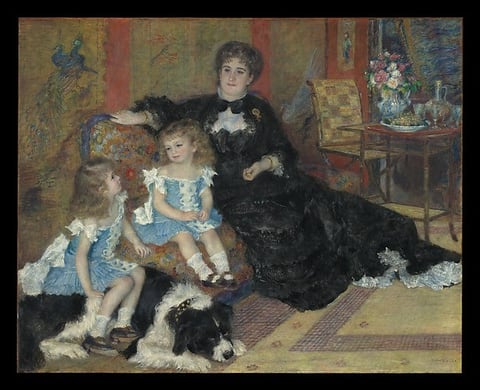
  1. Madame Georges Charpentier (Marguerite-Louise Lemonnier, 1848–1904) and Her Children, Georgette-Berthe (1872–1945) and Paul-Emile-Charles (1875–1895), by Pierre-Auguste Renoir, 1878
    Madame Georges Charpentier (Marguerite-Louise Lemonnier, 1848–1904) and Her Children, Georgette-Berthe (1872–1945) and Paul-Emile-Charles (1875–1895)Pierre-Auguste Renoir, 1878Courtesy of The Metropolitan Museum of Art
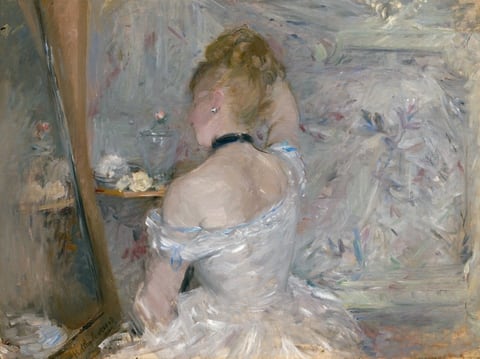
  2. Painted portrait dominated by loose, large brushstrokes of a woman, seen from the back, wearing a gauzy white off-the-shoulder dress and black choker, blond hair swept up, examining herself in a mirror at left. The background is a feathered swirl suggesting floral pattern in cool pale tones of gray, purple, pink, and blue.
    Woman at Her ToiletteBerthe Morisot, 1875–80Courtesy of the Art Institute of Chicago
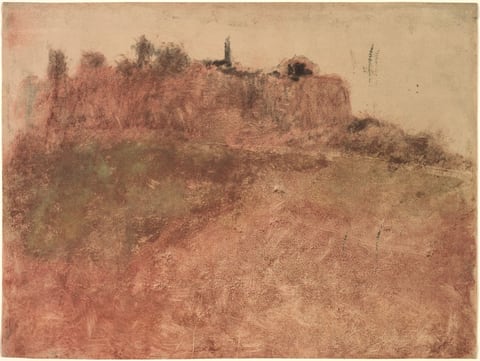
  3. Estérel Village, by Edgar Degas, c. 1890
    Estérel VillageEdgar Degas, c. 1890Courtesy of the Cleveland Museum of Art

Second room, south wall
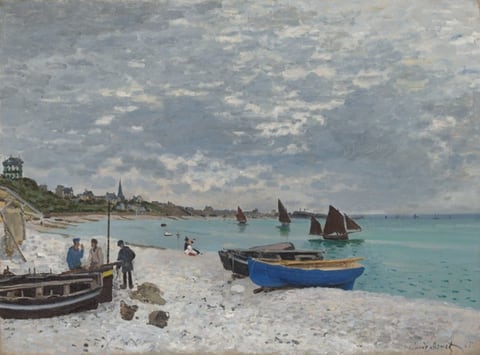
  1. Painting of a beach on a cloudy day with several sailboats on the water, a few rowboats on the shore, and two groupings of people on the sand.
    The Beach at Sainte-AdresseClaude Monet, 1867Courtesy of the Art Institute of Chicago
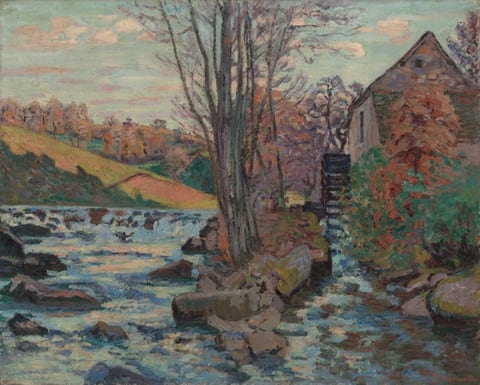
  2. A work made of oil on canvas.
    Mill of Pont MaupuitJean Baptiste Armand Guillaumin, c. 1900Courtesy of the Art Institute of Chicago
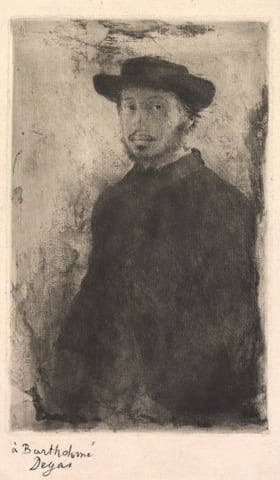
  3. Self-Portrait, by Edgar Degas, 1857
    Self-PortraitEdgar Degas, 1857Courtesy of the Cleveland Museum of Art

Second room, north wall
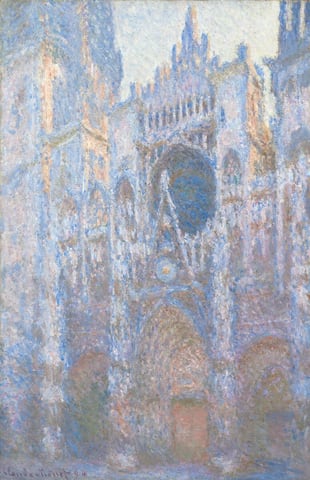
  1. We look up at the exterior of a church that soars the height of this vertical painting. The church is painted with visible dabs and strokes of azure blue, peach, lavender purple, and camel brown to create a blurred look, as if seeing a reflection in the rippling surface of a puddle. The church façade is angled to our left, away from us. The main door and its surround takes up the center of the composition, where a rectangular door is set within nested, pointed arches that lead up to a narrow, tall, triangular gable. The point of that gable overlaps the round, dark rose window, which is the same width as the portal surround below. Spires flank the central section and rise precipitously off the top edge of the painting. The sky above is painted with daubs of white and pale blue. The artist signed and dated the lower left, “Claude Monet 94.”
    Rouen Cathedral, West FaçadeClaude Monet, 1894Courtesy National Gallery of Art, Washington
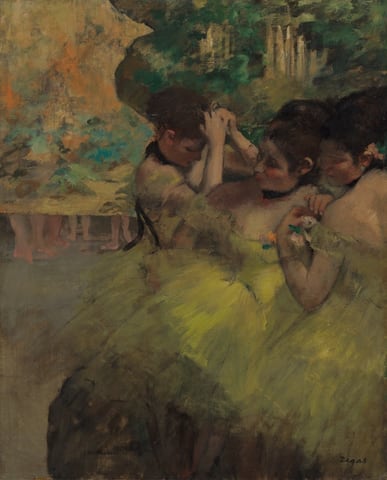
  2. Three light-skinned, dark-haired ballerinas, painted in muted tones, wear off-the-shoulder yellow leotards and tutus as they huddle near each other. One adjusts her costume, while one holds her hands clasped above her head. At left is a painted screen with four pairs of feet visible underneath.
    Yellow Dancers (In the Wings)Edgar Degas, 1874–76Courtesy of the Art Institute of Chicago
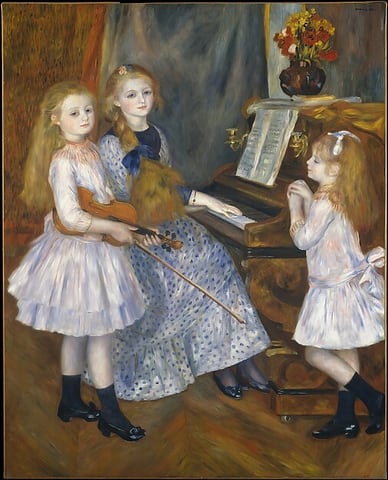
  3. The Daughters of Catulle Mendès, Huguette (1871–1964), Claudine (1876–1937), and Helyonne (1879–1955), by Pierre-Auguste Renoir, 1888
    The Daughters of Catulle Mendès, Huguette (1871–1964), Claudine (1876–1937), and Helyonne (1879–1955)Pierre-Auguste Renoir, 1888Courtesy of The Metropolitan Museum of Art

Third room, north wall
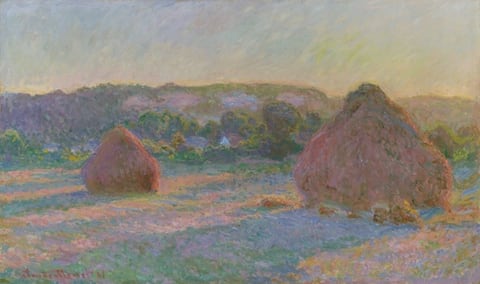
  1. Painting composed of short, dense brushstrokes depicts two domed stacks of wheat that cast long shadows on a field. The angled light indicates either a rising or setting sun.
    Stacks of Wheat (End of Summer)Claude Monet, 1890–91Courtesy of the Art Institute of Chicago
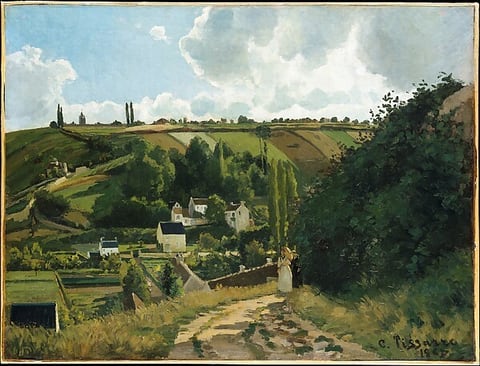
  2. Jalais Hill, Pontoise, by Camille Pissarro, 1867
    Jalais Hill, PontoiseCamille Pissarro, 1867Courtesy of The Metropolitan Museum of Art

Third room, south wall
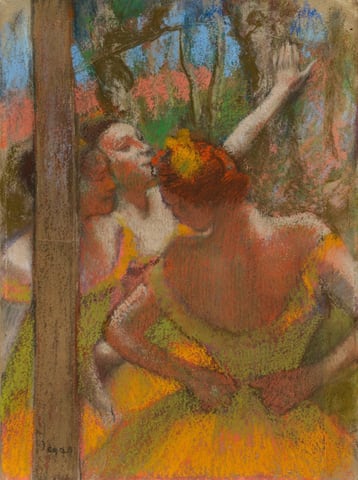
  1. Dancers, by Edgar Degas, c. 1896
    DancersEdgar Degas, c. 1896Courtesy of the Cleveland Museum of Art
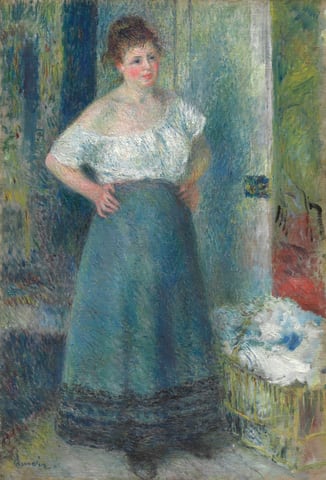
  2. A work made of oil on canvas.
    The LaundressPierre-Auguste Renoir, 1877–79Courtesy of the Art Institute of Chicago

Walk on

  • Impressionism, room 2
  • Post-Impressionism 62 works
Ochre Editions

The world's museums, on your wall. Every work here is a reproduction of a public-domain original, credited to the museum that holds it.

Shop

All artCollectionsLimited dropsPrints and framing

Help

Find an orderShippingReturnsVerify a certificate

About

About Ochre EditionsMuseum creditsFor agentsDevelopers

Legal

Terms of UseTerms of SaleLimited Editions and CertificatesPrivacy PolicyCookie PolicyAcceptable Use PolicyAgent & API TermsCopyright and DMCA PolicyPrinting Your Own PhotoVulnerability Disclosure PolicyAccessibility StatementOpen-Access Credits
© 2026 Ochre EditionsPrices in US dollars. Prints ship within the United States.