Floor plan

West wing: Old MastersRenaissance

Renaissance

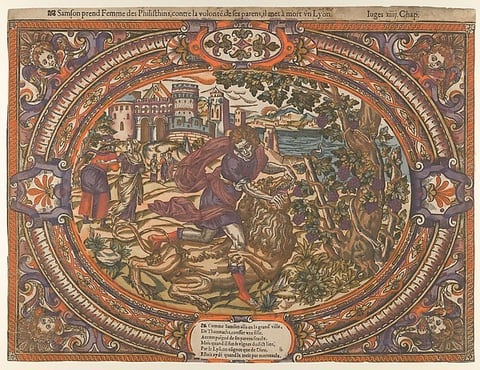
Samson and the Lion, from "The Story of Samson", ca. 1560–80
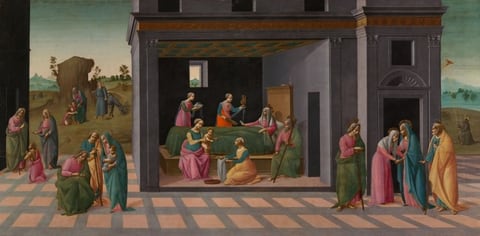
Outdoors, distinct groupings of adult men and women, some with halos, gather near a building. The front-facing wall of the building is not depicted, allowing for a view inside, where a woman sits in bed with two women nearby and two other women dress a baby. A bearded man sits near the bed.
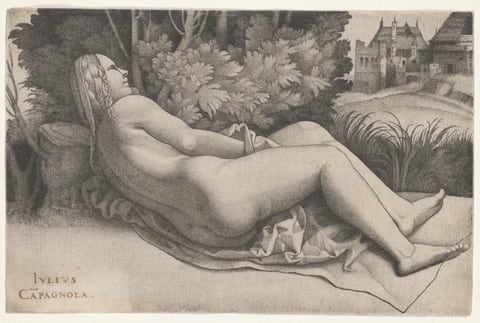
Venus Reclining in a Landscape, by Giulio Campagnola, c. 1508–9
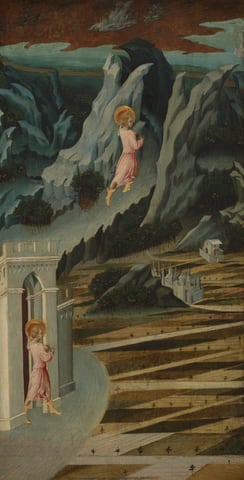
A work made of tempera on panel.
A work made of engraving and etching in black on cream laid paper.
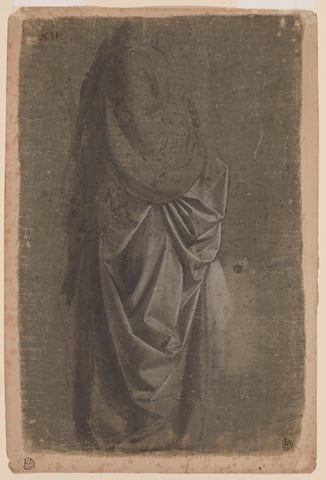
A work made of brush and opaque watercolor, on linen prepared with a gray ground, mounted to cream laid paper.
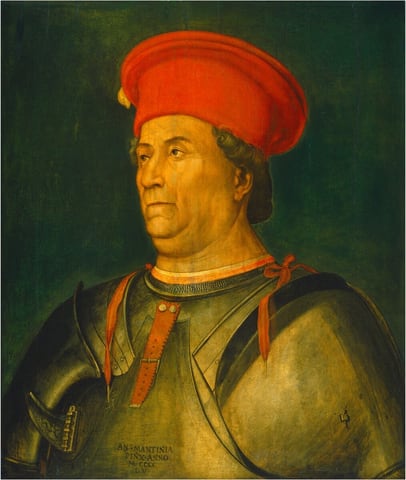
This painting shows an upper-body portrait of a man in a three-quarter view, turned to the left. He has a prominent double chin, a slightly furrowed brow, thin lips, and a serious expression. He has pale yellow skin and short, dark hair, and he wears a large, red hat. He is clad in silver armor with red straps on his shoulder and chest. The background is a simple, dark green color.
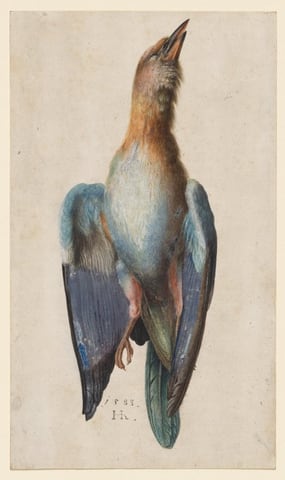
Dead Blue Roller, by Hans Hoffmann, 1583

The works in this room are listed below.

Works in this room

European art from about 1400 to 1600, when painters rediscovered perspective and the classical past.

Section 1, north wall

  1. Samson and the Lion, from "The Story of Samson", ca. 1560–80
    Samson and the Lion, from "The Story of Samson"Unrecorded French maker, ca. 1560–80Courtesy of The Metropolitan Museum of Art
  2. Outdoors, distinct groupings of adult men and women, some with halos, gather near a building. The front-facing wall of the building is not depicted, allowing for a view inside, where a woman sits in bed with two women nearby and two other women dress a baby. A bearded man sits near the bed.
    Scenes from the Life of Saint John the BaptistBartolomeo di Giovanni, 1490/95Courtesy of the Art Institute of Chicago
  3. Venus Reclining in a Landscape, by Giulio Campagnola, c. 1508–9
    Venus Reclining in a LandscapeGiulio Campagnola, c. 1508–9Courtesy of the Cleveland Museum of Art
  4. A work made of tempera on panel.
    Saint John the Baptist Entering the WildernessGiovanni di Paolo, 1455–60Courtesy of the Art Institute of Chicago

Section 1, south wall

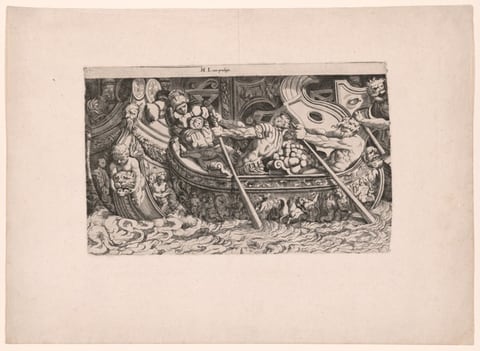
  1. A work made of engraving and etching in black on cream laid paper.
    A Naval BattleMichele Lucchese, c. 1550Courtesy of the Art Institute of Chicago
  2. A work made of brush and opaque watercolor, on linen prepared with a gray ground, mounted to cream laid paper.
    Drapery Study of a Standing Figure Facing Right, in ProfileAndrea del Verrocchio, late 1460s–early 1470sCourtesy of the Art Institute of Chicago
  3. This painting shows an upper-body portrait of a man in a three-quarter view, turned to the left. He has a prominent double chin, a slightly furrowed brow, thin lips, and a serious expression. He has pale yellow skin and short, dark hair, and he wears a large, red hat. He is clad in silver armor with red straps on his shoulder and chest. The background is a simple, dark green color.
    Francesco SforzaUnrecorded Italian maker, probably c. 1480/1500Courtesy National Gallery of Art, Washington
  4. Dead Blue Roller, by Hans Hoffmann, 1583
    Dead Blue RollerHans Hoffmann, 1583Courtesy of the Cleveland Museum of Art

Section 2, south wall
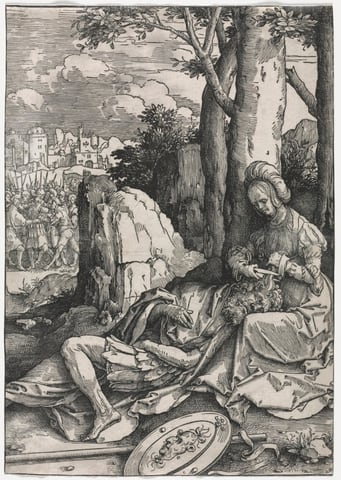
  1. The Power of Women: Samson and Delilah, by Lucas van Leyden, c. 1512
    The Power of Women: Samson and DelilahLucas van Leyden, c. 1512Courtesy of the Cleveland Museum of Art
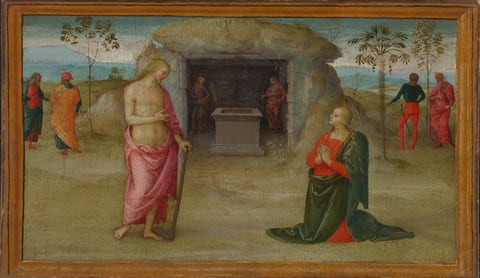
  2. A work made of tempera on panel, transferred to canvas.
    Noli Me TangerePerugino, 1500–05Courtesy of the Art Institute of Chicago
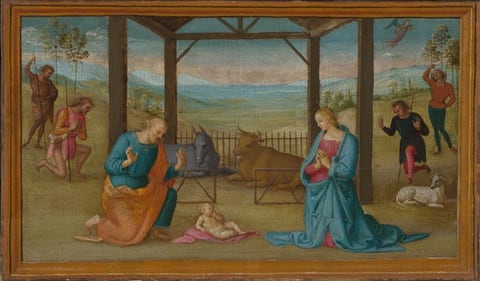
  3. A work made of tempera on panel, transferred to canvas.
    The NativityPerugino, 1500–05Courtesy of the Art Institute of Chicago
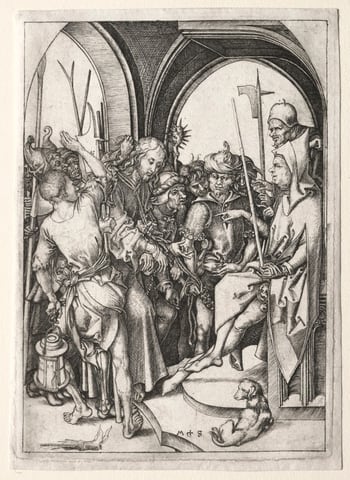
  4. The Passion: Christ Before Annas, by Martin Schongauer, c. 1480
    The Passion: Christ Before AnnasMartin Schongauer, c. 1480Courtesy of the Cleveland Museum of Art

Section 2, north wall
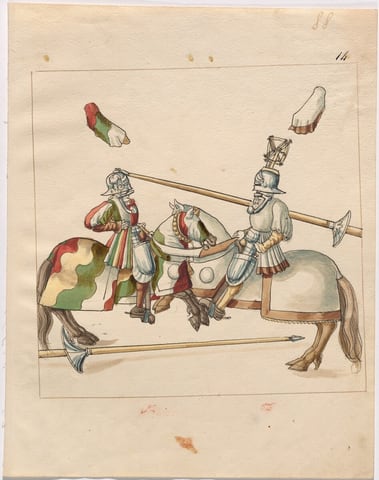
  1. This is a drawing of two armored knights on horseback during a joust. It depicts two horses with riders clad in full armor, including helmets with decorative details. Each knight holds a lance, poised as if they are about to engage in a jousting match. The horses are also adorned in armor, with a colorful caparison draped over them. On the ground, there are lances and a halberd seen in the foreground. There are also disembodied arms and hands illustrated in the composition, adding an abstract element. The style is illustrative, capturing the medieval theme of chivalric tournaments.
    Mock Joust of War with Flying Shields and Without BevorsUnrecorded German maker, c.1512-1515Courtesy National Gallery of Art, Washington
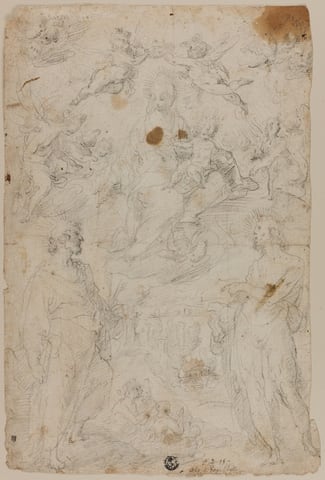
  2. A work made of black chalk (recto), and black chalk and pen and black ink (verso), on ivory laid paper.
    Virgin and Child with Saints Peter and John the Baptist (recto); Saint John the Baptist (verso)Pietro d' Asaro, n.d.Courtesy of the Art Institute of Chicago
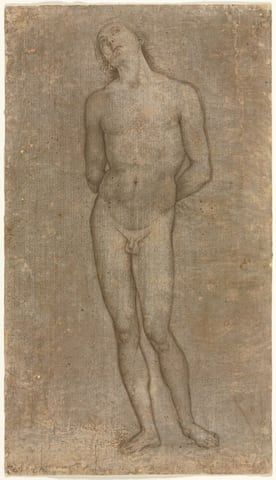
  3. Saint Sebastian, by Perugino, c. 1493
    Saint SebastianPerugino, c. 1493Courtesy of the Cleveland Museum of Art
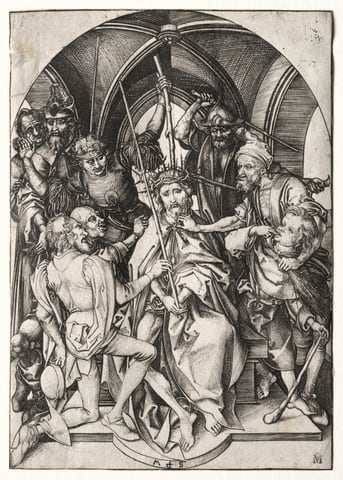
  4. Christ Crowned with Thorns, by Martin Schongauer, 1470–82
    Christ Crowned with ThornsMartin Schongauer, 1470–82Courtesy of the Cleveland Museum of Art