Floor plan

Style galleriesAmerican folk and design
American folk and design
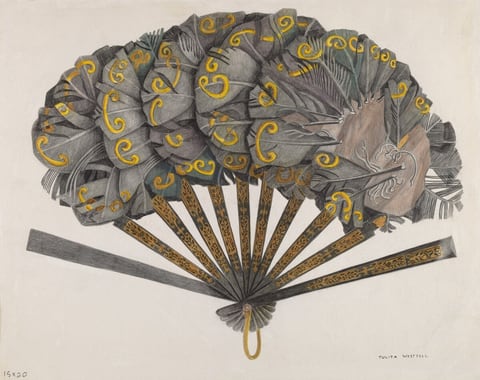
The image shows a large fan with intricate feather-like segments adorned with yellow patterns and a bird depiction. The color palette is grey with hints of yellow, brown, and metallic sheen on the ribs. The fan is positioned upright with the handle at the bottom center, and the feathers extend outward in a semi-circular shape.
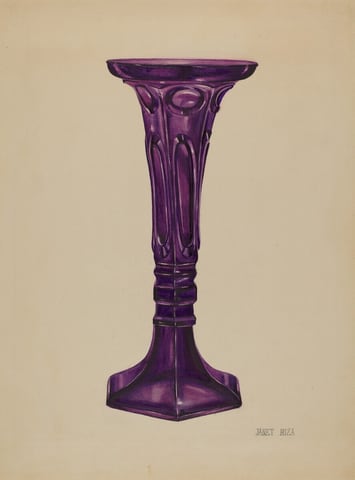
The image shows a tall, intricately designed purple candlestick against a light beige background. The overall color palette is dominated by shades of purple. The candlestick is centrally positioned and stands upright with detailed patterns visible.
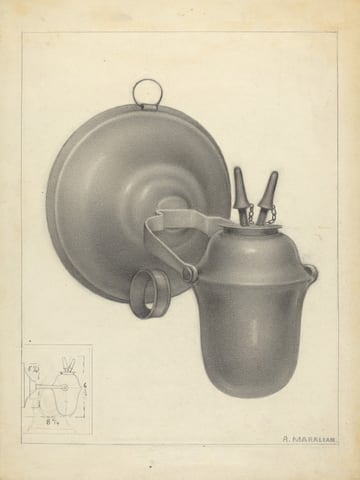
The image depicts a detailed drawing of a wall-mounted vessel. It consists of a large, spherical body attached to a flat disc, with two smaller protrusions resembling handles or clips. The color palette is monochromatic with shades of gray, giving it a metallic or ceramic appearance. The objects are centrally positioned, with a small inset illustration in the bottom left corner showing annotations. The artist's signature, "A. Marshall," is located near the lower right corner of the image.
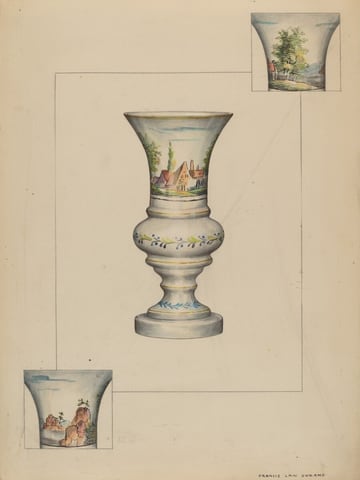
The image shows a large, intricately designed vase with a bulbous base and flared top at the center. The vase is decorated with painted scenes of a town or village. The color scheme includes shades of blue, green, brown, and touches of yellow and red. Surrounding the vase are two smaller detailed sections showing close-ups of the painted scenes on it. The main vase image is enclosed within a boxed outline on the page.
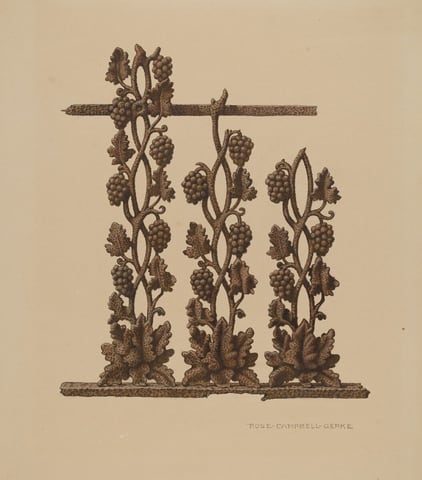
The image depicts an iron sculpture with grapevine motifs. The color scheme is primarily brown, with a textured appearance. The grapevine design is arranged vertically and includes grape clusters and leaves. The sculpture is mounted on a base and includes an iron bar at the top. The artist's signature "ROSE CAMPBELL GERKE" is visible in the lower right corner of the image.
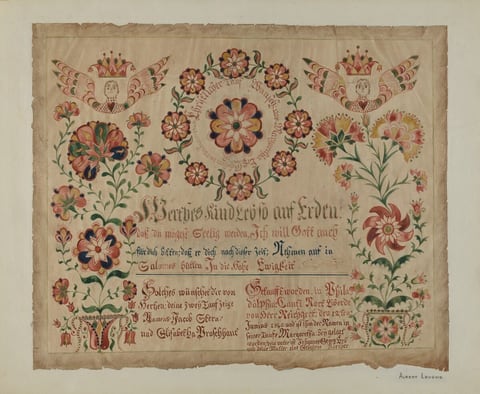
This is a painting of a colorful floral design with text. The artwork features stylized flowers in shades of red, green, and yellow scattered across the page. In the center, there is calligraphic text in varying boldness and fonts, likely in German. Two symmetrical bird-like figures with human faces and crowns are above the text. The piece combines imagery with artistic lettering in a style reminiscent of traditional Pennsylvania German fraktur. The artwork is bordered by a thin line, suggesting it's part of a larger artifact or document.

The works in this room are listed below.

Works in this room

The everyday art of early America, recorded in watercolour by the Index of American Design.

Section 1, north wall

  1. The image shows a large fan with intricate feather-like segments adorned with yellow patterns and a bird depiction. The color palette is grey with hints of yellow, brown, and metallic sheen on the ribs. The fan is positioned upright with the handle at the bottom center, and the feathers extend outward in a semi-circular shape.
    Feather FanTulita Westfall, c. 1937Courtesy National Gallery of Art, Washington
  2. The image shows a tall, intricately designed purple candlestick against a light beige background. The overall color palette is dominated by shades of purple. The candlestick is centrally positioned and stands upright with detailed patterns visible.
    VaseJanet Riza, c. 1937Courtesy National Gallery of Art, Washington
  3. The image depicts a detailed drawing of a wall-mounted vessel. It consists of a large, spherical body attached to a flat disc, with two smaller protrusions resembling handles or clips. The color palette is monochromatic with shades of gray, giving it a metallic or ceramic appearance. The objects are centrally positioned, with a small inset illustration in the bottom left corner showing annotations. The artist's signature, "A. Marshall," is located near the lower right corner of the image.
    LampArsen Maralian, c. 1936Courtesy National Gallery of Art, Washington

Section 1, south wall

  1. The image shows a large, intricately designed vase with a bulbous base and flared top at the center. The vase is decorated with painted scenes of a town or village. The color scheme includes shades of blue, green, brown, and touches of yellow and red. Surrounding the vase are two smaller detailed sections showing close-ups of the painted scenes on it. The main vase image is enclosed within a boxed outline on the page.
    Fire Lighter VaseFrancis Law Durand, 1935/1942Courtesy National Gallery of Art, Washington
  2. The image depicts an iron sculpture with grapevine motifs. The color scheme is primarily brown, with a textured appearance. The grapevine design is arranged vertically and includes grape clusters and leaves. The sculpture is mounted on a base and includes an iron bar at the top. The artist's signature "ROSE CAMPBELL GERKE" is visible in the lower right corner of the image.
    FenceRose Campbell-Gerke, c. 1940Courtesy National Gallery of Art, Washington
  3. This is a painting of a colorful floral design with text. The artwork features stylized flowers in shades of red, green, and yellow scattered across the page. In the center, there is calligraphic text in varying boldness and fonts, likely in German. Two symmetrical bird-like figures with human faces and crowns are above the text. The piece combines imagery with artistic lettering in a style reminiscent of traditional Pennsylvania German fraktur. The artwork is bordered by a thin line, suggesting it's part of a larger artifact or document.
    Pa. German Birth CertificateAlbert Levone, c. 1940Courtesy National Gallery of Art, Washington

Section 2, south wall
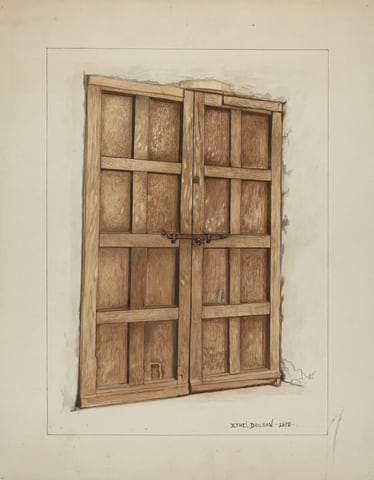
  1. This is a drawing of a wooden window shutter in a light-colored wall. The detailed study shows the craftsmanship of the shutter, with a focus on texture, form, wood grain, and panels. The aged and weathered texture suggests exposure to the elements. The shutter is secured with a metal latch in the center. The wall is subtly shaded to imply depth and setting, with slight distress marks adding to the aged ambiance of the scene.
    Sacristy Door at Mission San Juan BautistaEthel Dougan, 1938Courtesy National Gallery of Art, Washington
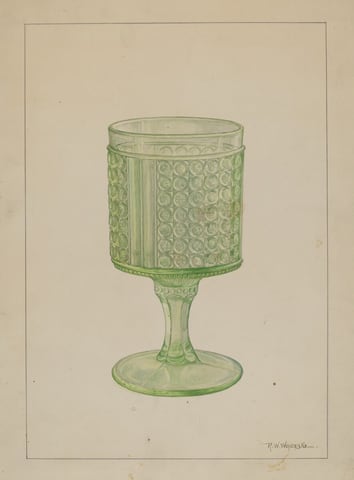
  2. The image shows a green glass goblet with a textured, bubble-like pattern on the cup and a smooth stem. The color palette consists of shades of green with varying tones, depending on the glass's thickness and pattern. The goblet is positioned centrally, seen straight-on with the cup's pattern visible across its surface. It rests on a flat surface, slightly above the center of the image.
    GobletRonau William Woiceske, 1935/1942Courtesy National Gallery of Art, Washington
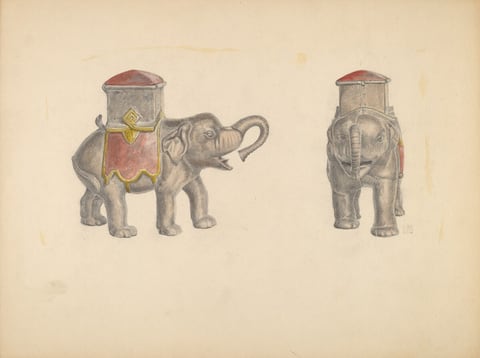
  3. This is a drawing of two ornate elephants. The image depicts two stylized elephants, each adorned with decorative elements. Both elephants are shown carrying a structure on their backs, resembling a small tower or box with a red domed top. The left elephant is turned to the side, its trunk raised. The right elephant faces forward. Each structure on their backs is detailed with intricate designs, including a diamond shape on the side. The overall composition suggests a ceremonial or regal theme. The subtle use of colors like red and gold enhances the ornate appearance. The coloring and shading indicate an attention to detail typical of deliberately crafted illustrations.
    Iron Bank ElephantZ.S. Lupus, c. 1938Courtesy National Gallery of Art, Washington

Section 2, north wall
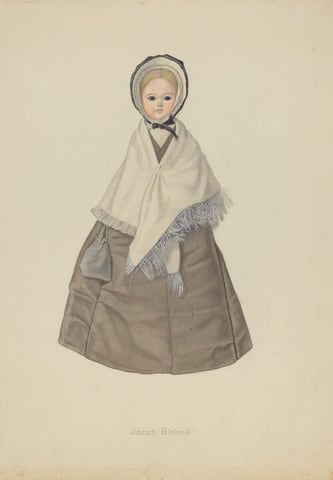
  1. The image depicts a young person standing upright with distinct facial features including rounded cheeks, a small mouth, and large eyes. They are wearing a brown dress with a cream-colored shawl, a bonnet with dark trim, and a pouch hanging from their left side. The background is plain and cream-colored.
    Quaker DollJacob Gielens, 1935/1942Courtesy National Gallery of Art, Washington
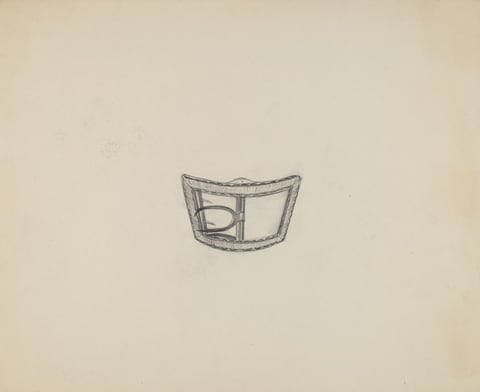
  2. The image displays a detailed pencil sketch of a curved architectural structure in the center of a light beige canvas. The sketch is in grayscale, with a simple color palette. The object occupies a small portion of the canvas, surrounded by negative space.
    Knee BuckleEdna Crenshaw Rex, c. 1937Courtesy National Gallery of Art, Washington
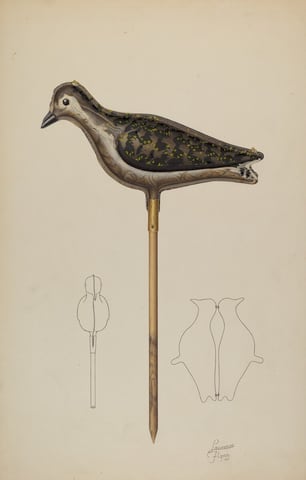
  3. The image shows a painted decoy of a bird mounted on a wooden stake. The decoy has intricate details with spots of yellow and green on top of a dark body. The colors are naturalistic with brown, black, yellow, white, and beige. In the lower left section of the image, there are two line drawings of a bird.
    Snipe DecoyLawrence Flynn, 1941Courtesy National Gallery of Art, Washington

Section 3, north wall
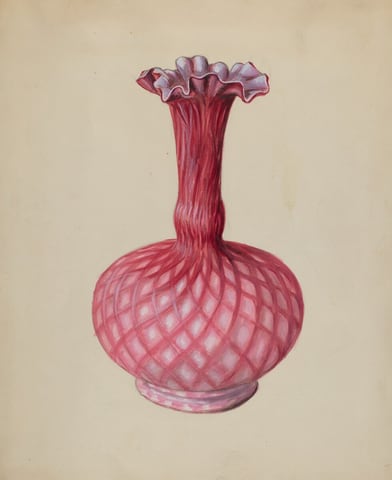
  1. The image displays a single ornate vase with a bulbous base and a ruffled top, taking up most of the frame. The vase is predominantly pink with red accents, the ruffled top is highlighted with white on the inner edges, and there's a crisscross pattern visible on the body. Against a plain beige background, the vase is centrally positioned.
    Ornamental Ruby VaseRobert Stewart, c. 1936Courtesy National Gallery of Art, Washington
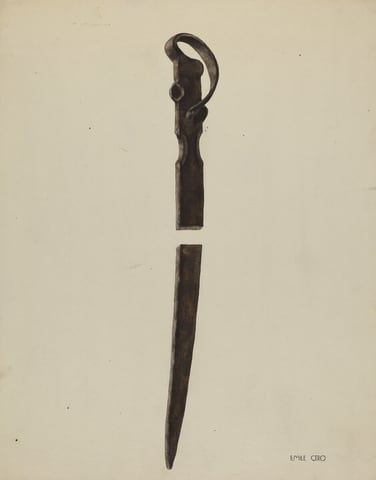
  2. The image shows a dark metal object with two parts: a handle and a blade. The color palette consists of shades of dark brown on a light beige background. The handle is located at the top center, and the blade portion is positioned below it, both aligned vertically in the center of the frame.
    SpitEmile Cero, c. 1938Courtesy National Gallery of Art, Washington

Section 3, south wall
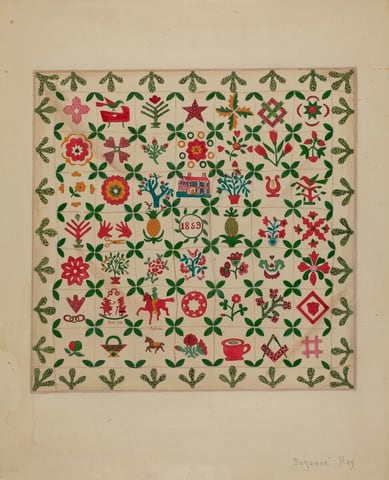
  1. This is a painting of a decorative quilt pattern. The image shows a grid of square sections with various colorful motifs including stars, flowers, a horse, a house, and a cup. The design features vibrant colors, symmetrical patterns, and a central section with the date "1859". The quilt border has leaf-like patterns creating a frame around the central grid. The style is folk art.
    Applique QuiltSuzanne Roy, 1938Courtesy National Gallery of Art, Washington
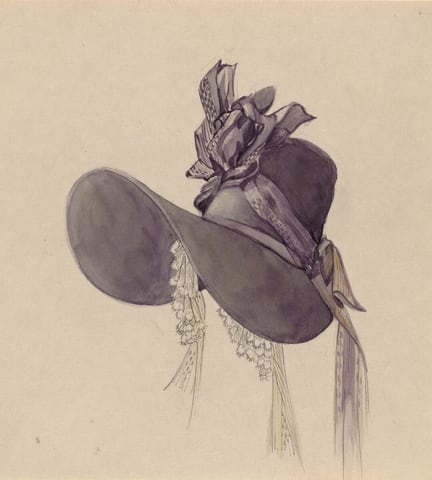
  2. The image shows a large hat with a broad brim, decorated with a ribbon and floral or lace-like embellishments. The color palette consists of shades of gray and soft purples. The hat is centered in the frame, with its brim curving to the left and the decorative elements extending to the sides.
    BonnetRosalia Lane, 1935/1942Courtesy National Gallery of Art, Washington