Floor plan

Style galleriesThe American Gilded Age
The American Gilded Age
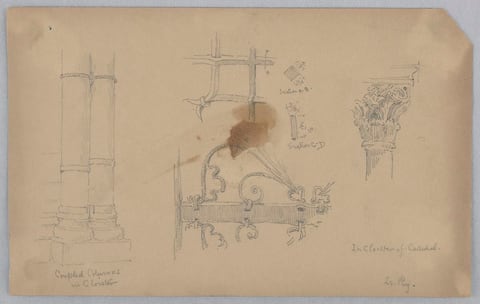
IN CLOISTER OF CATHEDREAL, LE PUY
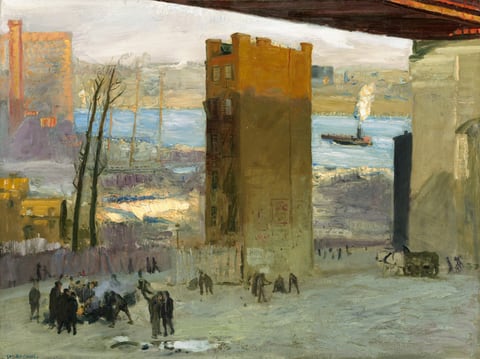
A six-story, narrow building stands alone in an otherwise unoccupied lot under the deck of a high bridge, with a river and cityscape in the background in this horizontal painting. Dozens of people, small in scale, are each painted with a few swipes of black and some with peach-colored faces. They gather at the foot of the building and around a fire to our left, near the lower left corner of the composition. The fire is painted with a dash of orange, a few touches of canary yellow, and a smudge of gray smoke. Several more people stand and sit against the building, which has a streetlamp near its entrance. The back end of the building angles away from us to our right, so we see the narrow, front entrance side to our left. Each of the six floors of the building has two windows with fire escape ladders on the narrow side we can see. Some strokes in red and white on the lower levels of the long, flat side of the building suggest signs or posters. The top story glows a warm sienna brown in sunlight, while the rest of the building and the scene below are in shadow. More people walk along a grayish-violet fence that encloses the lot beyond the building. The ground is painted thickly with slate gray, pale, sage green, and one smear of white to suggest snow. To our right and a short distance from us, a white horse pulls a carriage near the foot of the bridge. The ivory-white, concrete piling rises up and off the right edge of the canvas and supports the deck of the bridge above. Only a sliver of the brick-red underside of the bridge is visible, skimming the top edge of the painting in the upper right corner. Two twiggy, barren trees grow up beyond the muted purple fence, and the landscape beyond is bright in the sunlight. A terracotta-orange building rises along the left edge of the painting, with the area between it and the lot under the bridge filled with thickly painted patches of butter yellow, amethyst purple, and sage green. Beyond that, an ice-blue river flows across the composition. The shore beyond is lined with patches of beige and tan paint that could be buildings. A black tugboat puffs bright white smoke in the river. The sky above is frosty white. The artist signed the work with dark blue in the lower left corner of the painting, “Geo Bellows.”
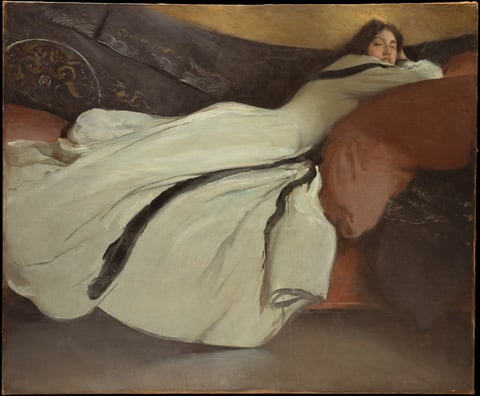
Repose, by John White Alexander, 1895
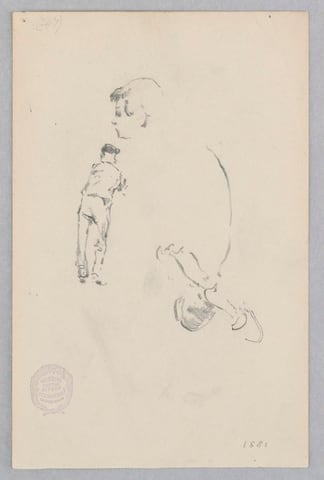
FIGURES
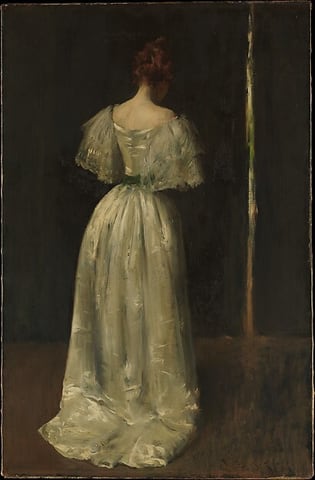
Seventeenth Century Lady, by William Merritt Chase, ca. 1895
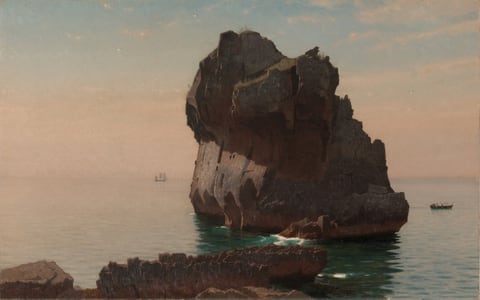
Capri, by William Stanley Haseltine, 1869
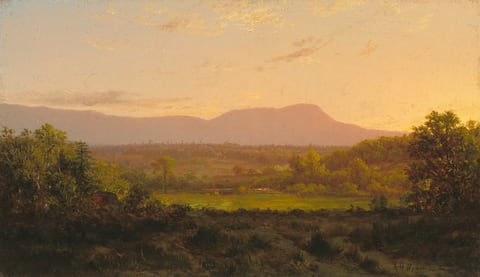
The painting depicts a rural landscape at sunset or sunrise. The horizon is slightly above the center, showing distant pale-pink and purple mountains against the sky. Closest to us is an area with dark green bushes and vegetation, leading to a lighter green field surrounded by green-and-brown trees. The palette is warm and earthy, with greens and browns in the bottom transitioning to purples and pinks in the distance. The sky is a pale-yellow color that fades into light blue towards the top left corner, and faint yellow and gray clouds drift across it.

The works in this room are listed below.

Works in this room

Painting and design in the United States from the Civil War to 1910.

First room, north wall

  1. IN CLOISTER OF CATHEDREAL, LE PUY
    In Cloister of Cathedreal, Le PuyArnold William Brunner, 1883Courtesy of Cooper Hewitt, Smithsonian Design Museum
  2. A six-story, narrow building stands alone in an otherwise unoccupied lot under the deck of a high bridge, with a river and cityscape in the background in this horizontal painting. Dozens of people, small in scale, are each painted with a few swipes of black and some with peach-colored faces. They gather at the foot of the building and around a fire to our left, near the lower left corner of the composition. The fire is painted with a dash of orange, a few touches of canary yellow, and a smudge of gray smoke. Several more people stand and sit against the building, which has a streetlamp near its entrance. The back end of the building angles away from us to our right, so we see the narrow, front entrance side to our left. Each of the six floors of the building has two windows with fire escape ladders on the narrow side we can see. Some strokes in red and white on the lower levels of the long, flat side of the building suggest signs or posters. The top story glows a warm sienna brown in sunlight, while the rest of the building and the scene below are in shadow. More people walk along a grayish-violet fence that encloses the lot beyond the building. The ground is painted thickly with slate gray, pale, sage green, and one smear of white to suggest snow. To our right and a short distance from us, a white horse pulls a carriage near the foot of the bridge. The ivory-white, concrete piling rises up and off the right edge of the canvas and supports the deck of the bridge above. Only a sliver of the brick-red underside of the bridge is visible, skimming the top edge of the painting in the upper right corner. Two twiggy, barren trees grow up beyond the muted purple fence, and the landscape beyond is bright in the sunlight. A terracotta-orange building rises along the left edge of the painting, with the area between it and the lot under the bridge filled with thickly painted patches of butter yellow, amethyst purple, and sage green. Beyond that, an ice-blue river flows across the composition. The shore beyond is lined with patches of beige and tan paint that could be buildings. A black tugboat puffs bright white smoke in the river. The sky above is frosty white. The artist signed the work with dark blue in the lower left corner of the painting, “Geo Bellows.”
    The Lone TenementGeorge Bellows, 1909Courtesy National Gallery of Art, Washington
  3. Repose, by John White Alexander, 1895
    ReposeJohn White Alexander, 1895Courtesy of The Metropolitan Museum of Art

First room, south wall

  1. FIGURES
    FiguresRobert Frederick Blum, 1881Courtesy of Cooper Hewitt, Smithsonian Design Museum
  2. Seventeenth Century Lady, by William Merritt Chase, ca. 1895
    Seventeenth Century LadyWilliam Merritt Chase, ca. 1895Courtesy of The Metropolitan Museum of Art
  3. Capri, by William Stanley Haseltine, 1869
    CapriWilliam Stanley Haseltine, 1869Courtesy of the Cleveland Museum of Art
  4. The painting depicts a rural landscape at sunset or sunrise. The horizon is slightly above the center, showing distant pale-pink and purple mountains against the sky. Closest to us is an area with dark green bushes and vegetation, leading to a lighter green field surrounded by green-and-brown trees. The palette is warm and earthy, with greens and browns in the bottom transitioning to purples and pinks in the distance. The sky is a pale-yellow color that fades into light blue towards the top left corner, and faint yellow and gray clouds drift across it.
    Peaceful ValleyAlexander Helwig Wyant, c. 1872Courtesy National Gallery of Art, Washington

Second room, south wall
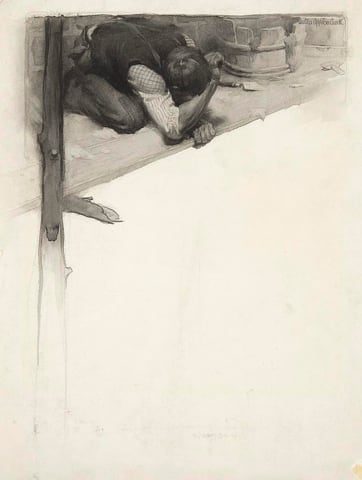
  1. VIGNETTE: MAN CROUCHING ON A SCAFFOLDING
    Vignette: Man Crouching on a ScaffoldingWalter Appleton Clark, 1899Courtesy of Cooper Hewitt, Smithsonian Design Museum
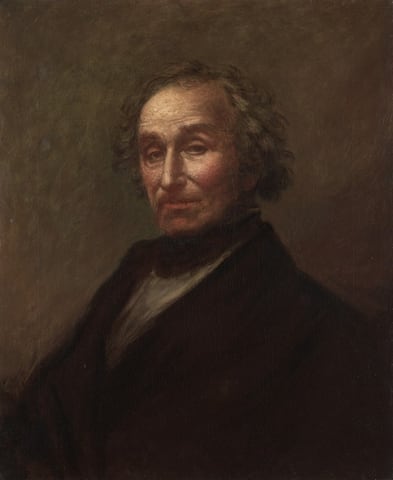
  2. Alvan Clark, 1870s
    Alvan ClarkUnrecorded American maker, 1870sCourtesy of the Cleveland Museum of Art
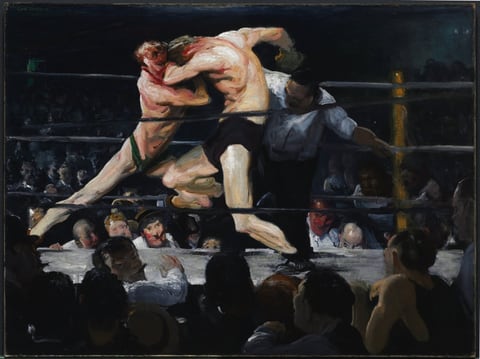
  3. Stag at Sharkey's, by George Bellows, 1909
    Stag at Sharkey'sGeorge Bellows, 1909Courtesy of the Cleveland Museum of Art

Second room, north wall
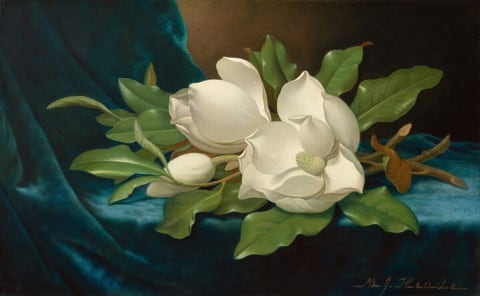
  1. Twigs of a magnolia tree with light green, glossy leaves and three cream-white blossoms lie on a sapphire-blue cloth in this horizontal still life painting. Brightly lit from our left, the blossoms and leaves nearly fill the composition, and the cut ends lie on the fabric to our right. The blue fabric cascades from the upper left and across the table or ledge. The three flowers are in various stages of bloom. The tightest bud is to our left, overlapped by a stem and the tender, unfurling leaves of a branch. The blossom next to it, at the center, is starting to open. The petals of the third blossom, to our right, splay open around the flower’s oval-shaped stamen. Light glints off the waxy leaves surrounding the flowers. The tawny-brown underside of one leaf is visible where it turns over, near the cut ends of the branches. Light shimmering on the fabric darkens from bright blue to our right, to deep royal blue in the shadows to the upper left, suggesting the fabric is velvet. The background is streaked with tan and pine green behind the fabric, and becomes nearly black in the shadows of the upper right corner and along the bottom edge. The artist signed the lower right corner, "MJ. Heade."
    Giant Magnolias on a Blue Velvet ClothMartin Johnson Heade, c. 1890Courtesy National Gallery of Art, Washington
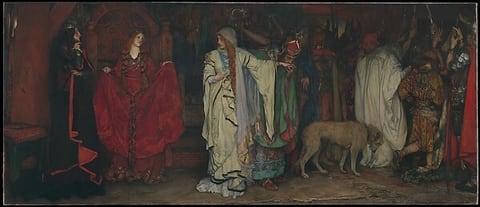
  2. "King Lear," Act I, Scene I, by Edwin Austin Abbey, 1898
    "King Lear," Act I, Scene IEdwin Austin Abbey, 1898Courtesy of The Metropolitan Museum of Art

Third room, north wall
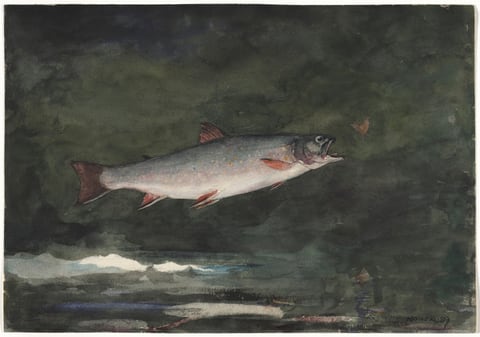
  1. Leaping Trout, by Winslow Homer, 1889
    Leaping TroutWinslow Homer, 1889Courtesy of the Cleveland Museum of Art
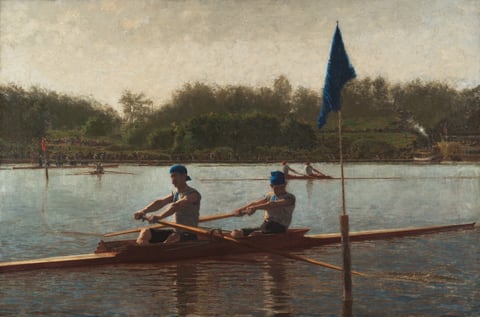
  2. The Biglin Brothers Turning the Stake, by Thomas Eakins, 1873
    The Biglin Brothers Turning the StakeThomas Eakins, 1873Courtesy of the Cleveland Museum of Art

Third room, south wall
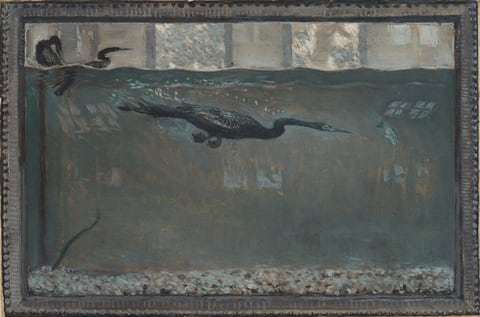
  1. Diving Cormorant, by Otto H. Bacher, 1900
    Diving CormorantOtto H. Bacher, 1900Courtesy of the Cleveland Museum of Art
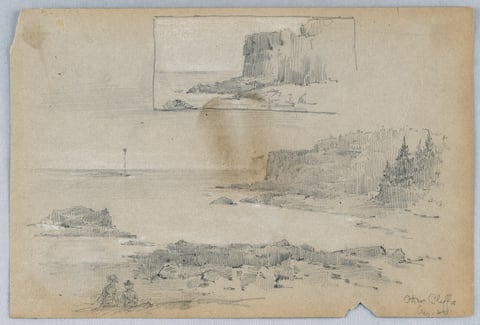
  2. OTTER CLIFFS
    Otter CliffsArnold William Brunner, 1879–80Courtesy of Cooper Hewitt, Smithsonian Design Museum