Floor plan

Style galleriesThe Italian Renaissance
The Italian Renaissance
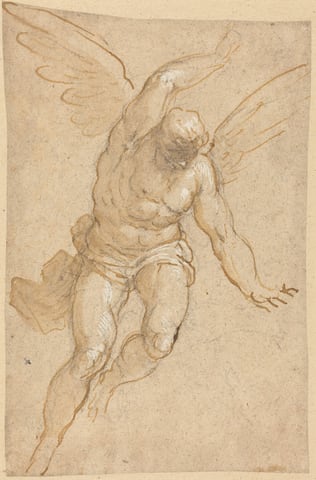
The image shows a human figure with wings positioned as though in flight. The figure is captured from a slightly frontal perspective, with the head turned downwards and the right arm outstretched. The facial features are undefined, focusing more on the body's muscular structure. The figure wears a cloth or drapery around the waist and has well-defined muscles on the chest, arms, and legs. Large wings extend out behind the figure, adding to the sense of flight. The background is plain with a light texture.
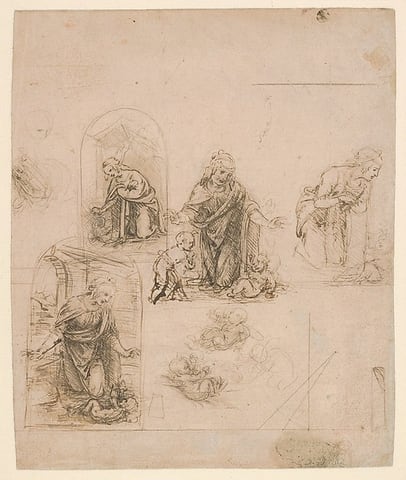
Compositional Sketches for the Virgin Adoring the Christ Child, with and without the Infant St. John the Baptist; Diagram of a Perspectival Projection (recto); Slight Doodles (verso), by Leonardo da Vinci, 1480–85
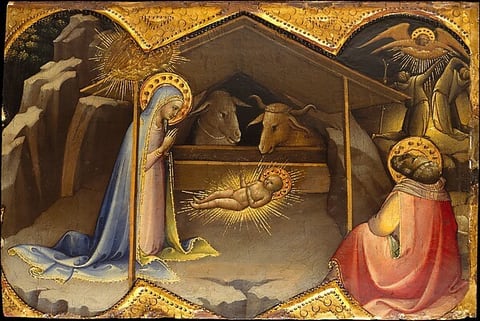
The Nativity, by Lorenzo Monaco, ca. 1406–10
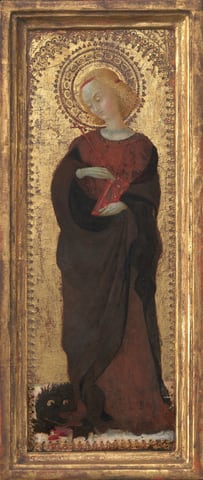
This painting shows a person standing, their body turned to us, with their head looking downward to the left. The person has pale skin, round, rosy cheeks, and wavy yellow hair surrounded by a golden halo with intricate patterns. They are wearing a dark robe over a dark red dress or tunic and holding a long, thin red cross in one hand, while the other hand holds a closed red book. At their feet lies a black dog-like animal with wide yellow eyes. The scene is set against a golden textured background within a gilded border.
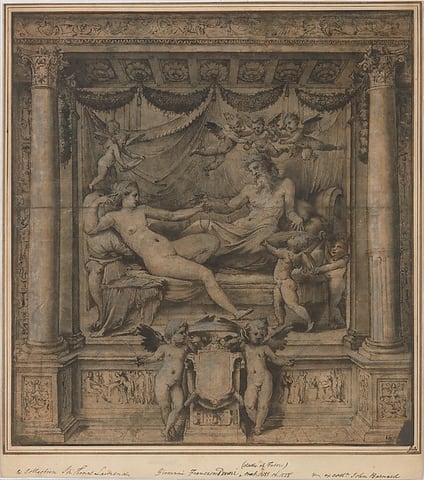
Jupiter and Juno: Study for the "Furti di Giove" Tapestries, by Perino del Vaga (Pietro Buonaccorsi), ca. 1532–35
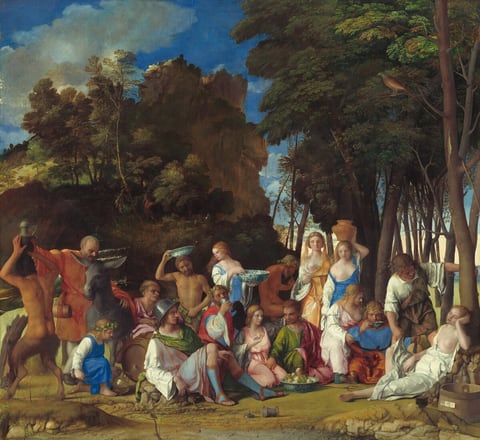
Six women, eight men, two satyrs, and one child gather in pairs and trios in a loose row that spans the width of this nearly square painting. They are set within a landscape with craggy rocks, cliffs, and trees. Most of the people face us, and the men, women, and child have pale skin. The two satyrs have men’s torsos and furry goat’s legs, and they have darker, olive complexions. Most of the men wear voluminous, knee-length togas wrapped in short robes in shades of white, topaz blue, grass green, coral orange, or rose pink. Most of the women wear long, dress-like garments in tones of shell pink, apricot orange, or lapis blue over white sleeves. For all but one woman, their garments have fallen off one shoulder to reveal a round, firm breast. Several objects are strewn on the rocky, dirt ground in front of the group, including a wide, wooden bucket with a piece of paper affixed to its front to our right, a glass goblet, a pitchfork, a large blue and white ceramic dish filled with grapes and small yellow fruits, and an overturned cup near the center. Cliff-like, craggy rocks rise steeply behind the group to our left, filling much of the sky opposite a tall grove of leafy, dark green trees to our right. A few puffy white clouds float across the vivid blue sky. The slip of paper on the barrel has been inscribed, “joannes bellinus venetus p MDXIIII.”
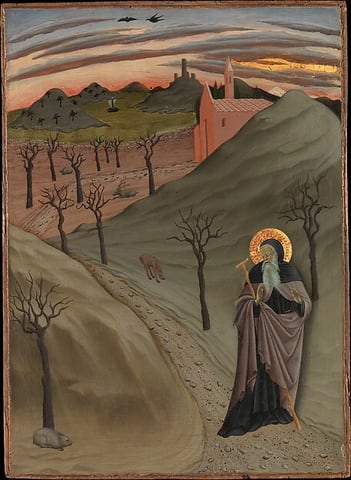
Saint Anthony the Abbot in the Wilderness, by Sano di Pietro (Ansano di Pietro di Mencio), ca. 1440

The works in this room are listed below.

Works in this room

Florence, Venice and Rome from 1400 to 1600: perspective, anatomy and the classical past.

First room, north wall

  1. The image shows a human figure with wings positioned as though in flight. The figure is captured from a slightly frontal perspective, with the head turned downwards and the right arm outstretched. The facial features are undefined, focusing more on the body's muscular structure. The figure wears a cloth or drapery around the waist and has well-defined muscles on the chest, arms, and legs. Large wings extend out behind the figure, adding to the sense of flight. The background is plain with a light texture.
    A Flying AngelJacopo Palma il Giovane, 1580/1590Courtesy National Gallery of Art, Washington
  2. Compositional Sketches for the Virgin Adoring the Christ Child, with and without the Infant St. John the Baptist; Diagram of a Perspectival Projection (recto); Slight Doodles (verso), by Leonardo da Vinci, 1480–85
    Compositional Sketches for the Virgin Adoring the Christ Child, with and without the Infant St. John the Baptist; Diagram of a Perspectival Projection (recto); Slight Doodles (verso)Leonardo da Vinci, 1480–85Courtesy of The Metropolitan Museum of Art
  3. The Nativity, by Lorenzo Monaco, ca. 1406–10
    The NativityLorenzo Monaco, ca. 1406–10Courtesy of The Metropolitan Museum of Art
  4. This painting shows a person standing, their body turned to us, with their head looking downward to the left. The person has pale skin, round, rosy cheeks, and wavy yellow hair surrounded by a golden halo with intricate patterns. They are wearing a dark robe over a dark red dress or tunic and holding a long, thin red cross in one hand, while the other hand holds a closed red book. At their feet lies a black dog-like animal with wide yellow eyes. The scene is set against a golden textured background within a gilded border.
    Saint MargaretSassetta, c. 1435Courtesy National Gallery of Art, Washington

First room, south wall

  1. Jupiter and Juno: Study for the "Furti di Giove" Tapestries, by Perino del Vaga (Pietro Buonaccorsi), ca. 1532–35
    Jupiter and Juno: Study for the "Furti di Giove" TapestriesPerino del Vaga (Pietro Buonaccorsi), ca. 1532–35Courtesy of The Metropolitan Museum of Art
  2. Six women, eight men, two satyrs, and one child gather in pairs and trios in a loose row that spans the width of this nearly square painting. They are set within a landscape with craggy rocks, cliffs, and trees. Most of the people face us, and the men, women, and child have pale skin. The two satyrs have men’s torsos and furry goat’s legs, and they have darker, olive complexions. Most of the men wear voluminous, knee-length togas wrapped in short robes in shades of white, topaz blue, grass green, coral orange, or rose pink. Most of the women wear long, dress-like garments in tones of shell pink, apricot orange, or lapis blue over white sleeves. For all but one woman, their garments have fallen off one shoulder to reveal a round, firm breast. Several objects are strewn on the rocky, dirt ground in front of the group, including a wide, wooden bucket with a piece of paper affixed to its front to our right, a glass goblet, a pitchfork, a large blue and white ceramic dish filled with grapes and small yellow fruits, and an overturned cup near the center. Cliff-like, craggy rocks rise steeply behind the group to our left, filling much of the sky opposite a tall grove of leafy, dark green trees to our right. A few puffy white clouds float across the vivid blue sky. The slip of paper on the barrel has been inscribed, “joannes bellinus venetus p MDXIIII.”
    The Feast of the GodsGiovanni Bellini, 1514/1529Courtesy National Gallery of Art, Washington
  3. Saint Anthony the Abbot in the Wilderness, by Sano di Pietro (Ansano di Pietro di Mencio), ca. 1440
    Saint Anthony the Abbot in the WildernessSano di Pietro (Ansano di Pietro di Mencio), ca. 1440Courtesy of The Metropolitan Museum of Art

Second room, south wall
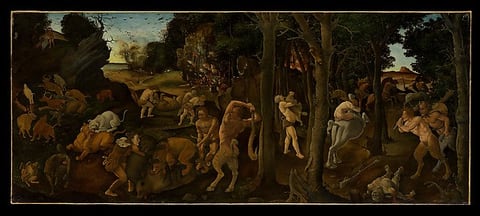
  1. A Hunting Scene, by Piero di Cosimo (Piero di Lorenzo di Piero d'Antonio), ca. 1494–1500
    A Hunting ScenePiero di Cosimo (Piero di Lorenzo di Piero d'Antonio), ca. 1494–1500Courtesy of The Metropolitan Museum of Art
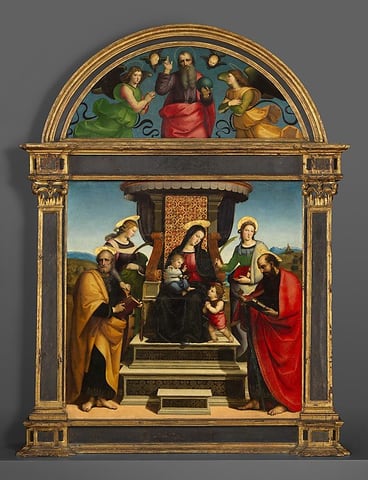
  2. Madonna and Child Enthroned with Saints, by Raphael, ca. 1504
    Madonna and Child Enthroned with SaintsRaphael, ca. 1504Courtesy of The Metropolitan Museum of Art

Second room, north wall
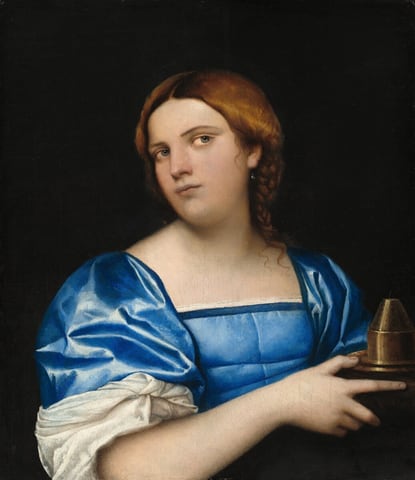
  1. A young woman with a pale, peachy skin is shown from waist up, wearing a shimmering, royal-blue dress in this vertical painting. Her body is angled to our right as she holds a metal object, perhaps a vessel or incense burner, in her hands by her chest. She turns and tilts her head to our left, but then looks back across her body, off to our right with flint-gray eyes. She has a full, oval-shaped face with a straight nose, smooth cheeks, and her pale pink lips are closed. A gray pearl earring hangs from the ear we can see. Her auburn-brown hair is parted down the middle, and loosely pulled back into a braid that brushes her left shoulder, to our right. The blue dress has a square neckline and a fitted bodice. Light glints off the fabric, shading it from royal to sapphire blue. A voluminous white sleeve is rolled back to her right elbow, to our left. That arm and hand nearly span the width of the painting as she holds the vessel, which has a conical top, near the lower right corner of the composition. The background is solid black.
    Portrait of a Young Woman as a Wise VirginSebastiano del Piombo, c. 1510Courtesy National Gallery of Art, Washington
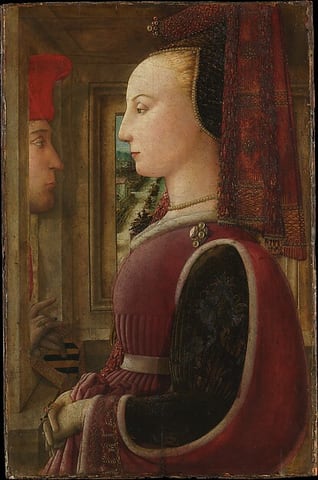
  2. Portrait of a Woman with a Man at a Casement, by Fra Filippo Lippi, ca. 1440
    Portrait of a Woman with a Man at a CasementFra Filippo Lippi, ca. 1440Courtesy of The Metropolitan Museum of Art
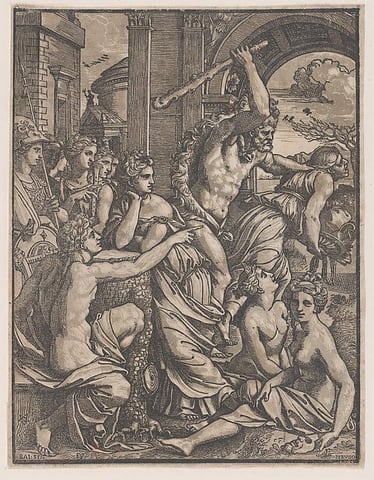
  3. Hercules chasing Avarice from the Temple of the Muses, by Ugo da Carpi, ca. 1520–27
    Hercules chasing Avarice from the Temple of the MusesUgo da Carpi, ca. 1520–27Courtesy of The Metropolitan Museum of Art
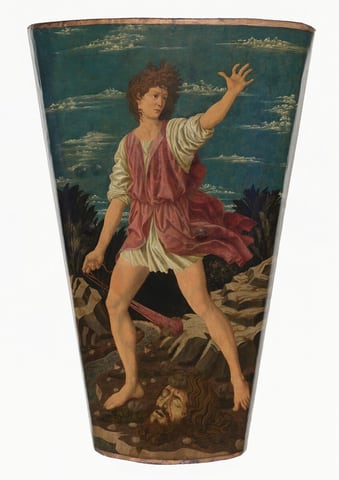
  4. This shield-shaped painting shows a young man with pale, peachy skin and curling brown hair standing astride the severed head of a man with dark hair and tanned skin. The painting is wider at the top and tapers like a pint glass to a narrower base. The young man, David, holds the end of long red slingshot with his right hand. The slingshot is weighted by a rock and swings behind his body. His sleeveless rust-red garment is cinched at his waist over a long white shirt. Both garments skim David’s thighs and his legs and feet are bare. Long, curling brown hair frames the ashen and bloodied upturned face of the head at David’s feet. A palm-sized stone is embedded in that forehead. The landscape background is made up of gray boulders, a meandering river, and low palm-like trees. Frothy white clouds sweep across an azure-blue sky.
    David with the Head of GoliathAndrea del Castagno, c. 1450/1455Courtesy National Gallery of Art, Washington

Third room, north wall
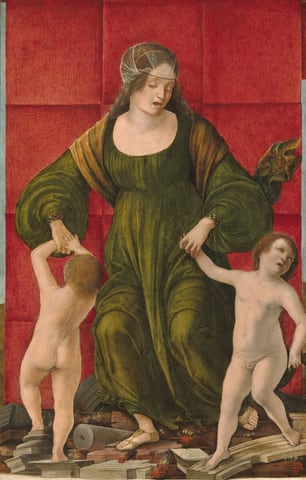
  1. A woman holds the hands of two nude children in front of a crimson-red cloth in this vertical painting. All three have pale skin and brown hair. The woman wears a forest-green dress with voluminous sleeves and a gauzy white headdress that wraps around her hair and is fastened with a band across her forehead. She stands crouching with one foot extended slightly forward in a sandal, surrounded by broken chunks of masonry and bits of burning logs. Her body faces us but she turns her head to the right. Her mouth is wide open, and her eyes cut back to our left. The woman clutches the children’s hands in both of her own. The child to our left turns away from us and reaches one hand up to touch the back of the woman’s hand. The child on the right twists away from the woman, eyes squinted up and to the right and mouth open. Behind them, fold lines create a grid across the red cloth. Slivers of grass and blue sky line each side of the composition.
    The Wife of Hasdrubal and Her ChildrenErcole de' Roberti, c. 1490/1493Courtesy National Gallery of Art, Washington
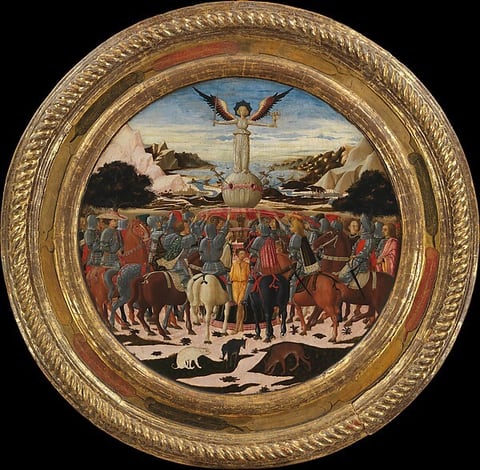
  2. The Triumph of Fame; (reverse) Impresa of the Medici Family and Arms of the Medici and Tornabuoni Families, by Giovanni di ser Giovanni Guidi (called Scheggia), ca. 1449
    The Triumph of Fame; (reverse) Impresa of the Medici Family and Arms of the Medici and Tornabuoni FamiliesGiovanni di ser Giovanni Guidi (called Scheggia), ca. 1449Courtesy of The Metropolitan Museum of Art
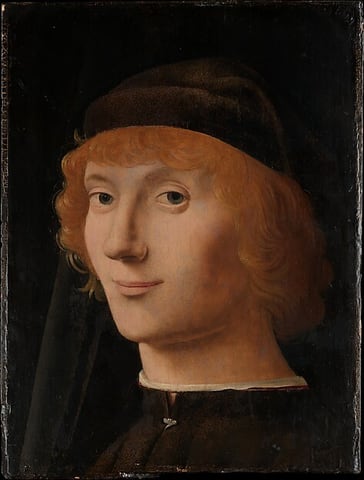
  3. Portrait of a Young Man, by Antonello da Messina (Antonello di Giovanni d'Antonio), ca. 1470
    Portrait of a Young ManAntonello da Messina (Antonello di Giovanni d'Antonio), ca. 1470Courtesy of The Metropolitan Museum of Art