Skip to content
Ochre Editions
ArtArtistsCollectionsGalleriesDrops
SearchSign inCart (0)
The galleries · Style galleries

The Italian Renaissance

Florence, Venice and Rome from 1400 to 1600: perspective, anatomy and the classical past.

61 works · hang 353 ·

Share The Italian Renaissance, in the galleries

The rooms are imagined; every work on their walls is real.

Walk this roomRehang this room

First room, north wall

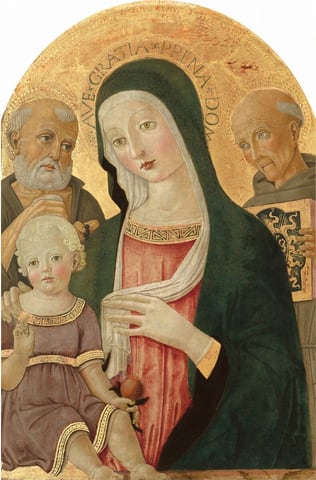
  1. Madonna and Child with Saint Jerome and Saint Bernardino of Siena, by Benvenuto di Giovanni, c. 1480/1485
    Madonna and Child with Saint Jerome and Saint Bernardino of SienaBenvenuto di Giovanni, c. 1480/1485Courtesy National Gallery of Art, Washington
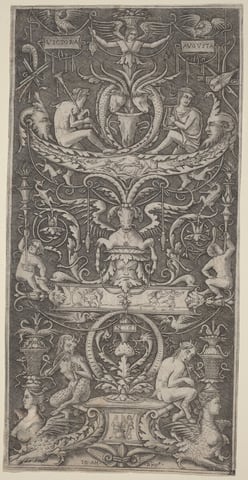
  2. This is a drawing of an ornamental design featuring mythological creatures and motifs. The artwork depicts a symmetrical arrangement with two central figures holding musical instruments, surrounded by acanthus leaves, griffins, and sphinxes. In the upper portion, there is a winged figure with a crown-like headdress carrying symbols or trophies. The design is detailed with decorative elements including floral patterns and architectural motifs. Throughout the drawing, there are various mythological creatures integrated into the composition.
    Ornamental Panel Inscribed "Victoria Augusta"Giovanni Antonio da Brescia, c. 1516Courtesy National Gallery of Art, Washington
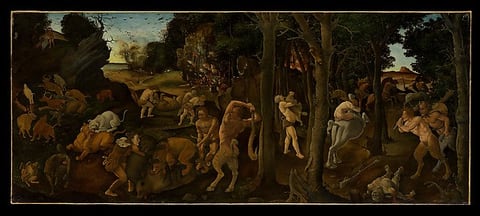
  3. A Hunting Scene, by Piero di Cosimo (Piero di Lorenzo di Piero d'Antonio), ca. 1494–1500
    A Hunting ScenePiero di Cosimo (Piero di Lorenzo di Piero d'Antonio), ca. 1494–1500Courtesy of The Metropolitan Museum of Art

First room, south wall
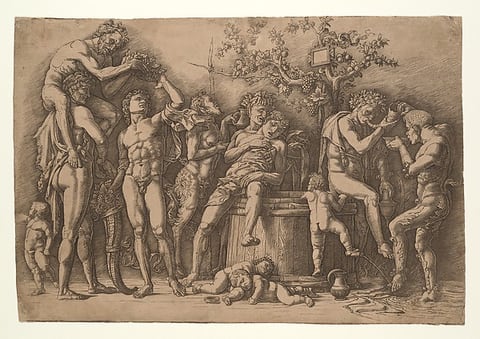
  1. Bacchanal with a Wine Vat, by Andrea Mantegna, Before 1475
    Bacchanal with a Wine VatAndrea Mantegna, Before 1475Courtesy of The Metropolitan Museum of Art
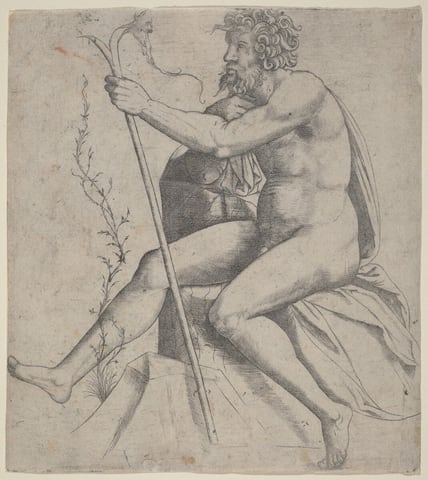
  2. The image shows a man seated with a slight forward tilt. He is muscular, with one leg bent and the other extended. His head is turned to the left in profile, revealing his facial features, which include a large nose, full beard, and curly hair. He appears naked except for a fabric drape over his shoulders. In his left hand, he holds a staff, and there is a plant with twisting vines near him. The background is a shaded rocky surface with no other details.
    Man Seated Holding a Forked StaffGiovanni Antonio da Brescia, c. 1514/1515Courtesy National Gallery of Art, Washington
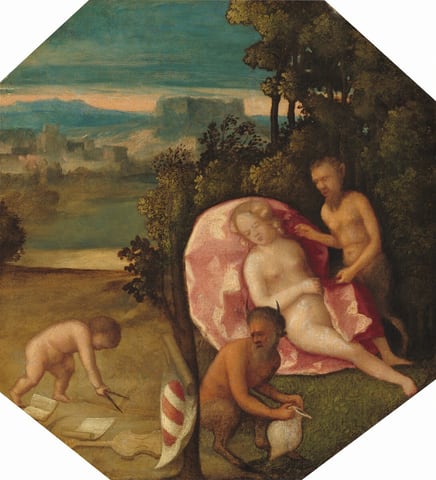
  3. A nude woman, pudgy child, and two satyrs, which have men’s heads and torsos with goat’s legs and horns, are in a landscape in this octagonal painting. The scene is divided in half by a tree stump which only reaches to the center of the composition. To the left of the stump, the pale-skinned, nude child stands and hunches over to draw on the ground with a V-shaped compass. Two pieces of paper and a violin lie nearby. The landscape behind him has a body of water leading back to a town with buildings streaked with peach, perhaps flames. A band of peach sky separates the blue silhouettes of mountains lining the horizon from the vivid blue sky above. At the bottom center of the painting, a shield with an oval horizontally striped with red and white leans on the boy’s side of the tree, which has one leafy branch growing on the left side. One satyr holds a jug and kneels close to the tree with his back to it as he looks back over one shoulder. He and the other satyr both have dark, peach-toned skin and full beards. The second satyr hovers to the right of the nude, sleeping woman, both hands reaching for her or the rose-pink cloth surrounding her. The woman has blond curls, a round face, and she sleeps with one hand resting across her belly and her head tipped to our left. The trio are on a grassy area enclosed by dense, dark-green bushes and trees.
    AllegoryPietro degli Ingannati, c. 1515-1525Courtesy National Gallery of Art, Washington
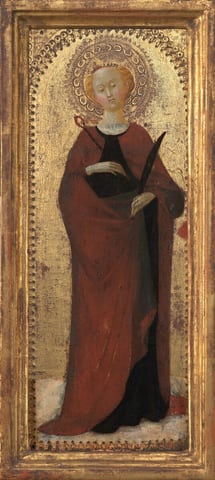
  4. This painting shows a person standing, their head slightly tilted to the left. They have a pale complexion, and short, wavy blonde hair adorned with a thin red crown. They have rosy, pink cheeks, arched eyebrows, a straight nose, and small lips set in a neutral expression. The individual is wearing a long red robe over a black tunic or dress and is holding a long black quill-like object in one hand, and what looks like a thin staff with a red loop at the end in the other. A detailed golden halo surrounds their head, and the background features an ornate gold pattern which is slightly worn and peeling in some places. The painting is bordered by a golden frame.
    Saint ApolloniaSassetta, c. 1435Courtesy National Gallery of Art, Washington

Second room, south wall
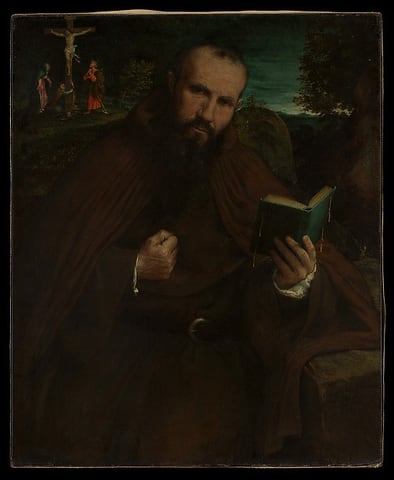
  1. Brother Gregorio Belo of Vicenza, by Lorenzo Lotto, 1547
    Brother Gregorio Belo of VicenzaLorenzo Lotto, 1547Courtesy of The Metropolitan Museum of Art
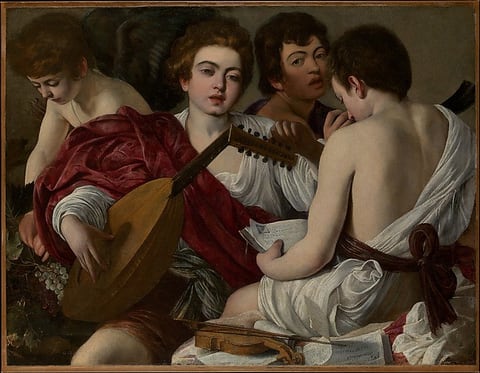
  2. The Musicians, by Caravaggio, 1597
    The MusiciansCaravaggio, 1597Courtesy of The Metropolitan Museum of Art
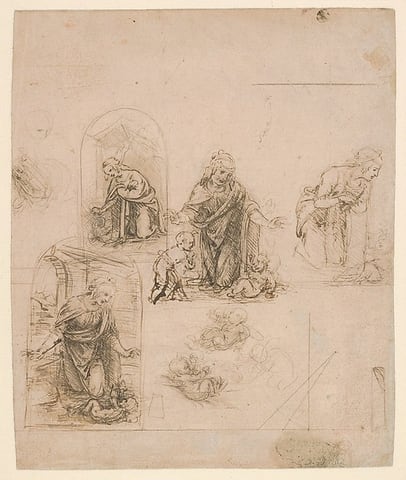
  3. Compositional Sketches for the Virgin Adoring the Christ Child, with and without the Infant St. John the Baptist; Diagram of a Perspectival Projection (recto); Slight Doodles (verso), by Leonardo da Vinci, 1480–85
    Compositional Sketches for the Virgin Adoring the Christ Child, with and without the Infant St. John the Baptist; Diagram of a Perspectival Projection (recto); Slight Doodles (verso)Leonardo da Vinci, 1480–85Courtesy of The Metropolitan Museum of Art

Second room, north wall
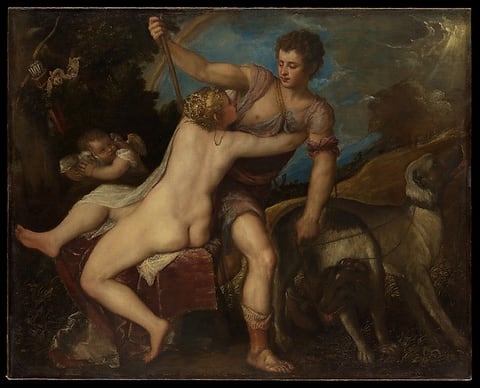
  1. Venus and Adonis, by Titian, 1550s
    Venus and AdonisTitian, 1550sCourtesy of The Metropolitan Museum of Art
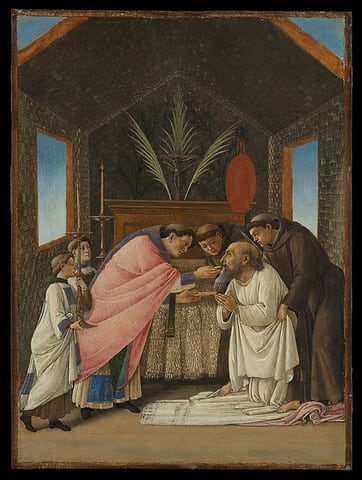
  2. The Last Communion of Saint Jerome, by Botticelli (Alessandro di Mariano Filipepi), early 1490s
    The Last Communion of Saint JeromeBotticelli (Alessandro di Mariano Filipepi), early 1490sCourtesy of The Metropolitan Museum of Art
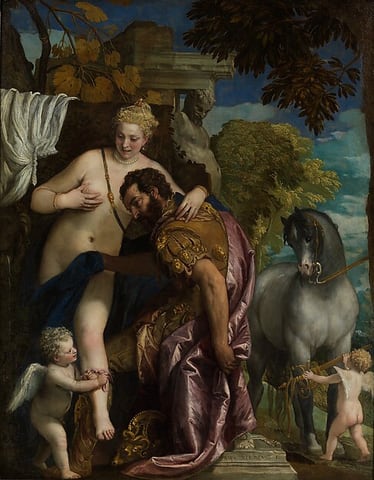
  3. Mars and Venus United by Love, by Paolo Veronese (Paolo Caliari), 1570s
    Mars and Venus United by LovePaolo Veronese (Paolo Caliari), 1570sCourtesy of The Metropolitan Museum of Art

Third room, north wall
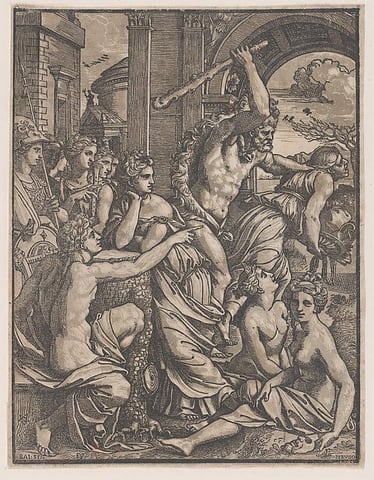
  1. Hercules chasing Avarice from the Temple of the Muses, by Ugo da Carpi, ca. 1520–27
    Hercules chasing Avarice from the Temple of the MusesUgo da Carpi, ca. 1520–27Courtesy of The Metropolitan Museum of Art
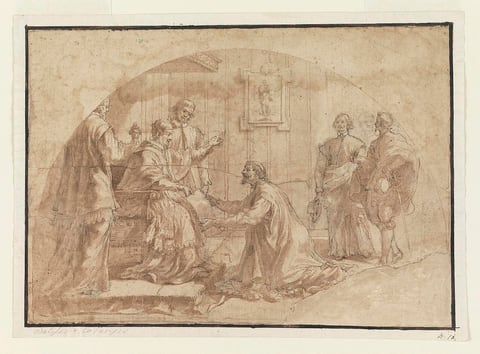
  2. POPE RECEIVING VISITOR
    Pope Receiving VisitorBelisario Corenzio, 1590–1646Courtesy of Cooper Hewitt, Smithsonian Design Museum
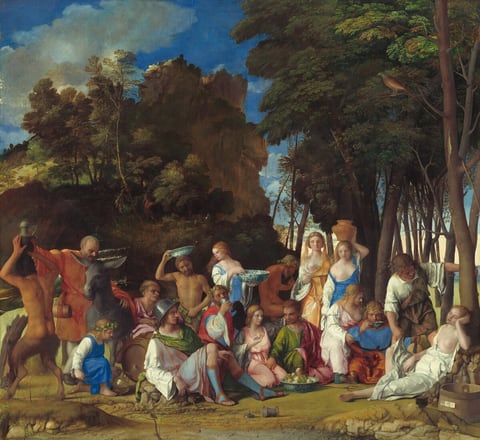
  3. Six women, eight men, two satyrs, and one child gather in pairs and trios in a loose row that spans the width of this nearly square painting. They are set within a landscape with craggy rocks, cliffs, and trees. Most of the people face us, and the men, women, and child have pale skin. The two satyrs have men’s torsos and furry goat’s legs, and they have darker, olive complexions. Most of the men wear voluminous, knee-length togas wrapped in short robes in shades of white, topaz blue, grass green, coral orange, or rose pink. Most of the women wear long, dress-like garments in tones of shell pink, apricot orange, or lapis blue over white sleeves. For all but one woman, their garments have fallen off one shoulder to reveal a round, firm breast. Several objects are strewn on the rocky, dirt ground in front of the group, including a wide, wooden bucket with a piece of paper affixed to its front to our right, a glass goblet, a pitchfork, a large blue and white ceramic dish filled with grapes and small yellow fruits, and an overturned cup near the center. Cliff-like, craggy rocks rise steeply behind the group to our left, filling much of the sky opposite a tall grove of leafy, dark green trees to our right. A few puffy white clouds float across the vivid blue sky. The slip of paper on the barrel has been inscribed, “joannes bellinus venetus p MDXIIII.”
    The Feast of the GodsGiovanni Bellini, 1514/1529Courtesy National Gallery of Art, Washington

Walk on

  • The Italian Renaissance, room 2
  • Giovanni Bellini's contemporaries 8 works
  • 16th-century Italy 66 works
Ochre Editions

The world's museums, on your wall. Every work here is a reproduction of a public-domain original, credited to the museum that holds it.

Shop

All artCollectionsLimited dropsPrints and framing

Help

Find an orderShippingReturnsVerify a certificate

About

About Ochre EditionsMuseum creditsFor agentsDevelopers

Legal

Terms of UseTerms of SaleLimited Editions and CertificatesPrivacy PolicyCookie PolicyAcceptable Use PolicyAgent & API TermsCopyright and DMCA PolicyPrinting Your Own PhotoVulnerability Disclosure PolicyAccessibility StatementOpen-Access Credits
© 2026 Ochre EditionsPrices in US dollars. Prints ship within the United States.