Floor plan

Style galleriesThe Italian Renaissance
The Italian Renaissance
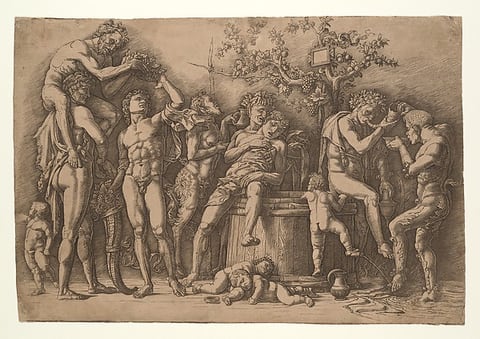
Bacchanal with a Wine Vat, by Andrea Mantegna, Before 1475
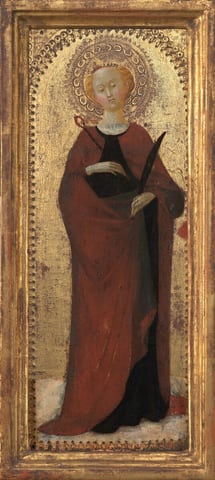
This painting shows a person standing, their head slightly tilted to the left. They have a pale complexion, and short, wavy blonde hair adorned with a thin red crown. They have rosy, pink cheeks, arched eyebrows, a straight nose, and small lips set in a neutral expression. The individual is wearing a long red robe over a black tunic or dress and is holding a long black quill-like object in one hand, and what looks like a thin staff with a red loop at the end in the other. A detailed golden halo surrounds their head, and the background features an ornate gold pattern which is slightly worn and peeling in some places. The painting is bordered by a golden frame.
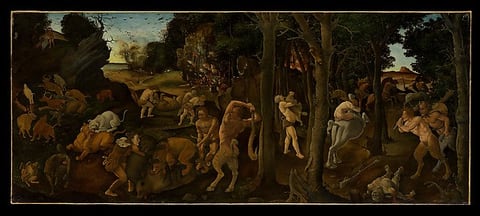
A Hunting Scene, by Piero di Cosimo (Piero di Lorenzo di Piero d'Antonio), ca. 1494–1500
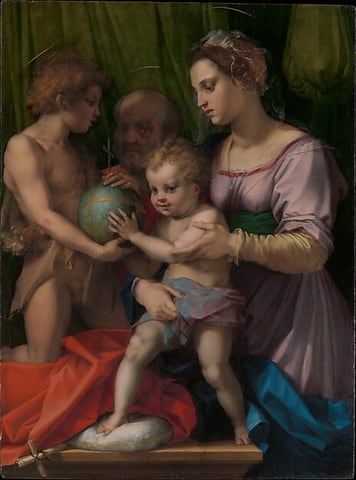
The Holy Family with the Young Saint John the Baptist, by Andrea del Sarto, ca. 1528
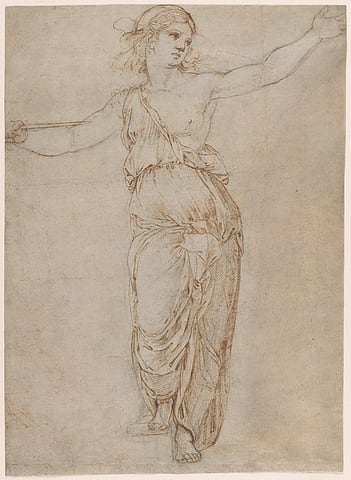
Lucretia, by Raphael, 1508–10
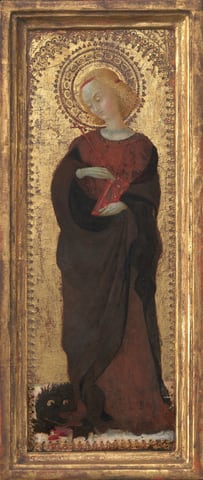
This painting shows a person standing, their body turned to us, with their head looking downward to the left. The person has pale skin, round, rosy cheeks, and wavy yellow hair surrounded by a golden halo with intricate patterns. They are wearing a dark robe over a dark red dress or tunic and holding a long, thin red cross in one hand, while the other hand holds a closed red book. At their feet lies a black dog-like animal with wide yellow eyes. The scene is set against a golden textured background within a gilded border.

The works in this room are listed below.

Works in this room

Florence, Venice and Rome from 1400 to 1600: perspective, anatomy and the classical past.

First room, north wall

  1. Bacchanal with a Wine Vat, by Andrea Mantegna, Before 1475
    Bacchanal with a Wine VatAndrea Mantegna, Before 1475Courtesy of The Metropolitan Museum of Art
  2. This painting shows a person standing, their head slightly tilted to the left. They have a pale complexion, and short, wavy blonde hair adorned with a thin red crown. They have rosy, pink cheeks, arched eyebrows, a straight nose, and small lips set in a neutral expression. The individual is wearing a long red robe over a black tunic or dress and is holding a long black quill-like object in one hand, and what looks like a thin staff with a red loop at the end in the other. A detailed golden halo surrounds their head, and the background features an ornate gold pattern which is slightly worn and peeling in some places. The painting is bordered by a golden frame.
    Saint ApolloniaSassetta, c. 1435Courtesy National Gallery of Art, Washington
  3. A Hunting Scene, by Piero di Cosimo (Piero di Lorenzo di Piero d'Antonio), ca. 1494–1500
    A Hunting ScenePiero di Cosimo (Piero di Lorenzo di Piero d'Antonio), ca. 1494–1500Courtesy of The Metropolitan Museum of Art

First room, south wall

  1. The Holy Family with the Young Saint John the Baptist, by Andrea del Sarto, ca. 1528
    The Holy Family with the Young Saint John the BaptistAndrea del Sarto, ca. 1528Courtesy of The Metropolitan Museum of Art
  2. Lucretia, by Raphael, 1508–10
    LucretiaRaphael, 1508–10Courtesy of The Metropolitan Museum of Art
  3. This painting shows a person standing, their body turned to us, with their head looking downward to the left. The person has pale skin, round, rosy cheeks, and wavy yellow hair surrounded by a golden halo with intricate patterns. They are wearing a dark robe over a dark red dress or tunic and holding a long, thin red cross in one hand, while the other hand holds a closed red book. At their feet lies a black dog-like animal with wide yellow eyes. The scene is set against a golden textured background within a gilded border.
    Saint MargaretSassetta, c. 1435Courtesy National Gallery of Art, Washington

Second room, south wall
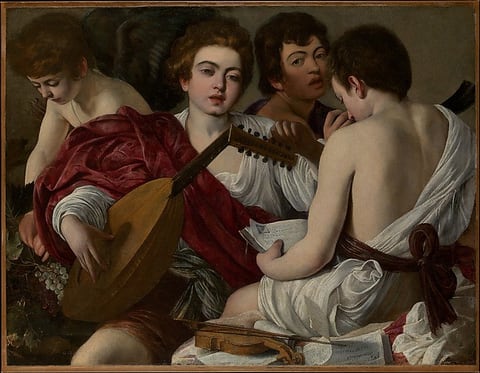
  1. The Musicians, by Caravaggio, 1597
    The MusiciansCaravaggio, 1597Courtesy of The Metropolitan Museum of Art
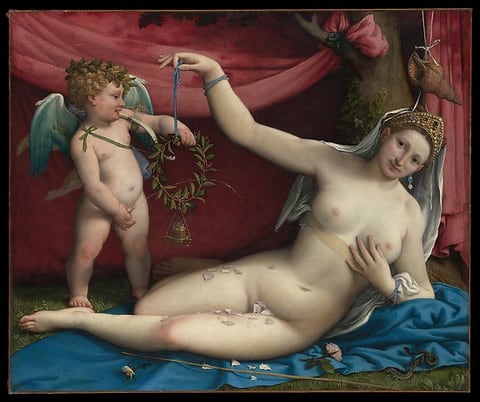
  2. Venus and Cupid, by Lorenzo Lotto, 1520s
    Venus and CupidLorenzo Lotto, 1520sCourtesy of The Metropolitan Museum of Art
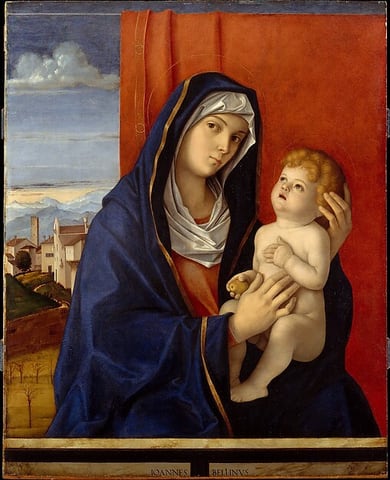
  3. Madonna and Child, by Giovanni Bellini, late 1480s
    Madonna and ChildGiovanni Bellini, late 1480sCourtesy of The Metropolitan Museum of Art

Second room, north wall
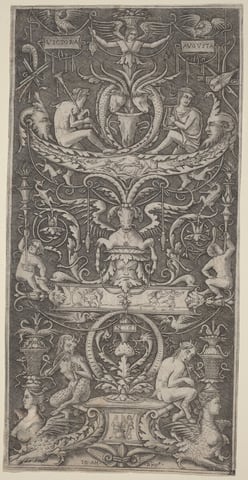
  1. This is a drawing of an ornamental design featuring mythological creatures and motifs. The artwork depicts a symmetrical arrangement with two central figures holding musical instruments, surrounded by acanthus leaves, griffins, and sphinxes. In the upper portion, there is a winged figure with a crown-like headdress carrying symbols or trophies. The design is detailed with decorative elements including floral patterns and architectural motifs. Throughout the drawing, there are various mythological creatures integrated into the composition.
    Ornamental Panel Inscribed "Victoria Augusta"Giovanni Antonio da Brescia, c. 1516Courtesy National Gallery of Art, Washington
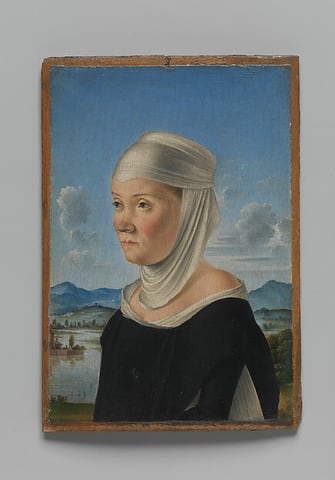
  2. Portrait of a Woman, Possibly a Nun of San Secondo; (verso) Scene in Grisaille, by Jacometto (Jacometto Veneziano), ca. 1485–95
    Portrait of a Woman, Possibly a Nun of San Secondo; (verso) Scene in GrisailleJacometto (Jacometto Veneziano), ca. 1485–95Courtesy of The Metropolitan Museum of Art
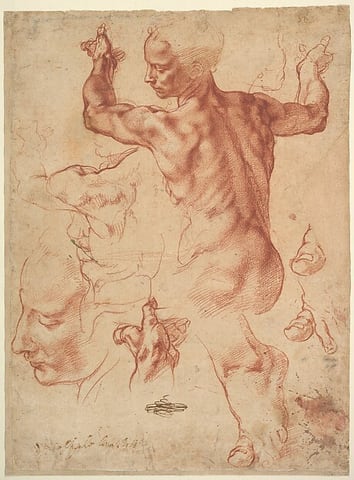
  3. Studies for the Libyan Sibyl (recto); Studies for the Libyan Sibyl and a small Sketch for a Seated Figure (verso), by Michelangelo Buonarroti, ca. 1510–11
    Studies for the Libyan Sibyl (recto); Studies for the Libyan Sibyl and a small Sketch for a Seated Figure (verso)Michelangelo Buonarroti, ca. 1510–11Courtesy of The Metropolitan Museum of Art
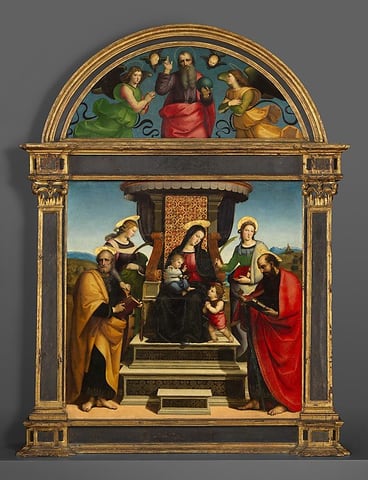
  4. Madonna and Child Enthroned with Saints, by Raphael, ca. 1504
    Madonna and Child Enthroned with SaintsRaphael, ca. 1504Courtesy of The Metropolitan Museum of Art

Third room, north wall
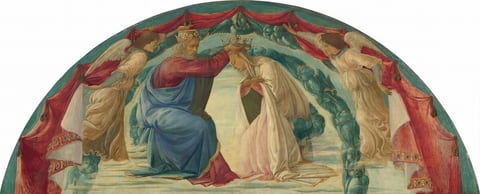
  1. In a wide, arched panel, a bearded man wearing a crown places another crown on the head of a woman. To our right, the woman bows her head with her eyes nearly closed and crosses her wrists over her chest. A white cloak covers her head, drapes over her shoulders, and pools in deep folds around her feet. The cloak is lined with pine green, and she wears a shell-pink dress. To our left, the man has shoulder-length, curly gray hair and a beard. His robe is dark rose pink, and the cloak is azure blue lined with pine green. Two winged angels have brown hair, short, white wings, and wear voluminous white robes. They stand to either side of the man and woman and hold up a swag of raspberry-red cloth hung with gold tassels. All the people have pale, peachy skin. Winged baby heads encircled with gold rays create an arch behind the man and woman, who sit on clouds. The background is pale blue sky.
    The Coronation of the VirginFilippino Lippi, c. 1475Courtesy National Gallery of Art, Washington
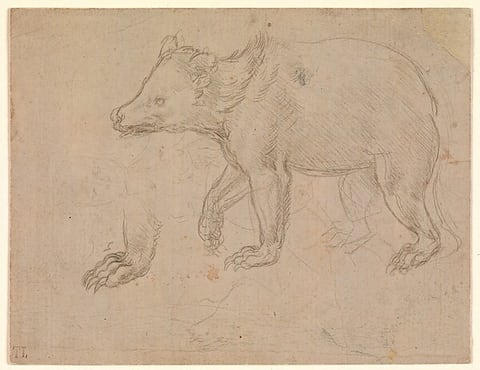
  2. A Bear Walking, by Leonardo da Vinci, ca. 1482–85
    A Bear WalkingLeonardo da Vinci, ca. 1482–85Courtesy of The Metropolitan Museum of Art
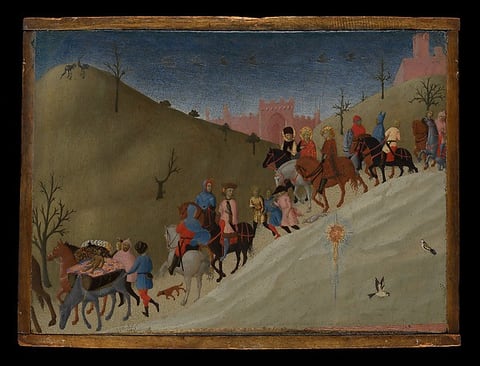
  3. The Journey of the Magi, by Sassetta, ca. 1433–35
    The Journey of the MagiSassetta, ca. 1433–35Courtesy of The Metropolitan Museum of Art