Floor plan

Style galleriesThe Italian Settecento
The Italian Settecento
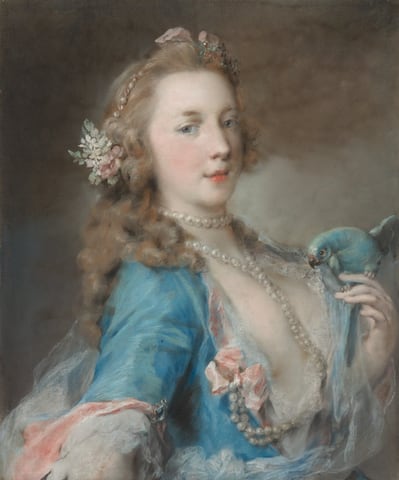
A pastel drawing of woman in blue and pink dress with blue parrot.
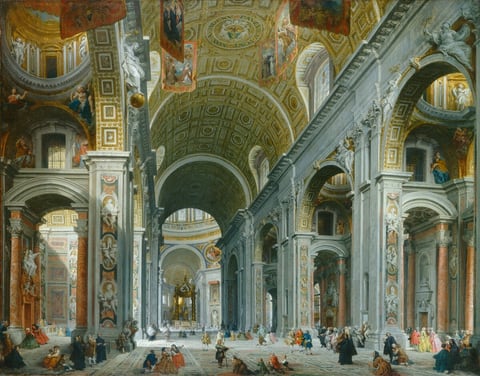
The soaring, gilded vault of a central aisle of the inside of a church fills this horizontal painting. The ceiling of the nave curves up and away from us like a tunnel. It is lined with coffers, which have inset panels, decorated with gold. The light-filled nave angles down from the top center of the composition toward the lower left as it moves away from us. The white stone pillars supporting the barrel vault are intricately carved and decorated with pudgy, winged cherubs holding portraits of men, and aisles run parallel to the central nave to our left and right. In the side aisles, pink marble columns flank altars in chapels. At the far end of the church, the nave is interrupted where it opens into the light-filled crossing, before continuing beyond. Marking the space where the long hall of the church is intersected by a shorter arm to create a cross shape is a structure made of four twisting columns supporting a pointed canopy, all cast in bronze. Tiny men and women pray or gather in pairs and small groups along the nave. Some wear tattered clothing and others are elegantly dressed.
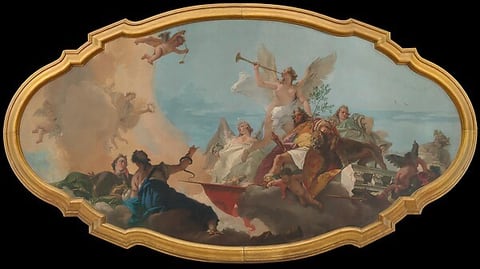
The Glorification of the Barbaro Family, by Giovanni Battista Tiepolo, ca. 1750
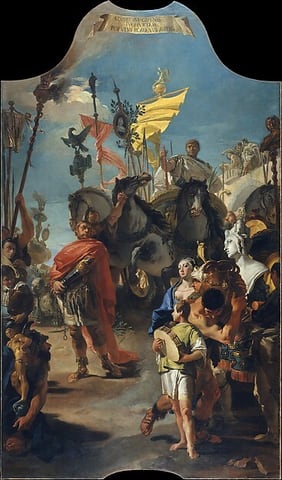
The Triumph of Marius, by Giovanni Battista Tiepolo, 1729

The works in this room are listed below.

Works in this room

Venetian views, Roman ruins and grand decoration in eighteenth-century Italy.

First room, north wall

  1. A pastel drawing of woman in blue and pink dress with blue parrot.
    A Young Lady with a ParrotRosalba Carriera, c. 1730Courtesy of the Art Institute of Chicago
  2. The soaring, gilded vault of a central aisle of the inside of a church fills this horizontal painting. The ceiling of the nave curves up and away from us like a tunnel. It is lined with coffers, which have inset panels, decorated with gold. The light-filled nave angles down from the top center of the composition toward the lower left as it moves away from us. The white stone pillars supporting the barrel vault are intricately carved and decorated with pudgy, winged cherubs holding portraits of men, and aisles run parallel to the central nave to our left and right. In the side aisles, pink marble columns flank altars in chapels. At the far end of the church, the nave is interrupted where it opens into the light-filled crossing, before continuing beyond. Marking the space where the long hall of the church is intersected by a shorter arm to create a cross shape is a structure made of four twisting columns supporting a pointed canopy, all cast in bronze. Tiny men and women pray or gather in pairs and small groups along the nave. Some wear tattered clothing and others are elegantly dressed.
    Interior of Saint Peter's, RomeGiovanni Paolo Panini, c. 1754Courtesy National Gallery of Art, Washington

First room, south wall

  1. The Glorification of the Barbaro Family, by Giovanni Battista Tiepolo, ca. 1750
    The Glorification of the Barbaro FamilyGiovanni Battista Tiepolo, ca. 1750Courtesy of The Metropolitan Museum of Art
  2. The Triumph of Marius, by Giovanni Battista Tiepolo, 1729
    The Triumph of MariusGiovanni Battista Tiepolo, 1729Courtesy of The Metropolitan Museum of Art

Second room, south wall
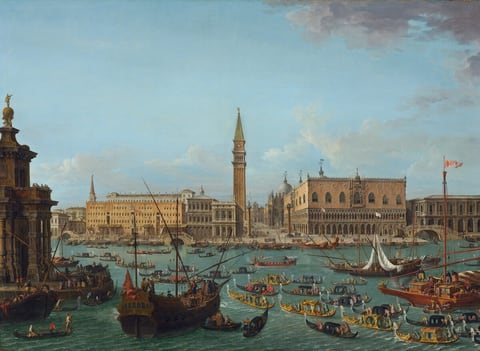
  1. The painting depicts many large and small ships on blue-green water. Gondolas in shades of gold, black, red, and blue drift across the water, small people on them pushing long poles through the water. There are also large sailboats and long boats with several rowers. They create a colorful mix. On the left, a large brown building with columns is visible. Some of the boats pull up to it, and many people in colorful clothing are visible on the shore. Behind the water are more large buildings in shades of brown, cream, and tan, with even more people visible on the streets below them. There is a large tower in the center of the painting, and several blue domes are visible in the distance. The sky is light blue, with white and gray clouds drifting across it.
    Procession of Gondolas in the Bacino di San Marco, VeniceAntonio Joli, 1742 or afterCourtesy National Gallery of Art, Washington
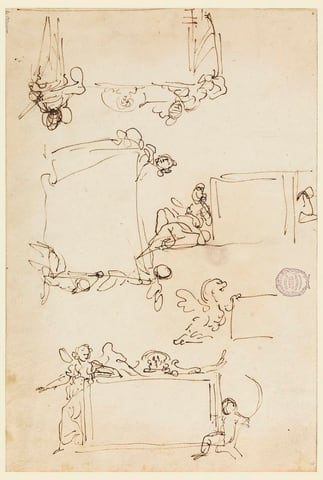
  2. SKETCHES FOR A TABLET
    Sketches for a tabletCarlo Marchionni, ca. 1750Courtesy of Cooper Hewitt, Smithsonian Design Museum
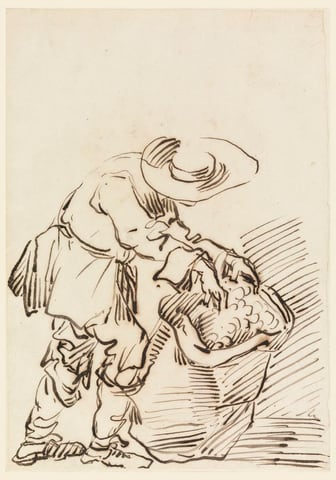
  3. WORKING PEASANT
    Working PeasantCarlo Marchionni, 1728–78Courtesy of Cooper Hewitt, Smithsonian Design Museum

Second room, north wall
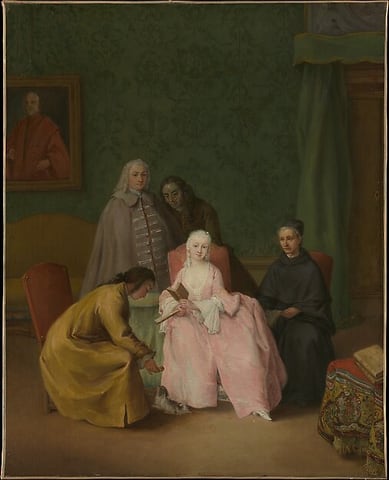
  1. The Visit, by Pietro Longhi, 1746
    The VisitPietro Longhi, 1746Courtesy of The Metropolitan Museum of Art
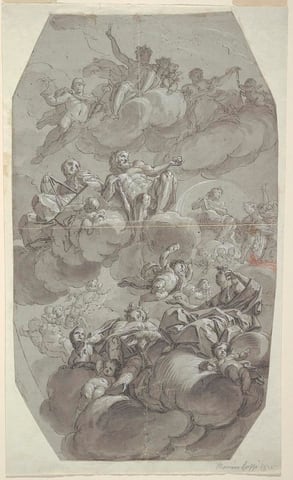
  2. STUDY FOR PAINTING, MOUNT OLYMPUS
    Study for Painting, Mount OlympusVito D'Anna, 1750–60Courtesy of Cooper Hewitt, Smithsonian Design Museum
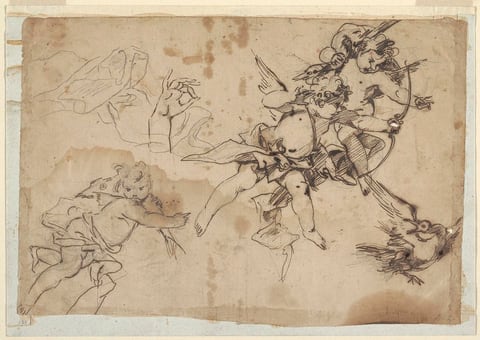
  3. STUDY FOR A PAINTING ON THEME OF CALLISTO
    Study for a Painting on Theme of CallistoFilippo Falciatore, ca. 1750Courtesy of Cooper Hewitt, Smithsonian Design Museum
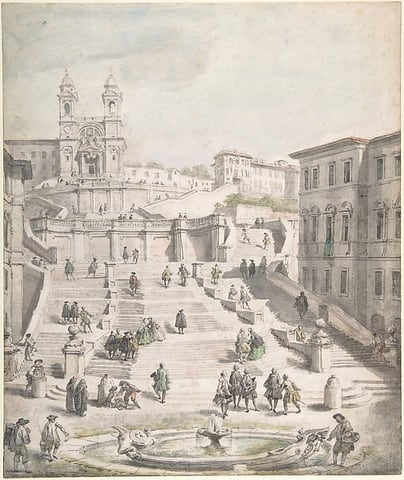
  4. Scalinata della Trinità dei Monti, by Giovanni Paolo Panini, ca. 1756–58
    Scalinata della Trinità dei MontiGiovanni Paolo Panini, ca. 1756–58Courtesy of The Metropolitan Museum of Art

Third room, north wall
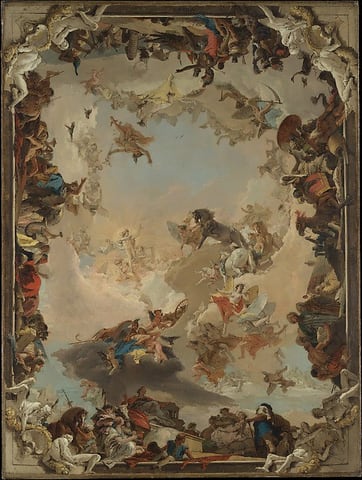
  1. Allegory of the Planets and Continents, by Giovanni Battista Tiepolo, 1752
    Allegory of the Planets and ContinentsGiovanni Battista Tiepolo, 1752Courtesy of The Metropolitan Museum of Art
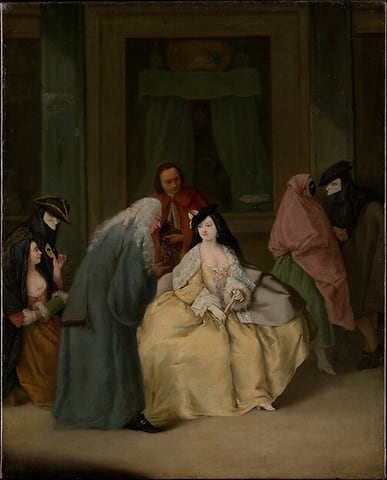
  2. The Meeting, by Pietro Longhi, 1746
    The MeetingPietro Longhi, 1746Courtesy of The Metropolitan Museum of Art

Third room, south wall
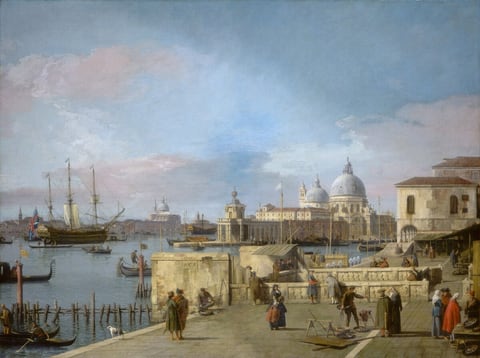
  1. We look slightly down onto a port-side town along a canal, with a church across the water from us in this horizontal landscape painting. A bright blue sky with billowing white, pink, and gray clouds fills the top two-thirds of the painting. Below, a three-masted ship with all but one sail furled is surrounded by a couple dozen black long, low boats, gondolas, and one or two other sailboats. People stand and walk mostly in pairs and trios along the stone walkway under us, which extends into the distance to our right. The women all wear long dresses and most of the men wear suits with knee-length jackets with tails or capes, and hats. The clothing is painted in shades of brick and terracotta red, pine green, royal blue, and gray. The walkway is interrupted by two low walls that partition off an area near us. The angled roofs of stalls line the walkway in the farther distance before it is again interrupted, this time by a two-story, cream-colored building. The walkway continues as a narrower path under an arched arcade on the lower level of that building, alongside the water. On the far side of the canal, to our left and in the distance, a cluster of ivory-white buildings includes a structure with two stone-blue domes. More buildings extend into the deep distance to our left.
    Entrance to the Grand Canal from the Molo, VeniceCanaletto, 1742/1744Courtesy National Gallery of Art, Washington
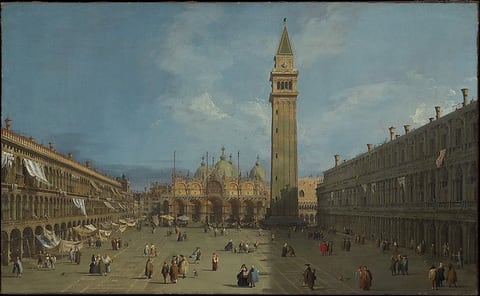
  2. Piazza San Marco, by Canaletto, late 1720s
    Piazza San MarcoCanaletto, late 1720sCourtesy of The Metropolitan Museum of Art
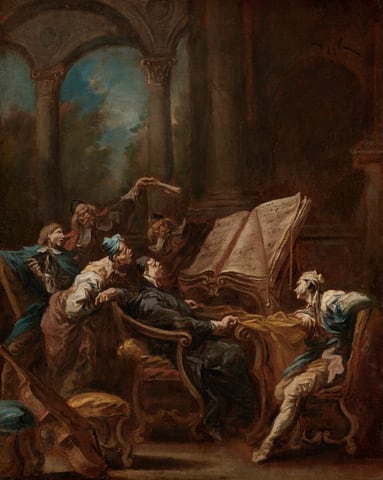
  3. This is a painting of a group engaged in a music session, all looking towards a large open music book in a grand, architectural setting. Behind the group are tall, ornate columns and an arched background that opens up to show a cloudy blue sky. Most of the people have open mouths as if they are singing, while one man in the back seems to be conducting, holding a up roll of paper. Some of the people in the group are seated in cushioned wooden chairs, and a yellowish cloth is draped over the surface that the large book rests on. There is a string instrument similar to a cello near the bottom left corner. The colors used are rich, earthy browns, yellows, and reds, with elements of blue and white clothing. All of the people have pale skin, and two have long white mustaches.
    The ChoristersAlessandro Magnasco, c. 1740/1745Courtesy National Gallery of Art, Washington