Floor plan

Style galleriesNeoclassicism

Neoclassicism

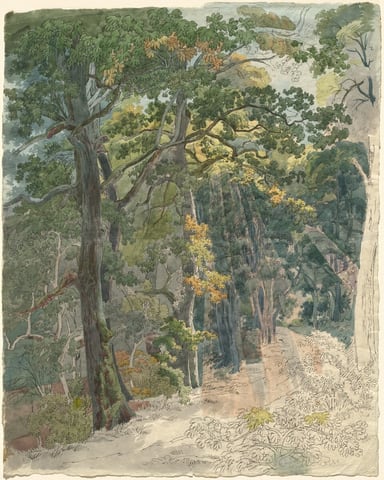
The image shows a dense, forested area with towering trees. The composition leads the eye along a pathway into the distance, without a distinct horizon line. The intricate brushstrokes depict the texture and foliage of the trees, suggesting movement and light filtering through the leaves. The color palette is rich and earthy, with shades of green, brown, yellow, and orange, creating a vibrant yet tranquil atmosphere emphasizing light and shadow.
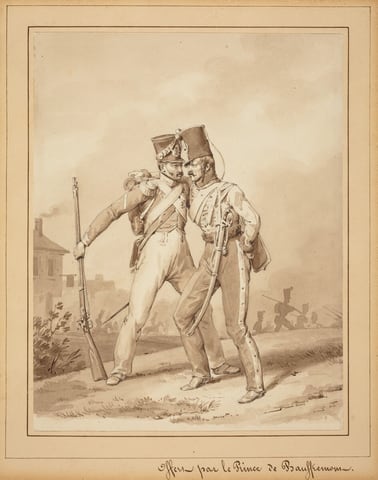
The image features two men in military uniform engaging closely with each other. Both are shown from head to toe. The man on the left stands with his left leg forward, holding a rifle, and has his right arm around the shoulder of the other man. The man on the right has his right leg slightly bent, supporting his weight, and is holding a sword in his left hand. Each man has distinctive facial features. Both wear tall, elaborate military hats and detailed uniforms. The man on the left displays a strap over his shoulder, while the man on the right has intricate decorations on his jacket and trousers. In the background, there are a few more soldiers and part of a building to the left. The setting is monochromatic.
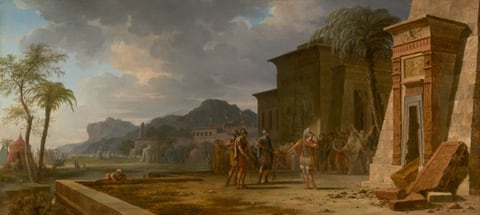
A work made of oil on canvas.
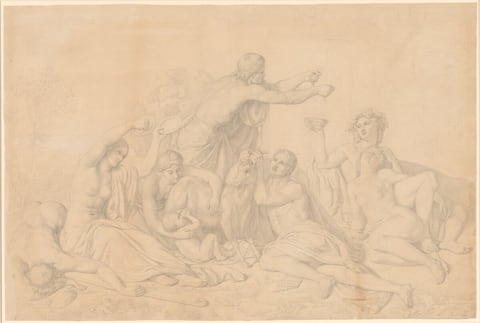
This is a drawing of a group of mythological figures in a ceremonial scene. The composition features multiple figures in various poses, centered around a symbolic gathering. The drawing is detailed, providing a classical representation of human forms, draped fabrics, and an animal. A plateau with trees is subtly depicted in the background. The figures display expressions ranging from serene to contemplative.
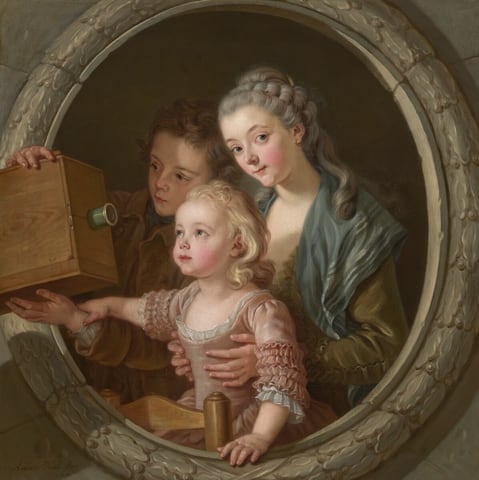
A young woman and two children are shown from the waist up through an oval, stone opening, holding and looking at a wooden box with a lens protruding from one side in this square painting. All three people have pale skin with rosy cheeks. To our right, the young woman’s body is angled to our left as she braces the torso of a young girl. The young woman looks at us from the corners of her sage-green eyes, under lifted brows. Her small, pink mouth is pursed in a slight smile, and she has a faint dimple in her rounded chin. Her heather-gray hair is partially plaited over the crown of her head, and long curls fall over her shoulders. She wears a spruce-blue shawl over the shoulders of her low-cut, olive-green dress. The child she braces has chubby cheeks, and her wavy blond hair is brushed back from her forehead and falls loosely to her shoulders. She wears a blush-pink dress with ruffles on the half-length sleeves and gossamer-white trim around the neckline and cuffs. The top and side rails of a wooden, ladderback chair up against the inside of the opening suggests she stands or kneels on a backward-facing chair. She rests her left hand on the edge of the stone opening and her other hand on the wrist of the boy standing close behind her. Mostly in the shadow behind the others, the boy has small, pointed features and short, curly, sable-brown hair. He wears a tan coat, and a muted blue scarf is tied at his throat. The two children gaze at the wooden box the boy holds, which is about the size of a toaster. A short, cylindrical, brass-lined lens pokes out of the center of the side facing the trio. The oval opening through which we see them is carved on our side with stylized leaves and berries, and the wall around it is the same elephant gray as the carvings. The girl and the box cast a shadow across the opening. The artist signed and dated the painting in the lower left corner, “Amedee Can Loo./1764.”
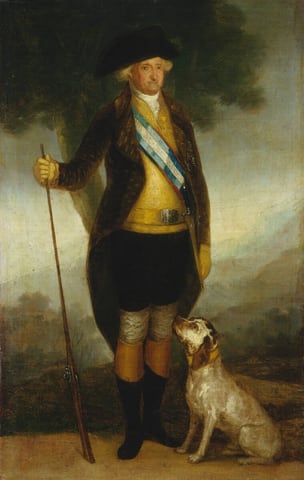
This painting shows a man standing upright, his body slightly turned to the right. He has pale skin and curled white hair under a large black hat, and he wears a long brown jacket over a yellow vest with a white ruffled neck and a wide blue-and-white striped sash over his torso. His pants are black, and he wears tall black boots with brown tops. His hands are covered by yellow gloves, and he is holding a tall, thin rifle on the left, its bottom on the ground. Next to him on the right is a white dog with brown spots and large brown ears. The dog is sitting, looking up at the man. The background features an outdoor setting, with a landscape of hazy hills in shades of pale green and blue below a white and gray sky. There is a tall, dark green tree behind the man, and the ground he stands on is brown.
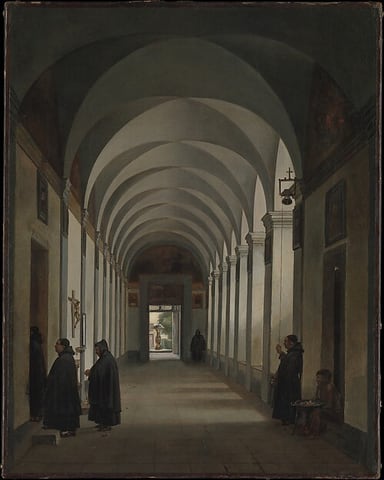
Monks in the Cloister of the Church of Gesù e Maria, Rome, by François Marius Granet, 1808

The works in this room are listed below.

Works in this room

Europe turns back to Greece and Rome: clear line, calm figures and civic virtue.

First room, north wall

  1. The image shows a dense, forested area with towering trees. The composition leads the eye along a pathway into the distance, without a distinct horizon line. The intricate brushstrokes depict the texture and foliage of the trees, suggesting movement and light filtering through the leaves. The color palette is rich and earthy, with shades of green, brown, yellow, and orange, creating a vibrant yet tranquil atmosphere emphasizing light and shadow.
    Rays of Sunlight Striking a Woodland PathFriedrich Salathé, c. 1815Courtesy National Gallery of Art, Washington
  2. The image features two men in military uniform engaging closely with each other. Both are shown from head to toe. The man on the left stands with his left leg forward, holding a rifle, and has his right arm around the shoulder of the other man. The man on the right has his right leg slightly bent, supporting his weight, and is holding a sword in his left hand. Each man has distinctive facial features. Both wear tall, elaborate military hats and detailed uniforms. The man on the left displays a strap over his shoulder, while the man on the right has intricate decorations on his jacket and trousers. In the background, there are a few more soldiers and part of a building to the left. The setting is monochromatic.
    Two GrenadiersVictor AdamCourtesy National Gallery of Art, Washington
  3. A work made of oil on canvas.
    Alexander at the Tomb of Cyrus the GreatPierre Henri de Valenciennes, 1796Courtesy of the Art Institute of Chicago

First room, south wall

  1. This is a drawing of a group of mythological figures in a ceremonial scene. The composition features multiple figures in various poses, centered around a symbolic gathering. The drawing is detailed, providing a classical representation of human forms, draped fabrics, and an animal. A plateau with trees is subtly depicted in the background. The figures display expressions ranging from serene to contemplative.
    The Nursing of JupiterThéodore ChassériauCourtesy National Gallery of Art, Washington
  2. A young woman and two children are shown from the waist up through an oval, stone opening, holding and looking at a wooden box with a lens protruding from one side in this square painting. All three people have pale skin with rosy cheeks. To our right, the young woman’s body is angled to our left as she braces the torso of a young girl. The young woman looks at us from the corners of her sage-green eyes, under lifted brows. Her small, pink mouth is pursed in a slight smile, and she has a faint dimple in her rounded chin. Her heather-gray hair is partially plaited over the crown of her head, and long curls fall over her shoulders. She wears a spruce-blue shawl over the shoulders of her low-cut, olive-green dress. The child she braces has chubby cheeks, and her wavy blond hair is brushed back from her forehead and falls loosely to her shoulders. She wears a blush-pink dress with ruffles on the half-length sleeves and gossamer-white trim around the neckline and cuffs. The top and side rails of a wooden, ladderback chair up against the inside of the opening suggests she stands or kneels on a backward-facing chair. She rests her left hand on the edge of the stone opening and her other hand on the wrist of the boy standing close behind her. Mostly in the shadow behind the others, the boy has small, pointed features and short, curly, sable-brown hair. He wears a tan coat, and a muted blue scarf is tied at his throat. The two children gaze at the wooden box the boy holds, which is about the size of a toaster. A short, cylindrical, brass-lined lens pokes out of the center of the side facing the trio. The oval opening through which we see them is carved on our side with stylized leaves and berries, and the wall around it is the same elephant gray as the carvings. The girl and the box cast a shadow across the opening. The artist signed and dated the painting in the lower left corner, “Amedee Can Loo./1764.”
    The Camera ObscuraCharles Amédée Philippe Van Loo, 1764Courtesy National Gallery of Art, Washington
  3. This painting shows a man standing upright, his body slightly turned to the right. He has pale skin and curled white hair under a large black hat, and he wears a long brown jacket over a yellow vest with a white ruffled neck and a wide blue-and-white striped sash over his torso. His pants are black, and he wears tall black boots with brown tops. His hands are covered by yellow gloves, and he is holding a tall, thin rifle on the left, its bottom on the ground. Next to him on the right is a white dog with brown spots and large brown ears. The dog is sitting, looking up at the man. The background features an outdoor setting, with a landscape of hazy hills in shades of pale green and blue below a white and gray sky. There is a tall, dark green tree behind the man, and the ground he stands on is brown.
    Charles IV of Spain as HuntsmanUnrecorded Spanish maker, c. 1799/1800Courtesy National Gallery of Art, Washington
  4. Monks in the Cloister of the Church of Gesù e Maria, Rome, by François Marius Granet, 1808
    Monks in the Cloister of the Church of Gesù e Maria, RomeFrançois Marius Granet, 1808Courtesy of The Metropolitan Museum of Art

Second room, south wall
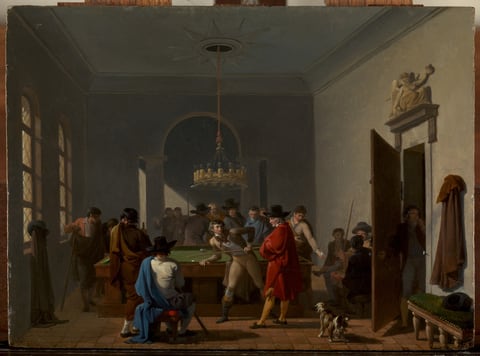
  1. The Billiard Room, by Nicolas Antoine Taunay, after 1810
    The Billiard RoomNicolas Antoine Taunay, after 1810Courtesy of The Metropolitan Museum of Art
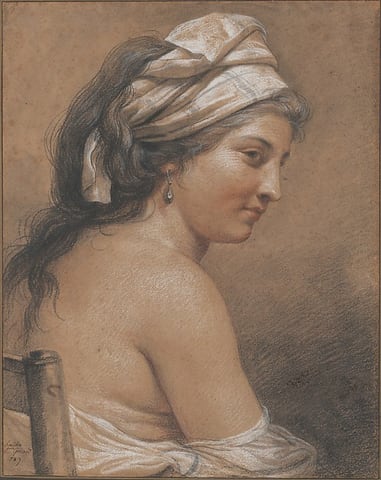
  2. Study of a Seated Woman Seen from Behind (Marie-Gabrielle Capet), by Adélaïde Labille-Guiard, 1789
    Study of a Seated Woman Seen from Behind (Marie-Gabrielle Capet)Adélaïde Labille-Guiard, 1789Courtesy of The Metropolitan Museum of Art
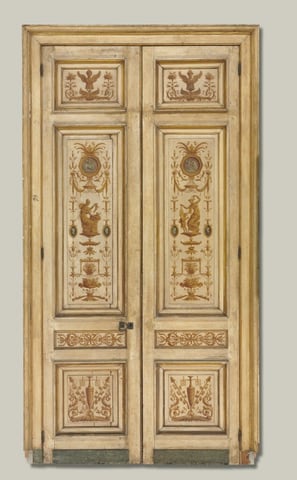
  3. Overdoor Painting, by Pierre Rousseau, 1790s
    Overdoor PaintingPierre Rousseau, 1790sCourtesy of the Cleveland Museum of Art
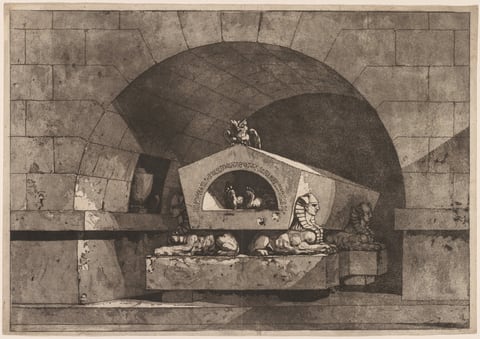
  4. Tomb with Sphinxes and an Owl, by Louis Jean Desprez, c. 1779–84
    Tomb with Sphinxes and an OwlLouis Jean Desprez, c. 1779–84Courtesy of the Cleveland Museum of Art

Second room, north wall
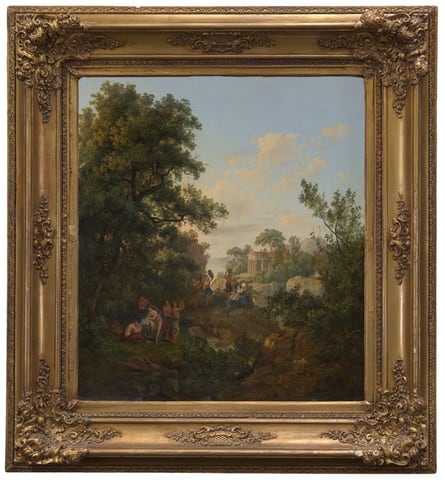
  1. A work made of oil on canvas.
    Birth of BacchusKároly Markó, Sr., 1826 (?)Courtesy of the Art Institute of Chicago
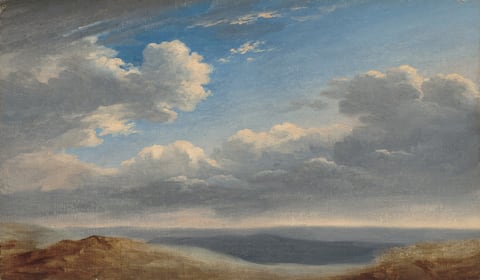
  2. A sliver of land across the bottom of this composition gives way to a procession of puffy gray and white clouds sweeping up across a vivid blue, panoramic sky in this horizontal landscape painting. An area of darker gray beyond the brown land could be a valley, mountain, or shadows from the billowing clouds. About one-fifth of the way up the composition, the horizon glows the faintest peach. The clouds trundle from our left up and to our right. The view is loosely painted, especially in the land.
    Study of Clouds over the Roman CampagnaPierre Henri de Valenciennes, c. 1782/1785Courtesy National Gallery of Art, Washington
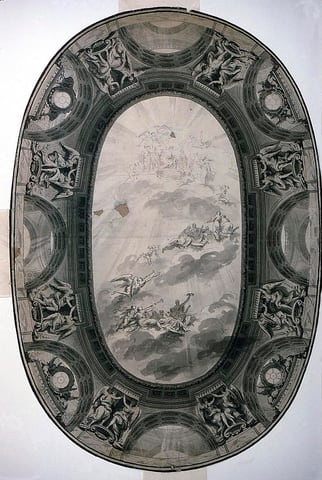
  3. PROJECT FOR THE PAINTED DECORATION OF THE CEILING OF A HALL (PAINTED OVAL CEILING)
    Project for the Painted Decoration of the Ceiling of a Hall (Painted Oval Ceiling)Jean Baptiste Marie Pierre, 1761Courtesy of Cooper Hewitt, Smithsonian Design Museum

Third room, north wall

  1. The engraving depicts a gathering around a woman holding a child in her arms in an indoor setting with stone columns and an arched background. Another woman is next to her, looking towards her while leaning over what appears to be a child or possibly a doll on a small donkey. Surrounding the central woman are several children, some seated and playing on the floor. A dog is resting at the central woman's feet. The image features lush drapery, creating a warm and intimate setting. The style suggests classical or historical fashion, and there is an ornate border with ivy leaves. The text and emblem below likely contain relevant inscriptions.
    L'heureuse féconditéNicolas Delaunay, 1777Courtesy National Gallery of Art, Washington
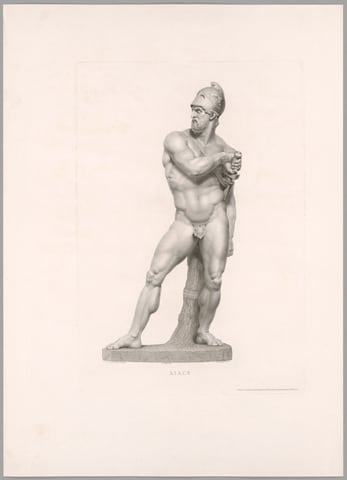
  2. A work made of engraving and etching in black on ivory wove paper.
    Ajax, Front View, from Oeuvre de CanovaAntonio Canova, 1817Courtesy of the Art Institute of Chicago