Skip to content
Ochre Editions
ArtArtistsCollectionsGalleriesDrops
SearchSign inCart (0)
The galleries · Style galleries

Neoclassicism

Europe turns back to Greece and Rome: clear line, calm figures and civic virtue.

109 works · hang 1195 ·

Share Neoclassicism, in the galleries

The rooms are imagined; every work on their walls is real.

Walk this roomRehang this room

First room, north wall

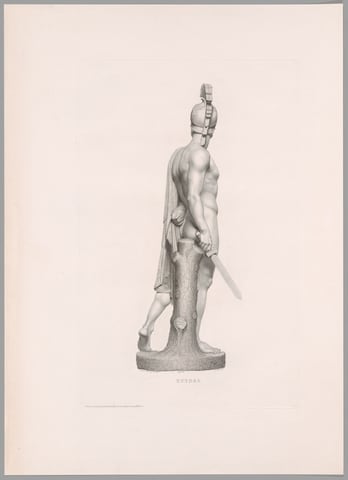
  1. A work made of engraving and etching in black on ivory wove paper.
    Ettore, Side View, from Oeuvre de CanovaAntonio Canova, 1817Courtesy of the Art Institute of Chicago
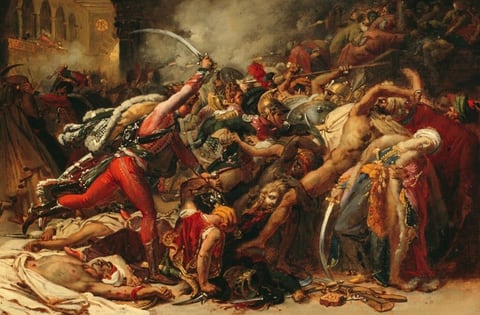
  2. A work made of oil and ink on paper, laid down on canvas.
    Sketch for The Revolt of CairoAnne-Louis Girodet de Roussy-Trioson, c. 1810Courtesy of the Art Institute of Chicago
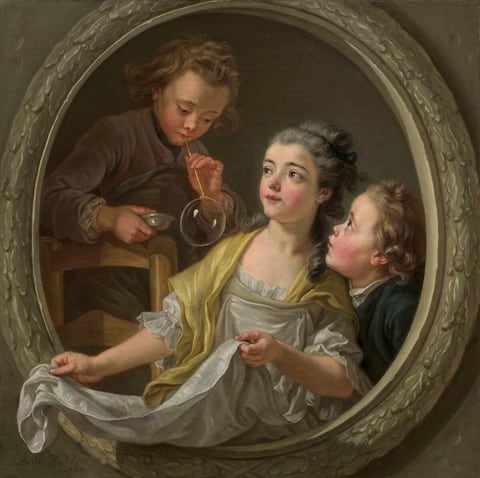
  3. The painting depicts three children within an oval frame, their upper bodies visible. The central child, a young girl, is positioned with her body facing forward and her head turned slightly to the left. She has a fair complexion, with rosy cheeks, pink lips, and wide brown eyes. Her hair is gray and partially pulled back by a blue ribbon. She is dressed in a white garment with a yellow shawl draped over her shoulders. Her arms are outstretched, holding the ends of a cloth that has been pinned on her dress. Her arms and the cloth extend forward beyond the oval frame that encircles the trio, as if the frame is a window or porthole that she is reaching out of. On the right, a boy leans on the girl's shoulder, also facing to the left, seen in profile. He has light brown, curly hair and a fair complexion. He wears a dark blue-green jacket over a white collar, and he is looking upward towards the third child. On the left, another boy, who also has light skin and light brown curly hair, appears to stand on a chair above the other two children. He is holding a long yellow straw up to his lips. At the other end of the straw, a large bubble hangs over the white cloth that the girl holds out. In his other hand is a small white dish. He wears a muted brown outfit with a dark cloth wrapped around him. The background within the frame is plain gray, and the frame that surrounds the children is light gray and appears to be carved with leaf designs. Beyond the oval frame is gray.
    Soap BubblesCharles Amédée Philippe Van Loo, 1764Courtesy National Gallery of Art, Washington
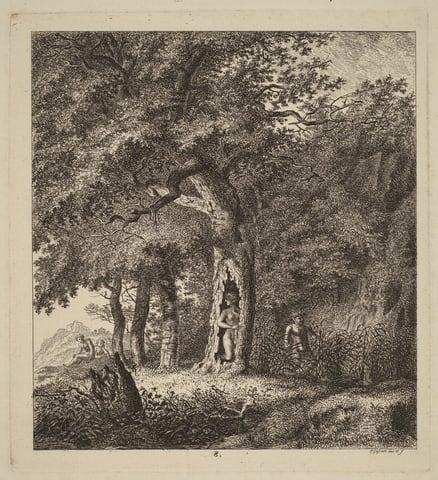
  4. The image shows an etching of a forest scene with towering trees dominating the upper half. The horizon is not clearly visible due to dense foliage, but a line of trees and rocky outcrops in the distance provide a boundary. The fine lines and cross-hatching technique create detailed textures in the tree bark and foliage. The color palette is monochromatic, in shades of black and white emphasizing light and shadow. A large tree with a partially hollow trunk and figures scattered throughout the scene give a sense of scale and activity within the forest setting.
    Wooded Landscape with a Nymph and a SatyrSalomon Gessner, 1764Courtesy National Gallery of Art, Washington

First room, south wall
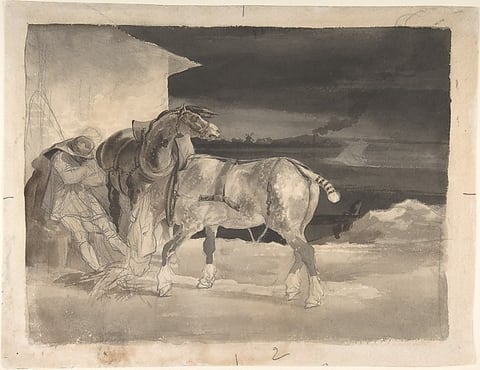
  1. Two Draft Horses with a Sleeping Driver, by Jean Louis André Théodore Géricault, 1820–22
    Two Draft Horses with a Sleeping DriverJean Louis André Théodore Géricault, 1820–22Courtesy of The Metropolitan Museum of Art
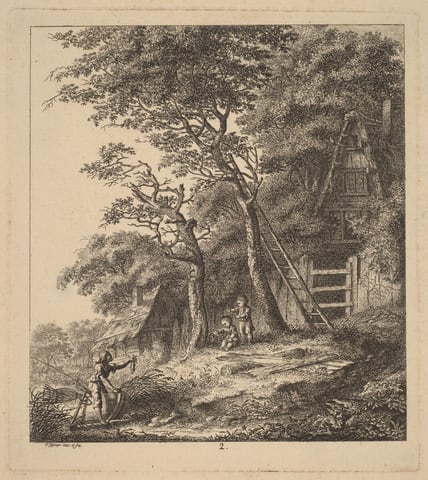
  2. The image shows a rustic scene with a house, trees, and a figure washing near a stream. Two children stand in the middle distance next to a ladder. In the background are two thatched houses among trees. The drawing style is detailed with fine lines and cross-hatching, creating texture. The color palette is monochromatic in shades of black and gray, emphasizing light and shadow.
    A Fisherman and Two Children in a Landscape with Thatched CottagesSalomon Gessner, 1764Courtesy National Gallery of Art, Washington
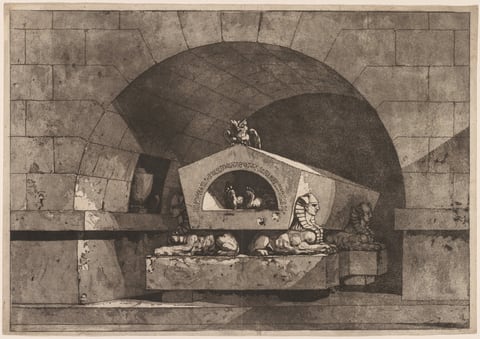
  3. Tomb with Sphinxes and an Owl, by Louis Jean Desprez, c. 1779–84
    Tomb with Sphinxes and an OwlLouis Jean Desprez, c. 1779–84Courtesy of the Cleveland Museum of Art
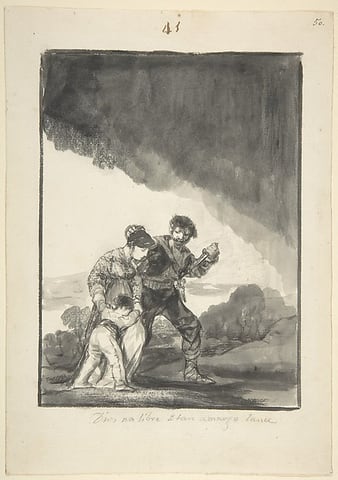
  4. God save us from such a bitter fate; a bandit threatening a woman and a child with a knife, page 41 from the "Black Border Album" (E), by Francisco Goya, ca. 1816–20
    God save us from such a bitter fate; a bandit threatening a woman and a child with a knife, page 41 from the "Black Border Album" (E)Francisco Goya, ca. 1816–20Courtesy of The Metropolitan Museum of Art

Second room, south wall
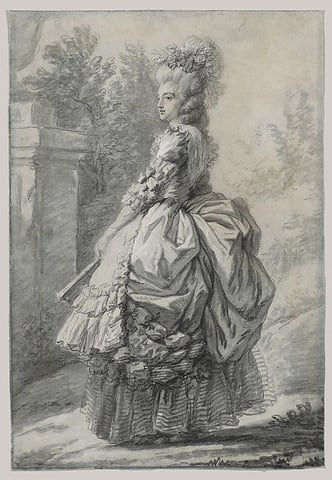
  1. Marie Antoinette in a Park, by Elisabeth Louise Vigée Le Brun, ca. 1780–81
    Marie Antoinette in a ParkElisabeth Louise Vigée Le Brun, ca. 1780–81Courtesy of The Metropolitan Museum of Art
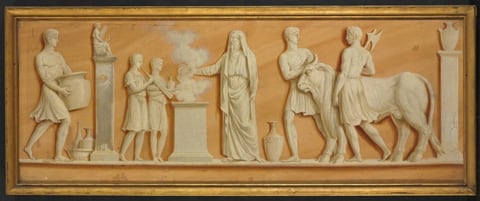
  2. Overdoor Painting and Double-Leaf Doors, by Pierre Rousseau, 1790s
    Overdoor Painting and Double-Leaf DoorsPierre Rousseau, 1790sCourtesy of the Cleveland Museum of Art
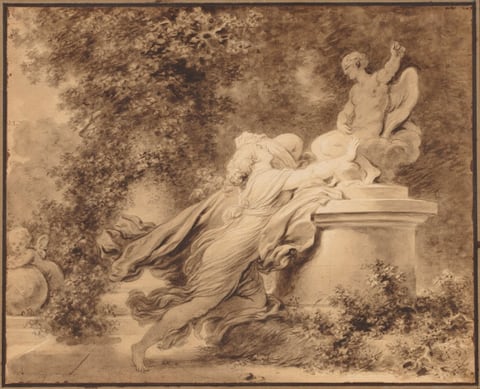
  3. Invocation to Love, by Jean Honoré Fragonard, c. 1781
    Invocation to LoveJean Honoré Fragonard, c. 1781Courtesy of the Cleveland Museum of Art

Second room, north wall
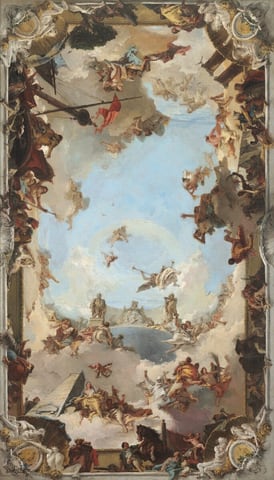
  1. We look up through an opening surrounded by a stone ledge, with clusters of people and clouds swirling into a blue sky up and away from us in this vertical, rectangular painting. From a distance, the scene looks like a complete illusion but up close, the people, clouds, and architecture are sketchily painted. The ledge running around the opening has a gold, oval medallion at each corner. Appearing to be carved from white stone, two bearded men with long hair recline against each medallion, flanking them to each side in front of large shells that curve up over the people and frames them. A few architectural structures extend up into the sky, including a pointed obelisk in the lower left corner, a pair of columns at the upper right, and what seems to be the mast of a ship at the top left. Most of the people have pale skin but some have more tan complexions, and a few, including those wearing feather headdresses near the upper left corner, have brown skin. The people wear windswept robes of pale, butter yellow, robin’s egg blue, rose pink, and ivory. The eye may drawn to a few vignettes, such as the man holding a rearing, chestnut-brown horse on the illusionistic ledge near the lower right, a nun wearing a white robe and holding a cross above him in the clouds, and, farthest away, a crowned person sitting on a throne.
    Wealth and Benefits of the Spanish Monarchy under Charles IIIGiovanni Battista Tiepolo, 1762Courtesy National Gallery of Art, Washington
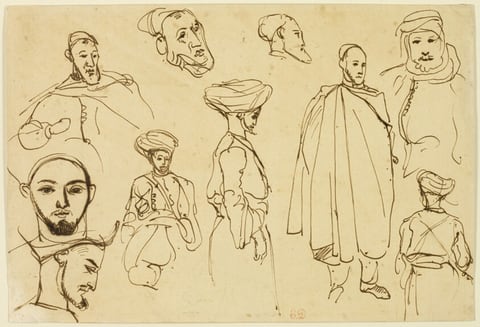
  2. A work made of pen and brown ink, with traces of graphite, on tan wove paper, laid down on cream wove paper.
    Sketches of Algerian MenEugène Delacroix, c. 1832Courtesy of the Art Institute of Chicago
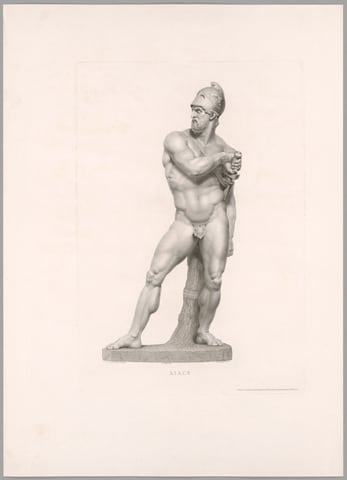
  3. A work made of engraving and etching in black on ivory wove paper.
    Ajax, Front View, from Oeuvre de CanovaAntonio Canova, 1817Courtesy of the Art Institute of Chicago

Third room, north wall
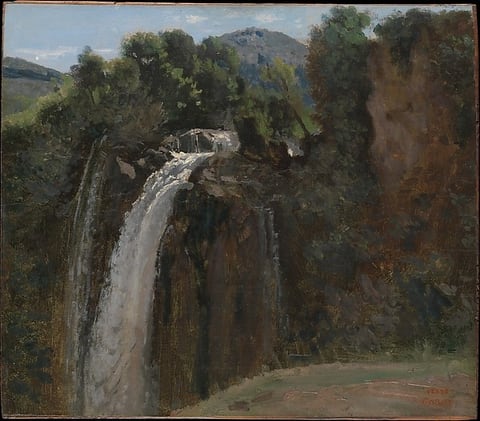
  1. Waterfall at Terni, by Jean Baptiste Camille Corot, 1826
    Waterfall at TerniJean Baptiste Camille Corot, 1826Courtesy of The Metropolitan Museum of Art
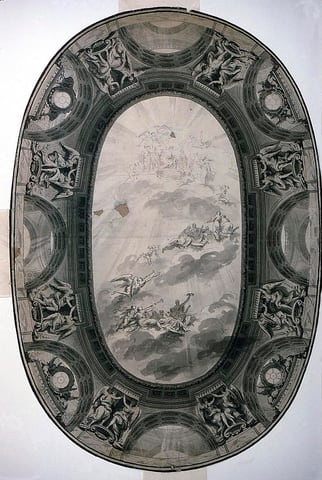
  2. PROJECT FOR THE PAINTED DECORATION OF THE CEILING OF A HALL (PAINTED OVAL CEILING)
    Project for the Painted Decoration of the Ceiling of a Hall (Painted Oval Ceiling)Jean Baptiste Marie Pierre, 1761Courtesy of Cooper Hewitt, Smithsonian Design Museum

Walk on

  • Neoclassicism, room 2
  • Jean Baptiste Marie Pierre's contemporaries 8 works
  • 18th-century France 75 works
Ochre Editions

The world's museums, on your wall. Every work here is a reproduction of a public-domain original, credited to the museum that holds it.

Shop

All artCollectionsLimited dropsPrints and framing

Help

Find an orderShippingReturnsVerify a certificate

About

About Ochre EditionsMuseum creditsFor agentsDevelopers

Legal

Terms of UseTerms of SaleLimited Editions and CertificatesPrivacy PolicyCookie PolicyAcceptable Use PolicyAgent & API TermsCopyright and DMCA PolicyPrinting Your Own PhotoVulnerability Disclosure PolicyAccessibility StatementOpen-Access Credits
© 2026 Ochre EditionsPrices in US dollars. Prints ship within the United States.