Floor plan

Style galleriesNeoclassicism

Neoclassicism

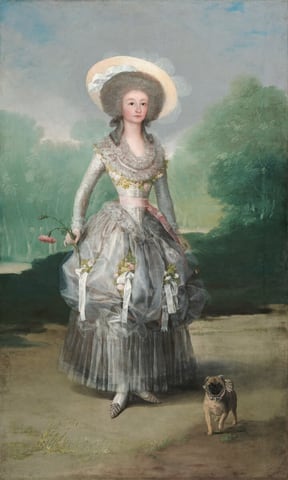
A woman with pale skin, wearing a silvery-gray dress adorned with white ribbons and light pink roses, stands looking out at us with a small, pug dog by her feet in this vertical portrait painting. The woman’s body is angled slightly to our right but she looks at us with dark eyes under faint, arched brows. Her nose is rounded, her cheeks smooth and flushed, and her pale pink lips are closed. Her face is framed in a cloud of nickel-gray hair, and tendrils curl down over her shoulders. She wears a wide-brimmed straw hat with a white ribbon set on the back of her head and slightly off to one side. The bodice of her dress has a low, curving neck. This area is loosely painted to create the impression of layers of lace. A band of intertwined pale pink roses and delicate green leaves borders the outer edge of the lace. The dress has long, tight sleeves with lace at the cuffs and the notably narrow waist is tied with a blush-pink ribbon. The full, silver skirt is picked up to create a row of puffs, like the top of a muffin, around her knees. Bunches of pink roses and white ribbons are nestled into the puffs, and below, the skirt falls in long, vertical pleats to her ankles. She wears white stockings and pointed, petal-pink shoes. In her left arm, on our right, she holds a closed fan loosely at her side, almost lost behind the skirt. She holds a pink carnation with a full bloom and a bud on a long, curving stem in her other hand, by her hip. A caramel-brown pug with a black face, wearing a pink collar lined with three bells, stands facing us with one front paw lifted, to our right of the woman's feet. The landscape is painted in tones of mint and sage green for grass beneath trees enclosing the space the woman stands in, sand brown for the ground, and icy blue for the sky above.
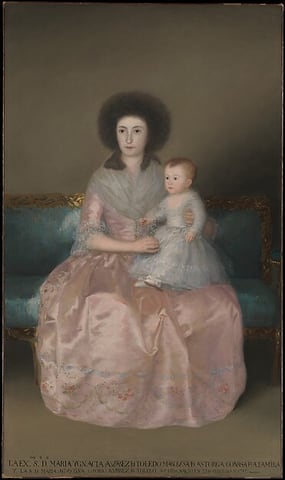
Condesa de Altamira and Her Daughter, María Agustina, by Francisco Goya, 1787–88
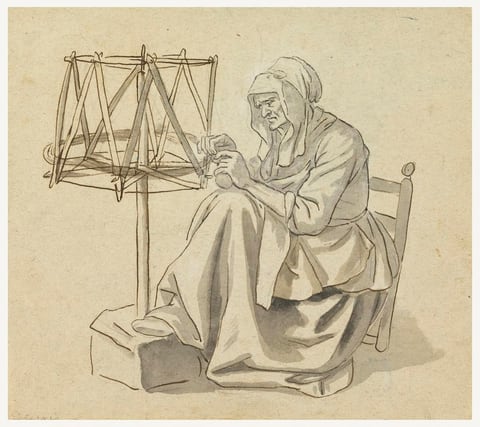
AN OLD WOMAN SPINNING
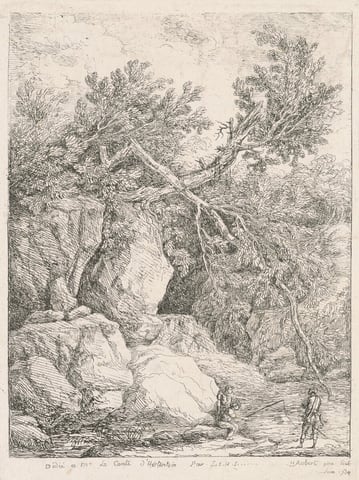
The image shows an illustration of a rocky terrain with towering stone formations and dense foliage. The sky is textured and the scene is created using an etching technique with intricate linework. There are two figures in the scene, one appearing to climb or position near a rock, while the other observes. The color palette is monochromatic, using black on a white background to depict depth and dimension in the artwork.
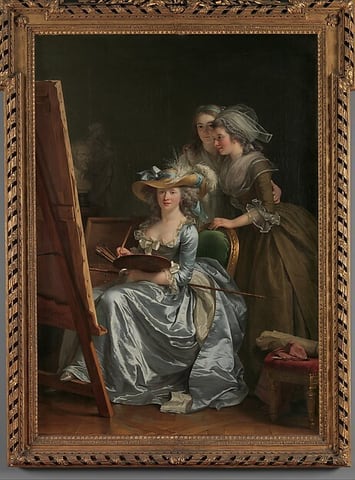
Self-Portrait with Two Pupils, Marie Gabrielle Capet (1761–1818) and Marie Marguerite Carraux de Rosemond (1765–1788), by Adélaïde Labille-Guiard, 1785
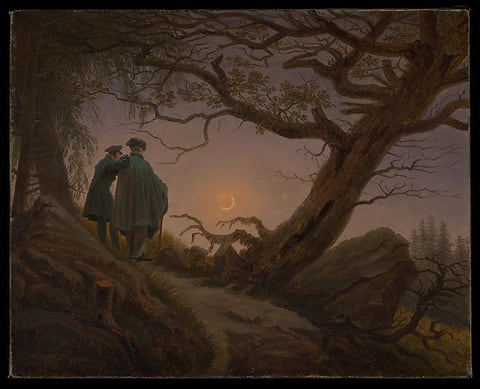
Two Men Contemplating the Moon, by Caspar David Friedrich, ca. 1825–30

The works in this room are listed below.

Works in this room

Europe turns back to Greece and Rome: clear line, calm figures and civic virtue.

First room, north wall

  1. A woman with pale skin, wearing a silvery-gray dress adorned with white ribbons and light pink roses, stands looking out at us with a small, pug dog by her feet in this vertical portrait painting. The woman’s body is angled slightly to our right but she looks at us with dark eyes under faint, arched brows. Her nose is rounded, her cheeks smooth and flushed, and her pale pink lips are closed. Her face is framed in a cloud of nickel-gray hair, and tendrils curl down over her shoulders. She wears a wide-brimmed straw hat with a white ribbon set on the back of her head and slightly off to one side. The bodice of her dress has a low, curving neck. This area is loosely painted to create the impression of layers of lace. A band of intertwined pale pink roses and delicate green leaves borders the outer edge of the lace. The dress has long, tight sleeves with lace at the cuffs and the notably narrow waist is tied with a blush-pink ribbon. The full, silver skirt is picked up to create a row of puffs, like the top of a muffin, around her knees. Bunches of pink roses and white ribbons are nestled into the puffs, and below, the skirt falls in long, vertical pleats to her ankles. She wears white stockings and pointed, petal-pink shoes. In her left arm, on our right, she holds a closed fan loosely at her side, almost lost behind the skirt. She holds a pink carnation with a full bloom and a bud on a long, curving stem in her other hand, by her hip. A caramel-brown pug with a black face, wearing a pink collar lined with three bells, stands facing us with one front paw lifted, to our right of the woman's feet. The landscape is painted in tones of mint and sage green for grass beneath trees enclosing the space the woman stands in, sand brown for the ground, and icy blue for the sky above.
    The Marquesa de PontejosFrancisco Goya, c. 1786Courtesy National Gallery of Art, Washington
  2. Condesa de Altamira and Her Daughter, María Agustina, by Francisco Goya, 1787–88
    Condesa de Altamira and Her Daughter, María AgustinaFrancisco Goya, 1787–88Courtesy of The Metropolitan Museum of Art
  3. AN OLD WOMAN SPINNING
    An Old Woman SpinningClaude-Louis Desrais, 1810–30Courtesy of Cooper Hewitt, Smithsonian Design Museum

First room, south wall

  1. The image shows an illustration of a rocky terrain with towering stone formations and dense foliage. The sky is textured and the scene is created using an etching technique with intricate linework. There are two figures in the scene, one appearing to climb or position near a rock, while the other observes. The color palette is monochromatic, using black on a white background to depict depth and dimension in the artwork.
    Landscape with a Fallen Tree (Paysage à l'arbre cassé)Hubert Robert, 1764Courtesy National Gallery of Art, Washington
  2. Self-Portrait with Two Pupils, Marie Gabrielle Capet (1761–1818) and Marie Marguerite Carraux de Rosemond (1765–1788), by Adélaïde Labille-Guiard, 1785
    Self-Portrait with Two Pupils, Marie Gabrielle Capet (1761–1818) and Marie Marguerite Carraux de Rosemond (1765–1788)Adélaïde Labille-Guiard, 1785Courtesy of The Metropolitan Museum of Art
  3. Two Men Contemplating the Moon, by Caspar David Friedrich, ca. 1825–30
    Two Men Contemplating the MoonCaspar David Friedrich, ca. 1825–30Courtesy of The Metropolitan Museum of Art

Second room, south wall
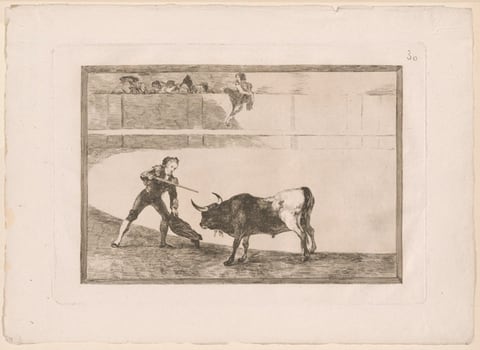
  1. A work made of etching, aquatint, drypoint and burin on ivory laid paper.
    Pedro Romero killing the halted bull, plate 30 from The Art of BullfightingFrancisco Goya, 1814/16, published 1816Courtesy of the Art Institute of Chicago
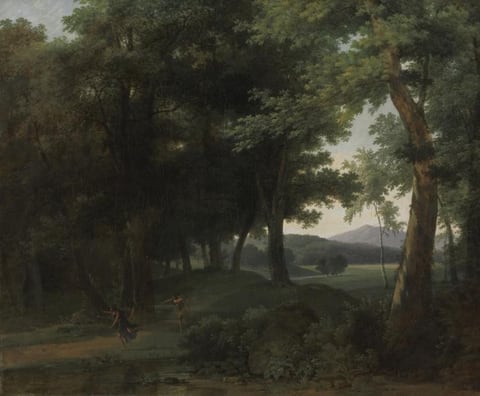
  2. A Forest with Apollo and Daphne, by Jean-Victor Bertin, 1810
    A Forest with Apollo and DaphneJean-Victor Bertin, 1810Courtesy of the Cleveland Museum of Art
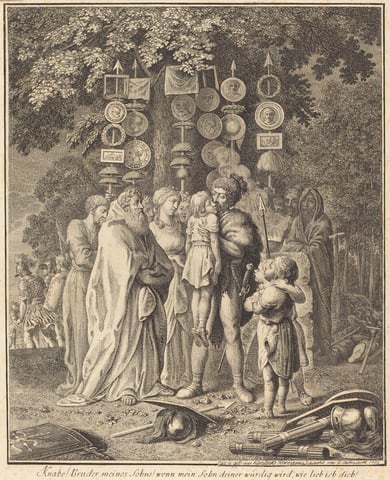
  3. The image depicts a group of people in varying poses and outfits. A central figure, possibly a child, is being held up by a man. Those around them are positioned differently, some standing closely. The figures have detailed faces and wear garments resembling classical attire. Shields and banners decorated with symbols are present in the background. Armor and helmets are scattered on the ground. Trees and a group of people in the distance are part of the background.
    Ancient TeutonsDaniel Nikolaus Chodowiecki, 1782Courtesy National Gallery of Art, Washington
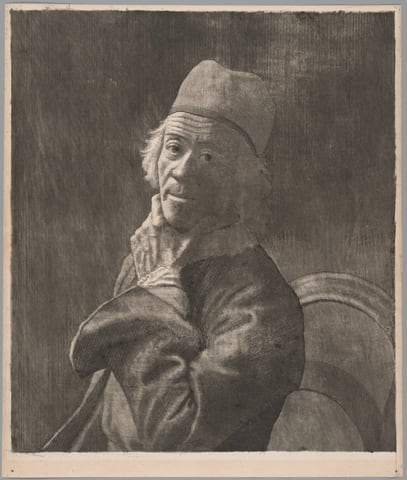
  4. A work made of etching, roulette, and mezzotint in black on cream laid paper.
    The Large Self-PortraitJean Etienne Liotard, 1778/81Courtesy of the Art Institute of Chicago

Second room, north wall
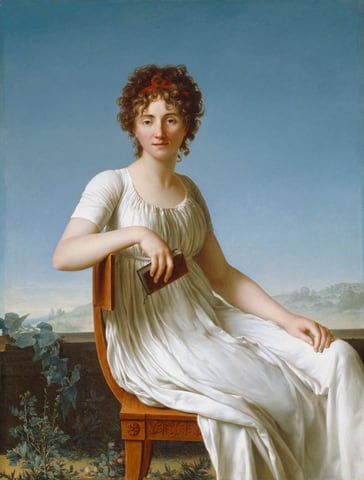
  1. A work made of oil on canvas.
    Portrait of Constance PipeletJean Baptiste François Désoria, 1797Courtesy of the Art Institute of Chicago
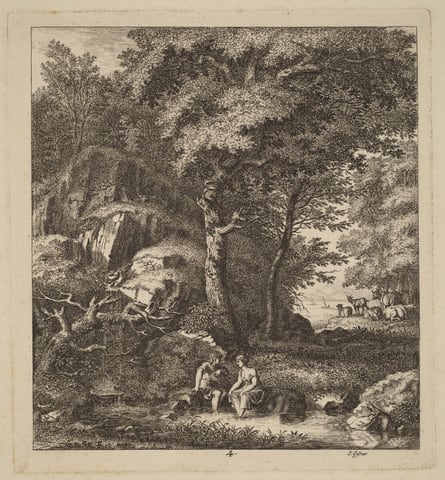
  2. The image depicts a forest scene with large trees dominating the right side, two figures seated by a stream, rocky formations on the left, grazing animals in the distance, and a monochrome color palette of brown and espresso tones.
    A Shepherd and a Young Woman With Their Feet in a BrookSalomon Gessner, 1764Courtesy National Gallery of Art, Washington
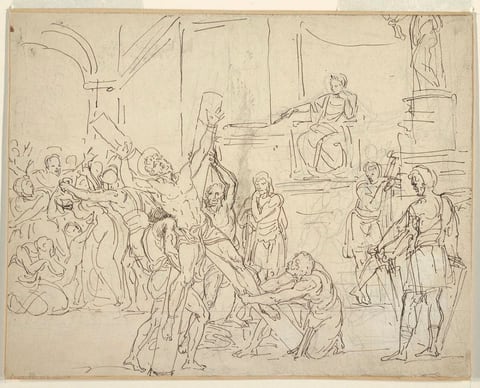
  3. MARTYRDOM OF ST. ANDREW
    Martyrdom of St. AndrewFrancesco Coghetti, 1825–50Courtesy of Cooper Hewitt, Smithsonian Design Museum
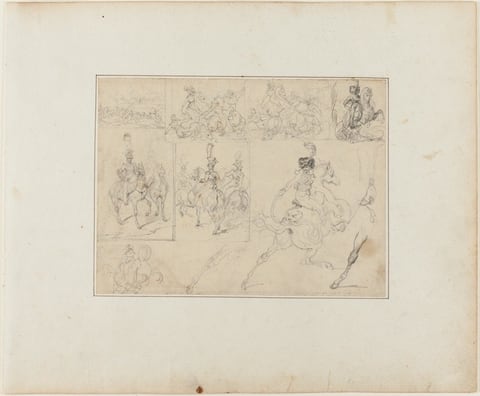
  4. A work made of graphite, on tan wove paper, perimeter mounted on ivory laid paper.
    Sheet of Sketches: Cavalry Battles and Mounted SoldiersJean Louis André Théodore Géricault, 1813/14Courtesy of the Art Institute of Chicago

Third room, north wall
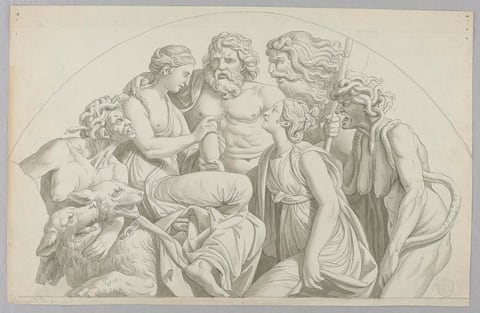
  1. PSYCHE ASKS PROSERPINE TO PUT A LITTLE OF HER BEAUTY IN AN URN FOR VENUS
    Psyche Asks Proserpine to Put a Little of her Beauty in an Urn for VenusJohann August Nahl The Younger, ca. 1781Courtesy of Cooper Hewitt, Smithsonian Design Museum
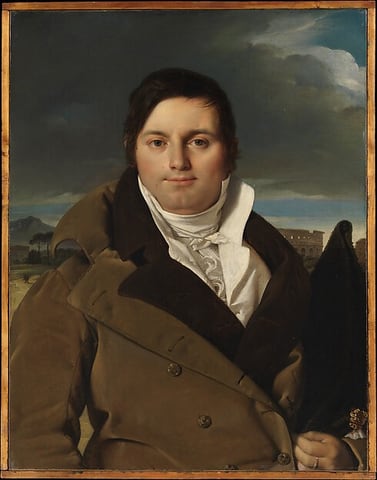
  2. Joseph-Antoine Moltedo (born 1775), by Jean Auguste Dominique Ingres, ca. 1810
    Joseph-Antoine Moltedo (born 1775)Jean Auguste Dominique Ingres, ca. 1810Courtesy of The Metropolitan Museum of Art