Floor plan

Style galleriesNeoclassicism

Neoclassicism

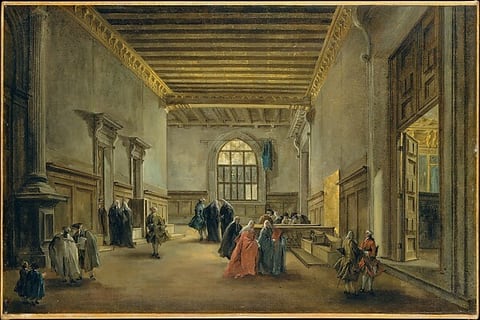
The Antechamber of the Sala del Maggior Consiglio, by Francesco Guardi, ca. 1765–68
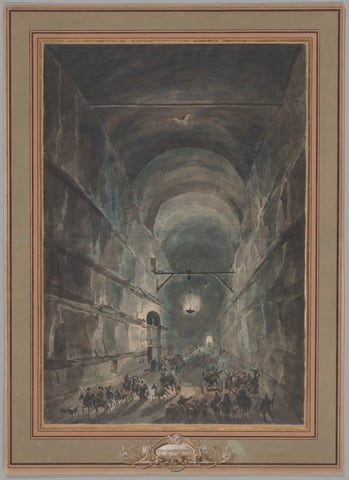
A work made of handcolored etching in black on cream laid paper.
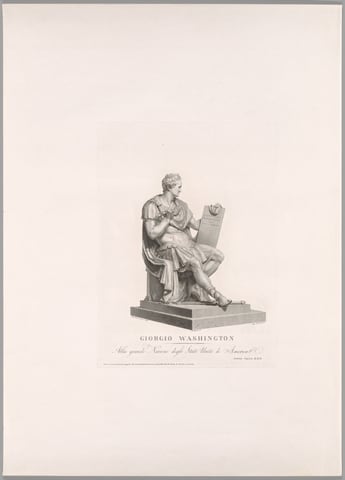
A work made of engraving in black on ivory wove paper.
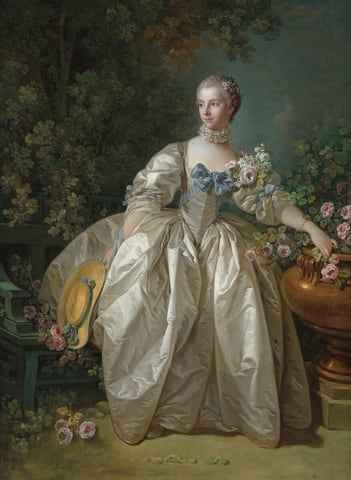
A young woman with light skin stands in a garden, wearing a voluminous, full-length, silvery, shimmering gown in this vertical portrait painting. Her body faces us, as she looks into the distance to our left. She has rosy cheeks, gray-green eyes under gently arched, light brown brows, and her coral-pink, thin, closed lips curve in a slight smile. Her ash-brown hair is pulled back and adorned with tiny shell-pink and azure-blue flowers along the left side top of head, to our right. A pleated lace ruffle encircles her smooth neck. Her gown is parchment white where the light glints off the stiff fabric and is silvery gray in the shadows, creating a silk-like sheen. The dress is cut low across the chest, fits tightly around her narrow waist, and has puffy sleeves tied at the elbows with topaz-blue bows. Another blue bow is tied at her chest, and the ends wrap around her back along her waist. A corsage at her left shoulder, to our right, is a profusion of white flowers around a pale pink rose. In her other hand, to our left, she holds a straw hat with a shallow crown and a wide brim, trimmed with sky-blue ribbon. The arm holding the hat is nearly engulfed in the deep folds of her full skirt. She holds a pink rose in her other hand, which rests on the lip of a shiny, copper-colored urn filled with pink flowers and delicate green leaves. On that wrist she wears a bracelet with four strands of white pearls holding a cameo. She stands on a pale, dirt ground. A teal-blue bench in the lower left corner of the painting is tucked into sage-green shrubbery. Sprigs of pink roses are strewn across the seat and on the ground. The woman is framed to either side with olive and celery-green trees and vegetation, which blend into the hazy distance beyond her head.
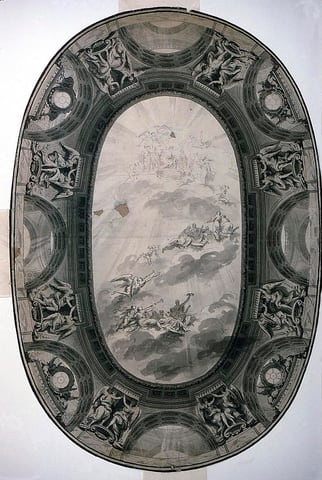
PROJECT FOR THE PAINTED DECORATION OF THE CEILING OF A HALL (PAINTED OVAL CEILING)
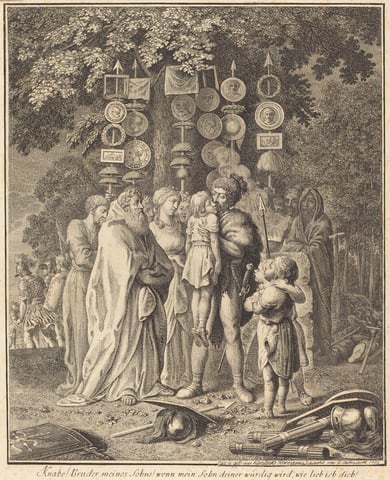
The image depicts a group of people in varying poses and outfits. A central figure, possibly a child, is being held up by a man. Those around them are positioned differently, some standing closely. The figures have detailed faces and wear garments resembling classical attire. Shields and banners decorated with symbols are present in the background. Armor and helmets are scattered on the ground. Trees and a group of people in the distance are part of the background.
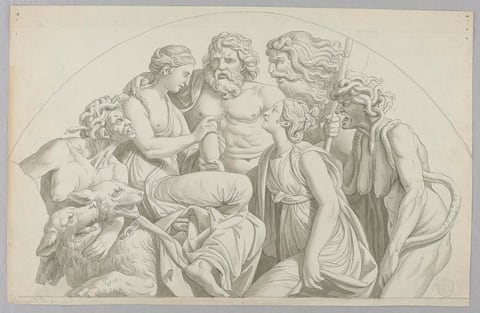
PSYCHE ASKS PROSERPINE TO PUT A LITTLE OF HER BEAUTY IN AN URN FOR VENUS
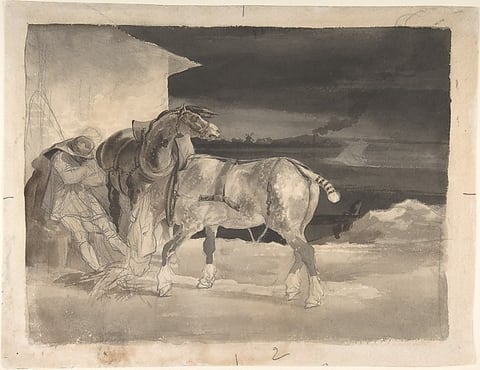
Two Draft Horses with a Sleeping Driver, by Jean Louis André Théodore Géricault, 1820–22

The works in this room are listed below.

Works in this room

Europe turns back to Greece and Rome: clear line, calm figures and civic virtue.

First room, north wall

  1. The Antechamber of the Sala del Maggior Consiglio, by Francesco Guardi, ca. 1765–68
    The Antechamber of the Sala del Maggior ConsiglioFrancesco Guardi, ca. 1765–68Courtesy of The Metropolitan Museum of Art
  2. A work made of handcolored etching in black on cream laid paper.
    The Grotto of Posillipo (La Grotta di Posillipo)Louis Jean Desprez, 1785/90Courtesy of the Art Institute of Chicago
  3. A work made of engraving in black on ivory wove paper.
    George Washington, Front View, from Oeuvre de CanovaAntonio Canova, 1817Courtesy of the Art Institute of Chicago
  4. A young woman with light skin stands in a garden, wearing a voluminous, full-length, silvery, shimmering gown in this vertical portrait painting. Her body faces us, as she looks into the distance to our left. She has rosy cheeks, gray-green eyes under gently arched, light brown brows, and her coral-pink, thin, closed lips curve in a slight smile. Her ash-brown hair is pulled back and adorned with tiny shell-pink and azure-blue flowers along the left side top of head, to our right. A pleated lace ruffle encircles her smooth neck. Her gown is parchment white where the light glints off the stiff fabric and is silvery gray in the shadows, creating a silk-like sheen. The dress is cut low across the chest, fits tightly around her narrow waist, and has puffy sleeves tied at the elbows with topaz-blue bows. Another blue bow is tied at her chest, and the ends wrap around her back along her waist. A corsage at her left shoulder, to our right, is a profusion of white flowers around a pale pink rose. In her other hand, to our left, she holds a straw hat with a shallow crown and a wide brim, trimmed with sky-blue ribbon. The arm holding the hat is nearly engulfed in the deep folds of her full skirt. She holds a pink rose in her other hand, which rests on the lip of a shiny, copper-colored urn filled with pink flowers and delicate green leaves. On that wrist she wears a bracelet with four strands of white pearls holding a cameo. She stands on a pale, dirt ground. A teal-blue bench in the lower left corner of the painting is tucked into sage-green shrubbery. Sprigs of pink roses are strewn across the seat and on the ground. The woman is framed to either side with olive and celery-green trees and vegetation, which blend into the hazy distance beyond her head.
    Madame BergeretFrançois Boucher, possibly 1766Courtesy National Gallery of Art, Washington

First room, south wall

  1. PROJECT FOR THE PAINTED DECORATION OF THE CEILING OF A HALL (PAINTED OVAL CEILING)
    Project for the Painted Decoration of the Ceiling of a Hall (Painted Oval Ceiling)Jean Baptiste Marie Pierre, 1761Courtesy of Cooper Hewitt, Smithsonian Design Museum
  2. The image depicts a group of people in varying poses and outfits. A central figure, possibly a child, is being held up by a man. Those around them are positioned differently, some standing closely. The figures have detailed faces and wear garments resembling classical attire. Shields and banners decorated with symbols are present in the background. Armor and helmets are scattered on the ground. Trees and a group of people in the distance are part of the background.
    Ancient TeutonsDaniel Nikolaus Chodowiecki, 1782Courtesy National Gallery of Art, Washington
  3. PSYCHE ASKS PROSERPINE TO PUT A LITTLE OF HER BEAUTY IN AN URN FOR VENUS
    Psyche Asks Proserpine to Put a Little of her Beauty in an Urn for VenusJohann August Nahl The Younger, ca. 1781Courtesy of Cooper Hewitt, Smithsonian Design Museum
  4. Two Draft Horses with a Sleeping Driver, by Jean Louis André Théodore Géricault, 1820–22
    Two Draft Horses with a Sleeping DriverJean Louis André Théodore Géricault, 1820–22Courtesy of The Metropolitan Museum of Art

Second room, south wall
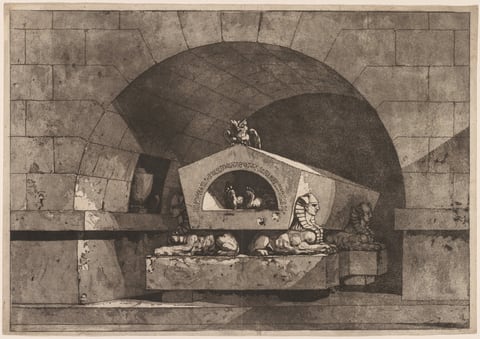
  1. Tomb with Sphinxes and an Owl, by Louis Jean Desprez, c. 1779–84
    Tomb with Sphinxes and an OwlLouis Jean Desprez, c. 1779–84Courtesy of the Cleveland Museum of Art
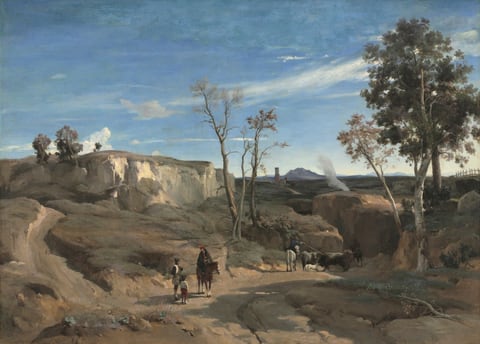
  2. La Cervara, the Roman Campagna, by Jean Baptiste Camille Corot, c. 1830–31
    La Cervara, the Roman CampagnaJean Baptiste Camille Corot, c. 1830–31Courtesy of the Cleveland Museum of Art

  3. Portrait of a Boy, ca. 1800
    Portrait of a BoyUnrecorded Italian maker, ca. 1800Courtesy of the Smithsonian American Art Museum

Second room, north wall

  1. Self-Portrait, by Francisco Goya, ca. 1796
    Self-PortraitFrancisco Goya, ca. 1796Courtesy of The Metropolitan Museum of Art
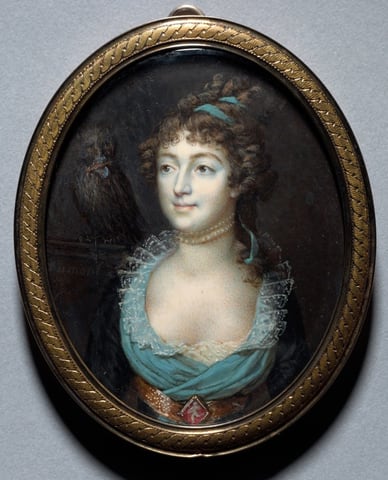
  2. Portrait of Mademoiselle Marie-Anne Adelaide Le Normand, by François Dumont, c. 1793
    Portrait of Mademoiselle Marie-Anne Adelaide Le NormandFrançois Dumont, c. 1793Courtesy of the Cleveland Museum of Art
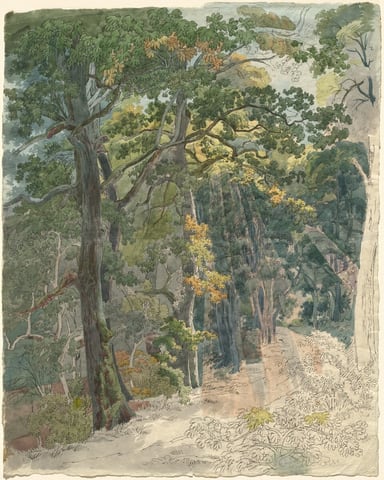
  3. The image shows a dense, forested area with towering trees. The composition leads the eye along a pathway into the distance, without a distinct horizon line. The intricate brushstrokes depict the texture and foliage of the trees, suggesting movement and light filtering through the leaves. The color palette is rich and earthy, with shades of green, brown, yellow, and orange, creating a vibrant yet tranquil atmosphere emphasizing light and shadow.
    Rays of Sunlight Striking a Woodland PathFriedrich Salathé, c. 1815Courtesy National Gallery of Art, Washington

Third room, north wall
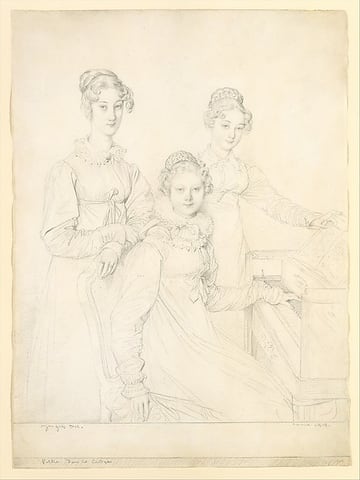
  1. The Kaunitz Sisters (Leopoldine, Caroline, and Ferdinandine), by Jean Auguste Dominique Ingres, 1818
    The Kaunitz Sisters (Leopoldine, Caroline, and Ferdinandine)Jean Auguste Dominique Ingres, 1818Courtesy of The Metropolitan Museum of Art
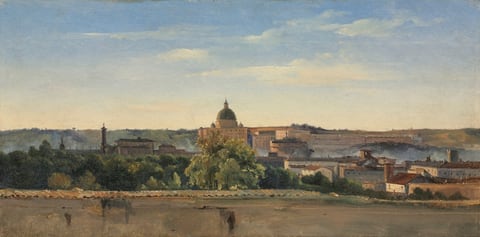
  2. View of Rome, by Pierre Henri de Valenciennes, c. 1782–84
    View of RomePierre Henri de Valenciennes, c. 1782–84Courtesy of the Cleveland Museum of Art