
Floor plan

Style galleriesNeoclassicism

Neoclassicism

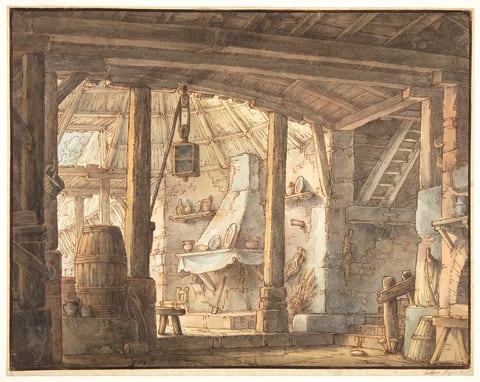
RUSTIC INTERIOR: STAGE DESIGN FOR THE TEATRO DE' FELICINI, BOLOGNA
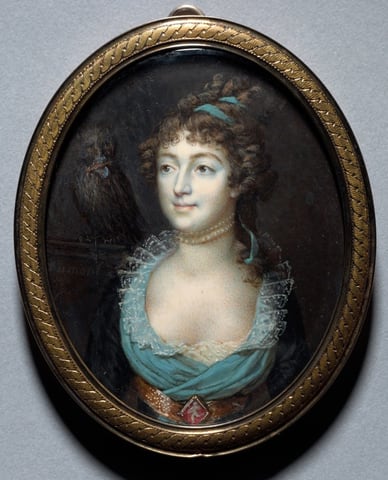
Portrait of Mademoiselle Marie-Anne Adelaide Le Normand, by François Dumont, c. 1793
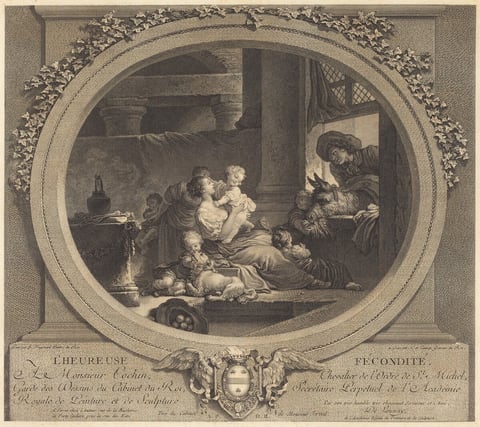
The engraving depicts a gathering around a woman holding a child in her arms in an indoor setting with stone columns and an arched background. Another woman is next to her, looking towards her while leaning over what appears to be a child or possibly a doll on a small donkey. Surrounding the central woman are several children, some seated and playing on the floor. A dog is resting at the central woman's feet. The image features lush drapery, creating a warm and intimate setting. The style suggests classical or historical fashion, and there is an ornate border with ivy leaves. The text and emblem below likely contain relevant inscriptions.
The image shows an illustration of a rocky terrain with towering stone formations and dense foliage. The sky is textured and the scene is created using an etching technique with intricate linework. There are two figures in the scene, one appearing to climb or position near a rock, while the other observes. The color palette is monochromatic, using black on a white background to depict depth and dimension in the artwork.
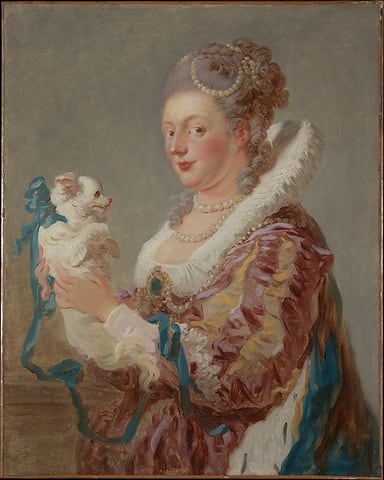
Marie Emilie Coignet de Courson (1716–1806) with a Dog, by Jean Honoré Fragonard, ca. 1769
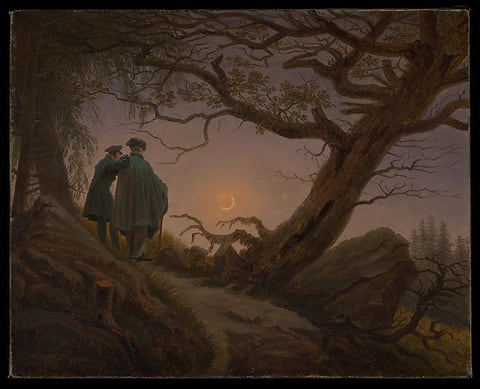
Two Men Contemplating the Moon, by Caspar David Friedrich, ca. 1825–30
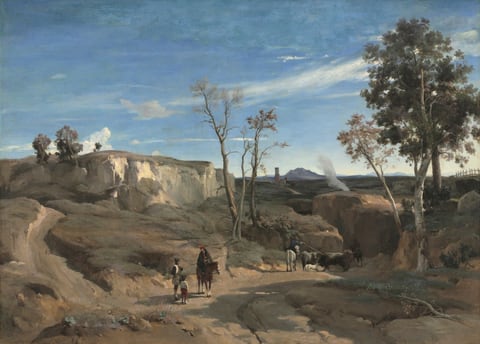
La Cervara, the Roman Campagna, by Jean Baptiste Camille Corot, c. 1830–31

The works in this room are listed below.

Works in this room

Europe turns back to Greece and Rome: clear line, calm figures and civic virtue.

First room, north wall

  1. RUSTIC INTERIOR: STAGE DESIGN FOR THE TEATRO DE' FELICINI, BOLOGNA
    Rustic Interior: Stage Design for the Teatro de' Felicini, BolognaAntonio Giuseppe Basoli, ca. 1810Courtesy of Cooper Hewitt, Smithsonian Design Museum
  2. Portrait of Mademoiselle Marie-Anne Adelaide Le Normand, by François Dumont, c. 1793
    Portrait of Mademoiselle Marie-Anne Adelaide Le NormandFrançois Dumont, c. 1793Courtesy of the Cleveland Museum of Art
  3. The engraving depicts a gathering around a woman holding a child in her arms in an indoor setting with stone columns and an arched background. Another woman is next to her, looking towards her while leaning over what appears to be a child or possibly a doll on a small donkey. Surrounding the central woman are several children, some seated and playing on the floor. A dog is resting at the central woman's feet. The image features lush drapery, creating a warm and intimate setting. The style suggests classical or historical fashion, and there is an ornate border with ivy leaves. The text and emblem below likely contain relevant inscriptions.
    L'heureuse féconditéNicolas Delaunay, 1777Courtesy National Gallery of Art, Washington
  4. The image shows an illustration of a rocky terrain with towering stone formations and dense foliage. The sky is textured and the scene is created using an etching technique with intricate linework. There are two figures in the scene, one appearing to climb or position near a rock, while the other observes. The color palette is monochromatic, using black on a white background to depict depth and dimension in the artwork.
    Landscape with a Fallen Tree (Paysage à l'arbre cassé)Hubert Robert, 1764Courtesy National Gallery of Art, Washington

First room, south wall

  1. Marie Emilie Coignet de Courson (1716–1806) with a Dog, by Jean Honoré Fragonard, ca. 1769
    Marie Emilie Coignet de Courson (1716–1806) with a DogJean Honoré Fragonard, ca. 1769Courtesy of The Metropolitan Museum of Art
  2. Two Men Contemplating the Moon, by Caspar David Friedrich, ca. 1825–30
    Two Men Contemplating the MoonCaspar David Friedrich, ca. 1825–30Courtesy of The Metropolitan Museum of Art
  3. La Cervara, the Roman Campagna, by Jean Baptiste Camille Corot, c. 1830–31
    La Cervara, the Roman CampagnaJean Baptiste Camille Corot, c. 1830–31Courtesy of the Cleveland Museum of Art

Second room, south wall
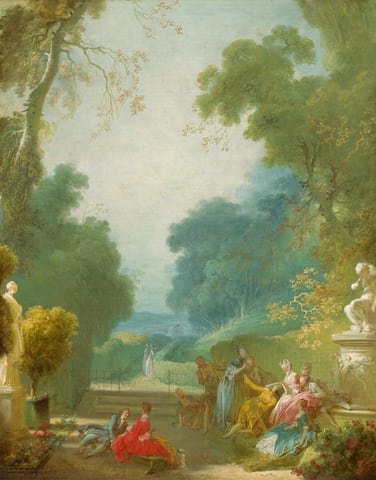
  1. Towering, pale, celery-green trees frame a view of a lush park with about a dozen elegantly dressed, light-skinned men and women in this vertical landscape painting. The color palette is dominated by moss and lemon-lime green, golden yellow, and spruce blue. The men all wear jackets with long tails over knee-breeches, and their long hair is pulled back at the napes of their necks. The women wear long dresses with full skirts and hints of lace at the sleeves and bust, and their brown or white hair is pulled up. Nine of the men and women gather to our right on a stone terrace along the bottom edge of the painting. A man in butter yellow kneels in front of a woman wearing rose pink. Around this pair, people stand, kneel, sit, or recline wearing aquamarine blue, light turquoise, or ivory white. A man and woman sit on a bench to our left, a little removed from the larger group. This woman wears ruby red and the man leaning toward her wears topaz blue. Two people in the park beyond these groups are painted with only a few strokes of pale blue and white paint, and they look over a low hedge row lining the walking path. Beds of red flowers fill the lower corners of the composition in front of a statue of a woman to our left and a person, perhaps on a fountain, to our right. The grassy walking path and trees become more blue as they fade into the hazy distance between the tall tress to either side. The sky fades from pale blue along the horizon to a silvery blue, almost white, at the top.
    A Game of Hot CocklesJean Honoré Fragonard, c. 1775/1780Courtesy National Gallery of Art, Washington
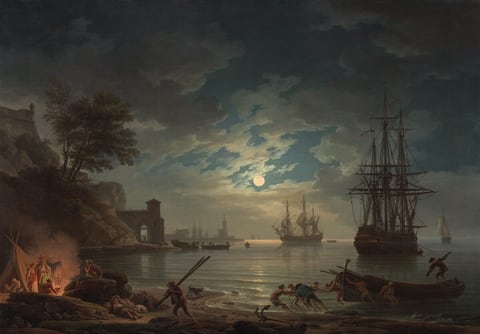
  2. Moonlight falls across several masted ships near a rocky shoreline in this horizontal painting. The sky fills the top three-quarters of the picture. A veil of slate-gray clouds is lit to pearl white around the crisp, full moon at the center of the composition. Patches of denim-blue sky are seen through breaks in the blanket of clouds. Moonlight reflects down the center of rippling, silvery-gray water that laps against a beach close to us, along the bottom edge of the painting. A tent is set up in the lower left corner of the composition. There, two women and one man stand looking at a glowing fire next to the tent. One woman holds a basket on her head, the other tucks a flat basket under one arm. The man stands between the two women, and a fourth man crouches near the fire, his back to us. In the opening of the tent, another woman kneels over a large bowl as she looks at the fire. A fifth person, a man, gazes at the fire as he sits smoking a long-stemmed pipe on a boulder. At the foot of the boulders, a man lies back against some bundles, one arm thrown up over his head. A dog curls up next to his hip. Not far from the sleeping man and in the center of the foreground, a man carries several long wooden objects, possibly oars, over one shoulder while a dog beyond him barks at the lapping surf. The beach curves like a C away from us, along the left. At the point of the curve in the middle distance, a structure like a city wall and gate jut out to the water’s edge. More buildings atop steep cliffs rise vertically beyond the gate. The shoreline curves into the distance again, and more buildings, including a lighthouse, and masted ships there are smoke-gray silhouettes. Near the lower right corner of the painting, four men pull on ropes tied around the prow of a small wooden boat while three others push it toward the land. Another man stands in the far end. A short distance beyond that boat is a tall wooden ship with three masts and rigging outlined against the night sky. Windows along the decks of that boat’s wide stern, angled toward us, glow with golden light. Beyond it and a bit to our left, another ship, smaller in scale, sails away from us. Several more ships move back to the horizon until we only see strokes of white and gray to indicate their unfurled sails.
    MoonlightClaude-Joseph Vernet, 1772Courtesy National Gallery of Art, Washington
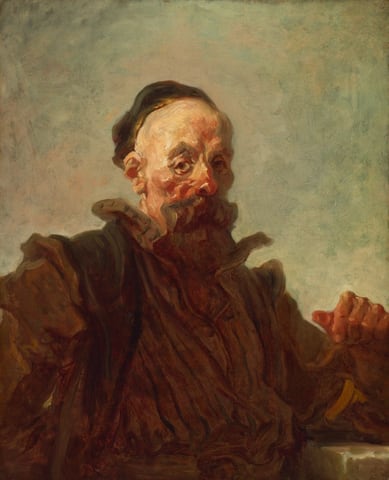
  3. Painting of bearded, ruddy-faced man in eighteenth century style clothing.
    Portrait of a Man in CostumeJean Honoré Fragonard, c. 1767–68Courtesy of the Art Institute of Chicago

Second room, north wall
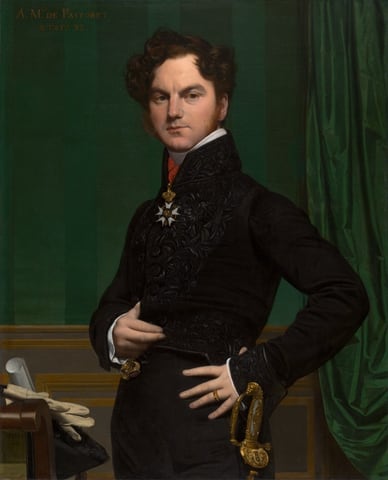
  1. Portrait of white man dressed in all black with medallion and sword.
    Amédée-David, the Comte de PastoretJean Auguste Dominique Ingres, 1823–26Courtesy of the Art Institute of Chicago
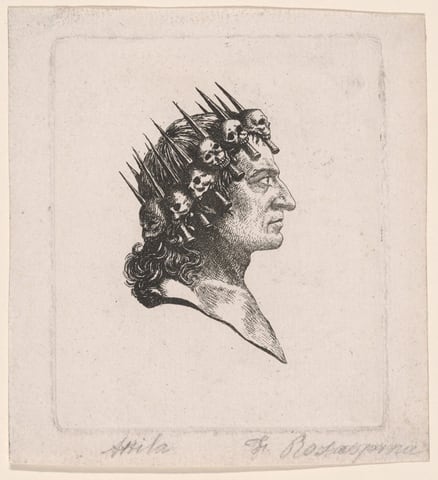
  2. A work made of etching in black on ivory laid paper.
    Portrait of Le Roi MaratViller, c. 1795Courtesy of the Art Institute of Chicago
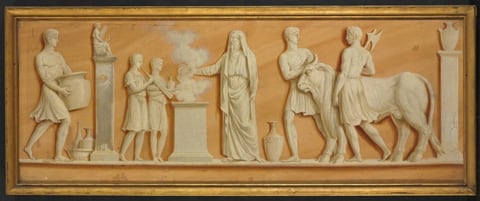
  3. Overdoor Painting and Double-Leaf Doors, by Pierre Rousseau, 1790s
    Overdoor Painting and Double-Leaf DoorsPierre Rousseau, 1790sCourtesy of the Cleveland Museum of Art

Third room, north wall
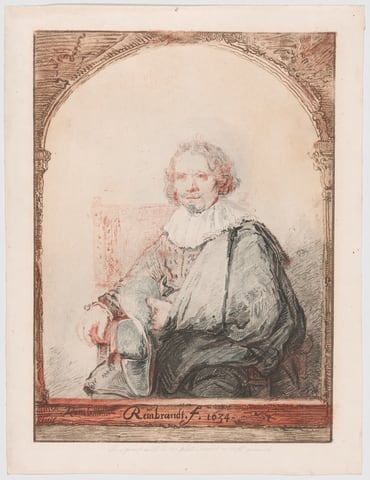
  1. A work made of soft ground etching from two plates, with roulette, on paper.
    Portrait of a Man in an Armchair, from Collection d'imitations de Dessins d'après les Principaux Maîtres Hollandais et FlamandsChristian Josi, 1826Courtesy of the Art Institute of Chicago
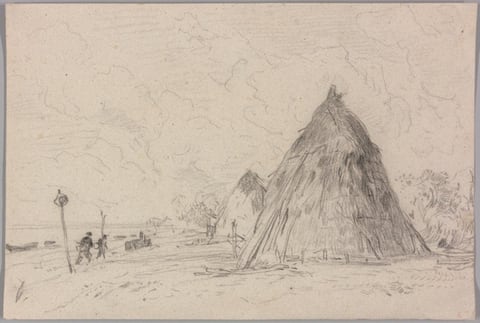
  2. A work made of conté crayon on gray-blue wove paper.
    Landscape with HaystacksConstant Troyon, n.d.Courtesy of the Art Institute of Chicago
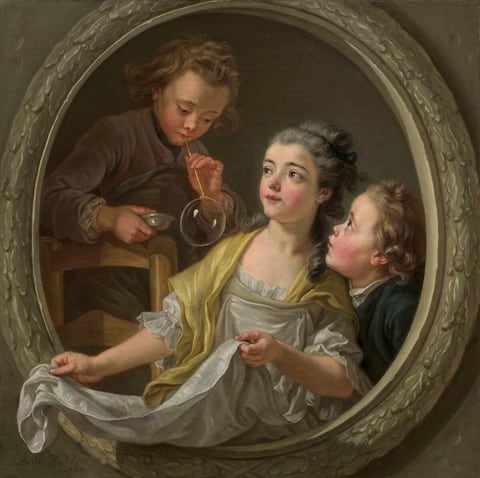
  3. The painting depicts three children within an oval frame, their upper bodies visible. The central child, a young girl, is positioned with her body facing forward and her head turned slightly to the left. She has a fair complexion, with rosy cheeks, pink lips, and wide brown eyes. Her hair is gray and partially pulled back by a blue ribbon. She is dressed in a white garment with a yellow shawl draped over her shoulders. Her arms are outstretched, holding the ends of a cloth that has been pinned on her dress. Her arms and the cloth extend forward beyond the oval frame that encircles the trio, as if the frame is a window or porthole that she is reaching out of. On the right, a boy leans on the girl's shoulder, also facing to the left, seen in profile. He has light brown, curly hair and a fair complexion. He wears a dark blue-green jacket over a white collar, and he is looking upward towards the third child. On the left, another boy, who also has light skin and light brown curly hair, appears to stand on a chair above the other two children. He is holding a long yellow straw up to his lips. At the other end of the straw, a large bubble hangs over the white cloth that the girl holds out. In his other hand is a small white dish. He wears a muted brown outfit with a dark cloth wrapped around him. The background within the frame is plain gray, and the frame that surrounds the children is light gray and appears to be carved with leaf designs. Beyond the oval frame is gray.
    Soap BubblesCharles Amédée Philippe Van Loo, 1764Courtesy National Gallery of Art, Washington