Floor plan

Style galleriesNeoclassicism

Neoclassicism

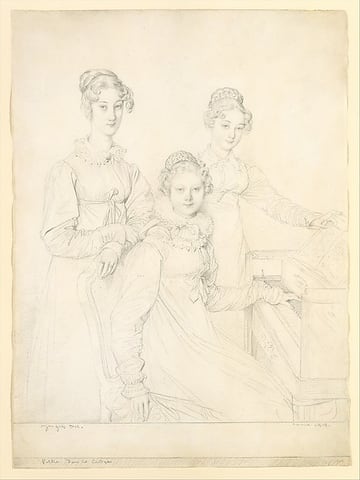
The Kaunitz Sisters (Leopoldine, Caroline, and Ferdinandine), by Jean Auguste Dominique Ingres, 1818
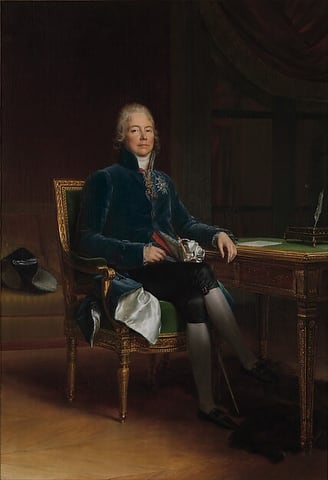
Charles Maurice de Talleyrand Périgord (1754–1838), Prince de Bénévent, by baron François Gérard, 1808
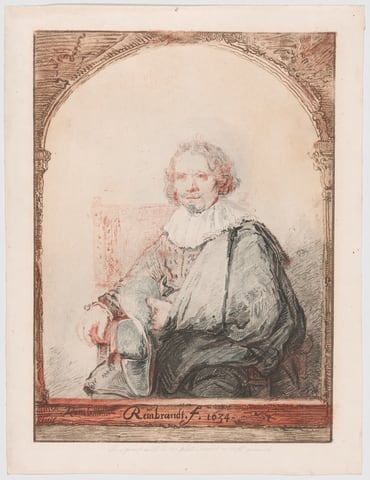
A work made of soft ground etching from two plates, with roulette, on paper.
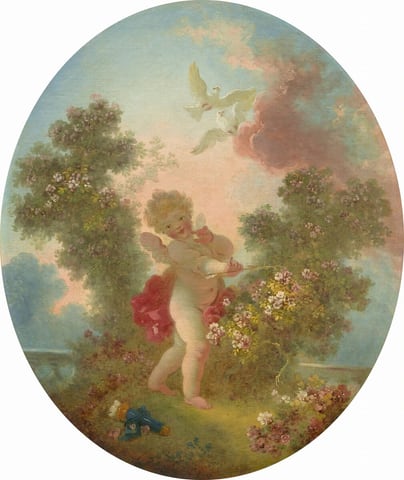
This oval painting depicts a cherubic child in a garden setting. The child is standing with one foot in front of the other and has small wings on their back. The child has light skin, curly blond hair, rosy cheeks, and a playful expression. They are mostly nude, except for a cloth that wraps around their back and covers their groin. The child is holding a golden arrow. They are standing in front of a light green bush with pink flowers. In the bottom left, there is a dark blue object in the green grass that looks like a torch or cylindrical quiver. The setting includes lush greenery and more clusters of pink and white flowers. The background features a pastel blue sky with soft pink clouds and two white doves flying above.
A work made of oil on canvas.
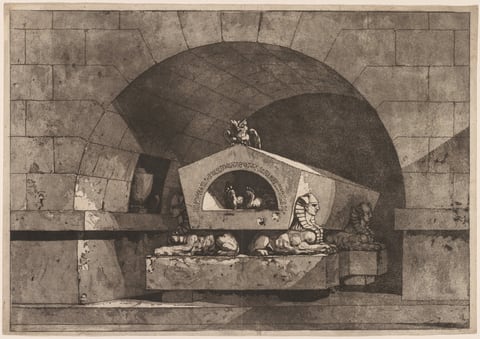
Tomb with Sphinxes and an Owl, by Louis Jean Desprez, c. 1779–84

The works in this room are listed below.

Works in this room

Europe turns back to Greece and Rome: clear line, calm figures and civic virtue.

First room, north wall

  1. The Kaunitz Sisters (Leopoldine, Caroline, and Ferdinandine), by Jean Auguste Dominique Ingres, 1818
    The Kaunitz Sisters (Leopoldine, Caroline, and Ferdinandine)Jean Auguste Dominique Ingres, 1818Courtesy of The Metropolitan Museum of Art
  2. Charles Maurice de Talleyrand Périgord (1754–1838), Prince de Bénévent, by baron François Gérard, 1808
    Charles Maurice de Talleyrand Périgord (1754–1838), Prince de Bénéventbaron François Gérard, 1808Courtesy of The Metropolitan Museum of Art
  3. A work made of soft ground etching from two plates, with roulette, on paper.
    Portrait of a Man in an Armchair, from Collection d'imitations de Dessins d'après les Principaux Maîtres Hollandais et FlamandsChristian Josi, 1826Courtesy of the Art Institute of Chicago

First room, south wall

  1. This oval painting depicts a cherubic child in a garden setting. The child is standing with one foot in front of the other and has small wings on their back. The child has light skin, curly blond hair, rosy cheeks, and a playful expression. They are mostly nude, except for a cloth that wraps around their back and covers their groin. The child is holding a golden arrow. They are standing in front of a light green bush with pink flowers. In the bottom left, there is a dark blue object in the green grass that looks like a torch or cylindrical quiver. The setting includes lush greenery and more clusters of pink and white flowers. The background features a pastel blue sky with soft pink clouds and two white doves flying above.
    Love the SentinelJean Honoré Fragonard, c. 1773/1776Courtesy National Gallery of Art, Washington
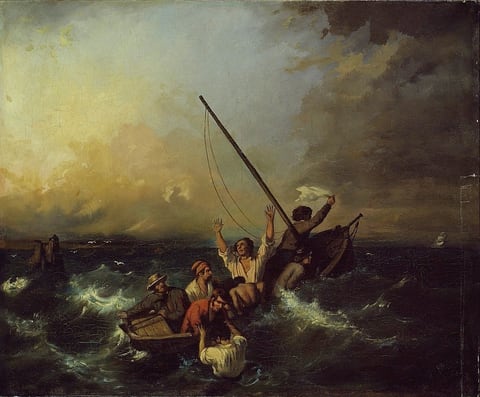
  2. A work made of oil on canvas.
    ShipwreckAfter Eugène Isabey, 19th centuryCourtesy of the Art Institute of Chicago
  3. Tomb with Sphinxes and an Owl, by Louis Jean Desprez, c. 1779–84
    Tomb with Sphinxes and an OwlLouis Jean Desprez, c. 1779–84Courtesy of the Cleveland Museum of Art

Second room, south wall
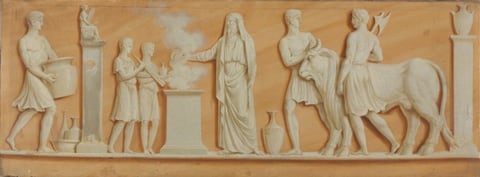
  1. Overdoor Painting, by Pierre Rousseau, 1790s
    Overdoor PaintingPierre Rousseau, 1790sCourtesy of the Cleveland Museum of Art
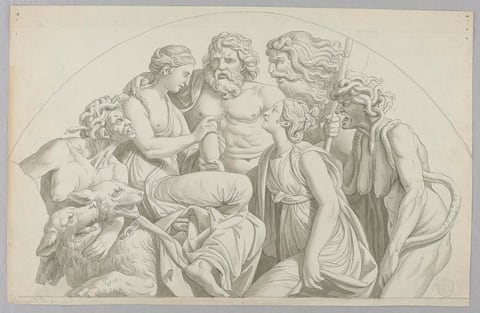
  2. PSYCHE ASKS PROSERPINE TO PUT A LITTLE OF HER BEAUTY IN AN URN FOR VENUS
    Psyche Asks Proserpine to Put a Little of her Beauty in an Urn for VenusJohann August Nahl The Younger, ca. 1781Courtesy of Cooper Hewitt, Smithsonian Design Museum
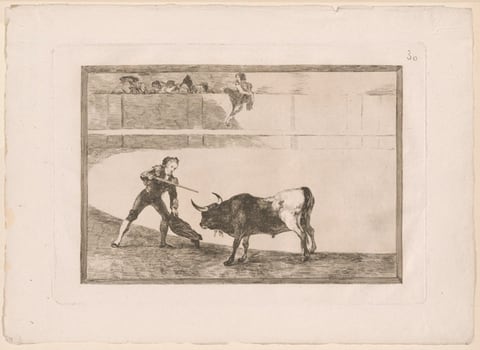
  3. A work made of etching, aquatint, drypoint and burin on ivory laid paper.
    Pedro Romero killing the halted bull, plate 30 from The Art of BullfightingFrancisco Goya, 1814/16, published 1816Courtesy of the Art Institute of Chicago

Second room, north wall

  1. A Forest with Apollo and Daphne, by Jean-Victor Bertin, 1810
    A Forest with Apollo and DaphneJean-Victor Bertin, 1810Courtesy of the Cleveland Museum of Art
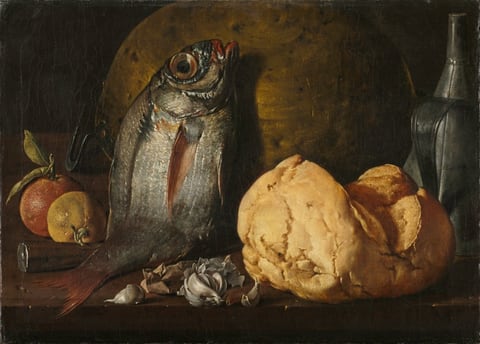
  2. Still Life with Fish, Bread, and Kettle, by Luis Meléndez, c. 1772
    Still Life with Fish, Bread, and KettleLuis Meléndez, c. 1772Courtesy of the Cleveland Museum of Art

  3. Portrait of a Boy, ca. 1800
    Portrait of a BoyUnrecorded Italian maker, ca. 1800Courtesy of the Smithsonian American Art Museum

  4. DESIGNS FOR ORNAMENTAL ARABESQUE MOTIFS
    Designs for Ornamental Arabesque MotifsEtienne de Lavallée-Poussin, 1770Courtesy of Cooper Hewitt, Smithsonian Design Museum

Third room, north wall
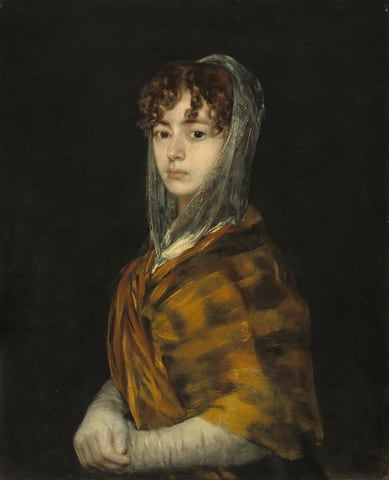
  1. Shown from the waist up in front of a black background, a young woman with pale white skin and curly brown hair looks directly out at us over her shoulder with her body angled to our left in this vertical portrait. She has dark brown eyes, a straight nose, smooth skin, and her pink lips are closed. Curls fall across her forehead but the rest of her hair is pulled up under a white lace scarf, called a mantilla. The mantilla is tucked under the wide orange and black shawl wrapped around her shoulders. She clasps her hands at her waist, and her hands and forearms are covered with long white gloves that disappear under the shawl.
    Señora Sabasa GarciaFrancisco Goya, c. 1806/1811Courtesy National Gallery of Art, Washington
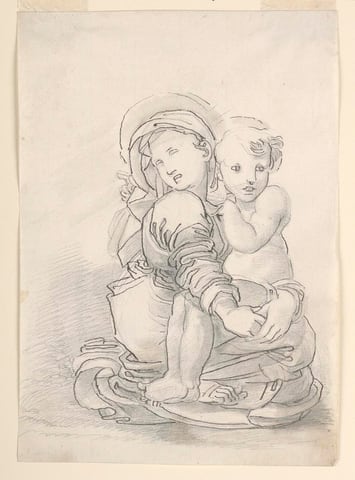
  2. THE VIRGIN WITH THE CHILD
    The Virgin with the ChildFortunato Duranti, 1820–1850Courtesy of Cooper Hewitt, Smithsonian Design Museum
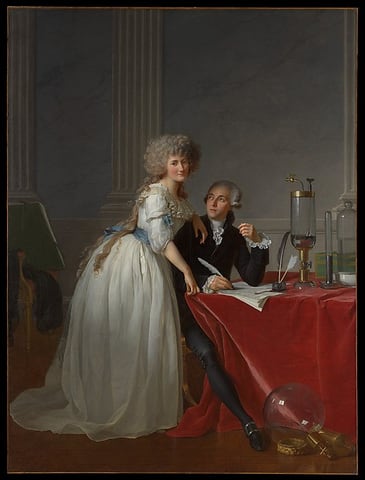
  3. Antoine Laurent Lavoisier (1743–1794) and Marie Anne Lavoisier (Marie Anne Pierrette Paulze, 1758–1836), by Jacques-Louis David, 1788
    Antoine Laurent Lavoisier (1743–1794) and Marie Anne Lavoisier (Marie Anne Pierrette Paulze, 1758–1836)Jacques-Louis David, 1788Courtesy of The Metropolitan Museum of Art