Skip to content
Ochre Editions
ArtArtistsCollectionsGalleriesDrops
SearchSign inCart (0)
The galleries · Style galleries

Neoclassicism

Europe turns back to Greece and Rome: clear line, calm figures and civic virtue.

109 works · hang 3276 ·

Share Neoclassicism, in the galleries

The rooms are imagined; every work on their walls is real.

Walk this roomRehang this room

First room, north wall

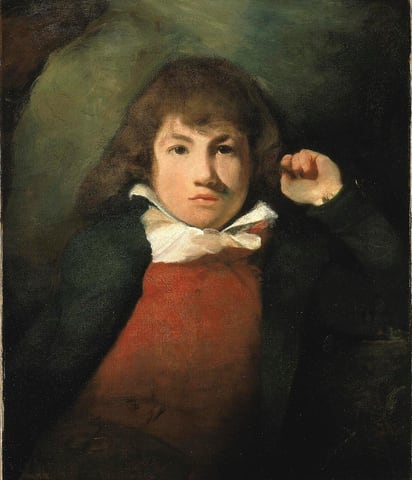
  1. Portrait of a Boy, ca. 1800
    Portrait of a BoyUnrecorded Italian maker, ca. 1800Courtesy of the Smithsonian American Art Museum
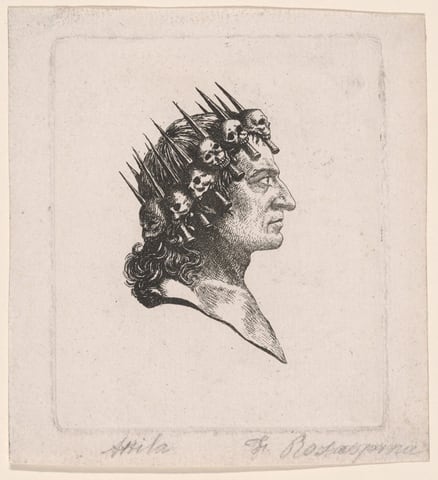
  2. A work made of etching in black on ivory laid paper.
    Portrait of Le Roi MaratViller, c. 1795Courtesy of the Art Institute of Chicago
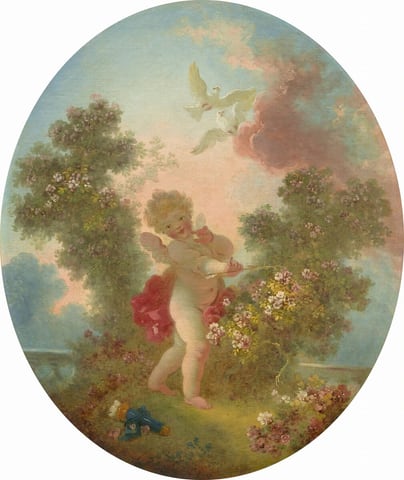
  3. This oval painting depicts a cherubic child in a garden setting. The child is standing with one foot in front of the other and has small wings on their back. The child has light skin, curly blond hair, rosy cheeks, and a playful expression. They are mostly nude, except for a cloth that wraps around their back and covers their groin. The child is holding a golden arrow. They are standing in front of a light green bush with pink flowers. In the bottom left, there is a dark blue object in the green grass that looks like a torch or cylindrical quiver. The setting includes lush greenery and more clusters of pink and white flowers. The background features a pastel blue sky with soft pink clouds and two white doves flying above.
    Love the SentinelJean Honoré Fragonard, c. 1773/1776Courtesy National Gallery of Art, Washington
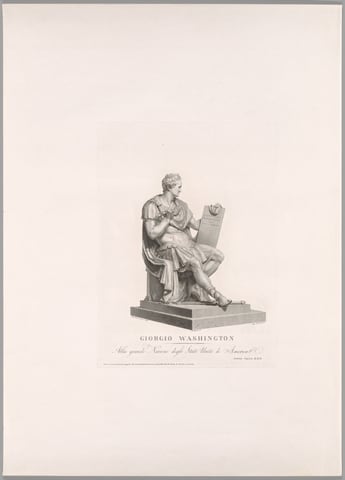
  4. A work made of engraving in black on ivory wove paper.
    George Washington, Front View, from Oeuvre de CanovaAntonio Canova, 1817Courtesy of the Art Institute of Chicago

First room, south wall
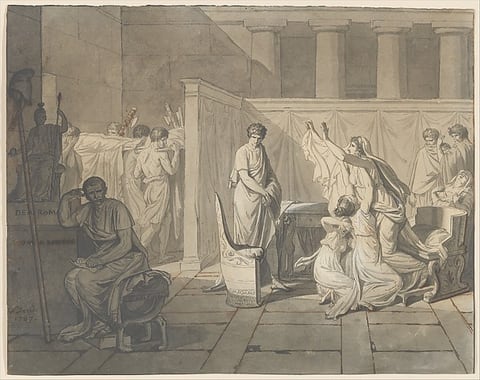
  1. The Lictors Bringing Brutus the Bodies of his Sons, by Jacques-Louis David, 1787
    The Lictors Bringing Brutus the Bodies of his SonsJacques-Louis David, 1787Courtesy of The Metropolitan Museum of Art
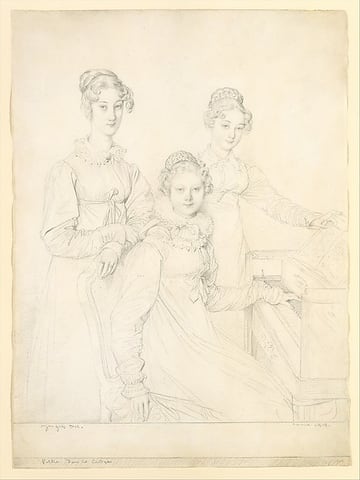
  2. The Kaunitz Sisters (Leopoldine, Caroline, and Ferdinandine), by Jean Auguste Dominique Ingres, 1818
    The Kaunitz Sisters (Leopoldine, Caroline, and Ferdinandine)Jean Auguste Dominique Ingres, 1818Courtesy of The Metropolitan Museum of Art
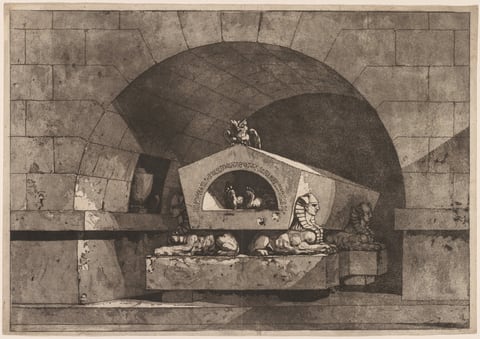
  3. Tomb with Sphinxes and an Owl, by Louis Jean Desprez, c. 1779–84
    Tomb with Sphinxes and an OwlLouis Jean Desprez, c. 1779–84Courtesy of the Cleveland Museum of Art
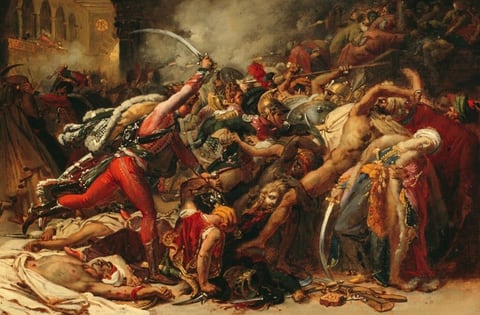
  4. A work made of oil and ink on paper, laid down on canvas.
    Sketch for The Revolt of CairoAnne-Louis Girodet de Roussy-Trioson, c. 1810Courtesy of the Art Institute of Chicago

Second room, south wall
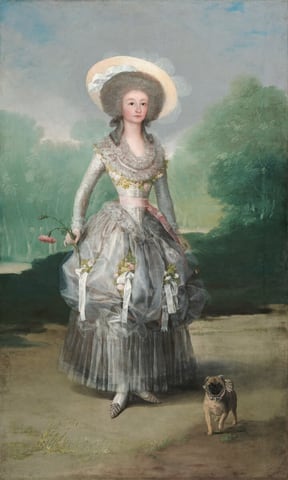
  1. A woman with pale skin, wearing a silvery-gray dress adorned with white ribbons and light pink roses, stands looking out at us with a small, pug dog by her feet in this vertical portrait painting. The woman’s body is angled slightly to our right but she looks at us with dark eyes under faint, arched brows. Her nose is rounded, her cheeks smooth and flushed, and her pale pink lips are closed. Her face is framed in a cloud of nickel-gray hair, and tendrils curl down over her shoulders. She wears a wide-brimmed straw hat with a white ribbon set on the back of her head and slightly off to one side. The bodice of her dress has a low, curving neck. This area is loosely painted to create the impression of layers of lace. A band of intertwined pale pink roses and delicate green leaves borders the outer edge of the lace. The dress has long, tight sleeves with lace at the cuffs and the notably narrow waist is tied with a blush-pink ribbon. The full, silver skirt is picked up to create a row of puffs, like the top of a muffin, around her knees. Bunches of pink roses and white ribbons are nestled into the puffs, and below, the skirt falls in long, vertical pleats to her ankles. She wears white stockings and pointed, petal-pink shoes. In her left arm, on our right, she holds a closed fan loosely at her side, almost lost behind the skirt. She holds a pink carnation with a full bloom and a bud on a long, curving stem in her other hand, by her hip. A caramel-brown pug with a black face, wearing a pink collar lined with three bells, stands facing us with one front paw lifted, to our right of the woman's feet. The landscape is painted in tones of mint and sage green for grass beneath trees enclosing the space the woman stands in, sand brown for the ground, and icy blue for the sky above.
    The Marquesa de PontejosFrancisco Goya, c. 1786Courtesy National Gallery of Art, Washington
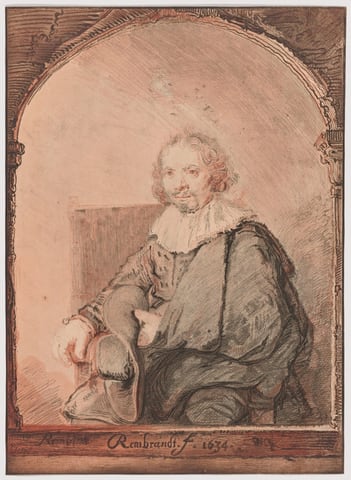
  2. A work made of soft ground etching, hard ground etching, aquatint, and roulette, printed from two plates in red-brown and black, on ivory laid paper.
    Portrait of a Man in an Armchair, from Collection d'imitations de Dessins d'après les Principaux Maîtres Hollandais et FlamandsChristian Josi, 1826Courtesy of the Art Institute of Chicago
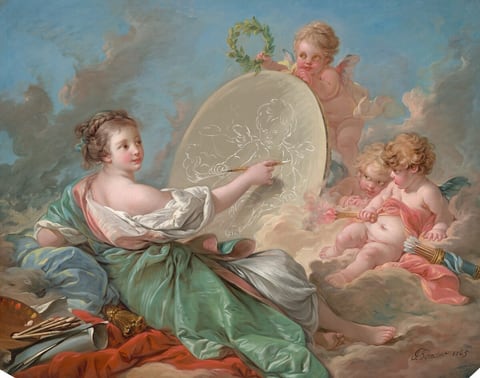
  3. A young woman draws on an oval surface with white chalk while three winged, baby-like putti gather nearby, all on a bank of pale pink clouds in this horizontal painting. The woman and putti have pale, rosy skin, flushed cheeks, and hazel-brown eyes. To our left, the woman reclines with her upper body propped up on her far elbow, which rests on a steel-blue cushion as her legs stretch out to our right. Her light brown hair is braided and wrapped across the top of her head. She wears a loose, seafoam-green robe over a billowing ivory-white garment that has slipped off the shoulder closer to us. A round paint palette with brushes sticking out of its thumb hole and a roll of blue and white paper sit in the lower left corner, behind the woman. The woman and the objects are on a red cloth. In front of the woman is a rounded surface, perhaps a canvas, on which she draws. She holds up a gold-colored stylus with her right hand, closer to us, with a pointed piece of white chalk in one end and black chalk in the other. The canvas is taller than her head, so the child-like putto she draws on it is life-sized. The three nude putti on the far side of the canvas have copper or golden-blond, curly hair, flushed, rounded cheeks, short wings in white or peacock blue, pudgy torsos, and dimpled limbs. One putto, presumably the one the woman draws, sits back on the bank of clouds with a carnation-pink sash across his chest. He pulls his chin back and looks at her from under his eyebrows. He holds a gold-colored torch with a pink flame in one hand, and the other hand rests near a cylindrical quiver of arrows. Another putto peeks around the side of the canvas, and the third stands and props the canvas up. That third putto holds up a wreath of laurel leaves up over the canvas, above the woman’s drawing hand. The bank of clouds is parchment-brown with muted pink and blue highlights against a vivid blue sky. The artist signed and dated the lower right, “F Boucher – 1765.”
    Allegory of PaintingFrançois Boucher, 1765Courtesy National Gallery of Art, Washington

Second room, north wall
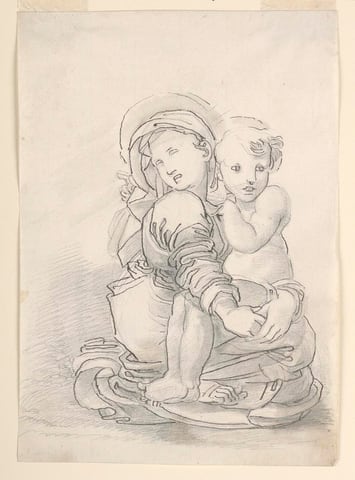
  1. THE VIRGIN WITH THE CHILD
    The Virgin with the ChildFortunato Duranti, 1820–1850Courtesy of Cooper Hewitt, Smithsonian Design Museum
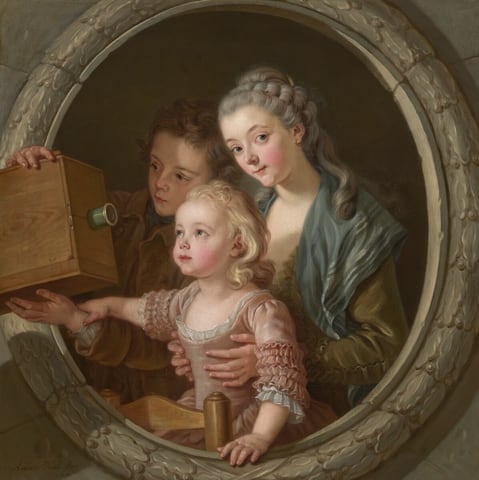
  2. A young woman and two children are shown from the waist up through an oval, stone opening, holding and looking at a wooden box with a lens protruding from one side in this square painting. All three people have pale skin with rosy cheeks. To our right, the young woman’s body is angled to our left as she braces the torso of a young girl. The young woman looks at us from the corners of her sage-green eyes, under lifted brows. Her small, pink mouth is pursed in a slight smile, and she has a faint dimple in her rounded chin. Her heather-gray hair is partially plaited over the crown of her head, and long curls fall over her shoulders. She wears a spruce-blue shawl over the shoulders of her low-cut, olive-green dress. The child she braces has chubby cheeks, and her wavy blond hair is brushed back from her forehead and falls loosely to her shoulders. She wears a blush-pink dress with ruffles on the half-length sleeves and gossamer-white trim around the neckline and cuffs. The top and side rails of a wooden, ladderback chair up against the inside of the opening suggests she stands or kneels on a backward-facing chair. She rests her left hand on the edge of the stone opening and her other hand on the wrist of the boy standing close behind her. Mostly in the shadow behind the others, the boy has small, pointed features and short, curly, sable-brown hair. He wears a tan coat, and a muted blue scarf is tied at his throat. The two children gaze at the wooden box the boy holds, which is about the size of a toaster. A short, cylindrical, brass-lined lens pokes out of the center of the side facing the trio. The oval opening through which we see them is carved on our side with stylized leaves and berries, and the wall around it is the same elephant gray as the carvings. The girl and the box cast a shadow across the opening. The artist signed and dated the painting in the lower left corner, “Amedee Can Loo./1764.”
    The Camera ObscuraCharles Amédée Philippe Van Loo, 1764Courtesy National Gallery of Art, Washington
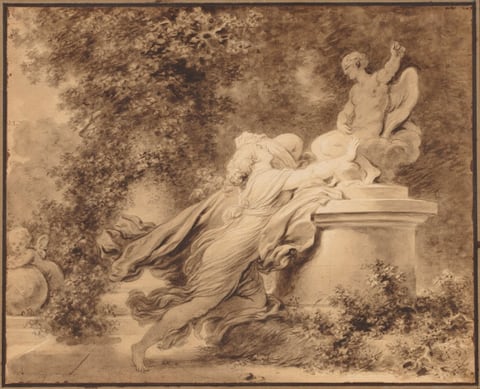
  3. Invocation to Love, by Jean Honoré Fragonard, c. 1781
    Invocation to LoveJean Honoré Fragonard, c. 1781Courtesy of the Cleveland Museum of Art

Third room, north wall
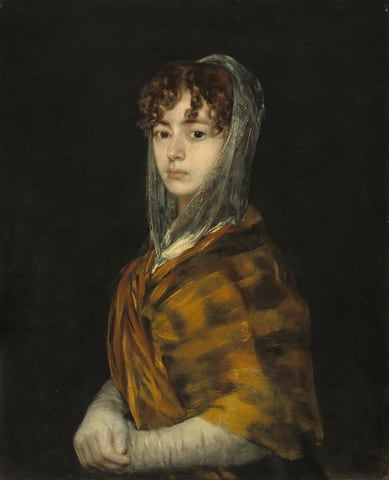
  1. Shown from the waist up in front of a black background, a young woman with pale white skin and curly brown hair looks directly out at us over her shoulder with her body angled to our left in this vertical portrait. She has dark brown eyes, a straight nose, smooth skin, and her pink lips are closed. Curls fall across her forehead but the rest of her hair is pulled up under a white lace scarf, called a mantilla. The mantilla is tucked under the wide orange and black shawl wrapped around her shoulders. She clasps her hands at her waist, and her hands and forearms are covered with long white gloves that disappear under the shawl.
    Señora Sabasa GarciaFrancisco Goya, c. 1806/1811Courtesy National Gallery of Art, Washington
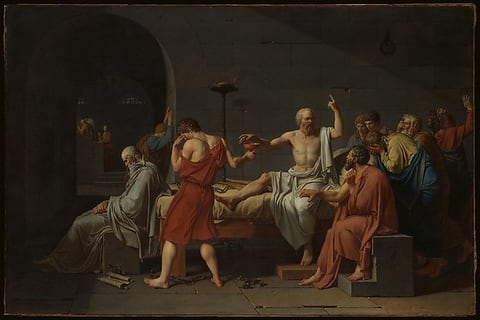
  2. The Death of Socrates, by Jacques-Louis David, 1787
    The Death of SocratesJacques-Louis David, 1787Courtesy of The Metropolitan Museum of Art

Walk on

  • Neoclassicism, room 2
  • More by Jacques-Louis David 4 works
  • 18th-century France 75 works
Ochre Editions

The world's museums, on your wall. Every work here is a reproduction of a public-domain original, credited to the museum that holds it.

Shop

All artCollectionsLimited dropsPrints and framing

Help

Find an orderShippingReturnsVerify a certificate

About

About Ochre EditionsMuseum creditsFor agentsDevelopers

Legal

Terms of UseTerms of SaleLimited Editions and CertificatesPrivacy PolicyCookie PolicyAcceptable Use PolicyAgent & API TermsCopyright and DMCA PolicyPrinting Your Own PhotoVulnerability Disclosure PolicyAccessibility StatementOpen-Access Credits
© 2026 Ochre EditionsPrices in US dollars. Prints ship within the United States.