Skip to content
Ochre Editions
ArtArtistsCollectionsGalleriesDrops
SearchSign inCart (0)
The galleries · Style galleries

Neoclassicism

Europe turns back to Greece and Rome: clear line, calm figures and civic virtue.

109 works · hang 4501 ·

Share Neoclassicism, in the galleries

The rooms are imagined; every work on their walls is real.

Walk this roomRehang this room

First room, north wall

  1. Portrait of a Boy, ca. 1800
    Portrait of a BoyUnrecorded Italian maker, ca. 1800Courtesy of the Smithsonian American Art Museum
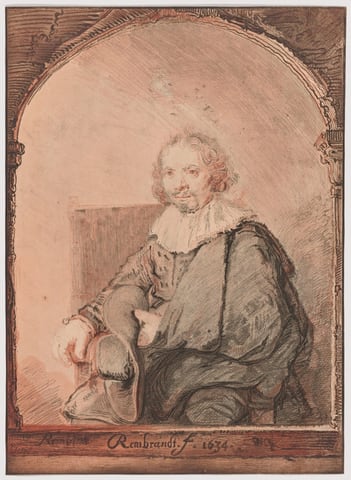
  2. A work made of soft ground etching, hard ground etching, aquatint, and roulette, printed from two plates in red-brown and black, on ivory laid paper.
    Portrait of a Man in an Armchair, from Collection d'imitations de Dessins d'après les Principaux Maîtres Hollandais et FlamandsChristian Josi, 1826Courtesy of the Art Institute of Chicago
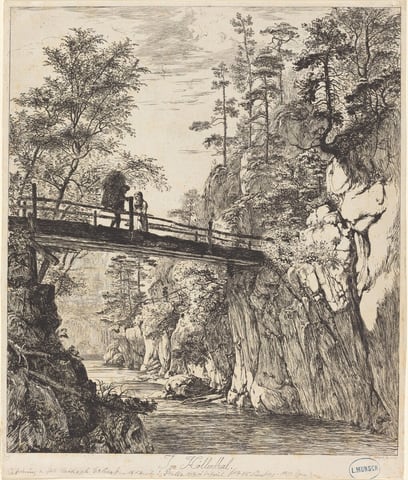
  3. The image shows a landscape with a wooden bridge crossing over a river in a valley. The scenery includes cliffs, trees, and flowing water below. The artwork features fine, detailed brushstrokes depicting the texture of the cliffs, foliage, and water. The color scheme is monochromatic with various shades of gray and sepia tones. Two figures are seen on the bridge, contributing to the sense of scale and activity in the serene setting.
    Im Höllenthal (In the Höllen Valley)Johann Christoph Erhard, 1818Courtesy National Gallery of Art, Washington
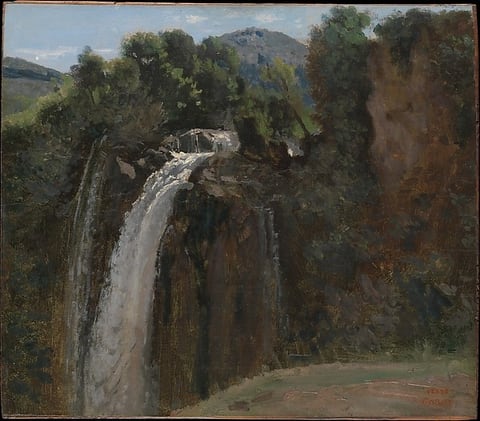
  4. Waterfall at Terni, by Jean Baptiste Camille Corot, 1826
    Waterfall at TerniJean Baptiste Camille Corot, 1826Courtesy of The Metropolitan Museum of Art

First room, south wall
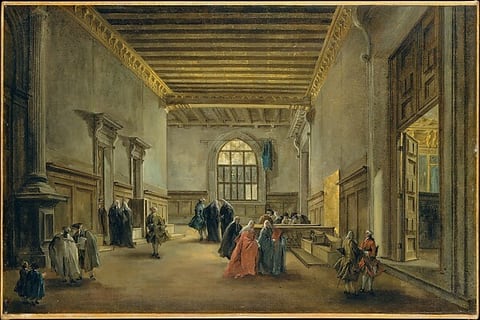
  1. The Antechamber of the Sala del Maggior Consiglio, by Francesco Guardi, ca. 1765–68
    The Antechamber of the Sala del Maggior ConsiglioFrancesco Guardi, ca. 1765–68Courtesy of The Metropolitan Museum of Art

  2. A Forest with Apollo and Daphne, by Jean-Victor Bertin, 1810
    A Forest with Apollo and DaphneJean-Victor Bertin, 1810Courtesy of the Cleveland Museum of Art
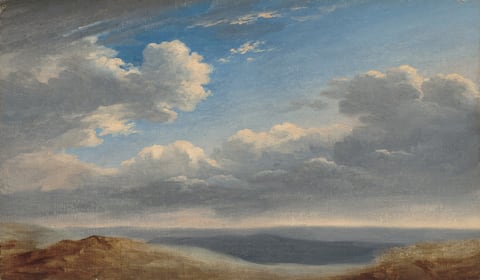
  3. A sliver of land across the bottom of this composition gives way to a procession of puffy gray and white clouds sweeping up across a vivid blue, panoramic sky in this horizontal landscape painting. An area of darker gray beyond the brown land could be a valley, mountain, or shadows from the billowing clouds. About one-fifth of the way up the composition, the horizon glows the faintest peach. The clouds trundle from our left up and to our right. The view is loosely painted, especially in the land.
    Study of Clouds over the Roman CampagnaPierre Henri de Valenciennes, c. 1782/1785Courtesy National Gallery of Art, Washington

Second room, south wall
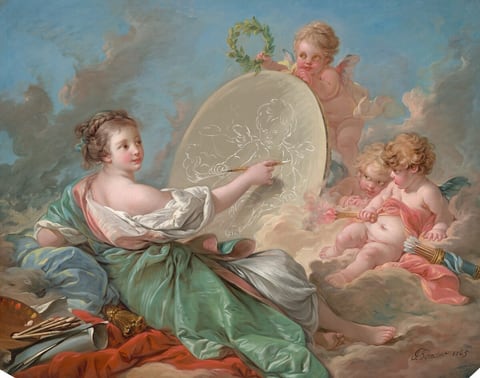
  1. A young woman draws on an oval surface with white chalk while three winged, baby-like putti gather nearby, all on a bank of pale pink clouds in this horizontal painting. The woman and putti have pale, rosy skin, flushed cheeks, and hazel-brown eyes. To our left, the woman reclines with her upper body propped up on her far elbow, which rests on a steel-blue cushion as her legs stretch out to our right. Her light brown hair is braided and wrapped across the top of her head. She wears a loose, seafoam-green robe over a billowing ivory-white garment that has slipped off the shoulder closer to us. A round paint palette with brushes sticking out of its thumb hole and a roll of blue and white paper sit in the lower left corner, behind the woman. The woman and the objects are on a red cloth. In front of the woman is a rounded surface, perhaps a canvas, on which she draws. She holds up a gold-colored stylus with her right hand, closer to us, with a pointed piece of white chalk in one end and black chalk in the other. The canvas is taller than her head, so the child-like putto she draws on it is life-sized. The three nude putti on the far side of the canvas have copper or golden-blond, curly hair, flushed, rounded cheeks, short wings in white or peacock blue, pudgy torsos, and dimpled limbs. One putto, presumably the one the woman draws, sits back on the bank of clouds with a carnation-pink sash across his chest. He pulls his chin back and looks at her from under his eyebrows. He holds a gold-colored torch with a pink flame in one hand, and the other hand rests near a cylindrical quiver of arrows. Another putto peeks around the side of the canvas, and the third stands and props the canvas up. That third putto holds up a wreath of laurel leaves up over the canvas, above the woman’s drawing hand. The bank of clouds is parchment-brown with muted pink and blue highlights against a vivid blue sky. The artist signed and dated the lower right, “F Boucher – 1765.”
    Allegory of PaintingFrançois Boucher, 1765Courtesy National Gallery of Art, Washington
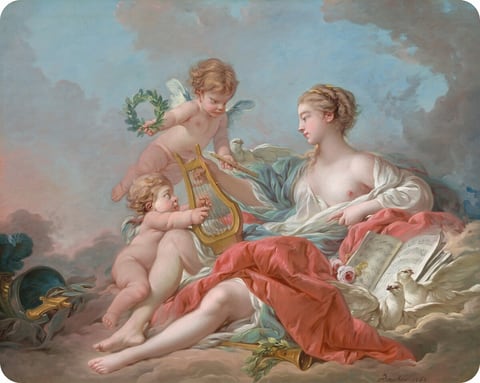
  2. A woman wearing flowing, pastel-colored robes and two, winged, child-like putti gather on a bank of clouds among musical instruments and sheet music in this horizontal painting. The people all have pale, pink-tinged skin. The woman sits to our right of center, facing our left in profile. She has straight nose, a rounded chin, and her small, pink lips are closed. Her ash-blond hair is pulled back under a yellow band. A voluminous white robe falls away over her left shoulder, to our right, to reveal a firm breast and small pink nipple. Sky-blue drapery wraps over her far arm, and deep rose-pink cloth falls across her lap and onto the clouds around her. Her legs extend to our left, her toes pointed. She leans back on her left elbow, closer to us, and points with that index finger to a lyre she props against her knee with her other hand. One chubby, nude putto reaches forward to strum the strings. The other putto hovers above, holding a ring of laurel leaves up in one hand and a flute in the other. Both putti have chubby limbs and torsos, blond curls lifted as if in a breeze, and short, ice-blue wings. Both look at the woman. In the lower left corner, a helmet with a topaz-blue feather and the gold hilt of a sword sit near the woman’s feet. Beneath the woman’s lower leg, at the bottom center of the painting, is a gold horn encircled by another wreath of laurel leaves. Two white doves with wings spread support an open book of sheet music and two pink roses tucked under the woman’s bent elbow. Fog-gray clouds billow up both sides of the scene against a pale blue sky. The clouds on which the trio gathers are parchment brown shaded with mauve pink. The outer corners of the image are white, indicating that the corners of the canvas were rounded. The artist signed and dated the painting in the lower right corner, “F Boucher 1764.”
    Allegory of MusicFrançois Boucher, 1764Courtesy National Gallery of Art, Washington
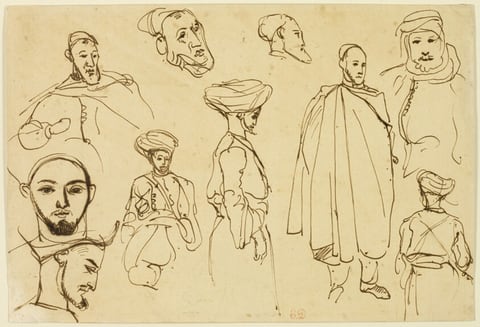
  3. A work made of pen and brown ink, with traces of graphite, on tan wove paper, laid down on cream wove paper.
    Sketches of Algerian MenEugène Delacroix, c. 1832Courtesy of the Art Institute of Chicago

Second room, north wall

  1. The image shows three figures. Two of them are embracing in the foreground, kneeling on the ground and facing each other in a kiss. The person on the left has curly hair and appears to be wearing a coat-like garment, while the person on the right has long hair tied back and is dressed in a long robe. The third figure emerges from the bushes in the background, with shoulder-length hair, wearing a dress with a sash and a light shawl or scarf over their head. The setting includes tall trees, shrubs, and a structure with columns and arches on the right side, suggesting a garden or courtyard. Rolling hills and cloudy skies are in the distant background.
    The Fortunate RescueDaniel Nikolaus Chodowiecki, 1791Courtesy National Gallery of Art, Washington
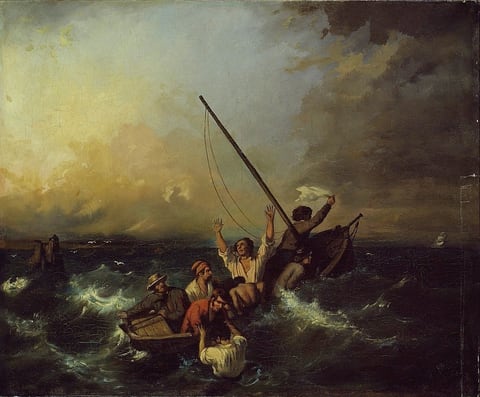
  2. A work made of oil on canvas.
    ShipwreckAfter Eugène Isabey, 19th centuryCourtesy of the Art Institute of Chicago
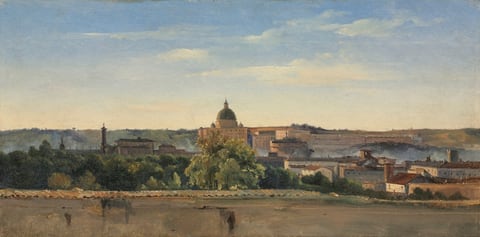
  3. View of Rome, by Pierre Henri de Valenciennes, c. 1782–84
    View of RomePierre Henri de Valenciennes, c. 1782–84Courtesy of the Cleveland Museum of Art
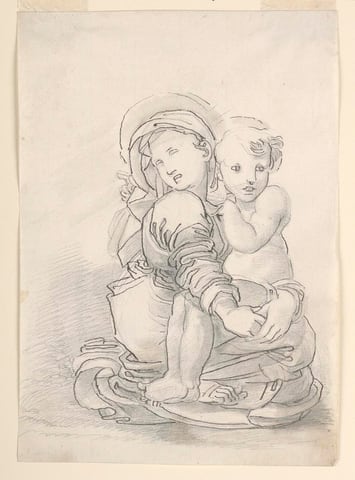
  4. THE VIRGIN WITH THE CHILD
    The Virgin with the ChildFortunato Duranti, 1820–1850Courtesy of Cooper Hewitt, Smithsonian Design Museum

Third room, north wall
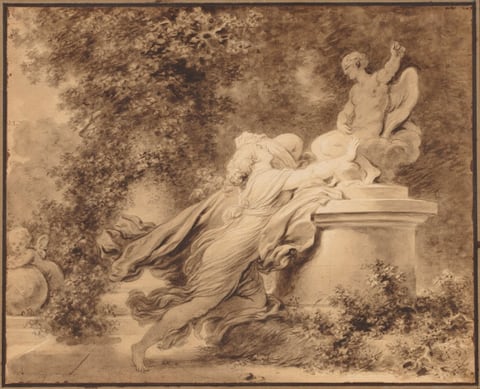
  1. Invocation to Love, by Jean Honoré Fragonard, c. 1781
    Invocation to LoveJean Honoré Fragonard, c. 1781Courtesy of the Cleveland Museum of Art
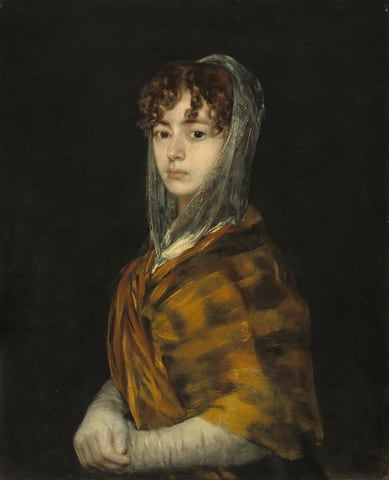
  2. Shown from the waist up in front of a black background, a young woman with pale white skin and curly brown hair looks directly out at us over her shoulder with her body angled to our left in this vertical portrait. She has dark brown eyes, a straight nose, smooth skin, and her pink lips are closed. Curls fall across her forehead but the rest of her hair is pulled up under a white lace scarf, called a mantilla. The mantilla is tucked under the wide orange and black shawl wrapped around her shoulders. She clasps her hands at her waist, and her hands and forearms are covered with long white gloves that disappear under the shawl.
    Señora Sabasa GarciaFrancisco Goya, c. 1806/1811Courtesy National Gallery of Art, Washington

Walk on

  • Neoclassicism, room 2
  • More by Francisco Goya 12 works
  • 19th-century Spain 9 works
Ochre Editions

The world's museums, on your wall. Every work here is a reproduction of a public-domain original, credited to the museum that holds it.

Shop

All artCollectionsLimited dropsPrints and framing

Help

Find an orderShippingReturnsVerify a certificate

About

About Ochre EditionsMuseum creditsFor agentsDevelopers

Legal

Terms of UseTerms of SaleLimited Editions and CertificatesPrivacy PolicyCookie PolicyAcceptable Use PolicyAgent & API TermsCopyright and DMCA PolicyPrinting Your Own PhotoVulnerability Disclosure PolicyAccessibility StatementOpen-Access Credits
© 2026 Ochre EditionsPrices in US dollars. Prints ship within the United States.
