

Floor plan

Style galleriesNeoclassicism

Neoclassicism

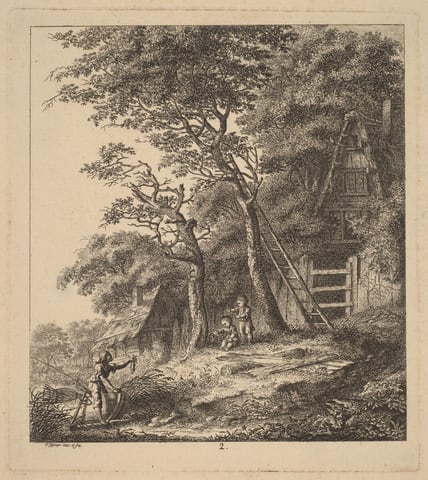
The image shows a rustic scene with a house, trees, and a figure washing near a stream. Two children stand in the middle distance next to a ladder. In the background are two thatched houses among trees. The drawing style is detailed with fine lines and cross-hatching, creating texture. The color palette is monochromatic in shades of black and gray, emphasizing light and shadow.
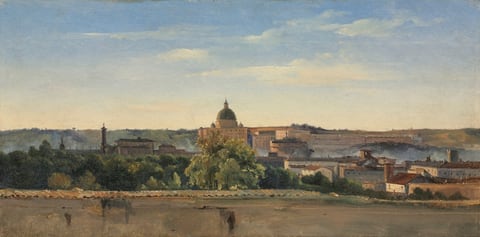
View of Rome, by Pierre Henri de Valenciennes, c. 1782–84
DESIGNS FOR ORNAMENTAL ARABESQUE MOTIFS
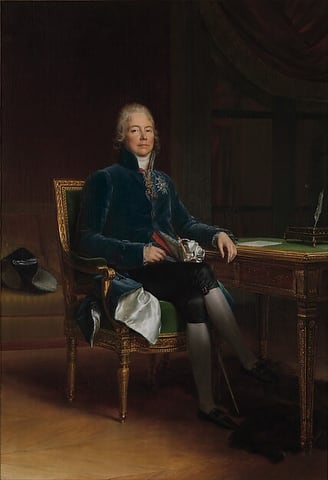
Charles Maurice de Talleyrand Périgord (1754–1838), Prince de Bénévent, by baron François Gérard, 1808
A Forest with Apollo and Daphne, by Jean-Victor Bertin, 1810
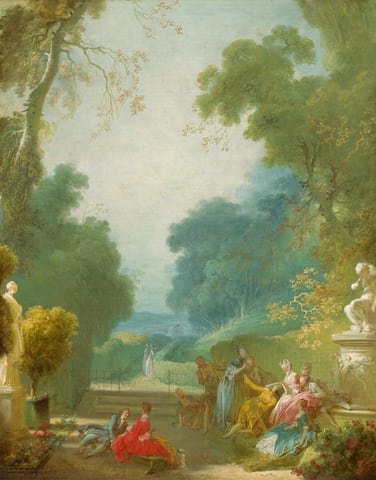
Towering, pale, celery-green trees frame a view of a lush park with about a dozen elegantly dressed, light-skinned men and women in this vertical landscape painting. The color palette is dominated by moss and lemon-lime green, golden yellow, and spruce blue. The men all wear jackets with long tails over knee-breeches, and their long hair is pulled back at the napes of their necks. The women wear long dresses with full skirts and hints of lace at the sleeves and bust, and their brown or white hair is pulled up. Nine of the men and women gather to our right on a stone terrace along the bottom edge of the painting. A man in butter yellow kneels in front of a woman wearing rose pink. Around this pair, people stand, kneel, sit, or recline wearing aquamarine blue, light turquoise, or ivory white. A man and woman sit on a bench to our left, a little removed from the larger group. This woman wears ruby red and the man leaning toward her wears topaz blue. Two people in the park beyond these groups are painted with only a few strokes of pale blue and white paint, and they look over a low hedge row lining the walking path. Beds of red flowers fill the lower corners of the composition in front of a statue of a woman to our left and a person, perhaps on a fountain, to our right. The grassy walking path and trees become more blue as they fade into the hazy distance between the tall tress to either side. The sky fades from pale blue along the horizon to a silvery blue, almost white, at the top.
A work made of oil on canvas.

The works in this room are listed below.

Works in this room

Europe turns back to Greece and Rome: clear line, calm figures and civic virtue.

First room, north wall

  1. The image shows a rustic scene with a house, trees, and a figure washing near a stream. Two children stand in the middle distance next to a ladder. In the background are two thatched houses among trees. The drawing style is detailed with fine lines and cross-hatching, creating texture. The color palette is monochromatic in shades of black and gray, emphasizing light and shadow.
    A Fisherman and Two Children in a Landscape with Thatched CottagesSalomon Gessner, 1764Courtesy National Gallery of Art, Washington
  2. View of Rome, by Pierre Henri de Valenciennes, c. 1782–84
    View of RomePierre Henri de Valenciennes, c. 1782–84Courtesy of the Cleveland Museum of Art
  3. DESIGNS FOR ORNAMENTAL ARABESQUE MOTIFS
    Designs for Ornamental Arabesque MotifsEtienne de Lavallée-Poussin, 1770Courtesy of Cooper Hewitt, Smithsonian Design Museum
  4. Charles Maurice de Talleyrand Périgord (1754–1838), Prince de Bénévent, by baron François Gérard, 1808
    Charles Maurice de Talleyrand Périgord (1754–1838), Prince de Bénéventbaron François Gérard, 1808Courtesy of The Metropolitan Museum of Art

First room, south wall

  1. A Forest with Apollo and Daphne, by Jean-Victor Bertin, 1810
    A Forest with Apollo and DaphneJean-Victor Bertin, 1810Courtesy of the Cleveland Museum of Art
  2. Towering, pale, celery-green trees frame a view of a lush park with about a dozen elegantly dressed, light-skinned men and women in this vertical landscape painting. The color palette is dominated by moss and lemon-lime green, golden yellow, and spruce blue. The men all wear jackets with long tails over knee-breeches, and their long hair is pulled back at the napes of their necks. The women wear long dresses with full skirts and hints of lace at the sleeves and bust, and their brown or white hair is pulled up. Nine of the men and women gather to our right on a stone terrace along the bottom edge of the painting. A man in butter yellow kneels in front of a woman wearing rose pink. Around this pair, people stand, kneel, sit, or recline wearing aquamarine blue, light turquoise, or ivory white. A man and woman sit on a bench to our left, a little removed from the larger group. This woman wears ruby red and the man leaning toward her wears topaz blue. Two people in the park beyond these groups are painted with only a few strokes of pale blue and white paint, and they look over a low hedge row lining the walking path. Beds of red flowers fill the lower corners of the composition in front of a statue of a woman to our left and a person, perhaps on a fountain, to our right. The grassy walking path and trees become more blue as they fade into the hazy distance between the tall tress to either side. The sky fades from pale blue along the horizon to a silvery blue, almost white, at the top.
    A Game of Hot CocklesJean Honoré Fragonard, c. 1775/1780Courtesy National Gallery of Art, Washington
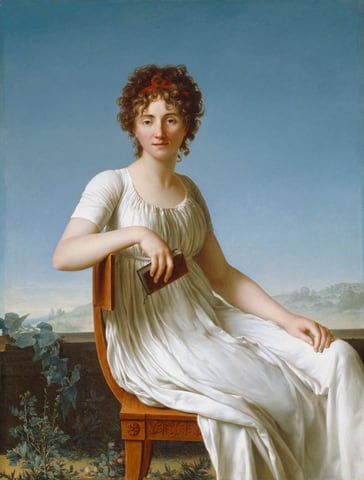
  3. A work made of oil on canvas.
    Portrait of Constance PipeletJean Baptiste François Désoria, 1797Courtesy of the Art Institute of Chicago

Second room, south wall
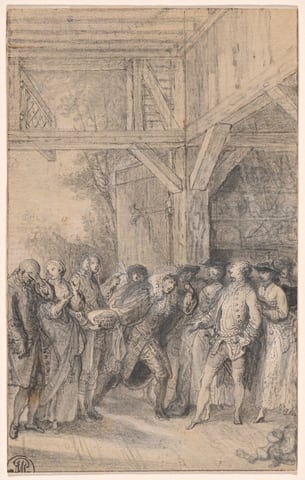
  1. A work made of graphite and pen and black ink, with touches of opaque, white watercolor on cream laid paper.
    Farmer Requesting Permission to Marry a Nobleman's DaughterGabriel de Saint-Aubin, 1761Courtesy of the Art Institute of Chicago
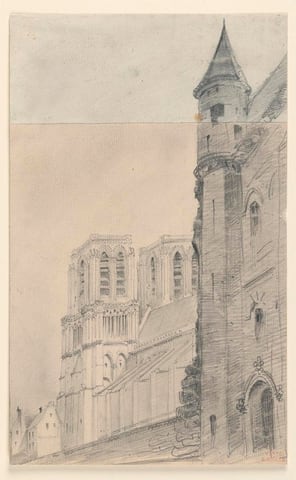
  2. CATHEDRAL OF NOTRE DAME IN PARIS
    Cathedral of Notre Dame in ParisCharles Nicolas Ransonnette, 1825–1840Courtesy of Cooper Hewitt, Smithsonian Design Museum
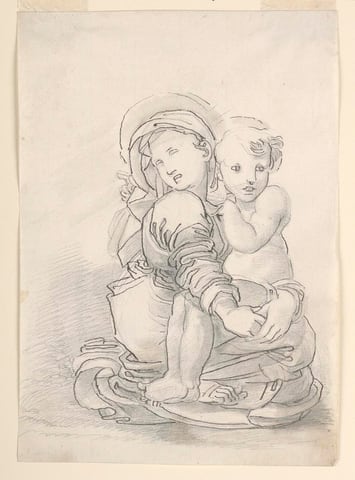
  3. THE VIRGIN WITH THE CHILD
    The Virgin with the ChildFortunato Duranti, 1820–1850Courtesy of Cooper Hewitt, Smithsonian Design Museum
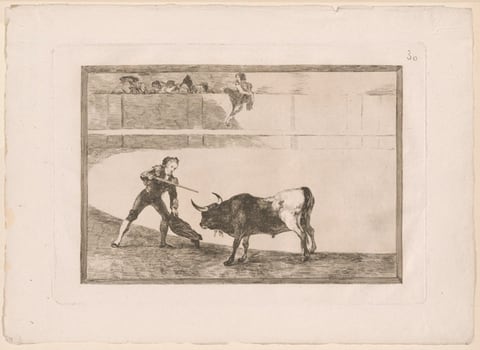
  4. A work made of etching, aquatint, drypoint and burin on ivory laid paper.
    Pedro Romero killing the halted bull, plate 30 from The Art of BullfightingFrancisco Goya, 1814/16, published 1816Courtesy of the Art Institute of Chicago

Second room, north wall
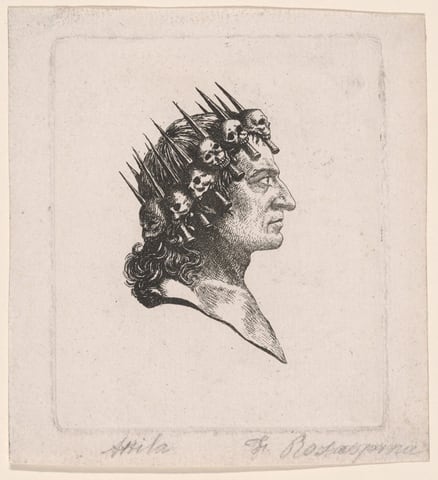
  1. A work made of etching in black on ivory laid paper.
    Portrait of Le Roi MaratViller, c. 1795Courtesy of the Art Institute of Chicago
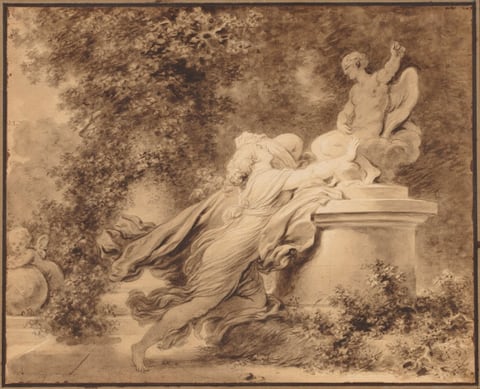
  2. Invocation to Love, by Jean Honoré Fragonard, c. 1781
    Invocation to LoveJean Honoré Fragonard, c. 1781Courtesy of the Cleveland Museum of Art
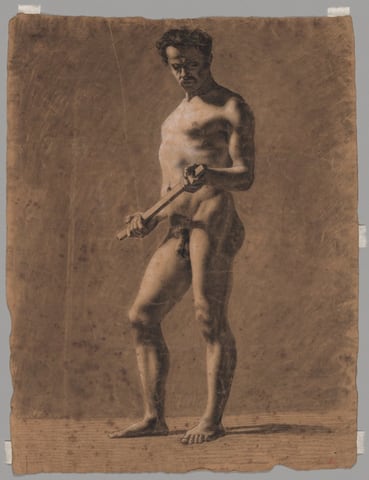
  3. A work made of black chalk and charcoal with stumping, heightened with white chalk (recto), and black chalk and charcoal with stumping (verso), on dark tan laid paper.
    Standing Academic Male Nude (recto); Sketch of Upper Arm (verso)Eugène Delacroix, 1816Courtesy of the Art Institute of Chicago

Third room, north wall
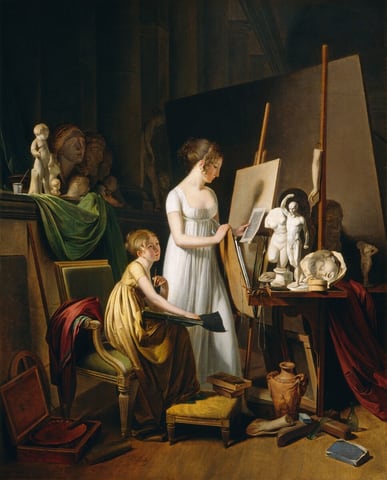
  1. In a room filled with easels, white plaster heads and statuettes, a box of paints, books, and papers, a young woman stands looking at a sketch and a young girl looks on, seated in an armchair, in this vertical painting. The scene is lit from the upper left, presumably from a window out of our view. Both women have smooth, pale skin, and their hair is swept up with curls framing their faces. They face our right in profile so their faces are in gentle shadow. They have straight noses, and their rose-pink lips are closed. They wear gowns with short sleeves, low, scooped necks, and floor-length skirts cinched under the bust. In the center of the painting, the young woman has chestnut-brown hair and wears a white gown tied with a sky-blue ribbon. She stands in front of a portfolio propped up against a tall easel. The portfolio is made of two stiff boards that tie together with pale blue ribbon to secure large sheets of paper. She rests her right hand, closer to us, on the front board of the portfolio and looks down at the sketch on a gray piece of paper she holds with her other hand. Next to her and closer to us, the younger girl sits in a gold chair upholstered with olive-green velvet. She faces our right almost in profile, and she looks up toward the drawing the other woman holds. The girl in the chair has blond hair and a gold-colored dress. Her feet are propped on a gold footstool, and she holds another portfolio on her lap. She supports the portfolio and holds a piece of paper with one hand, and a stylus or brush in the other hand, up by her chin. To the right of the easel, a wooden table holds a collection of plaster casts of faces, a hand, and small-scale bodies along with a glass vessel and a few other tools. Two translucent green bottles, boxes, a book, and a terracotta vase are collected on the footstool and the floor around the base of the easel. Garnet-red cloths are draped down the front of the table to our right and behind the girl on the chair. Next to her chair, in the lower left corner of the composition, is a wooden box with a paint palette and a handful of thin paintbrushes. A scroll of paper lies next to the box. A shelf at the standing girl’s shoulder height and behind the pair, to our left, is piled with white busts of a man, child, and woman, more figurines, and a brush in a small cup, all arranged across a moss-green cloth. The space with the girls and artist’s tools is enclosed by a large, dark brown form, presumably a canvas in shadow, that leans against the tall easels and mostly cuts off a view into the rest of the room. A glimpse of shadowy capitals is seen over the board, across the top of the painting, to suggest that a row of columns recedes into the space beyond. The artist signed the work as if he had painted his name on the floor next to the scroll, “L. Boilly.”
    A Painter's StudioLouis-Léopold Boilly, c. 1800Courtesy National Gallery of Art, Washington
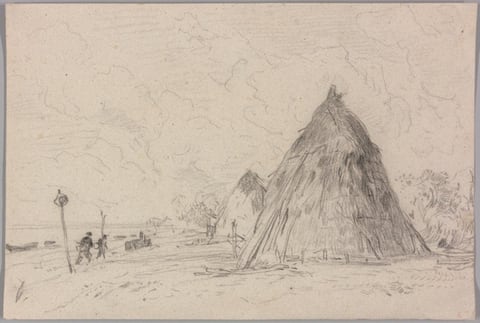
  2. A work made of conté crayon on gray-blue wove paper.
    Landscape with HaystacksConstant Troyon, n.d.Courtesy of the Art Institute of Chicago