Skip to content
Ochre Editions
ArtArtistsCollectionsGalleriesDrops
SearchSign inCart (0)
The galleries · Style galleries

Neoclassicism

Europe turns back to Greece and Rome: clear line, calm figures and civic virtue.

109 works · hang 4964 ·

Share Neoclassicism, in the galleries

The rooms are imagined; every work on their walls is real.

Walk this roomRehang this room

First room, north wall

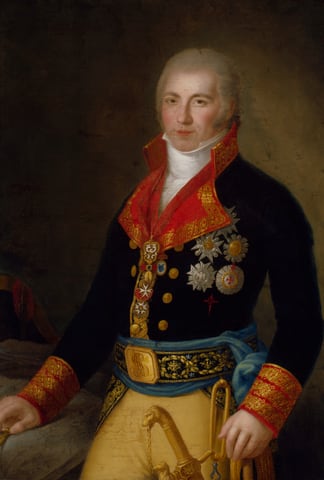
  1. A work made of oil on canvas.
    Manuel GodoyAgustin Esteve y Marqués, 1800–8Courtesy of the Art Institute of Chicago
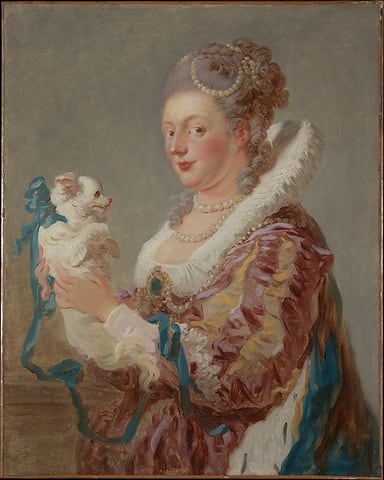
  2. Marie Emilie Coignet de Courson (1716–1806) with a Dog, by Jean Honoré Fragonard, ca. 1769
    Marie Emilie Coignet de Courson (1716–1806) with a DogJean Honoré Fragonard, ca. 1769Courtesy of The Metropolitan Museum of Art
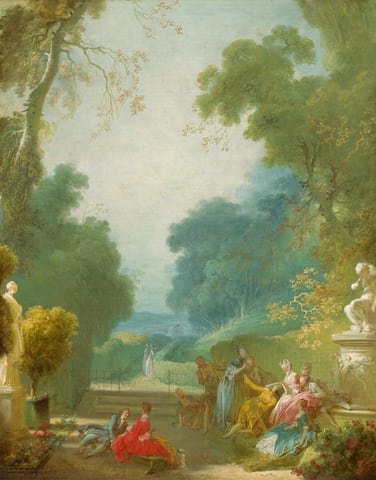
  3. Towering, pale, celery-green trees frame a view of a lush park with about a dozen elegantly dressed, light-skinned men and women in this vertical landscape painting. The color palette is dominated by moss and lemon-lime green, golden yellow, and spruce blue. The men all wear jackets with long tails over knee-breeches, and their long hair is pulled back at the napes of their necks. The women wear long dresses with full skirts and hints of lace at the sleeves and bust, and their brown or white hair is pulled up. Nine of the men and women gather to our right on a stone terrace along the bottom edge of the painting. A man in butter yellow kneels in front of a woman wearing rose pink. Around this pair, people stand, kneel, sit, or recline wearing aquamarine blue, light turquoise, or ivory white. A man and woman sit on a bench to our left, a little removed from the larger group. This woman wears ruby red and the man leaning toward her wears topaz blue. Two people in the park beyond these groups are painted with only a few strokes of pale blue and white paint, and they look over a low hedge row lining the walking path. Beds of red flowers fill the lower corners of the composition in front of a statue of a woman to our left and a person, perhaps on a fountain, to our right. The grassy walking path and trees become more blue as they fade into the hazy distance between the tall tress to either side. The sky fades from pale blue along the horizon to a silvery blue, almost white, at the top.
    A Game of Hot CocklesJean Honoré Fragonard, c. 1775/1780Courtesy National Gallery of Art, Washington

First room, south wall
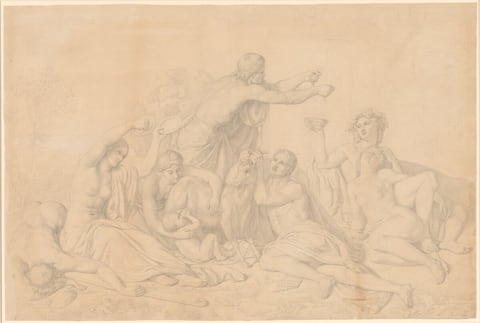
  1. This is a drawing of a group of mythological figures in a ceremonial scene. The composition features multiple figures in various poses, centered around a symbolic gathering. The drawing is detailed, providing a classical representation of human forms, draped fabrics, and an animal. A plateau with trees is subtly depicted in the background. The figures display expressions ranging from serene to contemplative.
    The Nursing of JupiterThéodore ChassériauCourtesy National Gallery of Art, Washington
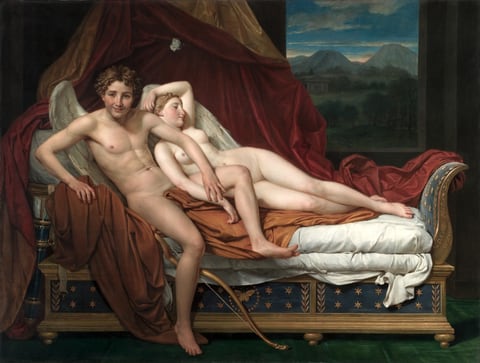
  2. Cupid and Psyche, by Jacques-Louis David, 1817
    Cupid and PsycheJacques-Louis David, 1817Courtesy of the Cleveland Museum of Art

Second room, south wall
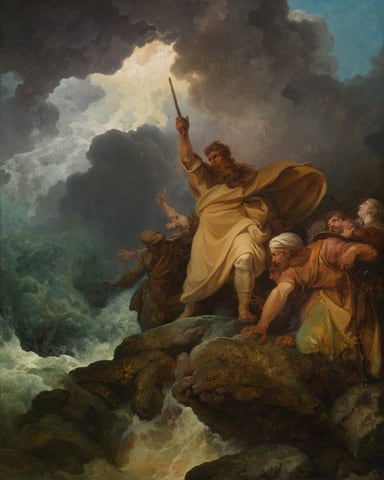
  1. A work made of oil on canvas.
    The Destruction of Pharaoh's ArmyPhilippe Jacques de Loutherbourg, II, 1792Courtesy of the Art Institute of Chicago
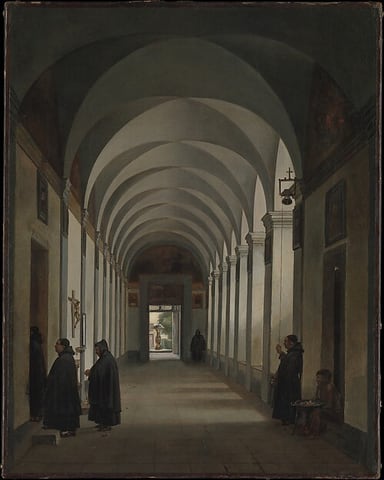
  2. Monks in the Cloister of the Church of Gesù e Maria, Rome, by François Marius Granet, 1808
    Monks in the Cloister of the Church of Gesù e Maria, RomeFrançois Marius Granet, 1808Courtesy of The Metropolitan Museum of Art
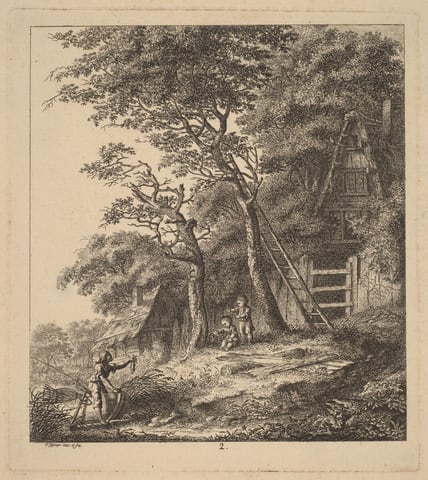
  3. The image shows a rustic scene with a house, trees, and a figure washing near a stream. Two children stand in the middle distance next to a ladder. In the background are two thatched houses among trees. The drawing style is detailed with fine lines and cross-hatching, creating texture. The color palette is monochromatic in shades of black and gray, emphasizing light and shadow.
    A Fisherman and Two Children in a Landscape with Thatched CottagesSalomon Gessner, 1764Courtesy National Gallery of Art, Washington

Second room, north wall
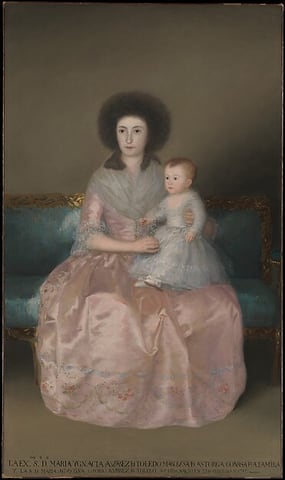
  1. Condesa de Altamira and Her Daughter, María Agustina, by Francisco Goya, 1787–88
    Condesa de Altamira and Her Daughter, María AgustinaFrancisco Goya, 1787–88Courtesy of The Metropolitan Museum of Art

  2. The image shows three figures. Two of them are embracing in the foreground, kneeling on the ground and facing each other in a kiss. The person on the left has curly hair and appears to be wearing a coat-like garment, while the person on the right has long hair tied back and is dressed in a long robe. The third figure emerges from the bushes in the background, with shoulder-length hair, wearing a dress with a sash and a light shawl or scarf over their head. The setting includes tall trees, shrubs, and a structure with columns and arches on the right side, suggesting a garden or courtyard. Rolling hills and cloudy skies are in the distant background.
    The Fortunate RescueDaniel Nikolaus Chodowiecki, 1791Courtesy National Gallery of Art, Washington
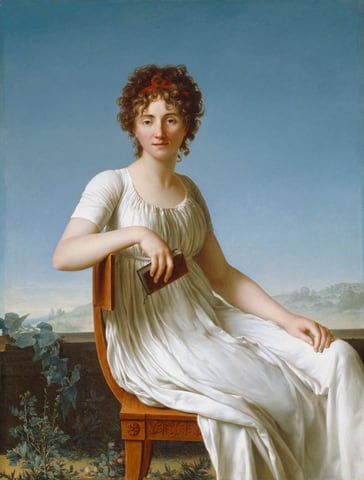
  3. A work made of oil on canvas.
    Portrait of Constance PipeletJean Baptiste François Désoria, 1797Courtesy of the Art Institute of Chicago

Third room, north wall
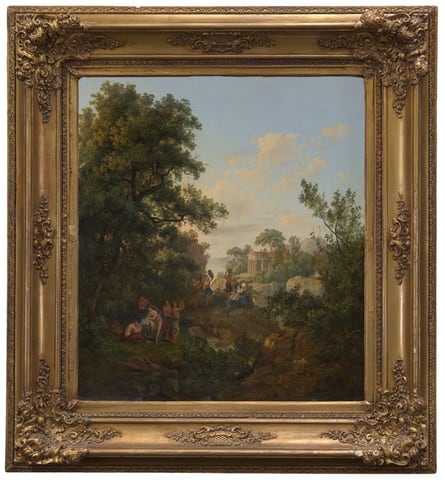
  1. A work made of oil on canvas.
    Birth of BacchusKároly Markó, Sr., 1826 (?)Courtesy of the Art Institute of Chicago
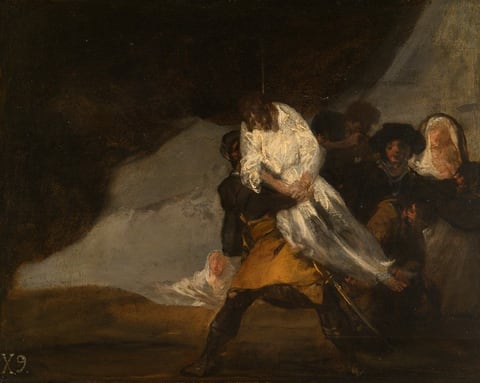
  2. A work made of oil on panel.
    The Hanged MonkFrancisco Goya, c. 1810Courtesy of the Art Institute of Chicago
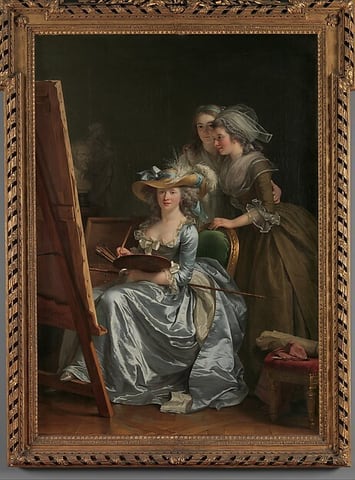
  3. Self-Portrait with Two Pupils, Marie Gabrielle Capet (1761–1818) and Marie Marguerite Carraux de Rosemond (1765–1788), by Adélaïde Labille-Guiard, 1785
    Self-Portrait with Two Pupils, Marie Gabrielle Capet (1761–1818) and Marie Marguerite Carraux de Rosemond (1765–1788)Adélaïde Labille-Guiard, 1785Courtesy of The Metropolitan Museum of Art

Third room, south wall
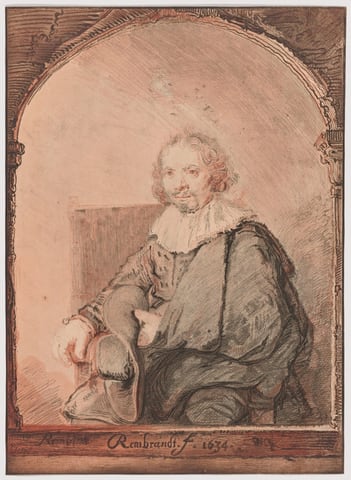
  1. A work made of soft ground etching, hard ground etching, aquatint, and roulette, printed from two plates in red-brown and black, on ivory laid paper.
    Portrait of a Man in an Armchair, from Collection d'imitations de Dessins d'après les Principaux Maîtres Hollandais et FlamandsChristian Josi, 1826Courtesy of the Art Institute of Chicago

  2. Portrait of a Boy, ca. 1800
    Portrait of a BoyUnrecorded Italian maker, ca. 1800Courtesy of the Smithsonian American Art Museum

Walk on

  • Neoclassicism, room 2
  • More by unrecorded makers of Italy 14 works
  • 18th-century Italy 49 works
Ochre Editions

The world's museums, on your wall. Every work here is a reproduction of a public-domain original, credited to the museum that holds it.

Shop

All artCollectionsLimited dropsPrints and framing

Help

Find an orderShippingReturnsVerify a certificate

About

About Ochre EditionsMuseum creditsFor agentsDevelopers

Legal

Terms of UseTerms of SaleLimited Editions and CertificatesPrivacy PolicyCookie PolicyAcceptable Use PolicyAgent & API TermsCopyright and DMCA PolicyPrinting Your Own PhotoVulnerability Disclosure PolicyAccessibility StatementOpen-Access Credits
© 2026 Ochre EditionsPrices in US dollars. Prints ship within the United States.