
Floor plan

Style galleriesNeoclassicism

Neoclassicism

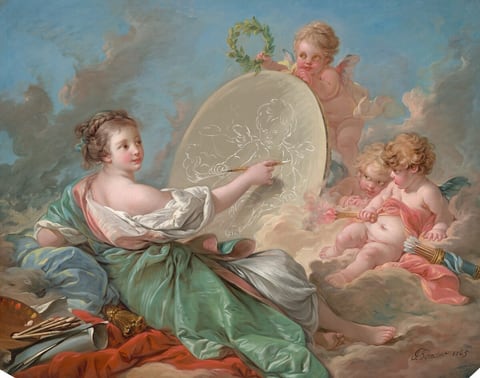
A young woman draws on an oval surface with white chalk while three winged, baby-like putti gather nearby, all on a bank of pale pink clouds in this horizontal painting. The woman and putti have pale, rosy skin, flushed cheeks, and hazel-brown eyes. To our left, the woman reclines with her upper body propped up on her far elbow, which rests on a steel-blue cushion as her legs stretch out to our right. Her light brown hair is braided and wrapped across the top of her head. She wears a loose, seafoam-green robe over a billowing ivory-white garment that has slipped off the shoulder closer to us. A round paint palette with brushes sticking out of its thumb hole and a roll of blue and white paper sit in the lower left corner, behind the woman. The woman and the objects are on a red cloth. In front of the woman is a rounded surface, perhaps a canvas, on which she draws. She holds up a gold-colored stylus with her right hand, closer to us, with a pointed piece of white chalk in one end and black chalk in the other. The canvas is taller than her head, so the child-like putto she draws on it is life-sized. The three nude putti on the far side of the canvas have copper or golden-blond, curly hair, flushed, rounded cheeks, short wings in white or peacock blue, pudgy torsos, and dimpled limbs. One putto, presumably the one the woman draws, sits back on the bank of clouds with a carnation-pink sash across his chest. He pulls his chin back and looks at her from under his eyebrows. He holds a gold-colored torch with a pink flame in one hand, and the other hand rests near a cylindrical quiver of arrows. Another putto peeks around the side of the canvas, and the third stands and props the canvas up. That third putto holds up a wreath of laurel leaves up over the canvas, above the woman’s drawing hand. The bank of clouds is parchment-brown with muted pink and blue highlights against a vivid blue sky. The artist signed and dated the lower right, “F Boucher – 1765.”
Portrait of a Boy, ca. 1800
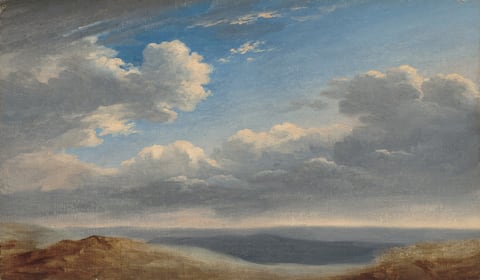
A sliver of land across the bottom of this composition gives way to a procession of puffy gray and white clouds sweeping up across a vivid blue, panoramic sky in this horizontal landscape painting. An area of darker gray beyond the brown land could be a valley, mountain, or shadows from the billowing clouds. About one-fifth of the way up the composition, the horizon glows the faintest peach. The clouds trundle from our left up and to our right. The view is loosely painted, especially in the land.
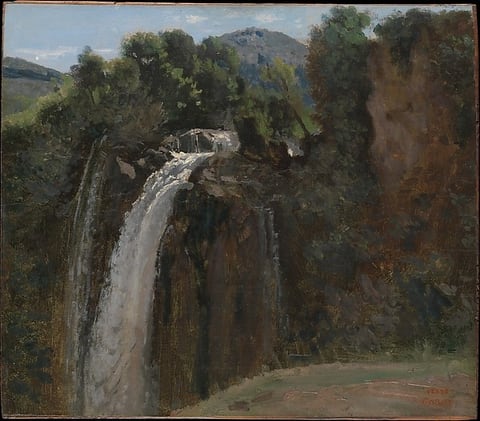
Waterfall at Terni, by Jean Baptiste Camille Corot, 1826
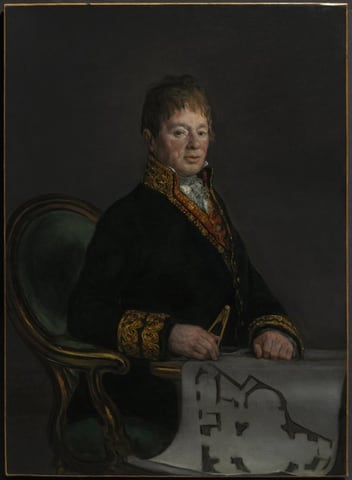
Portrait of Don Juan Antonio Cuervo, by Francisco Goya, 1819
A work made of conté crayon on gray-blue wove paper.
MARTYRDOM OF ST. ANDREW
A work made of pen and brown ink and black ink wash, with brown ink wash, on blued-white laid paper.

The works in this room are listed below.

Works in this room

Europe turns back to Greece and Rome: clear line, calm figures and civic virtue.

First room, north wall

  1. A young woman draws on an oval surface with white chalk while three winged, baby-like putti gather nearby, all on a bank of pale pink clouds in this horizontal painting. The woman and putti have pale, rosy skin, flushed cheeks, and hazel-brown eyes. To our left, the woman reclines with her upper body propped up on her far elbow, which rests on a steel-blue cushion as her legs stretch out to our right. Her light brown hair is braided and wrapped across the top of her head. She wears a loose, seafoam-green robe over a billowing ivory-white garment that has slipped off the shoulder closer to us. A round paint palette with brushes sticking out of its thumb hole and a roll of blue and white paper sit in the lower left corner, behind the woman. The woman and the objects are on a red cloth. In front of the woman is a rounded surface, perhaps a canvas, on which she draws. She holds up a gold-colored stylus with her right hand, closer to us, with a pointed piece of white chalk in one end and black chalk in the other. The canvas is taller than her head, so the child-like putto she draws on it is life-sized. The three nude putti on the far side of the canvas have copper or golden-blond, curly hair, flushed, rounded cheeks, short wings in white or peacock blue, pudgy torsos, and dimpled limbs. One putto, presumably the one the woman draws, sits back on the bank of clouds with a carnation-pink sash across his chest. He pulls his chin back and looks at her from under his eyebrows. He holds a gold-colored torch with a pink flame in one hand, and the other hand rests near a cylindrical quiver of arrows. Another putto peeks around the side of the canvas, and the third stands and props the canvas up. That third putto holds up a wreath of laurel leaves up over the canvas, above the woman’s drawing hand. The bank of clouds is parchment-brown with muted pink and blue highlights against a vivid blue sky. The artist signed and dated the lower right, “F Boucher – 1765.”
    Allegory of PaintingFrançois Boucher, 1765Courtesy National Gallery of Art, Washington
  2. Portrait of a Boy, ca. 1800
    Portrait of a BoyUnrecorded Italian maker, ca. 1800Courtesy of the Smithsonian American Art Museum
  3. A sliver of land across the bottom of this composition gives way to a procession of puffy gray and white clouds sweeping up across a vivid blue, panoramic sky in this horizontal landscape painting. An area of darker gray beyond the brown land could be a valley, mountain, or shadows from the billowing clouds. About one-fifth of the way up the composition, the horizon glows the faintest peach. The clouds trundle from our left up and to our right. The view is loosely painted, especially in the land.
    Study of Clouds over the Roman CampagnaPierre Henri de Valenciennes, c. 1782/1785Courtesy National Gallery of Art, Washington
  4. Waterfall at Terni, by Jean Baptiste Camille Corot, 1826
    Waterfall at TerniJean Baptiste Camille Corot, 1826Courtesy of The Metropolitan Museum of Art

First room, south wall

  1. Portrait of Don Juan Antonio Cuervo, by Francisco Goya, 1819
    Portrait of Don Juan Antonio CuervoFrancisco Goya, 1819Courtesy of the Cleveland Museum of Art
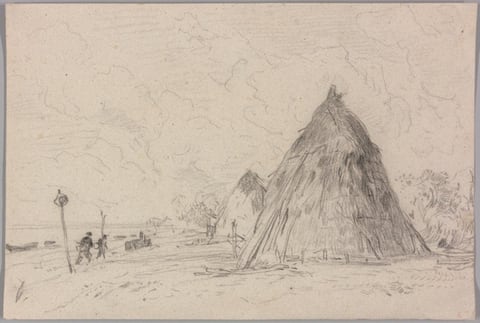
  2. A work made of conté crayon on gray-blue wove paper.
    Landscape with HaystacksConstant Troyon, n.d.Courtesy of the Art Institute of Chicago
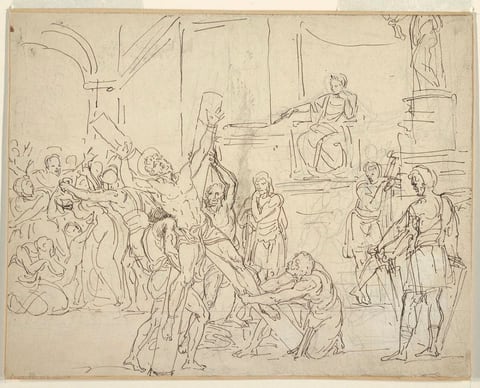
  3. MARTYRDOM OF ST. ANDREW
    Martyrdom of St. AndrewFrancesco Coghetti, 1825–50Courtesy of Cooper Hewitt, Smithsonian Design Museum
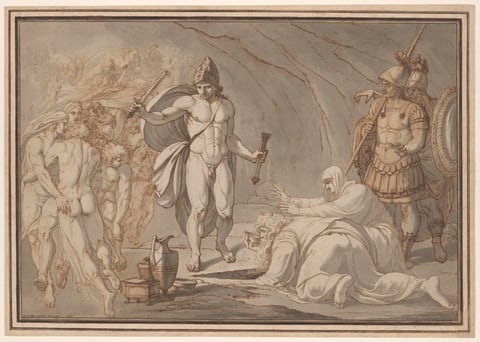
  4. A work made of pen and brown ink and black ink wash, with brown ink wash, on blued-white laid paper.
    Odysseus, at the Doors of Hades, Meets the Shades of Tiresias and AnticleaJohann Heinrich Lips, 1785Courtesy of the Art Institute of Chicago

Second room, south wall
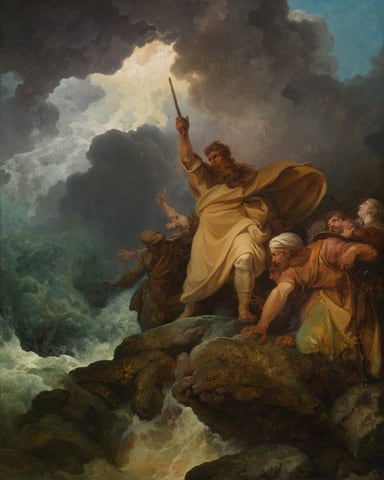
  1. A work made of oil on canvas.
    The Destruction of Pharaoh's ArmyPhilippe Jacques de Loutherbourg, II, 1792Courtesy of the Art Institute of Chicago
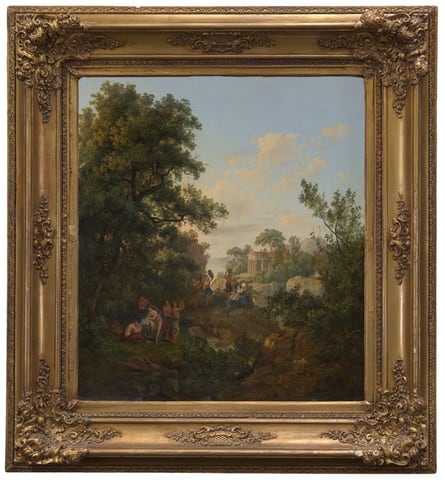
  2. A work made of oil on canvas.
    Birth of BacchusKároly Markó, Sr., 1826 (?)Courtesy of the Art Institute of Chicago
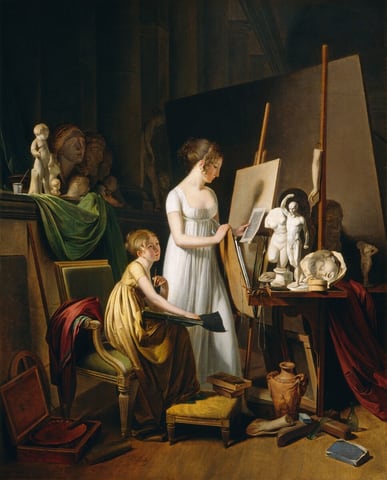
  3. In a room filled with easels, white plaster heads and statuettes, a box of paints, books, and papers, a young woman stands looking at a sketch and a young girl looks on, seated in an armchair, in this vertical painting. The scene is lit from the upper left, presumably from a window out of our view. Both women have smooth, pale skin, and their hair is swept up with curls framing their faces. They face our right in profile so their faces are in gentle shadow. They have straight noses, and their rose-pink lips are closed. They wear gowns with short sleeves, low, scooped necks, and floor-length skirts cinched under the bust. In the center of the painting, the young woman has chestnut-brown hair and wears a white gown tied with a sky-blue ribbon. She stands in front of a portfolio propped up against a tall easel. The portfolio is made of two stiff boards that tie together with pale blue ribbon to secure large sheets of paper. She rests her right hand, closer to us, on the front board of the portfolio and looks down at the sketch on a gray piece of paper she holds with her other hand. Next to her and closer to us, the younger girl sits in a gold chair upholstered with olive-green velvet. She faces our right almost in profile, and she looks up toward the drawing the other woman holds. The girl in the chair has blond hair and a gold-colored dress. Her feet are propped on a gold footstool, and she holds another portfolio on her lap. She supports the portfolio and holds a piece of paper with one hand, and a stylus or brush in the other hand, up by her chin. To the right of the easel, a wooden table holds a collection of plaster casts of faces, a hand, and small-scale bodies along with a glass vessel and a few other tools. Two translucent green bottles, boxes, a book, and a terracotta vase are collected on the footstool and the floor around the base of the easel. Garnet-red cloths are draped down the front of the table to our right and behind the girl on the chair. Next to her chair, in the lower left corner of the composition, is a wooden box with a paint palette and a handful of thin paintbrushes. A scroll of paper lies next to the box. A shelf at the standing girl’s shoulder height and behind the pair, to our left, is piled with white busts of a man, child, and woman, more figurines, and a brush in a small cup, all arranged across a moss-green cloth. The space with the girls and artist’s tools is enclosed by a large, dark brown form, presumably a canvas in shadow, that leans against the tall easels and mostly cuts off a view into the rest of the room. A glimpse of shadowy capitals is seen over the board, across the top of the painting, to suggest that a row of columns recedes into the space beyond. The artist signed the work as if he had painted his name on the floor next to the scroll, “L. Boilly.”
    A Painter's StudioLouis-Léopold Boilly, c. 1800Courtesy National Gallery of Art, Washington
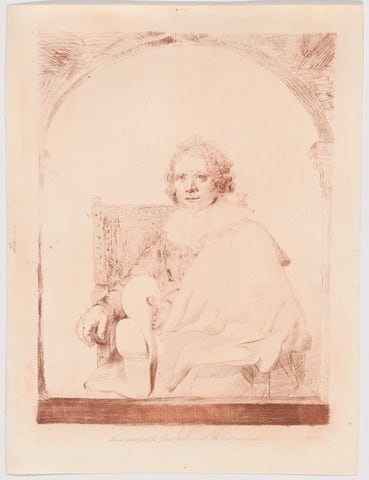
  4. A work made of soft ground etching, with roulette, printed in red on white wove paper.
    Portrait of a Man in an Armchair, from Collection d'imitations de Dessins d'après les Principaux Maîtres Hollandais et FlamandsChristian Josi, 1826Courtesy of the Art Institute of Chicago

Second room, north wall
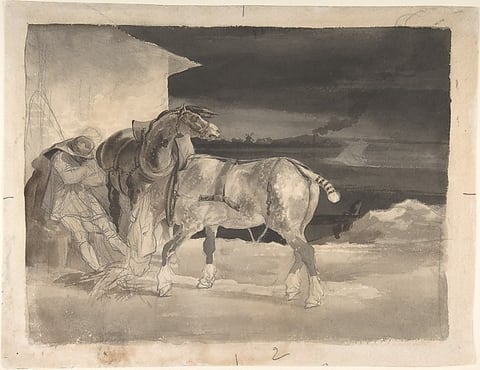
  1. Two Draft Horses with a Sleeping Driver, by Jean Louis André Théodore Géricault, 1820–22
    Two Draft Horses with a Sleeping DriverJean Louis André Théodore Géricault, 1820–22Courtesy of The Metropolitan Museum of Art
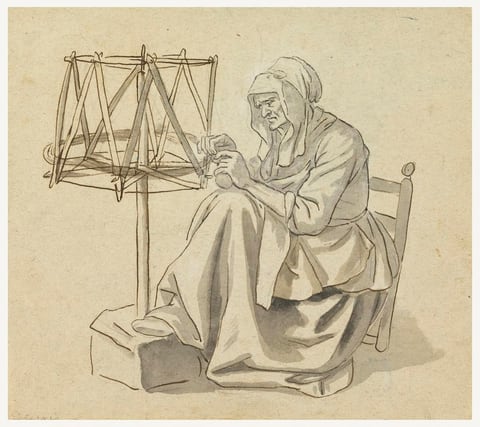
  2. AN OLD WOMAN SPINNING
    An Old Woman SpinningClaude-Louis Desrais, 1810–30Courtesy of Cooper Hewitt, Smithsonian Design Museum
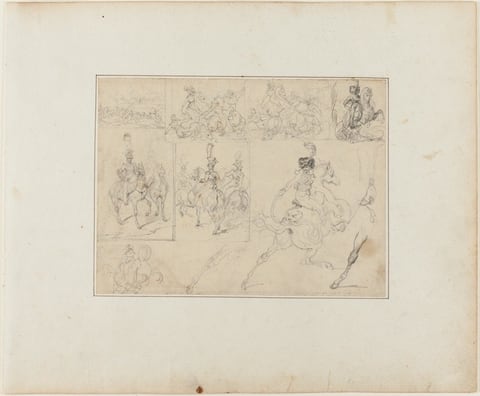
  3. A work made of graphite, on tan wove paper, perimeter mounted on ivory laid paper.
    Sheet of Sketches: Cavalry Battles and Mounted SoldiersJean Louis André Théodore Géricault, 1813/14Courtesy of the Art Institute of Chicago
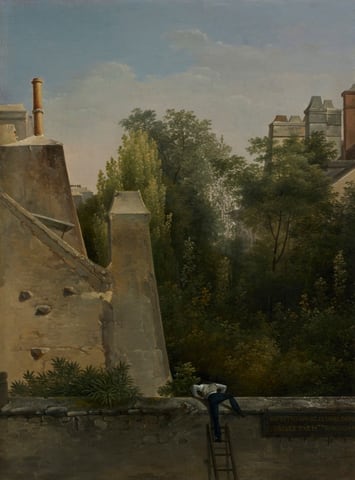
  4. The Curious One, by Antoine Pierre Mongin, 1823
    The Curious OneAntoine Pierre Mongin, 1823Courtesy of the Cleveland Museum of Art