Skip to content
Ochre Editions
ArtArtistsCollectionsGalleriesDrops
SearchSign inCart (0)
The galleries · Style galleries

Neoclassicism

Europe turns back to Greece and Rome: clear line, calm figures and civic virtue.

109 works · hang 8193 ·

Share Neoclassicism, in the galleries

The rooms are imagined; every work on their walls is real.

Walk this roomRehang this room

First room, north wall

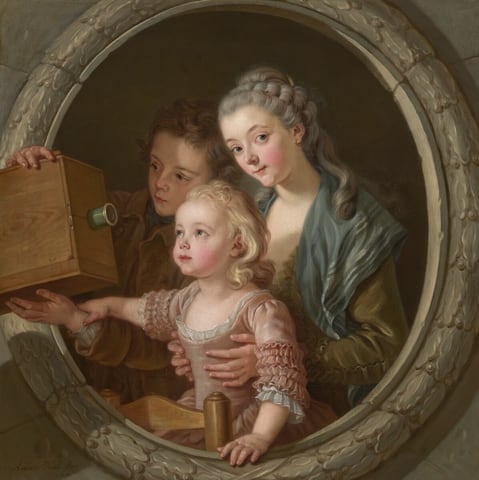
  1. A young woman and two children are shown from the waist up through an oval, stone opening, holding and looking at a wooden box with a lens protruding from one side in this square painting. All three people have pale skin with rosy cheeks. To our right, the young woman’s body is angled to our left as she braces the torso of a young girl. The young woman looks at us from the corners of her sage-green eyes, under lifted brows. Her small, pink mouth is pursed in a slight smile, and she has a faint dimple in her rounded chin. Her heather-gray hair is partially plaited over the crown of her head, and long curls fall over her shoulders. She wears a spruce-blue shawl over the shoulders of her low-cut, olive-green dress. The child she braces has chubby cheeks, and her wavy blond hair is brushed back from her forehead and falls loosely to her shoulders. She wears a blush-pink dress with ruffles on the half-length sleeves and gossamer-white trim around the neckline and cuffs. The top and side rails of a wooden, ladderback chair up against the inside of the opening suggests she stands or kneels on a backward-facing chair. She rests her left hand on the edge of the stone opening and her other hand on the wrist of the boy standing close behind her. Mostly in the shadow behind the others, the boy has small, pointed features and short, curly, sable-brown hair. He wears a tan coat, and a muted blue scarf is tied at his throat. The two children gaze at the wooden box the boy holds, which is about the size of a toaster. A short, cylindrical, brass-lined lens pokes out of the center of the side facing the trio. The oval opening through which we see them is carved on our side with stylized leaves and berries, and the wall around it is the same elephant gray as the carvings. The girl and the box cast a shadow across the opening. The artist signed and dated the painting in the lower left corner, “Amedee Can Loo./1764.”
    The Camera ObscuraCharles Amédée Philippe Van Loo, 1764Courtesy National Gallery of Art, Washington
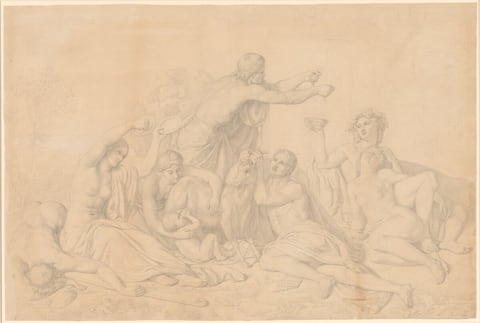
  2. This is a drawing of a group of mythological figures in a ceremonial scene. The composition features multiple figures in various poses, centered around a symbolic gathering. The drawing is detailed, providing a classical representation of human forms, draped fabrics, and an animal. A plateau with trees is subtly depicted in the background. The figures display expressions ranging from serene to contemplative.
    The Nursing of JupiterThéodore ChassériauCourtesy National Gallery of Art, Washington
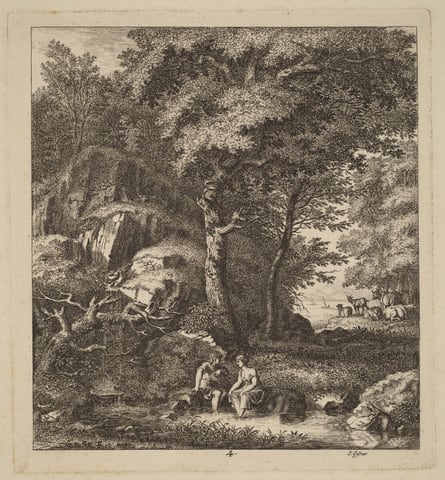
  3. The image depicts a forest scene with large trees dominating the right side, two figures seated by a stream, rocky formations on the left, grazing animals in the distance, and a monochrome color palette of brown and espresso tones.
    A Shepherd and a Young Woman With Their Feet in a BrookSalomon Gessner, 1764Courtesy National Gallery of Art, Washington

First room, south wall
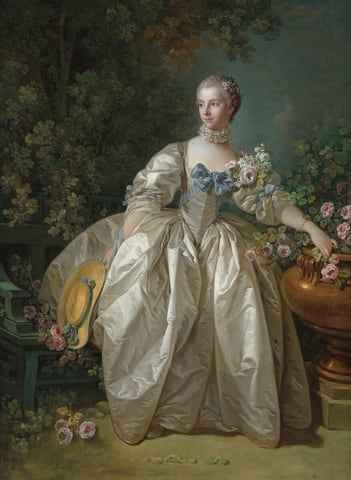
  1. A young woman with light skin stands in a garden, wearing a voluminous, full-length, silvery, shimmering gown in this vertical portrait painting. Her body faces us, as she looks into the distance to our left. She has rosy cheeks, gray-green eyes under gently arched, light brown brows, and her coral-pink, thin, closed lips curve in a slight smile. Her ash-brown hair is pulled back and adorned with tiny shell-pink and azure-blue flowers along the left side top of head, to our right. A pleated lace ruffle encircles her smooth neck. Her gown is parchment white where the light glints off the stiff fabric and is silvery gray in the shadows, creating a silk-like sheen. The dress is cut low across the chest, fits tightly around her narrow waist, and has puffy sleeves tied at the elbows with topaz-blue bows. Another blue bow is tied at her chest, and the ends wrap around her back along her waist. A corsage at her left shoulder, to our right, is a profusion of white flowers around a pale pink rose. In her other hand, to our left, she holds a straw hat with a shallow crown and a wide brim, trimmed with sky-blue ribbon. The arm holding the hat is nearly engulfed in the deep folds of her full skirt. She holds a pink rose in her other hand, which rests on the lip of a shiny, copper-colored urn filled with pink flowers and delicate green leaves. On that wrist she wears a bracelet with four strands of white pearls holding a cameo. She stands on a pale, dirt ground. A teal-blue bench in the lower left corner of the painting is tucked into sage-green shrubbery. Sprigs of pink roses are strewn across the seat and on the ground. The woman is framed to either side with olive and celery-green trees and vegetation, which blend into the hazy distance beyond her head.
    Madame BergeretFrançois Boucher, possibly 1766Courtesy National Gallery of Art, Washington
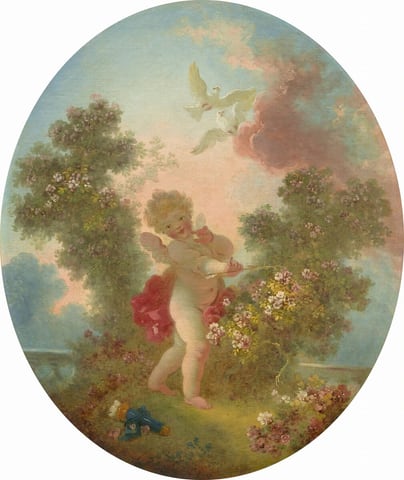
  2. This oval painting depicts a cherubic child in a garden setting. The child is standing with one foot in front of the other and has small wings on their back. The child has light skin, curly blond hair, rosy cheeks, and a playful expression. They are mostly nude, except for a cloth that wraps around their back and covers their groin. The child is holding a golden arrow. They are standing in front of a light green bush with pink flowers. In the bottom left, there is a dark blue object in the green grass that looks like a torch or cylindrical quiver. The setting includes lush greenery and more clusters of pink and white flowers. The background features a pastel blue sky with soft pink clouds and two white doves flying above.
    Love the SentinelJean Honoré Fragonard, c. 1773/1776Courtesy National Gallery of Art, Washington

  3. The image shows three figures. Two of them are embracing in the foreground, kneeling on the ground and facing each other in a kiss. The person on the left has curly hair and appears to be wearing a coat-like garment, while the person on the right has long hair tied back and is dressed in a long robe. The third figure emerges from the bushes in the background, with shoulder-length hair, wearing a dress with a sash and a light shawl or scarf over their head. The setting includes tall trees, shrubs, and a structure with columns and arches on the right side, suggesting a garden or courtyard. Rolling hills and cloudy skies are in the distant background.
    The Fortunate RescueDaniel Nikolaus Chodowiecki, 1791Courtesy National Gallery of Art, Washington
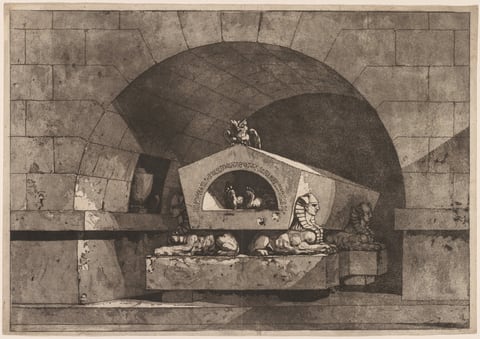
  4. Tomb with Sphinxes and an Owl, by Louis Jean Desprez, c. 1779–84
    Tomb with Sphinxes and an OwlLouis Jean Desprez, c. 1779–84Courtesy of the Cleveland Museum of Art

Second room, south wall
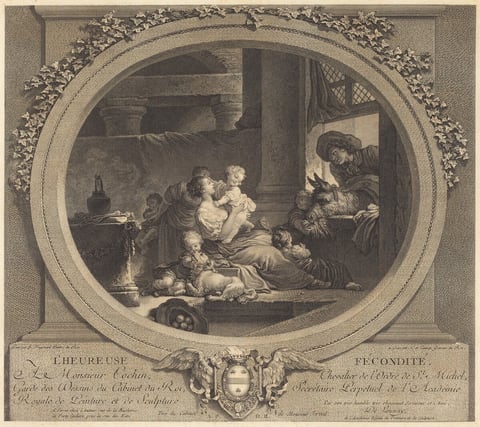
  1. The engraving depicts a gathering around a woman holding a child in her arms in an indoor setting with stone columns and an arched background. Another woman is next to her, looking towards her while leaning over what appears to be a child or possibly a doll on a small donkey. Surrounding the central woman are several children, some seated and playing on the floor. A dog is resting at the central woman's feet. The image features lush drapery, creating a warm and intimate setting. The style suggests classical or historical fashion, and there is an ornate border with ivy leaves. The text and emblem below likely contain relevant inscriptions.
    L'heureuse féconditéNicolas Delaunay, 1777Courtesy National Gallery of Art, Washington
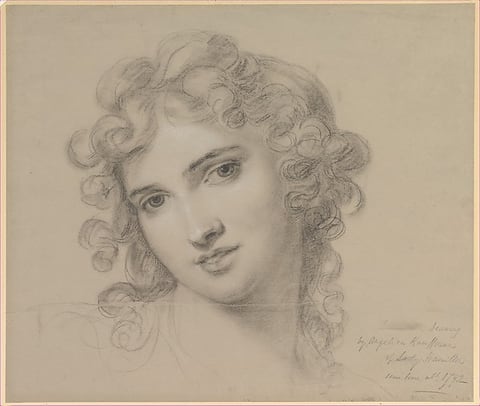
  2. Portrait of Emma Hamilton, by Angelica Kauffmann, 1791
    Portrait of Emma HamiltonAngelica Kauffmann, 1791Courtesy of The Metropolitan Museum of Art
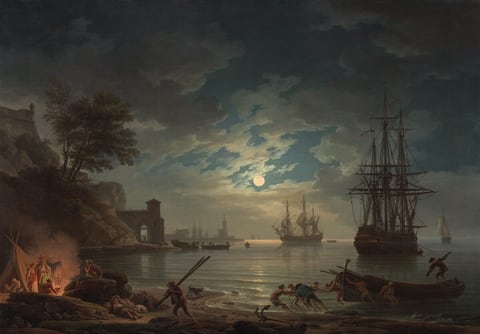
  3. Moonlight falls across several masted ships near a rocky shoreline in this horizontal painting. The sky fills the top three-quarters of the picture. A veil of slate-gray clouds is lit to pearl white around the crisp, full moon at the center of the composition. Patches of denim-blue sky are seen through breaks in the blanket of clouds. Moonlight reflects down the center of rippling, silvery-gray water that laps against a beach close to us, along the bottom edge of the painting. A tent is set up in the lower left corner of the composition. There, two women and one man stand looking at a glowing fire next to the tent. One woman holds a basket on her head, the other tucks a flat basket under one arm. The man stands between the two women, and a fourth man crouches near the fire, his back to us. In the opening of the tent, another woman kneels over a large bowl as she looks at the fire. A fifth person, a man, gazes at the fire as he sits smoking a long-stemmed pipe on a boulder. At the foot of the boulders, a man lies back against some bundles, one arm thrown up over his head. A dog curls up next to his hip. Not far from the sleeping man and in the center of the foreground, a man carries several long wooden objects, possibly oars, over one shoulder while a dog beyond him barks at the lapping surf. The beach curves like a C away from us, along the left. At the point of the curve in the middle distance, a structure like a city wall and gate jut out to the water’s edge. More buildings atop steep cliffs rise vertically beyond the gate. The shoreline curves into the distance again, and more buildings, including a lighthouse, and masted ships there are smoke-gray silhouettes. Near the lower right corner of the painting, four men pull on ropes tied around the prow of a small wooden boat while three others push it toward the land. Another man stands in the far end. A short distance beyond that boat is a tall wooden ship with three masts and rigging outlined against the night sky. Windows along the decks of that boat’s wide stern, angled toward us, glow with golden light. Beyond it and a bit to our left, another ship, smaller in scale, sails away from us. Several more ships move back to the horizon until we only see strokes of white and gray to indicate their unfurled sails.
    MoonlightClaude-Joseph Vernet, 1772Courtesy National Gallery of Art, Washington

Second room, north wall
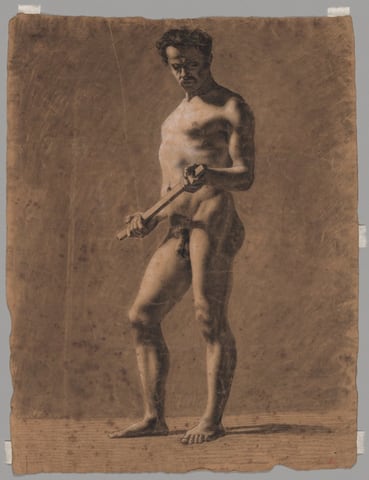
  1. A work made of black chalk and charcoal with stumping, heightened with white chalk (recto), and black chalk and charcoal with stumping (verso), on dark tan laid paper.
    Standing Academic Male Nude (recto); Sketch of Upper Arm (verso)Eugène Delacroix, 1816Courtesy of the Art Institute of Chicago
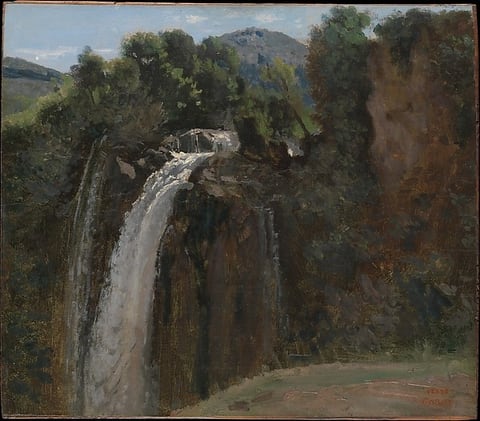
  2. Waterfall at Terni, by Jean Baptiste Camille Corot, 1826
    Waterfall at TerniJean Baptiste Camille Corot, 1826Courtesy of The Metropolitan Museum of Art
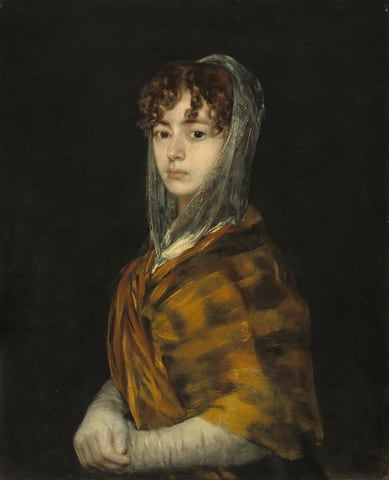
  3. Shown from the waist up in front of a black background, a young woman with pale white skin and curly brown hair looks directly out at us over her shoulder with her body angled to our left in this vertical portrait. She has dark brown eyes, a straight nose, smooth skin, and her pink lips are closed. Curls fall across her forehead but the rest of her hair is pulled up under a white lace scarf, called a mantilla. The mantilla is tucked under the wide orange and black shawl wrapped around her shoulders. She clasps her hands at her waist, and her hands and forearms are covered with long white gloves that disappear under the shawl.
    Señora Sabasa GarciaFrancisco Goya, c. 1806/1811Courtesy National Gallery of Art, Washington
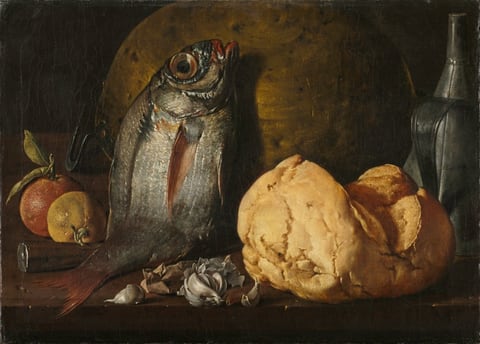
  4. Still Life with Fish, Bread, and Kettle, by Luis Meléndez, c. 1772
    Still Life with Fish, Bread, and KettleLuis Meléndez, c. 1772Courtesy of the Cleveland Museum of Art

Third room, north wall
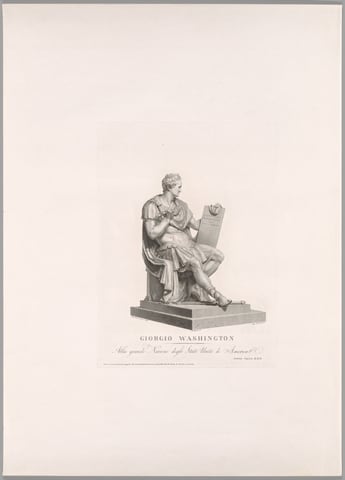
  1. A work made of engraving in black on ivory wove paper.
    George Washington, Front View, from Oeuvre de CanovaAntonio Canova, 1817Courtesy of the Art Institute of Chicago
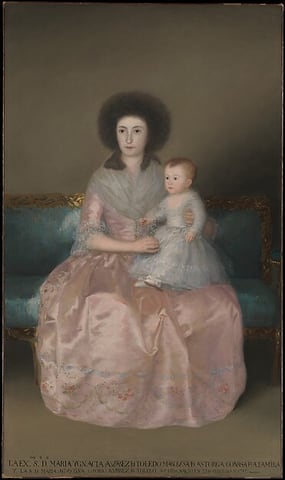
  2. Condesa de Altamira and Her Daughter, María Agustina, by Francisco Goya, 1787–88
    Condesa de Altamira and Her Daughter, María AgustinaFrancisco Goya, 1787–88Courtesy of The Metropolitan Museum of Art

Walk on

  • Neoclassicism, room 2
  • More by Francisco Goya 12 works
  • 18th-century Spain 10 works
Ochre Editions

The world's museums, on your wall. Every work here is a reproduction of a public-domain original, credited to the museum that holds it.

Shop

All artCollectionsLimited dropsPrints and framing

Help

Find an orderShippingReturnsVerify a certificate

About

About Ochre EditionsMuseum creditsFor agentsDevelopers

Legal

Terms of UseTerms of SaleLimited Editions and CertificatesPrivacy PolicyCookie PolicyAcceptable Use PolicyAgent & API TermsCopyright and DMCA PolicyPrinting Your Own PhotoVulnerability Disclosure PolicyAccessibility StatementOpen-Access Credits
© 2026 Ochre EditionsPrices in US dollars. Prints ship within the United States.