Skip to content
Ochre Editions
ArtArtistsCollectionsGalleriesDrops
SearchSign inCart (0)
The galleries · Style galleries

Neoclassicism

Europe turns back to Greece and Rome: clear line, calm figures and civic virtue.

109 works · hang 8916 ·

Share Neoclassicism, in the galleries

The rooms are imagined; every work on their walls is real.

Walk this roomRehang this room

First room, north wall

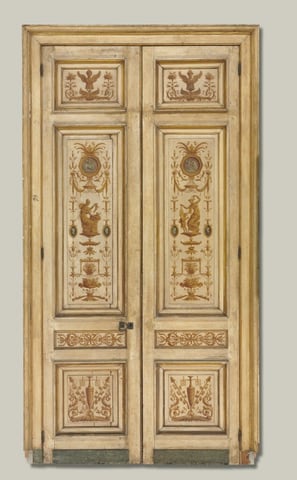
  1. Overdoor Painting, by Pierre Rousseau, 1790s
    Overdoor PaintingPierre Rousseau, 1790sCourtesy of the Cleveland Museum of Art

  2. We look up through an opening surrounded by a stone ledge, with clusters of people and clouds swirling into a blue sky up and away from us in this vertical, rectangular painting. From a distance, the scene looks like a complete illusion but up close, the people, clouds, and architecture are sketchily painted. The ledge running around the opening has a gold, oval medallion at each corner. Appearing to be carved from white stone, two bearded men with long hair recline against each medallion, flanking them to each side in front of large shells that curve up over the people and frames them. A few architectural structures extend up into the sky, including a pointed obelisk in the lower left corner, a pair of columns at the upper right, and what seems to be the mast of a ship at the top left. Most of the people have pale skin but some have more tan complexions, and a few, including those wearing feather headdresses near the upper left corner, have brown skin. The people wear windswept robes of pale, butter yellow, robin’s egg blue, rose pink, and ivory. The eye may drawn to a few vignettes, such as the man holding a rearing, chestnut-brown horse on the illusionistic ledge near the lower right, a nun wearing a white robe and holding a cross above him in the clouds, and, farthest away, a crowned person sitting on a throne.
    Wealth and Benefits of the Spanish Monarchy under Charles IIIGiovanni Battista Tiepolo, 1762Courtesy National Gallery of Art, Washington
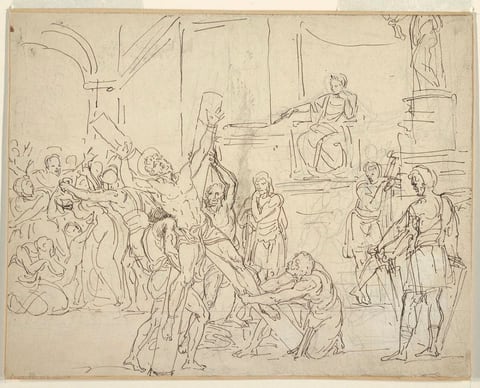
  3. MARTYRDOM OF ST. ANDREW
    Martyrdom of St. AndrewFrancesco Coghetti, 1825–50Courtesy of Cooper Hewitt, Smithsonian Design Museum
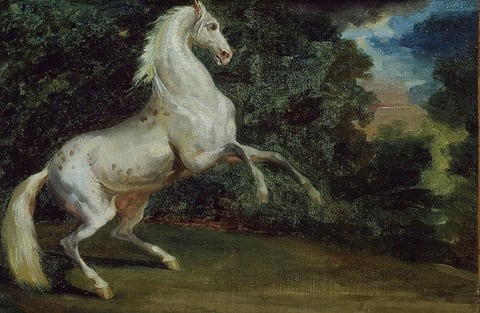
  4. A work made of oil on canvas.
    Prancing HorseFollower of Jean Louis André Théodore Géricault, 1808–12Courtesy of the Art Institute of Chicago

First room, south wall
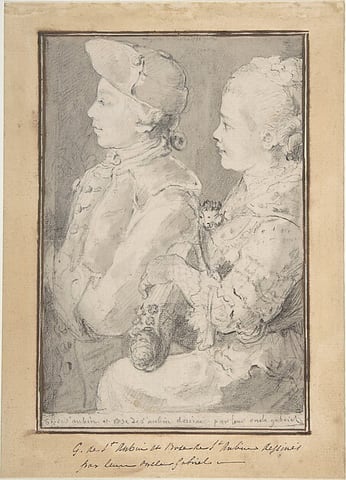
  1. Germain-Augustin and Rose de Saint-Aubin, Drawn by Their Uncle, by Gabriel de Saint-Aubin, 1766
    Germain-Augustin and Rose de Saint-Aubin, Drawn by Their UncleGabriel de Saint-Aubin, 1766Courtesy of The Metropolitan Museum of Art

  2. The engraving depicts a gathering around a woman holding a child in her arms in an indoor setting with stone columns and an arched background. Another woman is next to her, looking towards her while leaning over what appears to be a child or possibly a doll on a small donkey. Surrounding the central woman are several children, some seated and playing on the floor. A dog is resting at the central woman's feet. The image features lush drapery, creating a warm and intimate setting. The style suggests classical or historical fashion, and there is an ornate border with ivy leaves. The text and emblem below likely contain relevant inscriptions.
    L'heureuse féconditéNicolas Delaunay, 1777Courtesy National Gallery of Art, Washington
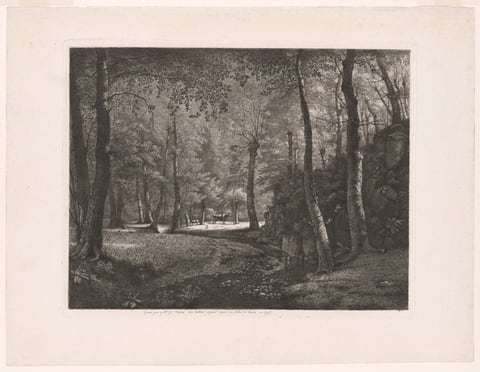
  3. A work made of etching with roulette in black on ivory wove paper.
    The Forest of RochecardonJean-Michel Grobon, 1800Courtesy of the Art Institute of Chicago
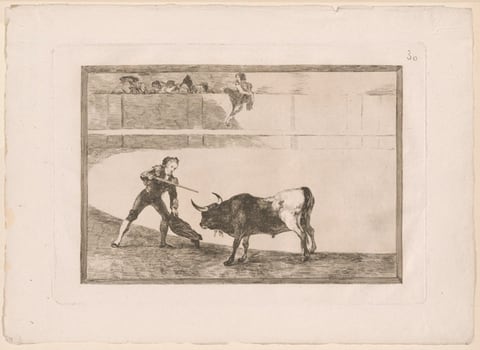
  4. A work made of etching, aquatint, drypoint and burin on ivory laid paper.
    Pedro Romero killing the halted bull, plate 30 from The Art of BullfightingFrancisco Goya, 1814/16, published 1816Courtesy of the Art Institute of Chicago

Second room, south wall
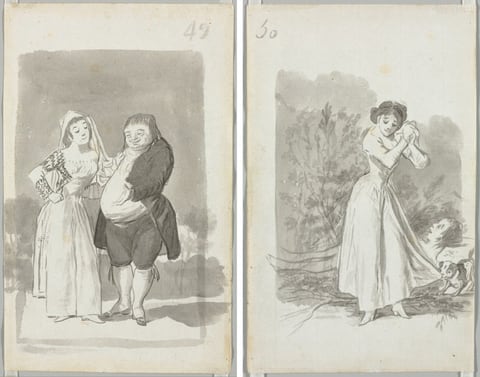
  1. Young Woman (possibly a Sex Worker) with a Man (recto); Young Woman Wringing Her Hands over a Man's Naked Body (verso), by Francisco Goya, 1796–97
    Young Woman (possibly a Sex Worker) with a Man (recto); Young Woman Wringing Her Hands over a Man's Naked Body (verso)Francisco Goya, 1796–97Courtesy of the Cleveland Museum of Art
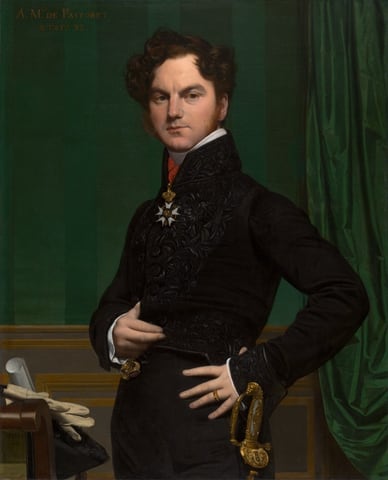
  2. Portrait of white man dressed in all black with medallion and sword.
    Amédée-David, the Comte de PastoretJean Auguste Dominique Ingres, 1823–26Courtesy of the Art Institute of Chicago
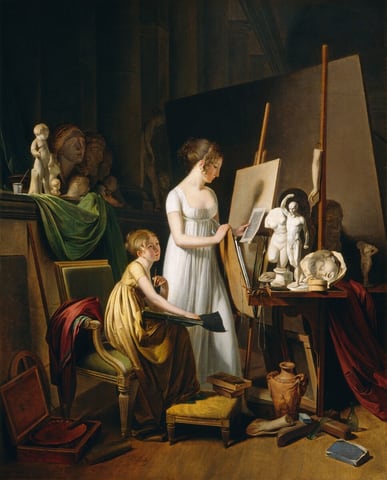
  3. In a room filled with easels, white plaster heads and statuettes, a box of paints, books, and papers, a young woman stands looking at a sketch and a young girl looks on, seated in an armchair, in this vertical painting. The scene is lit from the upper left, presumably from a window out of our view. Both women have smooth, pale skin, and their hair is swept up with curls framing their faces. They face our right in profile so their faces are in gentle shadow. They have straight noses, and their rose-pink lips are closed. They wear gowns with short sleeves, low, scooped necks, and floor-length skirts cinched under the bust. In the center of the painting, the young woman has chestnut-brown hair and wears a white gown tied with a sky-blue ribbon. She stands in front of a portfolio propped up against a tall easel. The portfolio is made of two stiff boards that tie together with pale blue ribbon to secure large sheets of paper. She rests her right hand, closer to us, on the front board of the portfolio and looks down at the sketch on a gray piece of paper she holds with her other hand. Next to her and closer to us, the younger girl sits in a gold chair upholstered with olive-green velvet. She faces our right almost in profile, and she looks up toward the drawing the other woman holds. The girl in the chair has blond hair and a gold-colored dress. Her feet are propped on a gold footstool, and she holds another portfolio on her lap. She supports the portfolio and holds a piece of paper with one hand, and a stylus or brush in the other hand, up by her chin. To the right of the easel, a wooden table holds a collection of plaster casts of faces, a hand, and small-scale bodies along with a glass vessel and a few other tools. Two translucent green bottles, boxes, a book, and a terracotta vase are collected on the footstool and the floor around the base of the easel. Garnet-red cloths are draped down the front of the table to our right and behind the girl on the chair. Next to her chair, in the lower left corner of the composition, is a wooden box with a paint palette and a handful of thin paintbrushes. A scroll of paper lies next to the box. A shelf at the standing girl’s shoulder height and behind the pair, to our left, is piled with white busts of a man, child, and woman, more figurines, and a brush in a small cup, all arranged across a moss-green cloth. The space with the girls and artist’s tools is enclosed by a large, dark brown form, presumably a canvas in shadow, that leans against the tall easels and mostly cuts off a view into the rest of the room. A glimpse of shadowy capitals is seen over the board, across the top of the painting, to suggest that a row of columns recedes into the space beyond. The artist signed the work as if he had painted his name on the floor next to the scroll, “L. Boilly.”
    A Painter's StudioLouis-Léopold Boilly, c. 1800Courtesy National Gallery of Art, Washington
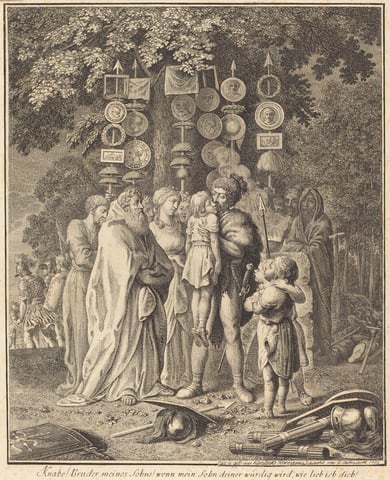
  4. The image depicts a group of people in varying poses and outfits. A central figure, possibly a child, is being held up by a man. Those around them are positioned differently, some standing closely. The figures have detailed faces and wear garments resembling classical attire. Shields and banners decorated with symbols are present in the background. Armor and helmets are scattered on the ground. Trees and a group of people in the distance are part of the background.
    Ancient TeutonsDaniel Nikolaus Chodowiecki, 1782Courtesy National Gallery of Art, Washington

Second room, north wall

  1. Self-Portrait, by Francisco Goya, ca. 1796
    Self-PortraitFrancisco Goya, ca. 1796Courtesy of The Metropolitan Museum of Art
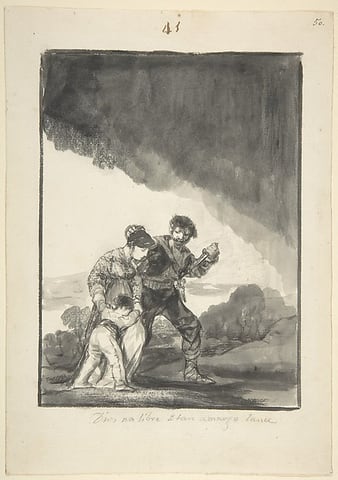
  2. God save us from such a bitter fate; a bandit threatening a woman and a child with a knife, page 41 from the "Black Border Album" (E), by Francisco Goya, ca. 1816–20
    God save us from such a bitter fate; a bandit threatening a woman and a child with a knife, page 41 from the "Black Border Album" (E)Francisco Goya, ca. 1816–20Courtesy of The Metropolitan Museum of Art
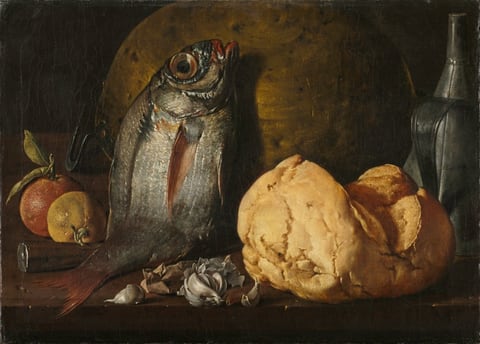
  3. Still Life with Fish, Bread, and Kettle, by Luis Meléndez, c. 1772
    Still Life with Fish, Bread, and KettleLuis Meléndez, c. 1772Courtesy of the Cleveland Museum of Art
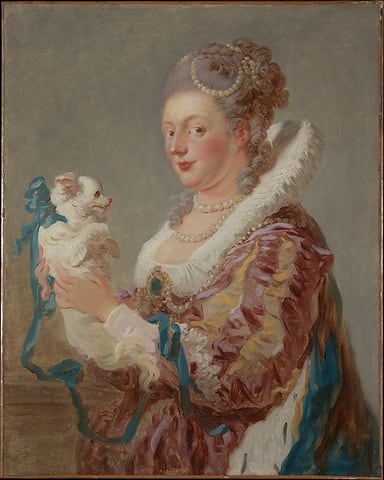
  4. Marie Emilie Coignet de Courson (1716–1806) with a Dog, by Jean Honoré Fragonard, ca. 1769
    Marie Emilie Coignet de Courson (1716–1806) with a DogJean Honoré Fragonard, ca. 1769Courtesy of The Metropolitan Museum of Art

Walk on

  • Neoclassicism, room 2
  • More by Jean Honoré Fragonard 6 works
  • 18th-century France 75 works
Ochre Editions

The world's museums, on your wall. Every work here is a reproduction of a public-domain original, credited to the museum that holds it.

Shop

All artCollectionsLimited dropsPrints and framing

Help

Find an orderShippingReturnsVerify a certificate

About

About Ochre EditionsMuseum creditsFor agentsDevelopers

Legal

Terms of UseTerms of SaleLimited Editions and CertificatesPrivacy PolicyCookie PolicyAcceptable Use PolicyAgent & API TermsCopyright and DMCA PolicyPrinting Your Own PhotoVulnerability Disclosure PolicyAccessibility StatementOpen-Access Credits
© 2026 Ochre EditionsPrices in US dollars. Prints ship within the United States.